Shadakshari Mantra Sadashiva Stotram
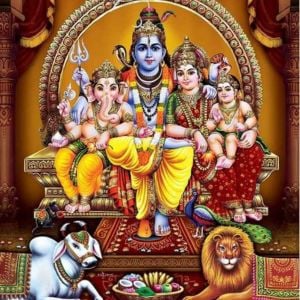
धनुर्धरित्रीधरसार्वभौमो मौर्वी च दर्वीकरसार्वभौमः ।
शरस्तु सर्वामरसार्वभौमः पायात्स नो दैवतसार्वभौमः ॥
'May He protect us, that Supreme Emperor of all Deities, for whom the Emperor of Mountains became the bow, the Emperor of Serpents became the bowstring, and the Emperor of all Gods became the arrow.'
'This verse describes the Tripurantaka form of Lord Shiva. According to mythology, when Shiva set out to destroy the three flying cities (Tripura) of the demons, the entire universe contributed to his war chariot to ensure victory. Mount Meru (the king of mountains) served as his bow, Vasuki (the king of serpents) served as the string, and Lord Vishnu (the supreme among gods) transformed himself into the arrow. The verse highlights the supremacy of Shiva, indicating that even the highest entities in the cosmos serve as mere instruments in his hands.'
वेदान्ततत्त्वमथितं नवनीतसारं चिद्रूपदृक्परमशैवरहस्यमन्त्रम् ।
ज्योतिर्मयोज्ज्वलनिरञ्जनरूपमन्त्रं वन्दे षडक्षरिसदाशिवनाममन्त्रम् ॥
'I offer my salutations to the six-syllabled mantra which is the name of Lord Sadashiva. It is the essence akin to fresh butter, churned from the ocean of Vedantic philosophy. It is the secret mantra of supreme Shaivism that embodies the vision of pure consciousness. It is the mantra whose form is radiant, comprised of light, and absolutely stainless.'
'The verse uses the metaphor of churning butter from milk. Just as butter is the hidden, rich essence of milk, the six-syllable mantra (Om Namah Shivaya) is presented here as the ultimate essence extracted from the vast and complex teachings of the Vedas and Upanishads (Vedanta). It is described as Niranjana (spotless), meaning it is free from the blemishes of karma and ignorance, representing the pure light of the self.'
अश्रान्तदुष्कृतिसमुद्रतरीशमन्त्रं पापाम्बुराशिबडवानलतुल्यमन्त्रम् ।
ब्रह्माच्युतेन्द्रसुरमौलिजपैकमन्त्रं वन्दे षडक्षरिसदाशिवनाममन्त्रम् ॥
'I offer my salutations to the six-syllabled mantra of Sadashiva. It is the competent boat to cross the relentless ocean of bad deeds. It acts like the submarine fire that consumes the vast ocean of sins. It is the primary mantra chanted by the heads of Brahma, Vishnu (Achyuta), Indra, and the other celestials.'
'This verse employs two powerful aquatic metaphors. First, life is depicted as a dangerous ocean of Dushkriti (bad karma), and this mantra is the boat (Tari) that carries the devotee safely across. Second, the mass of accumulated sins is compared to an ocean, and the mantra is compared to the Badavanala—a mythical fire believed to exist deep underwater that consumes the ocean's water. This implies that the mantra has the power to completely dry up and destroy even the most massive accumulation of sins.'
कामादिवर्गविपिनप्रलयाग्निमन्त्रं दुर्दोषशैलकुलिशाधिकभीममन्त्रम् ।
मायान्धकारपरिशोषितभानुमन्त्रं वन्दे षडक्षरिसदाशिवनाममन्त्रम् ॥
'I offer my salutations to the six-syllabled mantra of Sadashiva. It acts as the fire of cosmic dissolution to the forest of internal enemies like lust. It is a weapon more fearsome than the thunderbolt against the mountain of severe faults. It is the sun that dispels and dries up the darkness of illusion (Maya).'
'Here, the mantra is praised for its ability to purify the internal state of the seeker. Kama-adi varga refers to the six internal enemies: lust, anger, greed, delusion, pride, and envy; the mantra burns them just as a forest fire consumes trees. Furthermore, just as Indra’s weapon, the Vajra (thunderbolt), splits mountains, this mantra shatters the heavy, immovable burden of one's faults. Finally, it brings the light of wisdom to remove the darkness of ignorance.'
अष्टत्रयाष्टपुरवायुविकारकोशक्लेशाष्टपाशबहुदुःखविनाशमन्त्रम् ।
दुश्चित्तदुर्व्यसनदामविभेदमन्त्रं वन्दे षडक्षरिसदाशिवनाममन्त्रम् ॥
'I offer my salutations to the six-syllabled mantra of Sadashiva. It destroys the manifold sorrows arising from the twenty-four cosmic principles, the disorders of vital airs, the bodily sheaths, the afflictions, and the eight fetters. It severs the binding ropes of evil thoughts and wicked addictions.'
'This verse references technical concepts from Sankhya and Shaiva Siddhanta philosophies regarding human bondage. Ashta-traya (three eights) refers to the 24 tattvas or elements that make up the material world and body. The Koshas are the five layers covering the soul. The Ashta-pasha are the eight bonds (such as hatred, shame, fear, and lineage) that tie the soul to the material world. The verse asserts that the mantra liberates the soul from this complex web of physical and psychological bondage.'
पञ्चप्रसादमहिताक्षरबीजमन्त्रं मन्त्राग्रगण्यभुवनस्तुतमन्त्रराजम् ।
सर्वोऽपि मन्त्रजनकप्रणवात्ममन्त्रं वन्दे षडक्षरिसदाशिवनाममन्त्रम् ॥
'I offer my salutations to the six-syllabled mantra of Sadashiva. It is the seed mantra glorified by the five-fold grace. It is the King of Mantras, counted as the foremost and praised across the worlds. It is the very soul of the Pranava (Om), which is the progenitor of all other mantras.'
'The "five graces" or syllables refer to Na-Mah-Shi-Va-Ya (the Panchakshari), which represents the five faces of Shiva and his five acts (creation, preservation, destruction, concealment, and grace). When combined with Om, it becomes the six-syllabled mantra. It is called Mantaraja (King of Mantras) because it is identified with Om itself, the primordial sound from which all other Vedic mantras originate.'
ओङ्कारबिन्दुसहिताधिकशक्तिबीजं पञ्चाक्षरत्रितयवर्णकमेकवर्णम् ।
एकादशाक्षरसमन्वितहंसमन्त्रं वन्दे षडक्षरिसदाशिवनाममन्त्रम् ॥
'I offer my salutations to the six-syllabled mantra of Sadashiva. It is the potent seed-energy associated with the syllable Om and the Bindu (dot). It encompasses the nature of the five syllables, the three component letters (of Om), and the singular Unity. It is harmonized with the eleven-syllabled metrics and the Hamsa mantra.'
'This is a tantric description of the mantra. It connects the mantra to the Bindu, the point of concentrated energy in Yantras (sacred geometry). It breaks down the sound: the five syllables (Namah Shivaya), the three sounds of Om (A-U-M), and the single indivisible sound of Om. It also connects the mantra to the natural sound of the breath, Hamsa (often interpreted as "I am He"), indicating that the mantra is woven into the very act of breathing.'
श्रीसज्जनात्मबहिरन्तरवित्कटाग्र क्ष्माभागगर्जितनिरन्तरघोषमन्त्रम् ।
षट्चक्रमण्डपविहारविशुद्धमन्त्रं वन्दे षडक्षरिसदाशिवनाममन्त्रम् ॥
'I offer my salutations to the six-syllabled mantra of Sadashiva. It is the continuous vibration that roars within and without the souls of the virtuous and across the vast earth. It is the pure mantra that sports playfully within the pavilion of the six chakras.'
'This verse focuses on Nada Brahman (God as sound vibration). The mantra is not merely spoken words but a cosmic vibration that resonates inside the sages and throughout the physical world. The "pavilion of six chakras" refers to the yogic body (from Muladhara at the base of the spine to Ajna at the brow). The mantra is described as a living energy (Kundalini) that travels through and purifies these spiritual centers.'
षड्वर्णमन्त्राष्टकमद्भुतार्थं सर्वागमप्रोक्तजगत्प्रकाशम् ।
यः संपठेन्मुक्तिसमस्तभोगान् प्राप्नोति सत्यं सति सिद्धमन्त्रम् ॥
'Whoever recites this octet (eight verses) glorifying the six-syllabled mantra, which contains wonderful meanings and illuminates the world as proclaimed by all the scriptures, will truly attain all worldly enjoyments and final liberation. This mantra is indeed the proven path to perfection.'
'This is the Phala Shruti (verse of fruits/benefits). It affirms that the hymn is grounded in the Agamas (authoritative scriptures of Shaivism). It promises a dual benefit: Bhoga (worldly happiness) during one's lifetime and Mukti (spiritual liberation) thereafter. The phrase Siddhamantram implies that the efficacy of this mantra has been tested and proven by sages.'
धनुर्धरित्रीधरसार्वभौमो मौर्वी च दर्वीकरसार्वभौमः ।
शरस्तु सर्वामरसार्वभौमः पायात्स नो दैवतसार्वभौमः ॥
वेदान्ततत्त्वमथितं नवनीतसारं चिद्रूपदृक्परमशैवरहस्यमन्त्रम् ।
ज्योतिर्मयोज्ज्वलनिरञ्जनरूपमन्त्रं वन्दे षडक्षरिसदाशिवनाममन्त्रम् ॥
अश्रान्तदुष्कृतिसमुद्रतरीशमन्त्रं पापाम्बुराशिबडवानलतुल्यमन्त्रम् ।
ब्रह्माच्युतेन्द्रसुरमौलिजपैकमन्त्रं वन्दे षडक्षरिसदाशिवनाममन्त्रम् ॥
कामादिवर्गविपिनप्रलयाग्निमन्त्रं दुर्दोषशैलकुलिशाधिकभीममन्त्रम् ।
मायान्धकारपरिशोषितभानुमन्त्रं वन्दे षडक्षरिसदाशिवनाममन्त्रम् ॥
अष्टत्रयाष्टपुरवायुविकारकोशक्लेशाष्टपाशबहुदुःखविनाशमन्त्रम् ।
दुश्चित्तदुर्व्यसनदामविभेदमन्त्रं वन्दे षडक्षरिसदाशिवनाममन्त्रम् ॥
पञ्चप्रसादमहिताक्षरबीजमन्त्रं मन्त्राग्रगण्यभुवनस्तुतमन्त्रराजम् ।
सर्वोऽपि मन्त्रजनकप्रणवात्ममन्त्रं वन्दे षडक्षरिसदाशिवनाममन्त्रम् ॥
ओङ्कारबिन्दुसहिताधिकशक्तिबीजं पञ्चाक्षरत्रितयवर्णकमेकवर्णम् ।
एकादशाक्षरसमन्वितहंसमन्त्रं वन्दे षडक्षरिसदाशिवनाममन्त्रम् ॥
श्रीसज्जनात्मबहिरन्तरवित्कटाग्र क्ष्माभागगर्जितनिरन्तरघोषमन्त्रम् ।
षट्चक्रमण्डपविहारविशुद्धमन्त्रं वन्दे षडक्षरिसदाशिवनाममन्त्रम् ॥
षड्वर्णमन्त्राष्टकमद्भुतार्थं सर्वागमप्रोक्तजगत्प्रकाशम् ।
यः संपठेन्मुक्तिसमस्तभोगान् प्राप्नोति सत्यं सति सिद्धमन्त्रम् ॥
dhanurdharitreedharasaarvabhaumo
maurvee cha darveekarasaarvabhaumah' .
sharastu sarvaamarasaarvabhaumah'
paayaatsa no daivatasaarvabhaumah' ..
vedaantatattvamathitam' navaneetasaaram'
chidroopadri'kparamashaivarahasyamantram .
jyotirmayojjvalaniranjanaroopamantram'
vande shad'aksharisadaashivanaamamantram ..
ashraantadushkri'tisamudratareeshamantram'
paapaamburaashibad'avaanalatulyamantram .
brahmaachyutendrasuramaulijapaikamantram'
vande shad'aksharisadaashivanaamamantram ..
kaamaadivargavipinapralayaagnimantram'
durdoshashailakulishaadhikabheemamantram .
maayaandhakaaraparishoshitabhaanumantram'
vande shad'aksharisadaashivanaamamantram ..
asht'atrayaasht'apuravaayuvikaarakosha-
kleshaasht'apaashabahuduh'khavinaashamantram .
dushchittadurvyasanadaamavibhedamantram'
vande shad'aksharisadaashivanaamamantram ..
panchaprasaadamahitaaksharabeejamantram'
mantraagraganyabhuvanastutamantraraajam .
sarvo'pi mantrajanakapranavaatmamantram'
vande shad'aksharisadaashivanaamamantram ..
onkaarabindusahitaadhikashaktibeejam'
panchaaksharatritayavarnakamekavarnam .
ekaadashaaksharasamanvitaham'samantram'
vande shad'aksharisadaashivanaamamantram ..
shreesajjanaatmabahirantaravitkat'aagra
kshmaabhaagagarjitanirantaraghoshamantram .
shat'chakramand'apavihaaravishuddhamantram'
vande shad'aksharisadaashivanaamamantram ..
shad'varnamantraasht'akamadbhutaartham'
sarvaagamaproktajagatprakaasham .
yah' sampat'henmuktisamastabhogaan
praapnoti satyam' sati siddhamantram ..





Other stotras


