Vishvesha Stotram
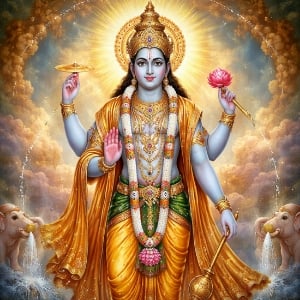
नमामि देवं विश्वेशं वामनं विष्णुरूपिणम् ।
बलिदर्पहरं शान्तं शाश्वतं पुरुषोत्तमम् ॥1॥
धीरं शूरं महादेवं शङ्खचक्रगदाधरम् ।
विशुद्धं ज्ञानसम्पन्नं नमामि हरिमच्युतम् ॥2॥
सर्वशक्तिमयं देवं सर्वगं सर्वभावनम् ।
अनादिमजरं नित्यं नमामि गरुडध्वजम् ॥3॥
सुरासुरैर्भक्तिमद्भिः स्तुतो नारायणः सदा ।
पूजितं च हृषीकेशं तं नमामि जगद्गुरुम् ॥4॥
हृदि संकल्प्य यद्रूपं ध्यायन्ति यतयः सदा ।
ज्योतीरूपमनौपम्यं नरसिंहं नमाम्यहम् ॥5॥
न जानन्ति परं रूपं ब्रह्माद्या देवतागणाः ।
यस्यावताररूपाणि समर्चन्ति नमामि तम् ॥6॥
एतत्समस्तं येनादौ सृष्टं दुष्टवधात्पुनः ।
त्रातं यत्र जगल्लीनं तं नमामि जनार्दनम् ॥7॥
भक्तैरभ्यर्चितो यस्तु नित्यं भक्तप्रियो हि यः ।
तं देवममलं दिव्यं प्रणमामि जगत्पतिम् ॥8॥
दुर्लभं चापि भक्तानां यः प्रयच्छति तोषितः ।
तं सर्वसाक्षिणं विष्णुं प्रणमामि सनातनम् ॥9॥
namaami devam' vishvesham' vaamanam' vishnuroopinam .
balidarpaharam' shaantam' shaashvatam' purushottamam ..1..
dheeram' shooram' mahaadevam' shankhachakragadaadharam .
vishuddham' jnyaanasampannam' namaami harimachyutam ..2..
sarvashaktimayam' devam' sarvagam' sarvabhaavanam .
anaadimajaram' nityam' namaami garud'adhvajam ..3..
suraasurairbhaktimadbhih' stuto naaraayanah' sadaa .
poojitam' cha hri'sheekesham' tam' namaami jagadgurum ..4..
hri'di sankalpya yadroopam' dhyaayanti yatayah' sadaa .
jyoteeroopamanaupamyam' narasim'ham' namaamyaham ..5..
na jaananti param' roopam' brahmaadyaa devataaganaah' .
yasyaavataararoopaani samarchanti namaami tam ..6..
etatsamastam' yenaadau sri'sht'am' dusht'avadhaatpunah' .
traatam' yatra jagalleenam' tam' namaami janaardanam ..7..
bhaktairabhyarchito yastu nityam' bhaktapriyo hi yah' .
tam' devamamalam' divyam' pranamaami jagatpatim ..8..
durlabham' chaapi bhaktaanaam' yah' prayachchhati toshitah' .
tam' sarvasaakshinam' vishnum' pranamaami sanaatanam ..9..
Verse 1
नमामि देवं विश्वेशं वामनं विष्णुरूपिणम् ।
बलिदर्पहरं शान्तं शाश्वतं पुरुषोत्तमम् ॥
The verse begins with the devotee declaring नमामि देवं, meaning I bow to the divine being. The term विश्वेशं means the Lord of the entire universe, the one who governs all worlds and beings. वामनं refers to the dwarf incarnation of Bhagavan Vishnu, the form in which he appeared before the generous king Bali. विष्णुरूपिणम् indicates that although he appeared as a small brahmana boy, he was truly Vishnu himself.
The phrase बलिदर्पहरं recalls the famous Vamana avatar narrative described in the Puranas. King Bali, though generous and righteous in many ways, had become proud of his power and authority over the three worlds. Bhagavan took the form of the humble Vamana and requested three steps of land. Expanding into the cosmic Trivikrama form, he measured the entire universe in two steps and thus removed Bali's pride. This act did not destroy Bali but purified him.
The verse also calls him शान्तं, the embodiment of peace and inner stillness. Even when correcting cosmic imbalance, Bhagavan remains calm and compassionate. शाश्वतं means eternal, beyond time and change. पुरुषोत्तमम् refers to the supreme person described in the Bhagavad Gita, the highest reality beyond both the perishable world and the imperishable self. The verse therefore praises Bhagavan as both the humble Vamana and the supreme cosmic being who guides the universe while remaining eternally serene.
Verse 2
धीरं शूरं महादेवं शङ्खचक्रगदाधरम् ।
विशुद्धं ज्ञानसम्पन्नं नमामि हरिमच्युतम् ॥
This verse continues the praise by describing Bhagavan with powerful epithets. धीरं means steadfast, composed, and wise. It refers to one whose mind never wavers under any circumstance. शूरं means heroic and courageous, indicating Bhagavan's role as the protector who confronts forces of adharma.
महादेवं here signifies the great divine being whose greatness surpasses all celestial powers. The phrase शङ्खचक्रगदाधरम् refers to the iconic attributes held by Vishnu. The conch represents the primordial sound that sustains the universe. The discus symbolizes divine power that cuts through ignorance and protects righteousness. The mace represents strength and authority used to uphold dharma.
The verse also calls him विशुद्धं, meaning completely pure, untouched by worldly limitations. ज्ञानसम्पन्नं means endowed with perfect knowledge. In the philosophical sense, Bhagavan is not merely knowledgeable but is the very source from which knowledge arises.
The closing words नमामि हरिमच्युतम् contain two important names. Hari means the one who removes suffering, ignorance, and bondage. Achyuta means the one who never falls from his true nature. While all beings are subject to change and decline, Bhagavan remains eternally perfect and unchanged. Thus the verse praises him as the fearless protector, the bearer of divine symbols, and the eternal source of wisdom.
Verse 3
सर्वशक्तिमयं देवं सर्वगं सर्वभावनम् ।
अनादिमजरं नित्यं नमामि गरुडध्वजम् ॥
This verse highlights the cosmic nature of Bhagavan. The term सर्वशक्तिमयं means the one who contains all powers. Every force operating in the universe, whether physical, moral, or spiritual, ultimately arises from him.
सर्वगं means the one who is present everywhere. Unlike ordinary beings who exist in one place at a time, Bhagavan pervades the entire cosmos. सर्वभावनम् means the sustainer and nurturer of all beings. Every form of life depends upon his sustaining presence.
The verse also calls him अनादि, meaning without beginning. He has no origin or cause. अजरं means free from aging or decay. नित्यं means eternal and constant. These terms emphasize that Bhagavan exists beyond the cycle of birth and death that governs all created beings.
गरुडध्वजम् refers to the one whose banner bears the symbol of Garuda, the divine eagle who serves as Vishnu's vehicle. In mythology, Garuda represents speed, strength, and the ability to rise above limitations. The image of Garuda on Vishnu's banner symbolizes the triumph of spiritual power over ignorance and bondage.
Thus the verse recognizes Bhagavan as the source of all energy, the omnipresent sustainer of existence, and the timeless reality beyond change. At the same time, it recalls the vivid imagery of Vishnu seated upon Garuda, moving through the cosmos to protect righteousness and guide devotees.
Verse 4
सुरासुरैर्भक्तिमद्भिः स्तुतो नारायणः सदा ।
पूजितं च हृषीकेशं तं नमामि जगद्गुरुम् ॥
In this verse Bhagavan is praised as Narayana, a name rich with meaning. Narayana signifies the ultimate refuge of all beings. The word nara can refer to living beings or the cosmic waters, while ayana means resting place. Thus Narayana is the one in whom the entire universe rests.
The verse states that both सुराः and असुराः, the gods and the asuras, praise him with devotion. This idea reflects an important principle in Hindu mythology. Even beings who oppose the gods often recognize the supreme authority of Vishnu. Ultimately all beings exist within the same cosmic order governed by Bhagavan.
The name हृषीकेश means the master of the senses. The senses are the gateways through which humans experience the world. Bhagavan, as Hrishikesha, is the inner controller who guides these faculties. This concept is central to many spiritual teachings where the control and purification of the senses lead to higher awareness.
The verse concludes with the title जगद्गुरु, the teacher of the entire universe. Through scriptures, avatars, and divine guidance, Bhagavan instructs humanity on the path of dharma and spiritual realization. Thus the devotee bows to the cosmic teacher who is revered by gods and humans alike.
Verse 5
हृदि संकल्प्य यद्रूपं ध्यायन्ति यतयः सदा ।
ज्योतीरूपमनौपम्यं नरसिंहं नमाम्यहम् ॥
This verse describes the form of Bhagavan contemplated by sages and spiritual seekers. The phrase हृदि संकल्प्य means visualizing within the heart. Spiritual practitioners often meditate upon a divine form internally, allowing the mind to focus and become purified.
यतयः refers to disciplined ascetics who have renounced worldly distractions. Such seekers constantly meditate upon the divine presence. The verse says they contemplate a form that is ज्योतीरूपम्, a form of pure light. This suggests that Bhagavan ultimately transcends physical form and appears as luminous consciousness.
The verse specifically mentions नरसिंह, the man-lion incarnation of Vishnu. In mythology, Narasimha appeared to protect the devotee Prahlada and to defeat the tyrant Hiranyakashipu. The form was extraordinary and unmatched, which is conveyed by the word अनौपम्यम् meaning incomparable.
The story symbolizes the protection granted to sincere devotion. Prahlada's unwavering faith brought forth the fierce yet compassionate form of Bhagavan. Philosophically, Narasimha represents the sudden emergence of divine power that destroys arrogance and restores righteousness. The verse therefore praises the radiant and incomparable Narasimha whom sages meditate upon in the depth of their hearts.
Verse 6
न जानन्ति परं रूपं ब्रह्माद्या देवतागणाः ।
यस्यावताररूपाणि समर्चन्ति नमामि तम् ॥
This verse emphasizes the transcendence of Bhagavan. It states that even the highest gods such as Brahma do not fully know his ultimate form. ब्रह्माद्या देवतागणाः refers to the entire assembly of celestial beings beginning with the creator Brahma.
The phrase परं रूपं indicates the supreme reality that lies beyond ordinary perception. In philosophical texts, this ultimate nature is described as beyond form, beyond attributes, and beyond conceptual understanding. Even divine beings who possess great knowledge cannot fully comprehend its depth.
However, Bhagavan out of compassion manifests through various avatars. These incarnations make the divine accessible to the world. The verse states that the gods themselves worship these avatar forms. This reflects the idea that the incarnations of Vishnu are not merely symbolic but are direct manifestations of the supreme reality.
Mythological narratives describe numerous such avatars including Vamana, Narasimha, Rama, and Krishna. Each appears at a particular moment in cosmic history to restore dharma and guide humanity. Thus the verse expresses reverence for the mysterious supreme being whose true nature remains beyond comprehension yet who graciously appears in forms that devotees can worship.
Verse 7
एतत्समस्तं येनादौ सृष्टं दुष्टवधात्पुनः ।
त्रातं यत्र जगल्लीनं तं नमामि जनार्दनम् ॥
This verse praises Bhagavan as the creator, protector, and dissolver of the universe. The phrase एतत्समस्तं means this entire cosmos. येनादौ सृष्टं indicates that it was created by him in the beginning.
The verse then refers to दुष्टवध, the destruction of wicked forces. Throughout the Puranic narratives, Bhagavan repeatedly incarnates to remove destructive powers that threaten cosmic harmony. These acts are not expressions of anger but manifestations of divine justice that restore balance.
The phrase त्रातं suggests protection and preservation. After eliminating harmful forces, Bhagavan safeguards the world and its inhabitants. This reflects the classic Hindu understanding of divine functions: creation, preservation, and transformation.
यत्र जगल्लीनं refers to the final dissolution where the entire universe returns into the divine source. At the end of cosmic cycles, all forms merge back into Bhagavan. Thus he is both the origin and the ultimate destination of existence.
The name जनार्दन means the one who protects people and removes their suffering. It also implies the one who corrects those who act against dharma. Through this verse the devotee acknowledges Bhagavan as the cosmic ruler who creates the universe, protects it from harm, and finally gathers it back into himself.
Verse 8
भक्तैरभ्यर्चितो यस्तु नित्यं भक्तप्रियो हि यः ।
तं देवममलं दिव्यं प्रणमामि जगत्पतिम् ॥
This verse highlights the loving relationship between Bhagavan and his devotees. The phrase भक्तैरभ्यर्चितः means worshipped by devotees through prayer, ritual, and devotion. Such worship can take many forms including chanting, meditation, and service.
नित्यं भक्तप्रियो means that Bhagavan is eternally fond of his devotees. In many scriptural stories, Bhagavan responds immediately to sincere devotion regardless of the devotee's social status or background. This theme appears repeatedly in narratives involving Prahlada, Dhruva, and many others.
The verse describes Bhagavan as अमलं, meaning pure and free from all imperfections. दिव्यं indicates that his nature is divine and beyond ordinary material limitations. जगत्पतिम् means the Lord of the universe who governs all existence.
Despite being the supreme ruler, Bhagavan responds with affection to even the simplest acts of devotion. This reflects an important spiritual teaching. Divine grace is not limited by power or hierarchy but flows toward sincere love and surrender.
Thus the devotee bows to the pure and divine Lord who rules the universe yet remains intimately connected to the hearts of his devotees.
Verse 9
दुर्लभं चापि भक्तानां यः प्रयच्छति तोषितः ।
तं सर्वसाक्षिणं विष्णुं प्रणमामि सनातनम् ॥
The final verse concludes with a reflection on divine grace. दुर्लभं means rare or difficult to obtain. The verse states that Bhagavan grants even such rare blessings when he is pleased with the devotion of his followers.
तोषितः means satisfied or pleased. In devotional traditions, sincere worship and dedication bring the grace of Bhagavan. The blessings granted are not limited to material prosperity but include spiritual wisdom, inner peace, and liberation.
The name सर्वसाक्षिणं means the witness of everything. Bhagavan observes all actions, thoughts, and intentions. This idea is central to many philosophical teachings. While humans may hide their actions from others, nothing remains hidden from the divine consciousness that pervades all existence.
The verse concludes by addressing him as विष्णु and सनातन. Vishnu signifies the all-pervading presence that sustains the universe. Sanatana means eternal and beginningless.
Thus the devotee offers a final bow to the timeless divine witness who sees all, grants blessings to the sincere, and remains the eternal protector and guide of the universe.ness who sees all, grants blessings to the sincere, and remains the eternal protector and guide of the universe.





Other stotras


