Ranganatha Ashtakam
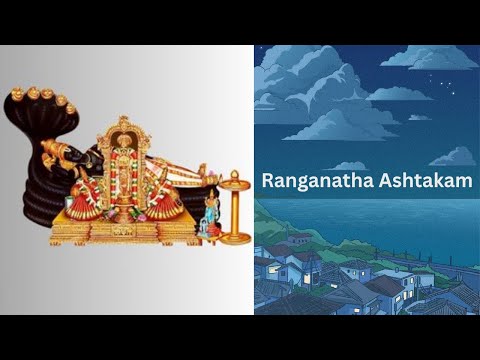
आनन्दरूपे निजबोधरूपे ब्रह्मस्वरूपे श्रुतिमूर्तिरूपे ।
शशाङ्करूपे रमणीयरूपे श्रीरङ्गरूपे रमतां मनो मे ॥
May my mind delight in the Lord of Sri Ranga, whose form is bliss itself, whose form is true self-knowledge, whose nature is Brahman the Absolute, who is the living embodiment of the Vedas, whose countenance is like the serene moon, and whose form is utterly captivating.
This inaugural verse harmonizes the Lord's most profound, abstract nature with his perceivable, aesthetic form. He is 'Anandarupa', the essence of pure bliss, and 'Nijabodharupa', the very embodiment of self-realization, pointing to the ultimate state of spiritual attainment. He is identified with the formless supreme reality, 'Brahman', and simultaneously as 'Shrutimurtirupe', the manifest form of all sacred scripture. The verse then transitions to his tangible beauty, comparing his cool, pleasing form to the moon ('Shashankarupa') and declaring it enchantingly beautiful ('Ramaniyarupa'). The prayer is for the devotee’s mind to find its final, joyful refuge in this singular Lord, who is both the highest truth and the supreme beauty.
कावेरितीरे करुणाविलोले मन्दारमूले धृतचारुचेले ।
दैत्यान्तकालेऽखिललोकलीले श्रीरङ्गलीले रमतां मनो मे ॥
May my mind delight in the divine play of Sri Ranga, who resides on the banks of the Kaveri, whose glances are filled with compassion, who rests beneath a Mandara tree, adorned in beautiful attire, who is the destroyer of demons, and for whom all the worlds are a divine sport.
This verse situates the transcendent Lord in his specific, earthly abode of Srirangam. He is found on the banks of the holy river Kaveri ('Kaveritire'), making the divine accessible. His nature is one of infinite mercy, expressed through his compassionate gaze ('Karunavilole'). The imagery is idyllic: he rests under a celestial tree ('Mandaramule') dressed in exquisite garments ('Dhritacharuchale'). This gentle depiction is balanced by a reminder of his formidable power as the vanquisher of evil forces ('Daityantakale'). Ultimately, all of creation is seen as his 'lila' or divine play ('Akhilalokalile'), and the devotee seeks to immerse the mind in this magnificent, cosmic sport of the Lord.
लक्ष्मीनिवासे जगतां निवासे हृत्पद्मवासे रविबिम्बवासे ।
कृपानिवासे गुणवृन्दवासे श्रीरङ्गवासे रमतां मनो मे ॥
May my mind delight in the Lord of Sri Ranga, the dwelling place of Lakshmi, the abode of all the worlds, the one who resides in the lotus of the heart, the one who dwells within the orb of the sun, the home of all compassion, and the repository of all noble qualities.
This verse contemplates the Lord as the ultimate 'nivasa' or abode. He is the eternal residence of Lakshmi, the Goddess of prosperity and grace ('Lakshminivase'), and the substratum that contains all the universes ('Jagatam nivase'). He is not merely an external deity but is also the indweller in the devotee's own heart-lotus ('Hritpadmavase') and the radiant life-giving principle within the sun ('Ravibimbavase'). He is the very source from which all mercy flows ('Kripanivase') and the home where the multitude of all auspicious virtues reside ('Gunavrindavase'). The prayer is for the mind to find its own true and final home in this all-encompassing Lord.
ब्रह्मादिवन्द्ये जगदेकवन्द्ये मुकुन्दवन्द्ये सुरनाथवन्द्ये ।
व्यासादिवन्द्ये सनकादिवन्द्ये श्रीरङ्गवन्द्ये रमतां मनो मे ॥
May my mind delight in the Lord of Sri Ranga, who is worshipped by Brahma and the gods, who is the sole one worthy of worship in the universe, who is venerated by Mukunda, who is adored by the lord of celestials, who is revered by the sage Vyasa and others, and who is honoured by the primeval sages like Sanaka.
Here, the absolute supremacy of Lord Ranganatha is affirmed by listing the exalted beings who offer him their worship. This celestial congregation includes the creator Brahma and the entire pantheon ('Brahmadivandye'), Indra the king of the gods ('Suranathavandye'), the great sage Vyasa who codified the Vedas ('Vyasadivandye'), and the first-born, ever-pure sages like Sanaka ('Sanakadivandye'). By stating that he is worshipped even by Mukunda (a name for Vishnu, the giver of liberation), it underscores that all divine forms bow to this supreme manifestation. He is declared the 'Jagadeka-vandye', the one being in all of existence who is deserving of universal adoration, and the devotee seeks to join this chorus of veneration.
ब्रह्माधिराजे गरुडाधिराजे वैकुण्ठराजे सुरराजराजे ।
त्रैलोक्यराजेऽखिललोकराजे श्रीरङ्गराजे रमतां मनो मे ॥
May my mind delight in the King of Sri Ranga, who is the sovereign Lord of Brahma, the sovereign Lord of Garuda, the King of Vaikuntha, the King over the king of gods, the King of the three worlds, and the King of all worlds.
This verse expands on the theme of the Lord's supremacy, portraying him as the ultimate 'Raja' or sovereign. He is not merely a king, but the ruler of other rulers. He is the supreme authority over the creator Brahma ('Brahmadhiraje') and over his divine eagle-mount, Garuda ('Garudadhiraje'). He is the undisputed monarch of the spiritual realm of Vaikuntha ('Vaikuntharaje') and even the king over Indra, who is himself the king of the celestials ('Surarajaraje'). His dominion encompasses all three worlds of existence ('Trailokyaraje') and extends to every conceivable realm ('Akhilalokaraje'). The prayer is for the mind to joyfully submit to the benevolent reign of this King of all kings.
अमोघमुद्रे परिपूर्णनिद्रे श्रीयोगनिद्रे ससमुद्रनिद्रे ।
श्रितैकभद्रे जगदेकनिद्रे श्रीरङ्गभद्रे रमतां मनो मे ॥
May my mind delight in the auspicious Lord of Sri Ranga, whose resolve is infallible, who is in a state of perfect slumber, who is in the conscious sleep of Yoga Nidra, who slumbers upon the ocean, who is the one sure source of well-being for those who seek refuge, and who is the singular foundation upon which the universe rests.
This verse meditates on the Lord’s profound, reclining state. His 'mudra' signifies his divine will, which is 'amogha'—unfailing and ever-potent. His sleep is not born of ignorance but is 'Paripurnanidra', a complete and perfect rest. It is 'Yoga Nidra', the cosmic, conscious slumber from which creation emanates and into which it dissolves. 'Sasamudranidre' evokes the iconic image of him resting on the cosmic waters. He is the sole provider of all that is auspicious ('bhadra') for his dependents. The phrase 'Jagadekanidre' is deeply philosophical, suggesting that he is the one, dormant, unified consciousness that serves as the foundation for the entire dynamic and diverse cosmos.
स चित्रशायी भुजगेन्द्रशायी नन्दाङ्कशायी कमलाङ्कशायी ।
क्षीराब्धिशायी वटपत्रशायी श्रीरङ्गशायी रमतां मनो मे ॥
May my mind delight in the reclining Lord of Sri Ranga, who reclines in wondrous forms: reclining on the king of serpents, reclining on the lap of Nanda, reclining on the lap of Kamala, reclining on the ocean of milk, and reclining on a banyan leaf.
This verse celebrates the Lord’s many divine reclining postures ('shayi'), the very form in which he is worshipped at Srirangam. He is 'Chitrashayi', one who reclines in various marvellous ways. These forms span across different contexts and eras: his cosmic posture on the serpent Adisesha ('Bhujagendrashayi'); his tender incarnation as the infant Krishna resting on Nanda's lap ('Nandankashayi'); his form as the divine consort on Goddess Lakshmi's lap ('Kamalankashayi'); his macrocosmic form on the milky ocean ('Kshirabdhishayi'); and his form as a baby on a banyan leaf during the cosmic deluge, containing all of creation within himself ('Vatapatrashayi'). All these reclining forms find their ultimate expression in the deity of Srirangam, Sri Ranga Shayi.
इदं हि रङ्गं त्यजतामिहाङ्गं पुनर्नचाङ्गं यदि चाङ्गमेति ।
पाणौ रथाङ्गं चरणेम्बु गाङ्गम् याने विहङ्गं शयने भुजङ्गम् ॥
For those who cast off their mortal body in this sacred place of Ranga, there is surely no rebirth. And if, for any reason, they do take on a body again, they shall possess the discus in their hand, the Ganga at their feet, the celestial bird as their vehicle, and the divine serpent as their bed.
This verse describes the glorious fruit of devotion and of ending one’s life in the holy land of Srirangam. It makes a powerful promise: to shed the mortal coil here is to attain final liberation ('punarnachangam' - no more body). It then offers an even more magnificent alternative. Should such a soul be reborn, it will not be in an ordinary form, but with a form reflecting the Lord's own divine majesty. They will be endowed with his emblems: the Sudarshana Chakra, the holy Ganga flowing from their feet, Garuda as their mount, and Adisesha as their couch. This signifies the attainment of 'sarupya mukti', a state of liberation where the devotee is blessed with a divine form similar to that of the Lord himself.
रङ्गनाथाष्टकं पुण्यम् प्रातरुत्थाय यः पठेत् ।
सर्वान् कामानवाप्नोति रङ्गिसायुज्यमाप्नुयात् ॥
Whoever rises in the morning and recites this sacred octet of praise to Lord Ranganatha will have all their desires fulfilled and will ultimately attain inseparable union with the Lord of Ranga.
This final verse, the 'Phala Shruti', declares the benefits of reciting this hymn. It promises the devotee who chants this 'ashtakam' with devotion a twofold reward. In the temporal realm, all their righteous wishes and aspirations will be fulfilled ('sarvan kamanavapnoti'). In the spiritual realm, they will achieve the highest goal of human existence: 'sayujya', the ultimate and final state of becoming one with the Lord, where the individual consciousness merges completely and inseparably into the divine.
आनन्दरूपे निजबोधरूपे ब्रह्मस्वरूपे श्रुतिमूर्तिरूपे ।
शशाङ्करूपे रमणीयरूपे श्रीरङ्गरूपे रमतां मनो मे ॥
कावेरितीरे करुणाविलोले मन्दारमूले धृतचारुचेले ।
दैत्यान्तकालेऽखिललोकलीले श्रीरङ्गलीले रमतां मनो मे ॥
लक्ष्मीनिवासे जगतां निवासे हृत्पद्मवासे रविबिम्बवासे ।
कृपानिवासे गुणवृन्दवासे श्रीरङ्गवासे रमतां मनो मे ॥
ब्रह्मादिवन्द्ये जगदेकवन्द्ये मुकुन्दवन्द्ये सुरनाथवन्द्ये ।
व्यासादिवन्द्ये सनकादिवन्द्ये श्रीरङ्गवन्द्ये रमतां मनो मे ॥
ब्रह्माधिराजे गरुडाधिराजे वैकुण्ठराजे सुरराजराजे ।
त्रैलोक्यराजेऽखिललोकराजे श्रीरङ्गराजे रमतां मनो मे ॥
अमोघमुद्रे परिपूर्णनिद्रे श्रीयोगनिद्रे ससमुद्रनिद्रे ।
श्रितैकभद्रे जगदेकनिद्रे श्रीरङ्गभद्रे रमतां मनो मे ॥
स चित्रशायी भुजगेन्द्रशायी नन्दाङ्कशायी कमलाङ्कशायी ।
क्षीराब्धिशायी वटपत्रशायी श्रीरङ्गशायी रमतां मनो मे ॥
इदं हि रङ्गं त्यजतामिहाङ्गं पुनर्नचाङ्कं यदि चाङ्गमेति ।
पाणौ रथाङ्गं चरणेम्बु गाङ्गम् याने विहङ्गं शयने भुजङ्गम् ॥
रङ्गनाथाष्टकं पुण्यम् प्रातरुत्थाय यः पठेत् ।
सर्वान् कामानवाप्नोति रङ्गिसायुज्यमाप्नुयात् ॥
aanandaroope nijabodharoope brahmasvaroope shrutimoortiroope .
shashaankaroope ramaneeyaroope shreerangaroope ramataam' mano me ..
kaaveriteere karunaavilole mandaaramoole dhri'tachaaruchele .
daityaantakaale'khilalokaleele shreerangaleele ramataam' mano me ..
lakshmeenivaase jagataam' nivaase hri'tpadmavaase ravibimbavaase .
kri'paanivaase gunavri'ndavaase shreerangavaase ramataam' mano me ..
brahmaadivandye jagadekavandye mukundavandye suranaathavandye .
vyaasaadivandye sanakaadivandye shreerangavandye ramataam' mano me ..
brahmaadhiraaje garud'aadhiraaje vaikunt'haraaje suraraajaraaje .
trailokyaraaje'khilalokaraaje shreerangaraaje ramataam' mano me ..
amoghamudre paripoornanidre shreeyoganidre sasamudranidre .
shritaikabhadre jagadekanidre shreerangabhadre ramataam' mano me ..
sa chitrashaayee bhujagendrashaayee nandaankashaayee kamalaankashaayee .
ksheeraabdhishaayee vat'apatrashaayee shreerangashaayee ramataam' mano me ..
idam' hi rangam' tyajataamihaangam' punarnachaankam' yadi chaangameti .
paanau rathaangam' charanembu gaangam yaane vihangam' shayane bhujangam ..
ranganaathaasht'akam' punyam praatarutthaaya yah' pat'het .
sarvaan kaamaanavaapnoti rangisaayujyamaapnuyaat ..





Other stotras


