Vishnu Dashavatara Stuti
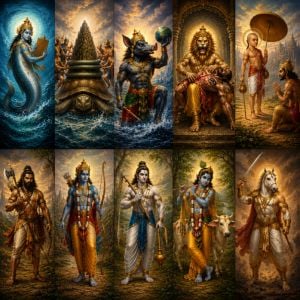
Lyrics:
मग्ना यदाज्या प्रलये पयोधा बुद्धारितो येन तदा हि वेदः।
मीनावताराय गदाधराय तस्मै नमः श्रीमधुसूदनाय।।1।।
कल्पान्तकाले पृथिवीं दधार पृष्ठेऽच्युतो यः सलिले निमग्नाम्।
कूर्मावताराय नमोऽस्तु तस्मै पीताम्बराय प्रियदर्शनाय।।2।।
रसातलस्था धरणी किलैषा दंष्ट्राग्रभागेन धृता हि येन।
वराहरूपाय जनार्दनाय तस्मै नमः कैटभनाशनाय।।3।।
स्तम्भं विदार्य प्रणतं हि भक्तं रक्ष प्रह्लादमथो विनाश्य।
दैत्यं नमो यो नरसिंहमूर्तिर्दीप्तानलार्कद्युतये तु तस्मै।।4।।
छलेन योऽजश्च बलिं निनाय पातालदेशं ह्यतिदानशीलम्।
अनन्तरूपश्च नमस्कृतः स मया हरिर्वामनरूपधारी।।5।।
पितुर्वधामर्षरर्येण येन त्रिःसप्तवारान्समरे हताश्च।
क्षत्राः पितुस्तर्पणमाहितञ्च तस्मै नमो भार्गवरूपिणे ते।।6।।
दशाननं यः समरे निहत्य,बद्धा पयोधिं हरिसैन्यचारी।
अयोनिजां सत्वरमुद्दधार सीतापतिं तं प्रणमामि रामम्।।7।।
विलोलनेनं मधुसिक्तवक्त्रं प्रसन्नमूर्तिं ज्वलदर्कभासम्।
कृष्णाग्रजं तं बलभद्ररूपं नीलाम्बरं सीरकरं नमामि।।8।।
पद्मासनस्थः स्थिरबद्धदृष्टिर्जितेन्द्रियो निन्दितजीवघातः।
नमोऽस्तु ते मोहविनाशकाय जिनाय बुद्धाय च केशवाय।।9।।
म्लेच्छान् निहन्तुं लभते तु जन्म कलौ च कल्की दशमावतारः।
नमोऽस्तु तस्मै नरकान्तकाय देवादिदेवाय महात्मने च।।10।।
magnaa yadaajyaa pralaye payodhaa buddhaarito yena tadaa hi vedah'.
meenaavataaraaya gadaadharaaya tasmai namah' shreemadhusoodanaaya..1..
kalpaantakaale pri'thiveem' dadhaara pri'sht'he'chyuto yah' salile nimagnaam.
koormaavataaraaya namo'stu tasmai peetaambaraaya priyadarshanaaya..2..
rasaatalasthaa dharanee kilaishaa dam'sht'raagrabhaagena dhri'taa hi yena.
varaaharoopaaya janaardanaaya tasmai namah' kait'abhanaashanaaya..3..
stambham' vidaarya pranatam' hi bhaktam' raksha prahlaadamatho vinaashya.
daityam' namo yo narasim'hamoortirdeeptaanalaarkadyutaye tu tasmai..4..
chhalena yo'jashcha balim' ninaaya paataaladesham' hyatidaanasheelam.
anantaroopashcha namaskri'tah' sa mayaa harirvaamanaroopadhaaree..5..
piturvadhaamarshararyena yena trih'saptavaaraansamare hataashcha.
kshatraah' pitustarpanamaahitancha tasmai namo bhaargavaroopine te..6..
dashaananam' yah' samare nihatya,baddhaa payodhim' harisainyachaaree.
ayonijaam' satvaramuddadhaara seetaapatim' tam' pranamaami raamam..7..
vilolanenam' madhusiktavaktram' prasannamoortim' jvaladarkabhaasam.
kri'shnaagrajam' tam' balabhadraroopam' neelaambaram' seerakaram' namaami..8..
padmaasanasthah' sthirabaddhadri'sht'irjitendriyo ninditajeevaghaatah'.
namo'stu te mohavinaashakaaya jinaaya buddhaaya cha keshavaaya..9..
mlechchhaan nihantum' labhate tu janma kalau cha kalkee dashamaavataarah'.
namo'stu tasmai narakaantakaaya devaadidevaaya mahaatmane cha..10..
Meaning:
Verse 1
मग्ना यदाज्या प्रलये पयोधा बुद्धारितो येन तदा हि वेदः।
मीनावताराय गदाधराय तस्मै नमः श्रीमधुसूदनाय।।1।।
The first verse of this hymn pays homage to the Matsya or Fish incarnation of Lord Vishnu. The literal translation describes a time of cosmic dissolution, known as Pralaya, when the entire universe was submerged in the primordial waters. During this chaotic period, the sacred Vedas, which represent the eternal knowledge and laws of the universe, were lost or stolen by the demon Hayagriva. Vishnu took the form of a giant fish to dive into the depths of the ocean, slay the demon, and rescue the scriptures, ensuring that divine knowledge would be available for the next cycle of creation.
Mythologically, this avatar appears in the Satya Yuga to save the pious King Manu and the seven celestial sages from the great deluge. By towing their boat, which was tied to a great horn on his head, the Lord preserved the seeds of life and the light of wisdom. The epithet Gadadhara refers to the Lord as the wielder of the mace, symbolizing his power to destroy ignorance and maintain cosmic order through strength. Madhusudana, another significant title used here, recalls his victory over the demon Madhu, emphasizing his role as the ultimate protector who removes all obstacles to spiritual growth and clarity.
From a philosophical perspective, the Matsya avatar signifies the preservation of consciousness amidst the overwhelming tides of change and destruction. The Vedas represent the core of our being and the truth of existence. When the mind is drowned in the ocean of worldly attachments and ignorance, the divine assumes a specialized form to lift the seeker out of the depths. This verse teaches that even in the most profound darkness or total dissolution, the light of truth is never truly lost as long as the divine grace remains active in the world, guiding the soul through the waters of existence.
Verse 2
कल्पान्तकाले पृथिवीं दधार पृष्ठेऽच्युतो यः सलिले निमग्नाम्।
कूर्मावताराय नमोऽस्तु तस्मै पीताम्बराय प्रियदर्शनाय।।2।।
This verse praises the Kurma or Tortoise incarnation, which occurred during the epic churning of the milk ocean. When the gods and demons attempted to extract the nectar of immortality, the mountain used as a churning rod, Mandara, began to sink into the soft ocean floor. Vishnu took the form of a colossal tortoise to provide a firm foundation, supporting the weight of the mountain on his vast back. The text refers to this event happening at the end of an aeon, where the earth and the stability of the cosmos were threatened by the waters of chaos.
The epithet Achyuta signifies the one who is infallible and never falls from his divine status, reflecting the absolute stability the tortoise provided during the churning process. Pitambara describes the Lord as being adorned in yellow silken garments, which represent the luminosity of pure consciousness and the radiant energy that sustains the universe. Priyadarshana translates to one who is pleasing to behold, suggesting that even in a humble animal form, the divine beauty and grace are evident to those who look with eyes of devotion.
Philosophically, the Kurma avatar represents the necessity of a stable foundation in one's spiritual practice. The churning of the ocean is a metaphor for the churning of the human mind to gain the nectar of self-realization. Without the base of steady discipline and divine support, the efforts of the seeker will collapse under the weight of worldly pressures and internal conflicts. The tortoise symbolizes the withdrawal of the senses into the shell of the self, which is the prerequisite for achieving inner balance and supporting the great work of spiritual evolution and transformation.
Verse 3
रसातलस्था धरणी किलैषा दंष्ट्राग्रभागेन धृता हि येन।
वराहरूपाय जनार्दनाय तस्मै नमः कैटभनाशनाय।।3।।
The third verse is dedicated to the Varaha or Boar incarnation of Vishnu. The literal meaning speaks of the Earth being submerged in the lowest depths of the netherworld, known as Rasatala. The demon Hiranyaksha had dragged the Earth into the dark waters, and Vishnu assumed the form of a wild boar to dive deep and rescue her. He used the tip of his powerful tusk to lift the Earth goddess back to her rightful place in the cosmos. This act restored the balance of the physical and spiritual planes and protected the living beings who inhabit the world.
The epithet Janardana is used here, which means the one who agitates or moves the masses of people, but it also refers to the protector of all living beings who removes their sufferings and answers their prayers. Kaitabhanashana refers to the slayer of the demon Kaitabha, a name that emphasizes the Lord's role as the destroyer of primordial darkness and inertia. By taking the form of a boar, the Lord demonstrates that no place is too low or too dark for the divine to reach and redeem those in need.
In a spiritual sense, the Varaha avatar symbolizes the lifting of the soul from the mire of material existence and ego. The Earth represents our grounded reality, which often gets buried under the weight of tamas or ignorance and worldly desire. The boar, an animal known for digging into the earth, represents the penetrative power of divine will and wisdom that digs through layers of delusion to reclaim the essential truth of our being. It teaches that the divine is ever-ready to descend into the darkest parts of the human psyche to bring the light of truth back to the surface.
Verse 4
स्तम्भं विदार्य प्रणतं हि भक्तं रक्ष प्रह्लादमथो विनाश्य।
दैत्यं नमो यो नरसिंहमूर्तिर्दीप्तानलार्कद्युतये तु तस्मै।।4।।
The fourth verse describes the Narasimha or Man-Lion incarnation, which is one of the most powerful and fierce forms of Lord Vishnu. The literal meaning tells of how the Lord tore open a pillar to emerge and protect his young devotee, Prahlad. Prahlad was the son of the demon king Hiranyakashipu, who had gained a boon that he could not be killed by man or beast, nor indoors or outdoors, nor by day or night. To honor the boon while ending the demon's tyranny, Vishnu appeared as a being that was half-man and half-lion, emerging from a pillar at twilight to slay the demon on the threshold of the palace.
The epithet Diptanalarkadyuti is particularly striking, as it describes the Lord as possessing a brilliance equivalent to the blazing fires of dissolution and the combined light of multiple suns. This highlights his terrifying aspect to the wicked, which is simultaneously a source of immense comfort and light to the virtuous. The name Narasimhamurti identifies this unique form, which transcends the natural boundaries of the animal and human kingdoms, proving that the divine is not limited by physical laws or worldly categories.
Philosophically, Narasimha represents the omnipresence of God and the triumph of pure devotion over worldly power. By emerging from a stone pillar, the Lord proves that the divine exists in all things, even in what appears to be inanimate matter. Prahlad represents the soul that is unshakeable in its faith despite being surrounded by hostile influences. The tearing of the pillar symbolizes the breaking of the hard shell of the ego and the material world to reveal the underlying spiritual reality that protects and sustains the devotee in times of crisis.
Verse 5
छलेन योऽजश्च बलिं निनाय पातालदेशं ह्यतिदानशीलम्।
अनन्तरूपश्च नमस्कृतः स मया हरिर्वामनरूपधारी।।5।।
The fifth verse focuses on the Vamana or Dwarf incarnation, the first human-like avatar of Vishnu. The literal meaning recounts how the unborn Lord took the form of a small brahmin boy to approach the demon king Bali. Bali was known for his immense generosity and had conquered the three worlds, displacing the gods. Vamana asked for a gift of only three paces of land. When Bali granted this, the dwarf transformed into a cosmic giant, covering the earth with one step and the heavens with the second. Finding no place for the third, Bali offered his own head, and the Lord pushed him down to the netherworld.
The epithet Atidanasheelam describes Bali as being exceedingly charitable, which was both his greatest virtue and the source of his pride. Anantarupa refers to the Lord as the one with infinite forms, transitioning from the tiny Vamana to the massive Trivikrama who encompasses the entire universe. The name Hari is used here to signify the one who takes away or removes the obstacles and the ego of his devotees, even if it requires a deceptive or humbling act like the one performed with King Bali.
In a philosophical sense, Vamana teaches the lesson of humility and the surrender of the ego. King Bali represents the ego that believes it owns the world through its own power and even its own virtues like charity. By asking for three steps, the Lord claims sovereignty over the physical, mental, and spiritual realms of the practitioner. The pushing of Bali into the netherworld is not a punishment but an act of grace that grounds the devotee in ultimate reality after stripping away worldly pretension, showing that true spiritual progress requires total self-surrender to the divine.
Verse 6
पितुर्वधामर्षरर्येण येन त्रिःसप्तवारान्समरे हताश्च।
क्षत्राः पितुस्तर्पणमाहितञ्च तस्मै नमो भार्गवरूपिणे ते।।6।।
The sixth verse honors Parashurama, the warrior-sage who is an incarnation of Vishnu's power of justice. The literal meaning describes his intense anger and grief following the murder of his father, the sage Jamadagni, by a corrupt king. Driven by this righteous fury, Parashurama traversed the earth twenty-one times, eradicating the warrior class or Kshatriyas who had abandoned their duty and become tyrants. He eventually performed a ritual of tarpana, or ancestral offering, using the blood of the fallen kings to appease the soul of his father and restore the moral order of society.
The epithet Bhargavarupine identifies him as a descendant of the great sage Bhrigu, marking him as a Brahmin who assumed the duties of a warrior to protect Dharma. This dual nature of a sage-warrior emphasizes that when the protectors of society become its predators, the divine intervention may come from unexpected sources to reset the balance. His weapon, the axe, symbolizes the sharp, decisive power of discrimination that cuts through the roots of corruption and unrighteousness in the world.
Philosophically, Parashurama represents the destructive aspect of divine grace that clears the way for a new beginning. The twenty-one cycles of battle signify the thoroughness with which the divine purifies the earth of negative tendencies. For the seeker, this avatar represents the internal battle against the lower instincts and the arrogant ego that seeks to dominate the spiritual heart. The offering to the ancestors signifies the restoration of traditional values and the lineage of wisdom that can only flourish when the obstacles of greed and power are removed.
Verse 7
दशाननं यः समरे निहत्य,बद्धा पयोधिं हरिसैन्यचारी।
अयोनिजां सत्वरमुद्दधार सीतापतिं तं प्रणमामि रामम्।।7।।
The seventh verse is dedicated to Lord Rama, the prince of Ayodhya and the embodiment of righteousness. The literal meaning highlights his major feats, including the slaying of the ten-headed demon king Ravana in a great battle. It mentions how Rama built a bridge across the ocean with the help of his army of monkeys and bears to reach the island of Lanka. His primary mission was to rescue his wife Sita, described here as Ayonija, meaning she was not born of a womb but found in the furrow of the earth, symbolizing her divine and pure nature.
The title Sitapati refers to him as the husband of Sita, emphasizing that his power is inseparable from the divine feminine energy he seeks to protect and reclaim. Rama is known as the Maryada Purushottama, the supreme man who follows every rule of social and moral conduct. His life serves as a blueprint for the perfect human existence, demonstrating how to maintain integrity and devotion even in the face of extreme suffering, exile, and loss.
Spiritually, Rama represents the soul or the Atman, while Sita represents the individual consciousness or the mind. Ravana, with his ten heads, represents the ten senses and the ego that abducts the consciousness away from its divine source. The bridge across the ocean symbolizes the path of devotion and discipline that connects the human realm to the divine. By conquering the ego and rescuing the consciousness, the seeker achieves the state of Ramarajya, or the kingdom of inner peace and harmony, where righteousness prevails over all distractions.
Verse 8
विलोलनेनं मधुसिक्तवक्त्रं प्रसन्नमूर्तिं ज्वलदर्कभासम्।
कृष्णाग्रजं तं बलभद्ररूपं नीलाम्बरं सीरकरं नमामि।।8।।
The eighth verse praises Balarama, the elder brother of Krishna, who is often considered a manifestation of the cosmic serpent Shesha. The literal description portrays him with eyes that move with divine intoxication and a face that appears as if smeared with honey, suggesting a state of perpetual bliss. He is described as having a joyful and calm form that shines with the brilliance of the blazing sun. He wears blue garments, which contrast with Krishna's yellow ones, and he carries a plow as his primary weapon, symbolizing his connection to agriculture and the earth.
The epithet Krishnagraja identifies him as the elder brother of Krishna, highlighting his role as the supportive and protective strength that accompanies the divine play. Balabhadra translates to the one who is both strong and auspicious, emphasizing that his immense power is always directed toward the welfare of the world. Nilambara refers to his blue clothing, which represents the infinite sky and the depth of the ocean, while Sirakara denotes his role as the wielder of the plow, the tool that prepares the ground for growth.
Philosophically, Balarama represents the strength of the spiritual path and the preparation of the heart. Just as a plow prepares the soil for seeds to be sown, Balarama represents the power that clears the mind of the weeds of worldly desires so that the seeds of devotion to Krishna can grow. He is the original spiritual teacher or Guru, providing the steady strength and support necessary for the soul to progress. His calm yet powerful presence reminds the seeker that spiritual life requires both great inner strength and a joyful, tranquil disposition.
Verse 9
पद्मासनस्थः स्थिरबद्धदृष्टिर्जितेन्द्रियो निन्दितजीवघातः।
नमोऽस्तु ते मोहविनाशकाय जिनाय बुद्धाय च केशवाय।।9।।
The ninth verse honors the Buddha incarnation, reflecting the period in Indian history when the emphasis shifted toward non-violence and internal meditation. The literal meaning describes him as being seated in the lotus posture with a steady and fixed gaze, signifying deep absorption in meditation. He is one who has completely conquered his senses and who spoke out against the killing of living beings, particularly the animal sacrifices that had become corrupted and excessive during that era. He is the destroyer of delusion and the victor over the cycle of birth and death.
The epithet Mohavinashakaya refers to him as the destroyer of delusion, which is the root cause of all human suffering and the primary obstacle to enlightenment. Jinaya means the victor, a title given to one who has conquered the internal enemies of lust, anger, and greed. The verse interestingly addresses him as Keshava, identifying the Buddha directly with Vishnu, thereby integrating the path of peace and meditation into the broader framework of the Dashavatara and asserting that the search for truth is a divine endeavor.
In a philosophical context, the Buddha avatar represents the path of jnana or wisdom and compassion. After the fierce battles of previous incarnations, this form emphasizes the internal struggle and the attainment of peace through the cessation of desire. He teaches that the divine is found not just in external rituals but in the silence of the heart and the practice of kindness toward all creatures. This verse highlights the evolutionary transition of the soul from external action to internal reflection, marking the height of ethical and psychological development on the spiritual journey.
Verse 10
म्लेच्छान् निहन्तुं लभते तु जन्म कलौ च कल्की दशमावतारः।
नमोऽस्तु तस्मै नरकान्तकाय देवादिदेवाय महात्मने च।।10।।
The final verse describes the future incarnation, Kalki, who is prophesied to appear at the end of the Kali Yuga, the current age of darkness and spiritual decline. The literal meaning states that he will take birth to eliminate the wicked and the unrighteous, referred to as Mlecchas, who have abandoned all spiritual principles. Riding a white horse and wielding a blazing sword, Kalki will cleanse the world of its corruption and herald the beginning of a new Satya Yuga, or age of truth. He is the tenth and final avatar in this cycle of time.
The epithet Narakantaka means the destroyer of hell or hellish conditions, suggesting that his arrival will end the misery and degradation that characterize the end of the iron age. Devadideva identifies him as the God of gods, the supreme being who remains the ultimate authority over time and creation. Mahatman refers to his great soul and his status as the highest manifestation of the divine will. He represents the final purification of the earth, where the old and decayed order is removed to make way for a fresh cycle of cosmic existence.
Philosophically, Kalki represents the ultimate victory of light over darkness and the cyclical nature of time. No matter how deep the world sinks into ignorance and chaos, the divine promise is that a restorative force will eventually appear to reset the balance. For the individual seeker, Kalki represents the sudden and decisive realization that cuts through the final remnants of the ego and the collective karma of the past. He is the hope of renewal and the reminder that the divine is the beginning, the middle, and the end of all things in the universe.





Other stotras


