Dashavatara Mangala Ashtakam
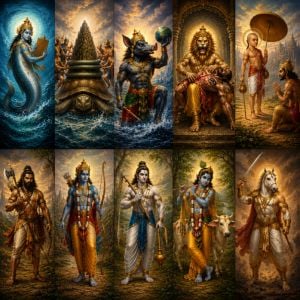
Lyrics:
आदावम्बुजसम्भवादिविनुतः शान्तोऽच्युतः शाश्वतः
सम्फुल्लामलपुण्डरीकनयनः पुण्यः पुराणः पुमान् ।
लोकेशः श्रुतिचोरसोमकहरो मत्स्यावतारो हरिः
श्रीमान् सिंहगिरीश्वरः करुणया दद्यात्सदा मङ्गलम् ॥
सप्तद्वीपकुलाचलेन्द्रजलधिस्तोमाभिसङ्क्रान्तभू-
भारालीढफणीन्द्रमन्दरधरो मन्दारमालार्चितः ।
भावज्ञो बहुचक्रलाञ्छिततनुः कूर्मावतारो हरिः
श्रीमान् सिंहगिरीश्वरः करुणया दद्यात्सदा मङ्गलम् ॥
लीलालोडितसर्वसागरजलः सम्पूर्णचन्द्रप्रभो
हेमाक्षासुरखण्डनो भुजगदः चक्राङ्कितः सन्ततम् ।
दंष्ट्राग्रोद्धृतमेदिनीभयहरः क्रोडावतारो हरिः
श्रीमान् सिंहगिरीश्वरः करुणया दद्यात्सदा मङ्गलम् ॥
कुन्देन्दुस्फटिकप्रभो बहुभुजो भूषासहस्रोज्ज्वलो
दैत्येन्द्रोदरदारणेऽतिनिपुणः स्तम्भोद्भवो भीषणः ।
प्रह्लादार्तिहरोदयो नरमृगाकारावतारो हरिः
श्रीमान् सिंहगिरीश्वरः करुणया दद्यात्सदा मङ्गलम् ॥
धातृक्षालितपादपङ्कजभवस्रोतोमहाशाम्बरः
प्रक्षालीकृतपादपद्मयुगलो बालो जगज्जीवनः ।
भिक्षार्थी बलिदर्पहा पटुवटुः खर्वावतारो हरिः
श्रीमान् सिंहगिरीश्वरः करुणया दद्यात्सदा मङ्गलम् ॥
सद्यःखण्डितराजमण्डलशरीरोद्भूतरक्तापगा
संसिक्ताखिलभूतलः पितृवचःसम्पालने निष्ठितः ।
वेदज्ञो जमदग्निजः परशुभृद्रामावतारो हरिः
श्रीमान् सिंहगिरीश्वरः करुणया दद्यात्सदा मङ्गलम् ॥
राजेन्द्रो रणरङ्गराजविनुतानेकासुराभासुरा-
कारो रावणकोटिखण्डनपटुः कोदण्डदीक्षागुरुः ।
सीतेशः सुरसज्जनामृतकरो रामावतारो हरिः
श्रीमान् सिंहगिरीश्वरः करुणया दद्यात्सदा मङ्गलम् ॥
कालिन्दीजलभेदनो बहुभुजो भूषासमुद्भासुरः
प्रध्वंसी मुसलायुधो हलधरो नीलाम्बरो निर्मलः ।
लावण्याप्पतिरेवतीपतिरसौ रामावतारो हरिः
श्रीमान् सिंहगिरीश्वरः करुणया दद्यात्सदा भङ्गलम् ॥
धर्मज्ञत्रिपुराधिनाथवनिताधर्मोपदेष्टा च त-
त्पातिव्रत्यविशेषभञ्जनपरो वेदान्तवेद्यः सदा ।
दैत्यव्रातविनाशनादिचतुरो बुद्धावतारो हरिः
श्रीमान् सिंहगिरीश्वरः करुणया दद्यात्सदा मङ्गलम् ॥
म्लेच्छव्रातविनाशकः कलियुगान्तेऽश्वाधिरूढो महा-
मायावी बहुभानुकोटिसदृशो भीमांशुचक्रायुधः ।
यश्चाङ्गीकृतकल्किरूपविभवो भूमौ अविष्यान्वयः
श्रीमान् सिंहगिरीश्वरः करुणया दद्यात्सदा मङ्गलम् ॥
aadaavambujasambhavaadivinutah' shaanto'chyutah' shaashvatah'
samphullaamalapund'areekanayanah' punyah' puraanah' pumaan .
lokeshah' shrutichorasomakaharo matsyaavataaro harih'
shreemaan sim'hagireeshvarah' karunayaa dadyaatsadaa mangalam ..
saptadveepakulaachalendrajaladhistomaabhisankraantabhoo-
bhaaraaleed'haphaneendramandaradharo mandaaramaalaarchitah' .
bhaavajnyo bahuchakralaanchhitatanuh' koormaavataaro harih'
shreemaan sim'hagireeshvarah' karunayaa dadyaatsadaa mangalam ..
leelaalod'itasarvasaagarajalah' sampoornachandraprabho
hemaakshaasurakhand'ano bhujagadah' chakraankitah' santatam .
dam'sht'raagroddhri'tamedineebhayaharah' krod'aavataaro harih'
shreemaan sim'hagireeshvarah' karunayaa dadyaatsadaa mangalam ..
kundendusphat'ikaprabho bahubhujo bhooshaasahasrojjvalo
daityendrodaradaarane'tinipunah' stambhodbhavo bheeshanah' .
prahlaadaartiharodayo naramri'gaakaaraavataaro harih'
shreemaan sim'hagireeshvarah' karunayaa dadyaatsadaa mangalam ..
dhaatri'kshaalitapaadapankajabhavasrotomahaashaambarah'
prakshaaleekri'tapaadapadmayugalo baalo jagajjeevanah' .
bhikshaarthee balidarpahaa pat'uvat'uh' kharvaavataaro harih'
shreemaan sim'hagireeshvarah' karunayaa dadyaatsadaa mangalam ..
sadyah'khand'itaraajamand'alashareerodbhootaraktaapagaa
sam'siktaakhilabhootalah' pitri'vachah'sampaalane nisht'hitah' .
vedajnyo jamadagnijah' parashubhri'draamaavataaro harih'
shreemaan sim'hagireeshvarah' karunayaa dadyaatsadaa mangalam ..
raajendro ranarangaraajavinutaanekaasuraabhaasuraa-
kaaro raavanakot'ikhand'anapat'uh' kodand'adeekshaaguruh' .
seeteshah' surasajjanaamri'takaro raamaavataaro harih'
shreemaan sim'hagireeshvarah' karunayaa dadyaatsadaa mangalam ..
kaalindeejalabhedano bahubhujo bhooshaasamudbhaasurah'
pradhvam'see musalaayudho haladharo neelaambaro nirmalah' .
laavanyaappatirevateepatirasau raamaavataaro harih'
shreemaan sim'hagireeshvarah' karunayaa dadyaatsadaa bhangalam ..
dharmajnyatripuraadhinaathavanitaadharmopadesht'aa cha ta-
tpaativratyavisheshabhanjanaparo vedaantavedyah' sadaa .
daityavraatavinaashanaadichaturo buddhaavataaro harih'
shreemaan sim'hagireeshvarah' karunayaa dadyaatsadaa mangalam ..
mlechchhavraatavinaashakah' kaliyugaante'shvaadhirood'ho mahaa-
maayaavee bahubhaanukot'isadri'sho bheemaam'shuchakraayudhah' .
yashchaangeekri'takalkiroopavibhavo bhoomau avishyaanvayah'
shreemaan sim'hagireeshvarah' karunayaa dadyaatsadaa mangalam ..
Meaning:
Verse 1
आदावम्बुजसम्भवादिविनुतः शान्तोऽच्युतः शाश्वतः
सम्फुल्लामलपुण्डरीकनयनः पुण्यः पुराणः पुमान् ।
लोकेशः श्रुतिचोरसोमकहरो मत्स्यावतारो हरिः
श्रीमान् सिंहगिरीश्वरः करुणया दद्यात्सदा मङ्गलम् ॥1॥
The opening verse praises the Matsya or fish incarnation of Lord Vishnu. The literal meaning describes a deity worshipped by Brahma, the one who is peaceful, eternal, and never-failing. He is depicted with eyes like blooming white lotuses, the ancient and supreme being who recovered the Vedas by slaying the demon Somaka. He is the master of all worlds and the Lord of Simhagiri who bestows auspiciousness through His mercy.
In mythological terms, this refers to the period of cosmic dissolution when the demon Hayagriva or Somaka stole the Vedas from the sleeping Brahma. Vishnu took the form of a fish to protect the scriptures and guide the king Satyavrata Manu through the rising floods. This act of preservation ensures that the cosmic law and spiritual knowledge are available for the next cycle of existence after the deluge.
Spiritually, the epithet Achyuta refers to the immutable nature of the Divine which remains unchanged even during the destruction of the universe. The term Shanta signifies the absolute peace that underlies all existence. By reclaiming the Vedas, the Lord is seen as the ultimate source of knowledge and the protector of the cosmic order. The request for mangalam or auspiciousness signifies the devotee's desire for spiritual prosperity and divine grace in all endeavors.
Verse 2
सप्तद्वीपकुलाचलेन्द्रजलधिस्तोमाभिसङ्क्रान्तभू-
भारालीढफणीन्द्रमन्दरधरो मन्दारमालार्चितः ।
भावज्ञो बहुचक्रलाञ्छिततनुः कूर्मावतारो हरिः
श्रीमान् सिंहगिरीश्वरः करुणया दद्यात्सदा मङ्गलम् ॥2॥
This verse celebrates the Kurma or tortoise incarnation of the Lord. The literal translation describes Him as the one who bears the immense weight of the earth and the seven islands upon His back. He is the supporter of the Mandara mountain and is adorned with garlands of Mandara flowers. He is the knower of all inner feelings and his body is marked with divine wheel symbols. As the Lord of Simhagiri, he is asked to grant blessings through His compassion.
The mythological context is the Samudra Manthan or the churning of the ocean of milk. To obtain the nectar of immortality, the gods and demons used Mount Mandara as a churning rod, but it began to sink into the soft ocean floor. Vishnu assumed the form of a giant tortoise to provide a stable base on his hard shell, allowing the churning to continue until the divine treasures emerged.
Philosophically, this avatar represents the quality of stability and the necessity of a firm foundation in spiritual practice. The epithet Bhavajnah suggests that the Divine is intimately aware of the devotee's internal state and emotional devotion. The tortoise's ability to withdraw its limbs into its shell is often used as a metaphor for Pratyahara or sense withdrawal, which is essential for meditation. The Lord supports the entire world just as He supports the seeker's spiritual efforts.
Verse 3
लीलालोडितसर्वसागरजलः सम्पूर्णचन्द्रप्रभो
हेमाक्षासुरखण्डनो भुजगदः चक्राङ्कितः सन्ततम् ।
दंष्ट्राग्रोद्धृतमेदिनीभयहरः क्रोडावतारो हरिः
श्रीमान् सिंहगिरीश्वरः करुणया दद्यात्सदा मङ्गलम् ॥3॥
The third verse describes the Varaha or boar incarnation. Literally, it refers to the Lord who playfully churns the ocean waters and shines with the brilliance of a full moon. He is the destroyer of the demon Hiranyaksha, whose name means golden-eyed. He carries the mace and is always marked by the divine discus. He is the one who lifted the earth on the tip of His tusks and removed the fear of the world.
In the mythological narrative, the demon Hiranyaksha dragged the Earth to the bottom of the cosmic ocean. Lord Vishnu took the form of a gigantic boar to dive into the depths, defeat the demon in a fierce battle, and rescue Mother Earth. He balanced the earth on His tusks and brought her back to her rightful place in the universe, restoring balance and safety to all living beings.
This avatar represents the Divine as the protector and rescuer of the fallen. The word Lila indicates that even the most difficult cosmic tasks are like effortless play for the Almighty. The epithet Bhayahara emphasizes His role as the remover of fear. Philosophically, the Varaha avatar signifies the upliftment of the soul from the depths of material ignorance and inertia into the light of spiritual awareness and stability.
Verse 4
कुन्देन्दुस्फटिकप्रभो बहुभुजो भूषासहस्रोज्ज्वलो
दैत्येन्द्रोदरदारणेऽतिनिपुणः स्तम्भोद्भवः भीषणः ।
प्रह्लादार्तिहरोदयो नरमृगाकारावतारो हरिः
श्रीमान् सिंहगिरीश्वरः करुणया दद्यात्सदा मङ्गलम् ॥4॥
This verse is dedicated to Narasimha, the half-man and half-lion incarnation. He is described as having the white brilliance of jasmine, the moon, and crystal. He has many arms and is adorned with thousands of shining ornaments. He is extremely skilled in tearing open the belly of the demon king and is known as the one born from a pillar. Though terrifying in form, He is the remover of Prahlada's distress.
The mythology involves the demon Hiranyakashipu, who had a boon that he could not be killed by man or beast, inside or outside, by day or night. To protect His devotee Prahlada and uphold the truth, Vishnu emerged from a stone pillar at twilight in a form that was neither fully human nor fully animal. He killed the demon on the threshold, fulfilling all conditions of the boon while ending the reign of terror.
Spiritually, Narasimha represents the omnipresence of God, as evidenced by His emergence from a pillar. The epithet Artihara highlights His extreme compassion for His devotees. The contrast between His terrifying appearance to the wicked and His gentleness toward the virtuous illustrates that the Divine protects Dharma with fierce power while remaining a source of infinite peace for the surrendered soul.
Verse 5
धातृक्षालितपादपङ्कजभवस्रोतोमहाशाम्बरः
प्रक्षालीकृतपादपद्मयुगलो बालो जगज्जीवनः ।
भिक्षार्थी बलिदर्पहा पटुवटुः खर्वावतारो हरिः
श्रीमान् सिंहगिरीश्वरः करुणया दद्यात्सदा मङ्गलम् ॥5॥
The fifth verse describes the Vamana or dwarf incarnation. The literal meaning speaks of the one whose lotus feet were washed by Brahma, causing the holy Ganges to flow. He is depicted as a young boy, the life of the universe, who came as a beggar to the sacrifice of King Bali. He is the clever young student who destroyed the pride of Bali and took a dwarfed form to accomplish His divine purpose.
In the Puranic story, King Bali had conquered the three worlds. Vishnu appeared as a small Brahmana boy and asked for only three paces of land. When granted, He expanded His form to cover the earth and heavens in two steps. Bali then offered his own head for the third step. This act humbled the king and restored the celestial kingdom to the gods while testing the king's devotion.
The philosophical significance lies in the concept of total surrender and the removal of ego. The epithet Bali-darpa-ha refers to the destruction of pride, which is the greatest obstacle to spiritual growth. Despite His small outward appearance as a dwarf, the Lord is the Jagad-jivana, the very life-breath of the cosmos. This teaches that the Divine can manifest in the humblest forms to perform the most profound miracles.
Verse 6
सद्यःखण्डितराजमण्डलशरीरोद्भूतरक्तापगा
संसिक्ताखिलभूतलः पितृवचःसम्पालने निष्ठितः ।
वेदज्ञो जमदग्निजः परशुभृद्रामावतारो हरिः
श्रीमान् सिंहगिरीश्वरः करुणया दद्यात्सदा मङ्गलम् ॥6॥
This verse honors Parashurama, the son of the sage Jamadagni. The literal meaning describes Him as the one who instantly severed the bodies of kings, creating rivers of blood that drenched the entire earth. He is strictly devoted to following His father's words and is a knower of the Vedas. Carrying an axe as His weapon, He is the Rama incarnation who brings order and auspiciousness to the land of Simhagiri.
Mythologically, Parashurama appeared when the warrior class became corrupt and oppressed the people. He rid the earth of tyrannical kings twenty-one times. He is also famous for His unwavering obedience to His father, Sage Jamadagni, even when faced with the most difficult commands. He represents the synthesis of Brahminical knowledge and Kshatriya valor, used solely for the protection of righteousness and the suppression of evil.
The spiritual significance of this avatar is the necessity of radical purification. The bloody rivers represent the total eradication of negative tendencies and egoistic power. The epithet Pitru-vacha-sampalana highlights the virtue of discipline and duty. Parashurama demonstrates that when the balance of society is lost, the Divine intervenes with power to clear the way for a new era of Dharma and Vedic wisdom.
Verse 7
राजेन्द्रो रणरङ्गराजविनुतानेकासुराभासुरा-
कारो रावणकोटिखण्डनपटुः कोदण्डदीक्षागुरुः ।
सीतेशः सुरसज्जनामृतकरो रामावतारो हरिः
श्रीमान् सिंहगिरीश्वरः करुणया दद्यात्सदा मङ्गलम् ॥7॥
The seventh verse praises Lord Rama, the son of Dasharatha and the King of Kings. The literal meaning depicts Him as the master of the battlefield, radiant in form, and praised for destroying millions of demons like Ravana. He is the supreme master of the bow, the lord of Sita, and a source of nectar-like joy for the gods and the virtuous. He is the Rama avatar who grants eternal blessings from His seat at Simhagiri.
The Ramayana tells the story of Rama's exile, His battle against the demon king Ravana, and His eventual return to establish Rama Rajya. He is the embodiment of Maryada or the perfect adherence to law and ethics. His life serves as a model for every human role, whether as a son, a brother, a husband, or a ruler, showing that one can remain divine while living a mortal life.
Philosophically, the epithet Kodanda-diksha-guru refers to His absolute focus and mastery over the mind and senses, symbolized by the bow. He is the Seeteshah, the lord of the primordial energy or Prakriti. His presence is described as Amruta-kara, meaning He provides the nectar of immortality and peace to those who follow the path of righteousness. Rama represents the triumph of steady character and devotion over the chaotic forces of ego and desire.
Verse 8
कालिन्दीजलभेदनो बहुभुजो भूषासमुद्भासुरः
प्रध्वंसी मुसलायुधो हलधरो नीलाम्बरो निर्मलः ।
लावण्याप्पतिरेवतीपतिरसौ रामावतारो हरिः
श्रीमान् सिंहगिरीश्वरः करुणया दद्यात्सदा भङ्गलम् ॥8॥
This verse refers to Balarama, the elder brother of Krishna. Literally, He is the one who divided or diverted the waters of the Yamuna river. He is many-armed and resplendent with ornaments. He carries a mace and a plough as His weapons and wears blue garments. He is pure, a master of beauty, and the husband of Revati. As the Rama who bears the plough, He is the protector who resides at Simhagiri.
Mythologically, Balarama used His plough to drag the Yamuna river toward Vrindavan, showing His power over nature. He is an incarnation of Shesha, the thousand-headed serpent who supports the universe. While Krishna is associated with the yellow garment, Balarama is Nila-ambara, representing the depth of the blue sky or the ocean. He played a crucial role in clearing forests and assisting Krishna in various pastimes.
The spiritual significance of the plough weapon is its connection to cultivation and the preparation of the heart's soil for devotion. The epithet Nirmala signifies His absolute purity and strength. Balarama represents the spiritual strength or Bala needed to walk the path of God-realization. He is the stabilizing force who removes obstacles with His mace and prepares the ground for spiritual growth with His plough.
Verse 9
धर्मज्ञत्रिपुराधिनाथवनिताधर्मोपदेष्टा च त-
त्पातिव्रत्यविशेषभञ्जनपरो वेदान्तवेद्यः सदा ।
दैत्यव्रातविनाशनादिचतुरो बुद्धावतारो हरिः
श्रीमान् सिंहगिरीश्वरः करुणया दद्यात्सदा मङ्गलम् ॥9॥
The ninth verse addresses the Buddha incarnation. The literal meaning describes Him as a knower of Dharma who taught specific duties to the wives of the lords of Tripura. He is involved in breaking the false sense of penance and is the one who is always knowable through the study of Vedanta. He is clever in the destruction of demonic hosts and manifests as the Buddha avatar to bring auspiciousness from Simhagiri.
In the Puranic tradition, Vishnu took this form to lead the enemies of the gods away from the Vedic path when they were using it for destructive purposes. By teaching them a different philosophy, He weakened their supernatural strength derived from their rituals. This allowed the cosmic order to be restored. This version of the Buddha is often seen as a strategic manifestation of the Divine to protect the essence of the Vedas from misuse.
Philosophically, the epithet Vedanta-vedyah is significant because it asserts that although the Buddha avatar may seem to critique certain external rituals, He remains the ultimate truth discovered at the end of all Vedic knowledge. He represents the path of compassion and non-violence. This verse highlights the Lord's role as a teacher and a master of psychological warfare against the internal demons of ego and malice.
Verse 10
म्लेच्छव्रातविनाशकः कलियुगान्तेऽश्वाधिरूढो महा-
मायावी बहुभानुकोटिसदृशो भीमांशुचक्रायुधः ।
यश्चाङ्गीकृतकल्किरूपविभवो भूमौ अविष्यान्वयः
श्रीमान् सिंहगिरीश्वरः करुणया दद्यात्सदा मङ्गलम् ॥10॥
The final verse describes the future incarnation, Kalki. He is the destroyer of the hordes of the wicked at the end of the Kali Yuga. He is depicted as mounted on a white horse, a master of great illusions and powers, shining with the brilliance of ten million suns. He carries a fearsome discus and other weapons to cleanse the earth. He is the one who has accepted the glorious form of Kalki to appear on earth in the future.
According to the scriptures, when the world is completely overrun by darkness, ignorance, and injustice at the end of the current age, Lord Vishnu will appear as Kalki. Riding the horse Devadatta and wielding a sword, He will annihilate the forces of evil and restore the Satya Yuga or the age of truth. This manifestation represents the final justice and the cyclical renewal of the entire cosmic order.
The spiritual significance of Kalki is the hope of eventual redemption and the certainty that light will always overcome darkness. The epithet Bahu-bhanu-koti-sadrisha emphasizes that the Divine truth is so brilliant that it instantly evaporates the shadows of the Kali Yuga. The prayer concludes the stotram by invoking the Lord of Simhagiri as the ultimate refuge who oversees the past, present, and future incarnations for the welfare of all beings.





Other stotras


