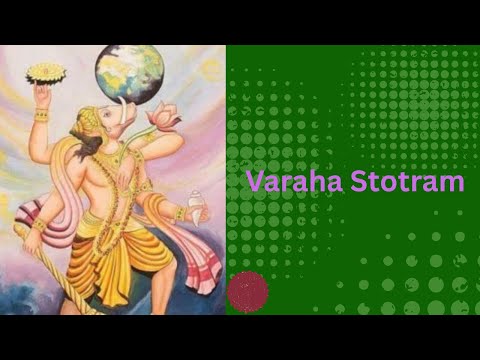
Varaha Stotram
जितं जितं तेऽजित यज्ञभावना त्रयीं तनुं स्वां परिधुन्वते नमः । यद्रोमगर्तेषु निलिल्युरध्वरास्तस्मै नमः कारणसूकराय ते ॥
O Unconquerable One, embodiment of sacrifice, all victory to You! Salutations to You who shakes His form, the very essence of the three Vedas. Salutations to You, the primeval Boar, in whose very pores all sacred rites find their ultimate refuge.
This opening verse of the hymn celebrates the Lord’s absolute supremacy and His intrinsic identity with the Vedic tradition. He is addressed as 'Ajita', the Unconquerable, and 'Yajna-bhavana', the protector and personification of sacrifice. The image of Him shaking His body, which is described as the embodiment of the three Vedas ('Trayim tanum'), signifies the activation of all cosmic laws and sacred knowledge. The verse culminates in a profound metaphor: all sacrifices ('adhvarah') find their home in the pores of His skin ('roma-garteshu'). This establishes that He is not merely the recipient of sacrifice, but its very source, substance, and conclusion. The final salutation is to the 'Karana-sukaraya', the 'Causal Boar', reminding us that this is no ordinary form, but the primeval cause of all existence.
रूपं तवैतन्ननु दुष्कृतात्मनां दुर्दर्शनं देव यदध्वरात्मकम् । छन्दांसि यस्य त्वचि बर्हिरोमस्वाज्यं दृशि त्वङ्घ्रिषु चातुर्होत्रम् ॥
O Lord, this form of Yours, the personification of sacrifice, is truly imperceptible to those of impure soul. The Vedic meters are Your skin, the sacred kusha grass Your bodily hair, clarified butter Your sight, and the four principal priests Your four feet.
The sages acknowledge that a vision of this divine form, which is the very soul of sacrifice ('adhvaratmakam'), is not possible for those with impure minds ('dushkritatmanam'). Spiritual purity is the prerequisite for divine perception. The verse then begins a sublime allegory, mapping the components of a Vedic sacrifice onto the Lord's cosmic body. The 'Chandas' (Vedic meters) form His skin, the very fabric of His being. The sacred 'Barhi' grass is His hair. The 'Ajyam' (clarified butter), the primary offering, is seen in His eyes, signifying that His glance bestows grace and nourishment. The 'Chaturhotram', the four chief priests who conduct the ceremony, are identified with His four feet, representing the stable foundation upon which the entire cosmic ritual rests.
स्रुक्तुण्ड आसीत्स्रुव ईश नासयोरिडोदरे चमसाः कर्णरन्ध्रे । प्राशित्रमास्ये ग्रसने ग्रहास्तु ते यच्चर्वणं ते भगवन्नग्निहोत्रम् ॥
O Lord, the great ladle (Sruk) was Your snout, the smaller ladle (Sruva) Your nostrils. The Ida offering was Your stomach, the sacrificial cups Your ear-cavities. The Prashitra offering was Your mouth, the Soma vessels Your throat, and O Blessed One, Your very act of chewing is the Agnihotra sacrifice.
The intricate superimposition of sacrificial paraphernalia onto the Lord's divine form continues. His snout, which lifted the Earth, is the 'Sruk', a large ladle for pouring offerings. His nostrils are the 'Sruva', another ritual ladle. His stomach contains the 'Ida', a sacred portion of the offering. The 'Chamasa', cups for the Soma ritual, are His ears. The 'Prashitra', the portion consumed by the supervising priest, is His mouth, and the 'Grahas', vessels for holding Soma, are His throat. The verse reaches its zenith by equating the Lord's chewing ('charvanam')—a seemingly mundane biological function—with the 'Agnihotra', the most fundamental daily fire sacrifice. This powerfully illustrates that in the Divine, there is no distinction between the sacred and the ordinary; His every action is cosmic ritual.
दीक्षानुजन्मोपसदः शिरोधरं त्वं प्रायणीयोदयनीयदंष्ट्रः । जिह्वा प्रवर्ग्यस्तव शीर्षकं क्रतोः सभ्यावसथ्यं चितयोऽसवो हि ते ॥
Your appearance itself is the initiation (Diksha), Your neck the three preliminary rites (Upasads), and Your tusks are the opening and concluding ceremonies (Prayaniya and Udaniya). Your tongue is the Pravargya ceremony, Your head the fire altar, and indeed, Your life breaths are the layers of sacrificial fires.
Here, the very timeline and structure of a complex sacrifice are identified with the Lord's being. His divine appearance is the 'Diksha', the solemn consecration that begins the great cosmic sacrifice. His neck represents the 'Upasads', a series of preparatory rites. His mighty tusks, the very instruments of His world-saving deed, are seen as the 'Prayaniya' (opening) and 'Udaniya' (concluding) ceremonies that frame the entire ritual. His tongue is the 'Pravargya', a special preliminary rite. His head is the 'Kratu', the altar itself, and His vital breaths ('asavah') are the 'Chitayah', the sacred fires arranged in layers, signifying that His life force is what fuels all sacred activity in the universe.
सोमस्तु रेतः सवनान्यवस्थितिः संस्थाविभेदास्तव देव धातवः । सत्राणि सर्वाणि शरीरसन्धिस्त्वं सर्वयज्ञक्रतुरिष्टिबन्धनः ॥
O Lord, the Soma juice is Your generative potency, the stages of the sacrifice are Your bodily postures, and the different categories of sacrifice are the tissues of Your body. All long sacrificial sessions are Your bodily joints, and You are the unifying principle of all sacrifices, rituals, and offerings.
The allegory now moves to the subtlest aspects of the sacrifice. 'Soma', the divine elixir, is equated with the Lord's creative seed ('retah'). The 'Savanas', the three daily periods for the Soma ritual, are His various states of being ('avasthitih'). The different types of sacrifices ('samstha-vibhedah') form the very tissues ('dhatavah') of His cosmic body. The 'Satrani', prolonged sacrificial sessions lasting for days or even years, are His joints ('sharira-sandhih'), connecting all parts into a cohesive whole. He is, therefore, the 'Ishti-bandhanah', the unifying thread that binds every ritual, every offering, and every sacrifice into a single, meaningful cosmic act.
नमो नमस्तेऽखिलयन्त्रदेवताद्रव्याय सर्वक्रतवे क्रियात्मने । वैराग्यभक्त्यात्मजयानुभावितज्ञानाय विद्यागुरवे नमो नमः ॥
Salutations, again and again, to You, who are all sacrificial implements, deities, and materials; who are the form of all sacrifices and the soul of all actions. Salutations, again and again, to the supreme spiritual preceptor, who is realized through the knowledge born of detachment, devotion, and self-mastery.
This verse marks a pivot from describing the Lord's form to explaining the means of knowing Him. The first line summarizes the preceding verses: He is the totality of the sacrifice—the tools ('yantra'), the presiding deities ('devata'), the offerings ('dravya'), the ritual itself ('sarva-kratave'), and the consciousness animating the action ('kriya-atmane'). The second line reveals the path to this understanding. He is the ultimate 'Vidya-guru' (spiritual teacher), who can only be truly known through 'Jnana' (knowledge) that is personally realized ('anubhavita'). This realization is the fruit of a threefold spiritual practice: 'Vairagya' (detachment), 'Bhakti' (loving devotion), and 'Atma-jaya' (conquest of the mind and senses).
दंष्ट्राग्रकोट्या भगवंस्त्वया धृता विराजते भूधर भूः सभूधरा । यथा वनान्निःसरतो दता धृता मतङ्गजेन्द्रस्य सपत्रपद्मिनी ॥
O Lord, O supporter of the mountains, the Earth with all its peaks, held by You on the very tip of Your tusk, shines with great splendor. It appears just like a lotus, complete with its leaves, held on the tusk of a majestic king of elephants emerging from a forest.
The sages now shift their focus from the abstract symbolism of sacrifice to the breathtaking beauty of the Lord's deed. The Earth ('Bhu'), laden with its mountains ('sa-bhudhara'), is held delicately yet securely on the point of His tusk ('damshtragra-kotya'). To capture this magnificent sight, they employ a powerful and elegant simile: the scene is compared to a mighty elephant ('matangajendra') emerging from the woods, effortlessly carrying a beautiful lotus flower with its leaves ('sa-patra-padmini') on its tusk. This imagery perfectly conveys both the Lord's immense, effortless power and the delicate beauty with which He protects His creation.
त्रयीमयं रूपमिदं च सौकरं भूमण्डलेनाथ दता धृतेन ते । चकास्ति शृङ्गोढघनेन भूयसा कुलाचलेन्द्रस्य यथैव विभ्रमः ॥
And this boar form of Yours, the embodiment of the three Vedas, shines magnificently with the Earth held upon Your tusk. It is as splendid as a great mountain king whose majesty is enhanced by a large cloud resting on its peak.
This verse masterfully weaves together the two central themes of the hymn: the Lord's form as the Vedas and His physical act of rescuing the Earth. His divine boar form ('saukaram rupam'), already glorious as the personification of sacred knowledge, is made even more resplendent ('chakaasti') by the rescued Earth upon His tusk. A new simile is introduced to express this enhanced grandeur. The Lord is likened to a 'Kulachalendra', a king among mountains, whose peak is made even more majestic by the presence of a large, beautiful cloud. In this analogy, the Lord is the eternal mountain, and the Earth He saves is the cloud that adorns and proclaims His glory.
संस्थापयैनां जगतां सतस्थुषां लोकाय पत्नीमसि मातरं पिता । विधेम चास्यै नमसा सह त्वया यस्यां स्वतेजोऽग्निमिवारणावधाः ॥
Please establish her firmly as the abode for all moving and unmoving beings. You are the father, and she is the mother and consort for all worlds. We offer our obeisances to her along with You, for it is in her that You have placed Your potency, just as fire is placed within the Arani wood.
Having offered praise, the sages now present their prayer. They request the Lord to firmly re-establish the Earth ('samsthapaya enam') as a stable home for all creatures. They articulate the divine cosmic relationship: the Lord is the supreme father ('pita'), and the Earth is the universal mother ('mataram') and provider ('patnim'). In recognition of her divine status, they offer obeisance to both her and the Lord. The final line reveals a deep truth using a Vedic analogy: the Lord has infused the Earth with His own creative energy ('sva-tejah'), just as a priest generates fire ('agnim') from the sacred 'Arani' wood. The Earth's power to sustain life is a direct impartation of the Lord's own divine potency.
कः श्रद्दधीतान्यतमस्तव प्रभो रसां गताया भुव उद्विबर्हणम् । न विस्मयोऽसौ त्वयि विश्वविस्मये यो माययेदं ससृजेऽतिविस्मयम् ॥
O Lord, who other than You could even conceive of lifting the Earth after it had sunk to the depths of the cosmic ocean? Yet, this act is no cause for wonder in You, who are the wonder of the universe itself, for by Your divine power You created this entire, exceedingly wonderful cosmos.
The sages express a sense of profound awe at the Lord's accomplishment. They ask rhetorically: who else could even have faith in such an impossible task as raising the entire planet from the abyss ('rasam gatayah bhuvah')? But they immediately realize the flaw in their own astonishment. While the feat is impossible for any other being, it is 'no wonder' ('na vismayo') for Him. The reason is that He is the 'Vishwa-vismaye', the source of all wonders. His creation of the entire, infinitely complex and marvelous universe ('idam ativismayam') through His divine energy ('mayaya') is a far greater miracle. Rescuing one part of that creation is, for Him, a natural expression of His limitless power.
विधुन्वता वेदमयं निजं वपुर्जनस्तपःसत्यनिवासिनो वयम् । सटाशिखोद्धूतशिवाम्बुबिन्दुभिर्विमृज्यमाना भृशमीश पाविताः ॥
O Lord, as You shook Your Veda-personified body, we, the inhabitants of the highest realms of Janas, Tapas, and Satya, were sprinkled by the auspicious water droplets flung from Your mane. Being touched by them, we have been profoundly purified.
Here, the sages, residents of the highest celestial realms of purity and penance, describe their direct experience of His grace. When the Lord emerged from the cosmic waters and shook His body ('vedamayam nijam vapuh'), droplets were cast from His mane. These were not mere water, but 'shiva-ambu-bindubhih'—drops of auspicious, sanctifying water. The sages declare that being touched ('vimrijyamanah') by these droplets, they, who were already among the most elevated beings, felt themselves to be immensely purified ('bhrisham pavitah'). This beautifully illustrates that even the slightest, most indirect contact with the Lord bestows immeasurable spiritual merit and purification.
स वै बत भ्रष्टमतिस्तवैष ते यः कर्मणां पारमपारकर्मणः । यद्योगमायागुणयोगमोहितं विश्वं समस्तं भगवन् विधेहि शम् ॥
Alas, that person's intelligence is surely lost who tries to comprehend the limits of the actions of You, whose actions are limitless. O Lord, this entire universe is bewildered by the interplay of the modes of Your divine energy. Please bestow well-being upon all.
The hymn concludes with a statement of profound humility and a universal benediction. The sages declare that any intellect that attempts to measure the deeds ('karmanam param') of the Lord, whose actions are immeasurable ('apara-karmanah'), is utterly confounded ('bhrashta-matih'). They recognize that the entire world ('vishvam samastam') is captivated and bewildered ('mohitam') by His 'Yoga-maya', the divine power that manifests as the three modes of material nature. Acknowledging this universal condition, their final prayer is not for personal boons, but for the welfare of all beings: 'Bhagavan, vidhehi sham'—'O Blessed Lord, please ordain peace and auspiciousness for everyone'.
जितं जितं तेऽजित यज्ञभावना त्रयीं तनुं स्वां परिधुन्वते नमः ।
यद्रोमगर्तेषु निलिल्युरध्वरास्तस्मै नमः कारणसूकराय ते ॥
रूपं तवैतन्ननु दुष्कृतात्मनां दुर्दर्शनं देव यदध्वरात्मकम् ।
छन्दांसि यस्य त्वचि बर्हिरोमस्वाज्यं दृशि त्वङ्घ्रिषु चातुर्होत्रम् ॥
स्रुक्तुण्ड आसीत्स्रुव ईश नासयोरिडोदरे चमसाः कर्णरन्ध्रे ।
प्राशित्रमास्ये ग्रसने ग्रहास्तु ते यच्चर्वणं ते भगवन्नग्निहोत्रम् ॥
दीक्षानुजन्मोपसदः शिरोधरं त्वं प्रायणीयोदयनीयदंष्ट्रः ।
जिह्वा प्रवर्ग्यस्तव शीर्षकं क्रतोः सभ्यावसथ्यं चितयोऽसवो हि ते ॥
सोमस्तु रेतः सवनान्यवस्थितिः संस्थाविभेदास्तव देव धातवः ।
सत्राणि सर्वाणि शरीरसन्धिस्त्वं सर्वयज्ञक्रतुरिष्टिबन्धनः ॥
नमो नमस्तेऽखिलयन्त्रदेवताद्रव्याय सर्वक्रतवे क्रियात्मने ।
वैराग्यभक्त्यात्मजयानुभावितज्ञानाय विद्यागुरवे नमो नमः ॥
दंष्ट्राग्रकोट्या भगवंस्त्वया धृता विराजते भूधर भूः सभूधरा ।
यथा वनान्निःसरतो दता धृता मतङ्गजेन्द्रस्य सपत्रपद्मिनी ॥
त्रयीमयं रूपमिदं च सौकरं भूमण्डलेनाथ दता धृतेन ते ।
चकास्ति शृङ्गोढघनेन भूयसा कुलाचलेन्द्रस्य यथैव विभ्रमः ॥
संस्थापयैनां जगतां सतस्थुषां लोकाय पत्नीमसि मातरं पिता ।
विधेम चास्यै नमसा सह त्वया यस्यां स्वतेजोऽग्निमिवारणावधाः ॥
कः श्रद्दधीतान्यतमस्तव प्रभो रसां गताया भुव उद्विबर्हणम् ।
न विस्मयोऽसौ त्वयि विश्वविस्मये यो माययेदं ससृजेऽतिविस्मयम् ॥
विधुन्वता वेदमयं निजं वपुर्जनस्तपःसत्यनिवासिनो वयम् ।
सटाशिखोद्धूतशिवाम्बुबिन्दुभिर्विमृज्यमाना भृशमीश पाविताः ॥
स वै बत भ्रष्टमतिस्तवैष ते यः कर्मणां पारमपारकर्मणः ।
यद्योगमायागुणयोगमोहितं विश्वं समस्तं भगवन् विधेहि शम् ॥
jitam' jitam' te'jita yajnyabhaavanaa trayeem' tanum' svaam' paridhunvate namah' .
yadromagarteshu nililyuradhvaraastasmai namah' kaaranasookaraaya te ..
roopam' tavaitannanu dushkri'taatmanaam' durdarshanam' deva yadadhvaraatmakam .
chhandaam'si yasya tvachi barhiromasvaajyam' dri'shi tvanghrishu chaaturhotram ..
sruktund'a aaseetsruva eesha naasayorid'odare chamasaah' karnarandhre .
praashitramaasye grasane grahaastu te yachcharvanam' te bhagavannagnihotram ..
deekshaanujanmopasadah' shirodharam' tvam' praayaneeyodayaneeyadam'sht'rah' .
jihvaa pravargyastava sheershakam' kratoh' sabhyaavasathyam' chitayo'savo hi te ..
somastu retah' savanaanyavasthitih' sam'sthaavibhedaastava deva dhaatavah' .
satraani sarvaani shareerasandhistvam' sarvayajnyakraturisht'ibandhanah' ..
namo namaste'khilayantradevataadravyaaya sarvakratave kriyaatmane .
vairaagyabhaktyaatmajayaanubhaavitajnyaanaaya vidyaagurave namo namah' ..
dam'sht'raagrakot'yaa bhagavam'stvayaa dhri'taa viraajate bhoodhara bhooh' sabhoodharaa .
yathaa vanaannih'sarato dataa dhri'taa matangajendrasya sapatrapadminee ..
trayeemayam' roopamidam' cha saukaram' bhoomand'alenaatha dataa dhri'tena te .
chakaasti shri'ngod'haghanena bhooyasaa kulaachalendrasya yathaiva vibhramah' ..
sam'sthaapayainaam' jagataam' satasthushaam' lokaaya patneemasi maataram' pitaa .
vidhema chaasyai namasaa saha tvayaa yasyaam' svatejo'gnimivaaranaavadhaah' ..
kah' shraddadheetaanyatamastava prabho rasaam' gataayaa bhuva udvibarhanam .
na vismayo'sau tvayi vishvavismaye yo maayayedam' sasri'je'tivismayam ..
vidhunvataa vedamayam' nijam' vapurjanastapah'satyanivaasino vayam .
sat'aashikhoddhootashivaambubindubhirvimri'jyamaanaa bhri'shameesha paavitaah' ..
sa vai bata bhrasht'amatistavaisha te yah' karmanaam' paaramapaarakarmanah' .
yadyogamaayaagunayogamohitam' vishvam' samastam' bhagavan vidhehi sham ..





Other stotras


