Sri Rangaraja Stotram
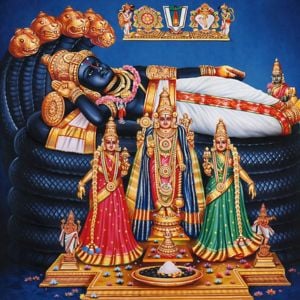
पद्माधिराजे गरुडाधिराजे
विरिञ्चराजे सुरराजराजे ।
त्रैलोक्यराजेऽखिलराजराजे
श्रीरङ्गराजे रमतां मनो मे ॥1॥
नीलाब्जवर्णे भुजपूर्णकर्णे
कर्णान्तनेत्रे कमलाकलत्रे ।
श्रीमल्लरङ्गे जितमल्लरङ्गे
श्रीरङ्गरङ्गे रमतां मनो मे ॥2॥
लक्ष्मीनिवासे जगतां निवासे
हृत्पद्मवासे रविबिम्बवासे ।
क्षीराब्धिवासे फणिभोगवासे
श्रीरङ्गवासे रमतां मनो मे ॥3॥
कुबेरलीले जगदेकलीले
मन्दारमालाङ्कितचारुफाले ।
दैत्यान्तकालेऽखिललोकमौले
श्रीरङ्गलीले रमतां मनो मे ॥4॥
अमोघनिद्रे जगदेकनिद्रे
विदेहनिद्रे च समुद्रनिद्रे ।
श्रीयोगनिद्रे सुखयोगनिद्रे
श्रीरङ्गनिद्रे रमतां मनो मे ॥5॥
आनन्दरूपे निजबोधरूपे
ब्रह्मस्वरूपे क्षितिमूर्तिरूपे ।
विचित्ररूपे रमणीयरूपे
श्रीरङ्गरूपे रमतां मनो मे ॥6॥
भक्ताकृतार्थे मुररावणार्थे
भक्तसमर्थे जगदेककीर्ते ।
अनेकमूर्ते रमणीयमूर्ते
श्रीरङ्गमूर्ते रमतां मनो मे ॥7॥
कंसप्रमाथे नरकप्रमाथे
दुष्टप्रमाथे जगतां निदाने ।
अनाथनाथे जगदेकनाथे
श्रीरङ्गनाथे रमतां मनो मे ॥8॥
सुचित्रशायी जगदेकशायी
नन्दाङ्कशायी कमलाङ्कशायी ।
अम्भोधिशायी वटपत्रशायी
श्रीरङ्गशायी रमतां मनो मे ॥9॥
सकलदुरितहारी भूमिभारापहारी
दशमुखकुलहारी दैत्यदर्पापहारी ।
सुललितकृतचारी पारिजातापहारी
त्रिभुवनभयहारी प्रीयतां श्रीमुरारिः ॥10॥
रङ्गस्तोत्रमिदं पुण्यं प्रातःकाले पठेन्नरः ।
कोटिजन्मार्जितं पापं स्मरणेन विनश्यति ॥11॥
padmaadhiraaje garud'aadhiraaje
virincharaaje suraraajaraaje .
trailokyaraaje'khilaraajaraaje
shreerangaraaje ramataam' mano me ..1..
neelaabjavarne bhujapoornakarne
karnaantanetre kamalaakalatre .
shreemallarange jitamallarange
shreerangarange ramataam' mano me ..2..
lakshmeenivaase jagataam' nivaase
hri'tpadmavaase ravibimbavaase .
ksheeraabdhivaase phanibhogavaase
shreerangavaase ramataam' mano me ..3..
kuberaleele jagadekaleele
mandaaramaalaankitachaaruphaale .
daityaantakaale'khilalokamaule
shreerangaleele ramataam' mano me ..4..
amoghanidre jagadekanidre
videhanidre cha samudranidre .
shreeyoganidre sukhayoganidre
shreeranganidre ramataam' mano me ..5..
aanandaroope nijabodharoope
brahmasvaroope kshitimoortiroope .
vichitraroope ramaneeyaroope
shreerangaroope ramataam' mano me ..6..
bhaktaakri'taarthe muraraavanaarthe
bhaktasamarthe jagadekakeerte .
anekamoorte ramaneeyamoorte
shreerangamoorte ramataam' mano me ..7..
kam'sapramaathe narakapramaathe
dusht'apramaathe jagataam' nidaane .
anaathanaathe jagadekanaathe
shreeranganaathe ramataam' mano me ..8..
suchitrashaayee jagadekashaayee
nandaankashaayee kamalaankashaayee .
ambhodhishaayee vat'apatrashaayee
shreerangashaayee ramataam' mano me ..9..
sakaladuritahaaree bhoomibhaaraapahaaree
dashamukhakulahaaree daityadarpaapahaaree .
sulalitakri'tachaaree paarijaataapahaaree
tribhuvanabhayahaaree preeyataam' shreemuraarih' ..10..
rangastotramidam' punyam' praatah'kaale pat'hennarah' .
kot'ijanmaarjitam' paapam' smaranena vinashyati ..11..
Verse 1
padmadhiraje garudadhiraje virincharaje surarajaraje trailokyaraje akhilarajaraje srirangaraje ramatam mano me
This verse is a majestic salutation to Sri Ranganatha as the supreme king. Padmadhiraja means the lord of Lakshmi, who is seated on the lotus. Garudadhiraja indicates that he is the master of Garuda, the king of birds and his divine vehicle. Virincharaja refers to Brahma, born of the lotus, and Surarajaraja means the lord of Indra and all gods. Thus, he is the king of kings, the sovereign of the three worlds, and the ultimate ruler beyond all rulers.
In mythology, Sri Ranganatha is Vishnu reclining in Srirangam, worshiped by Brahma, Indra, and all celestial beings. Even those considered rulers derive their power from him.
Philosophically, this verse affirms that all authority, power, and order in the universe originate from the Supreme. By saying ramatam mano me, let my mind delight in him, the devotee seeks inner alignment with the highest sovereignty, recognizing that true kingship lies not in external control but in divine consciousness.
Verse 2
nilabjavarn e bhujapurnakarne karnantanet re kamalakalatre srimallarange jitamallarange srirangarange ramatam mano me
Nilabjavarna describes his complexion as dark like a blue lotus, symbolizing depth, calmness, and infinite space. Bhujapurnakarna and karnantanetra poetically describe his beautifully proportioned limbs and long eyes extending to the ears, traditional marks of divine beauty. Kamalakalatra refers to Lakshmi as his consort. Srimallaranga and jitamallaranga recall the one who defeated mighty wrestlers, pointing to Krishna’s victory over Chanura and Mushtika.
Mythologically, this connects Sri Ranganatha with Krishna, affirming that all avatars are one Supreme being. His beauty is not merely physical but represents cosmic harmony.
Philosophically, the blue hue signifies transcendence, and the lotus-eyed form signifies compassion. The mind is urged to revel in this divine beauty, recognizing that contemplation of divine form purifies perception and awakens devotion.
Verse 3
lakshminivase jagatam nivase hrtpadmavase ravibimbavase ksirabdhivase phanibhogavase srirangavase ramatam mano me
Lakshminivasa means the abode of Lakshmi. Jagatam nivasa means the dwelling place of the entire universe. Hrtpadmavasa refers to residing in the lotus of the heart. Ravibimbavasa suggests presence even within the solar orb. Ksirabdhivasa recalls his reclining in the ocean of milk, and phanibhogavasa refers to resting on the serpent Adisesha.
In mythology, Vishnu resides in Vaikuntha, in the ocean of milk, and also as the indwelling Self in every heart. The temple of Srirangam embodies this cosmic residence.
Philosophically, this verse expands the idea of divine presence. The Lord is not confined to a temple or heaven. He pervades cosmos, sun, heart, and cosmic ocean. The devotee prays that the mind may rest in that all-pervading presence, shifting from external seeking to inner realization.
Verse 4
kuberalile jagadekalile mandarama lankitacaru phale daityantakale akhilalokamaule srirangalile ramatam mano me
Kuberalila suggests effortless enjoyment of divine wealth. Jagadekalila means that the entire universe is his sport. Mandaramala ankita caru phala describes his beautiful forehead adorned with celestial garlands. Daityantakala means the destroyer of demons, and akhilalokamaule indicates that he is the crown of all worlds.
Mythologically, Vishnu slays demons such as Hiranyakashipu and others to restore cosmic balance. His actions are not driven by anger but are divine play.
Philosophically, creation and destruction are not random acts but expressions of cosmic intelligence. Calling the universe his lila removes fear and anxiety. The mind that delights in this vision sees life’s events not as chaos but as part of divine order.
Verse 5
amoghanidre jagadekanidre videhanidre ca samudranidre sriyoganidre sukhayoganidre sriranganidre ramatam mano me
Amoghanidra means unfailing cosmic sleep. Jagadekanidra refers to the unique sleep in which the universe dissolves. Videhanidra suggests transcendence of bodily identity. Samudranidra recalls his reclining on the cosmic ocean. Sriyoganidra is the mystical yogic sleep, and sukhayoganidra indicates blissful absorption.
In mythology, during cosmic dissolution, Vishnu rests in yogic slumber upon the ocean, from which new creation arises.
Philosophically, this sleep is not ignorance but supreme awareness beyond activity. It represents the stillness underlying all motion. The devotee seeks to let the mind rest in that divine stillness, understanding that true peace lies beyond restless engagement.
Verse 6
anandarup e nijabodharupe brahmasvarupe ksitimurti rupe vicitrarupe ramaniyarupe srirangarup e ramatam mano me
Anandarupa means embodiment of bliss. Nijabodharupa indicates pure self-awareness. Brahmasvarupa identifies him with the absolute reality. Ksitimurti rupa shows his manifestation in the material world. Vicittrarupa and ramaniyarupa praise his wondrous and charming forms.
Mythologically, Vishnu appears in countless avatars, yet remains the same eternal reality.
Philosophically, the verse unites saguna and nirguna. He is bliss and pure consciousness, yet also the visible universe. The devotee’s mind is invited to delight in this unity, seeing no contradiction between transcendence and immanence.
Verse 7
bhaktakrtarthe murarav anarthe bhaktasamarthe jagadekakir te anekamurte ramaniyamurte srirangamurte ramatam mano me
Bhaktakrtartha means the fulfiller of devotees’ aspirations. Muraravanarthe recalls the destruction of Mura and Ravana. Bhaktasamartha means powerful in protecting devotees. Jagadekakirti declares him uniquely renowned. Anekamurte and ramaniyamurte refer to his many beautiful forms.
Mythologically, he protects Prahlada, rescues Gajendra, and destroys Ravana for dharma.
Philosophically, divine grace responds to sincere devotion. His many forms show adaptability to the needs of devotees. The mind is encouraged to rest in this compassionate protector.
Verse 8
kamsapramathe narakapramathe dustapramathe jagatam nidane anathanathe jagadekanathe sriranganathe ramatam mano me
Kamsapramatha means destroyer of Kamsa. Narakapramatha refers to the slayer of Narakasura. Dustapramatha means subduer of the wicked. Jagatam nidana means source of the universe. Anathanatha means lord of the helpless, and jagadekanatha means sole lord of all.
Mythologically, Krishna’s victories over tyrants restore moral order.
Philosophically, evil represents ignorance and ego. The Lord as destroyer of evil symbolizes inner purification. By taking refuge in him, the devotee seeks freedom from inner tyranny and protection in the ultimate refuge.
Verse 9
sucitrashayi jagadekashayi nandankashayi kamalankashayi ambhodhishayi vatapatrashayi srirangashayi ramatam mano me
Sucitrashayi means reclining on a splendid couch. Jagadekashayi means the one unique recliner of the universe. Nandankashayi recalls Krishna resting on Nanda’s lap. Kamalankashayi suggests resting with Lakshmi. Ambhodhishayi means reclining on the ocean, and vatapatrashayi recalls the infant form floating on a banyan leaf during dissolution.
Mythologically, these images span cosmic and pastoral dimensions.
Philosophically, whether as cosmic lord or divine child, the same reality pervades all states. The devotee’s mind delights in this unity across forms.
Verse 10
sakaladuritahari bhumibharapahari dashamukhakulahari daityadarpapahari sulalitakrtacari parijatapahari tribhuvanabhayahari priyatam sriramurarih
Sakaladuritahari means remover of all sins. Bhumibharapahari recalls lifting the burden of the earth. Dashamukhakulahari refers to destroying Ravana’s clan. Daityadarpapahari means remover of demonic pride. Parijatapahari recalls Krishna bringing the celestial tree. Tribhuvanabhayahari means remover of fear in three worlds.
Mythologically, these acts demonstrate divine intervention for restoring harmony.
Philosophically, the Lord removes inner burdens, pride, and fear. By invoking Murari, the slayer of Mura, the devotee seeks inner courage and purification.
Verse 11
rangastotram idam punyam pratahkale pathen narah kotijanmarjitam papam smaranena vinasyati
This concluding verse declares that this sacred hymn, when recited in the morning, destroys sins accumulated over millions of births.
Mythologically, remembrance of the divine is praised as supreme purifier in many scriptures.
Philosophically, sin signifies ignorance and habitual error. Regular contemplation reshapes consciousness. The promise of destruction of accumulated faults signifies transformation of the mind through devotion. Thus, the hymn ends with assurance that sincere remembrance of Sri Ranganatha leads to purification and inner freedom.





Other stotras


