Venkatesha Dwadasa Nama Stotram
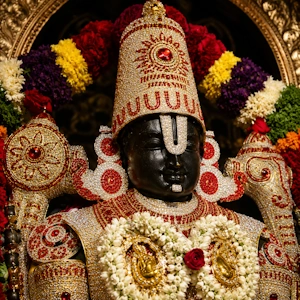
Lyrics:
अस्य श्रीवेङ्कटेशद्वादशनामस्तोत्रमहामन्त्रस्य।।
ब्रह्मा-ऋषिः।।
अनुष्टुप्-छन्दः।।
श्रीवेङ्कटेश्वरो देवता।।
इष्टार्थे विनियोगः।।
नारायणो जगन्नाथो वारिजासनवन्दितः।
स्वामिपुष्करिणीवासी शन्ङ्खचक्रगदाधरः।।1।।
पीताम्बरधरो देवो गरुडासनशोभितः।
कन्दर्पकोटिलावण्यः कमलायतलोचनः।।2।।
इन्दिरापतिगोविन्दः चन्द्रसूर्यप्रभाकरः।
विश्वात्मा विश्वलोकेशो जयश्रीवेङ्कटेश्वरः।।3।।
एतद्द्वादशनामानि त्रिसन्ध्यं यः पठेन्नरः।
दारिद्र्यदुःखनिर्मुक्तो धनधान्यसमृद्धिमान्।।4।।
जनवश्यं राजवश्य सर्वकामार्थसिद्धिदम्।
दिव्यतेजः समाप्नोति दीर्घमायुश्च विन्दति।।5।।
ग्रहरोगादिनाशं च कामितार्थफलप्रदम्।
इह जन्मनि सौख्यं च विष्णुसायुज्यमाप्नुयात्।।6।।
asya shreevenkat'eshadvaadashanaamastotramahaamantrasya..
brahmaa-ri'shih'..
anusht'up-chhandah'..
shreevenkat'eshvaro devataa..
isht'aarthe viniyogah'..
naaraayano jagannaatho vaarijaasanavanditah'.
svaamipushkarineevaasee shannkhachakragadaadharah'..1..
peetaambaradharo devo garud'aasanashobhitah'.
kandarpakot'ilaavanyah' kamalaayatalochanah'..2..
indiraapatigovindah' chandrasooryaprabhaakarah'.
vishvaatmaa vishvalokesho jayashreevenkat'eshvarah'..3..
etaddvaadashanaamaani trisandhyam' yah' pat'hennarah'.
daaridryaduh'khanirmukto dhanadhaanyasamri'ddhimaan..4..
janavashyam' raajavashya sarvakaamaarthasiddhidam.
divyatejah' samaapnoti deerghamaayushcha vindati..5..
graharogaadinaasham' cha kaamitaarthaphalapradam.
iha janmani saukhyam' cha vishnusaayujyamaapnuyaat..6..
Meaning:
अस्य श्रीवेङ्कटेशद्वादशनामस्तोत्रमहामन्त्रस्य।
ब्रह्मा-ऋषिः।
अनुष्टुप्-छन्दः।
श्रीवेङ्कटेश्वरो देवता।
इष्टार्थे विनियोगः।
This is the introductory statement, traditionally called the ऋष्यादिन्यास or viniyoga. It identifies the seer, meter, deity, and purpose of the stotra.
अस्य श्रीवेङ्कटेशद्वादशनामस्तोत्रमहामन्त्रस्य
'For this great mantra in the form of the Stotra of the Twelve Names of Sri Venkatesha.'
The word अस्य means 'of this.' श्रीवेङ्कटेशद्वादशनामस्तोत्र refers to the hymn containing the twelve sacred names of Lord Venkatesha. महामन्त्रस्य means 'of the great mantra.' This indicates that the stotra is not regarded merely as poetry but as a powerful spiritual mantra capable of producing both worldly and spiritual benefits.
ब्रह्मा-ऋषिः
'Brahma is the Rishi (seer).'
A Rishi is not the composer in the ordinary sense. He is the sage who first perceived or received the mantra through divine revelation. Here, Brahma, the creator of the universe, is said to be the seer of this stotra. This gives the hymn great authority and sanctity.
अनुष्टुप्-छन्दः
'The meter is Anushtup.'
Chandas refers to the poetic meter in which the mantra is composed. Anushtup is the most common Sanskrit meter, consisting of thirty-two syllables arranged in four quarters of eight syllables each. Many famous scriptures, including much of the Mahabharata and the Bhagavad Gita, are composed in this meter.
श्रीवेङ्कटेश्वरो देवता
'Sri Venkateshwara is the deity.'
Devata means the divine being who is praised, invoked, and worshipped through the mantra. In this stotra, the deity is Lord Venkateshwara, the form of Vishnu who resides on the sacred Venkata Hill at Tirumala and is revered as the compassionate protector of devotees in the Kali Yuga.
इष्टार्थे विनियोगः
'The application is for the attainment of desired objectives.'
Viniyoga states the purpose for which the mantra is recited. Ishta means cherished or desired, and artha means goal, purpose, or benefit. Thus, the stotra may be recited for the fulfillment of righteous wishes, prosperity, protection, peace, spiritual progress, and ultimately the grace of Lord Venkatesha.
In summary, this introductory passage declares that the twelve-name hymn of Lord Venkatesha was revealed by Brahma, is composed in the Anushtup meter, is dedicated to Lord Venkateshwara, and is recited for the attainment of one's worthy aspirations and spiritual welfare.
Verse 1
नारायणो जगन्नाथो वारिजासनवन्दितः।
स्वामिपुष्करिणीवासी शन्ङ्खचक्रगदाधरः।।1।।
The verse begins with the name Narayana, one of the most profound names of Vishnu. The word is interpreted in several ways. It can mean “the refuge of all beings” or “the One in whom all beings rest.” In Vedantic thought, Narayana is the Supreme Reality from whom the universe arises, in whom it exists, and into whom it finally dissolves.
Jagannatha means “Lord of the universe.” He is not merely the ruler of a particular region, race, or world, but the sovereign of all existence. The name emphasizes divine universality and supreme authority.
Varijasana-vanditah means “worshipped by the lotus-seated one,” referring to Brahma, who is born upon the lotus emerging from Vishnu’s navel. Even the creator of the universe bows before Venkatesha, indicating the supremacy of Vishnu over all other deities.
Svamipushkarini-vasi refers to the Lord who resides near the sacred Swami Pushkarini, the holy temple tank at Tirumala. This connects the transcendent Supreme Being with a specific sacred location where devotees can approach Him.
Shankha-chakra-gada-dharah means “the bearer of the conch, discus, and mace.” These divine weapons symbolize spiritual truths. The conch represents the sacred sound that awakens consciousness. The discus symbolizes divine knowledge that destroys ignorance. The mace represents strength and the power to uphold dharma.
Thus, the verse presents Venkatesha as the Supreme Lord who is beyond creation, yet accessible to devotees through sacred worship and pilgrimage.
Verse 2
पीताम्बरधरो देवो गरुडासनशोभितः।
कन्दर्पकोटिलावण्यः कमलायतलोचनः।।2।।
Pitambara-dharo Devo describes the Lord as wearing yellow garments. The yellow robe is not merely an ornament. In Hindu symbolism, yellow signifies purity, auspiciousness, wisdom, and divine splendor. Vishnu is traditionally depicted in yellow garments, indicating His sustaining and nurturing role in the cosmos.
Garudasana-shobhitah means “beautifully seated upon Garuda.” Garuda, the mighty celestial eagle, is the vehicle of Vishnu. In mythology, Garuda symbolizes strength, fearlessness, and liberation from bondage. He is also the enemy of serpents, which often represent ignorance and worldly attachment. Thus, the image of the Lord seated on Garuda signifies the triumph of divine wisdom over spiritual darkness.
Kandarpa-koti-lavanyah means “possessing beauty equal to millions of Kamadevas.” Kandarpa is Kamadeva, the god of beauty and attraction. The verse declares that the Lord’s beauty surpasses countless manifestations of worldly charm. His beauty is not merely physical but spiritual, captivating the hearts of devotees and drawing them toward divine realization.
Kamalayata-lochanah means “one whose eyes are broad like lotus petals.” The lotus is a symbol of purity because it remains untouched by the mud in which it grows. The Lord’s lotus-like eyes represent compassion, serenity, and unconditional grace. Devotees often pray for a single glance from those eyes, believing it can remove lifetimes of suffering.
This verse portrays Venkatesha as the embodiment of divine beauty, compassion, and spiritual attraction, drawing souls away from worldly fascinations toward eternal truth.
Verse 3
इन्दिरापतिगोविन्दः चन्द्रसूर्यप्रभाकरः।
विश्वात्मा विश्वलोकेशो जयश्रीवेङ्कटेश्वरः।।3।।
Indira-pati means “the husband of Indira,” another name for Lakshmi, the goddess of prosperity and auspiciousness. Lakshmi eternally resides with Vishnu. Their inseparable union symbolizes the harmony of divine power and divine compassion.
Govinda is a beloved name of Vishnu and Krishna. Literally, it means “protector of cows,” but the term carries deeper meanings. Go can also mean senses, Vedas, or living beings. Thus Govinda is the protector, guide, and nourisher of all existence.
Chandra-surya-prabhakarah means “the source of the radiance of the moon and the sun.” According to the scriptures, the brilliance of all celestial bodies ultimately originates from the Supreme Lord. The moon represents peace and nourishment, while the sun symbolizes knowledge and life. Both derive their power from Him.
Vishvatma means “the soul of the universe.” Just as one soul animates an individual body, the Supreme Self animates the entire cosmos. This is a central teaching of the Upanishads and Vedanta.
Vishva-lokeshah means “Lord of all worlds.” He governs every realm, visible and invisible, material and spiritual.
The final exclamation, Jaya Shri Venkateshvara, is a declaration of victory and glory to Lord Venkatesha. It expresses devotion, surrender, and recognition of His supreme sovereignty.
The verse elevates Venkatesha from a temple deity to the cosmic Lord who sustains, illumines, and indwells the entire universe.
Verse 4
एतद्द्वादशनामानि त्रिसन्ध्यं यः पठेन्नरः।
दारिद्र्यदुःखनिर्मुक्तो धनधान्यसमृद्धिमान्।।4।।
This verse explains the benefits of reciting the twelve names of Lord Venkatesha. Etad-dvadasha-namani means “these twelve names.” In Hindu tradition, divine names are not viewed merely as labels. They are considered embodiments of the deity’s presence and power.
Tri-sandhyam refers to the three junctions of the day: dawn, noon, and dusk. These periods are regarded as spiritually powerful moments when the mind naturally becomes calmer and more receptive to divine contemplation.
Yah pathen narah means “whoever recites them.” The promise is universal and not restricted by caste, status, learning, or background. Devotion is open to all.
Daridrya-duhkha-nirmuktah means becoming free from the sorrow associated with poverty. While this includes material hardship, traditional commentators also interpret poverty as spiritual emptiness, lack of faith, and absence of inner contentment.
Dhana-dhanya-samriddhiman refers to abundance of wealth and grain. Grain traditionally represents sustenance and stability. Therefore, the verse promises a life supported by both material necessities and divine grace.
Philosophically, the verse teaches that regular remembrance of God transforms the mind. Such remembrance cultivates discipline, gratitude, faith, and clarity. These qualities naturally help one overcome suffering and create conditions for prosperity.
The verse therefore presents both external and internal blessings arising from sincere devotion.
Verse 5
जनवश्यं राजवश्य सर्वकामार्थसिद्धिदम्।
दिव्यतेजः समाप्नोति दीर्घमायुश्च विन्दति।।5।।
Janavashyam means gaining the goodwill and affection of people. The term does not necessarily imply magical control over others. Rather, it indicates the development of virtues such as kindness, wisdom, integrity, and humility that naturally attract respect.
Rajavashyam means gaining favor from rulers, authorities, or people in positions of power. In ancient times, royal support was essential for social success and protection. Today, it can be understood as receiving cooperation from influential individuals and institutions.
Sarva-kamartha-siddhidam means fulfillment of righteous desires and goals. The scriptures generally distinguish between selfish cravings and legitimate aspirations aligned with dharma. The Lord supports efforts that contribute to personal and spiritual growth.
Divya-tejah samapnoti means attaining divine radiance. Tejas refers not merely to physical appearance but to spiritual brilliance, confidence, moral strength, and inner vitality. Many saints are described as possessing such radiance because of their closeness to God.
Dirgham ayushcha vindati means obtaining long life. Longevity is valued because it provides greater opportunity for spiritual practice, service, and self-realization.
From a philosophical perspective, remembrance of God refines character and purifies consciousness. Such transformation naturally improves relationships, enhances personal influence, and generates inner strength.
Thus the verse promises not only worldly success but also the cultivation of noble qualities that make life meaningful and spiritually productive.
Verse 6
ग्रहरोगादिनाशं च कामितार्थफलप्रदम्।
इह जन्मनि सौख्यं च विष्णुसायुज्यमाप्नुयात्।।6।।
Graha-rogadi-nasham means destruction of afflictions caused by planets, diseases, and other obstacles. In traditional Hindu thought, planetary influences are understood as manifestations of karmic forces. Divine grace is believed to soften or neutralize adverse karmic effects.
Kamitartha-phala-pradam means granting the fruits of cherished desires. However, the deeper implication is that devotion gradually purifies desires themselves. As spiritual maturity increases, the devotee begins seeking wisdom, peace, and God rather than merely worldly gains.
Iha janmani saukhyam cha means happiness in this very life. The verse emphasizes that spiritual practice is not only about the afterlife. Divine remembrance can bring peace, stability, courage, and contentment here and now.
The highest promise comes in the final phrase, Vishnu-sayujyam apnuyat. Sayujya is one of the traditional forms of liberation. It signifies intimate union with Vishnu and freedom from the cycle of birth and death. Different philosophical schools interpret this differently. Some see it as complete merger in the Divine. Others understand it as eternal proximity and loving communion with the Lord.
The progression of the verse is significant. It begins with relief from worldly troubles, proceeds to fulfillment and happiness, and culminates in liberation. This reflects the broader Hindu vision that while God grants material welfare, His ultimate gift is moksha.
The stotra therefore concludes by declaring that devotion to Lord Venkatesha leads from worldly well-being to the highest spiritual realization.





Other stotras


