Krishna Mangala Stuti
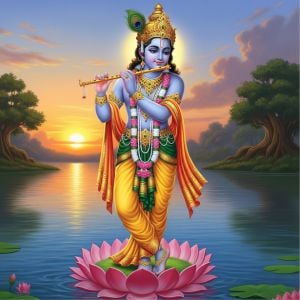
मङ्गलं बालकृष्णाय दिव्यलीलाय मङ्गलम् ।
मङ्गलं नीलवर्णाय मातृमान्याय मङ्गलम् ॥
Auspiciousness to Balakrishna (the child Krishna), auspiciousness to Him of divine pastimes. Auspiciousness to Him of blue complexion, auspiciousness to Him who is honored by His mother.
This verse begins by invoking auspiciousness upon Krishna in his beloved childhood form, Balakrishna. His 'divine pastimes' (दिव्यलीलाय) are central to his worship, encompassing his playful, mischievous, and miraculous acts as a child, which often convey profound spiritual truths. The 'blue complexion' (नीलवर्णाय) is a common iconographic feature of Vishnu and his avatars, symbolizing the infinite sky and ocean, suggesting his all-pervading nature. 'Honored by His mother' (मातृमान्याय) refers to Yashoda, Krishna's foster mother, and her immense love and devotion, which Krishna reciprocated, allowing himself to be bound by her affection despite being the Lord of the universe. This highlights the concept of bhakti (devotion) where even the Supreme Lord becomes subservient to the love of his devotee.
मङ्गलं रुक्मिणीशाय जगदीशाय मङ्गलम् ।
मङ्गलं यदुनाथाय दीननाथाय मङ्गलम् ॥
Auspiciousness to the Lord of Rukmini, auspiciousness to the Lord of the universe. Auspiciousness to the Lord of the Yadus, auspiciousness to the protector of the distressed.
This verse shifts to Krishna's adult form. 'Lord of Rukmini' (रुक्मिणीशाय) refers to his principal queen, Rukmini, whose abduction and marriage to Krishna is a famous story from the Bhagavata Purana, symbolizing the soul's yearning for God. 'Lord of the universe' (जगदीशाय) reaffirms his supreme position as the creator, preserver, and destroyer of all existence. 'Lord of the Yadus' (यदुनाथाय) refers to his lineage, the Yadu dynasty, of which he was the greatest king and protector. 'Protector of the distressed' (दीननाथाय) highlights his compassion and role as a refuge for those suffering, a central theme in many Puranic narratives where he comes to the aid of his devotees and the righteous.
मङ्गलं देवदेवाय वासुदेवाय मङ्गलम् ।
मङ्गलं नन्दपुत्राय सदानन्दाय मङ्गलम् ॥
Auspiciousness to the God of gods, auspiciousness to Vasudeva (son of Vasudeva). Auspiciousness to the son of Nanda, auspiciousness to the eternally blissful one.
'God of gods' (देवदेवाय) emphasizes his supremacy even over other deities. 'Vasudeva' (वासुदेवाय) is a significant name. It refers to him as the son of Vasudeva (his biological father) but also signifies his all-pervading nature, meaning 'one who dwells in all beings and in whom all beings dwell.' 'Son of Nanda' (नन्दपुत्राय) brings back his connection to his foster father, Nanda, and his idyllic childhood in Vrindavan, a period filled with joy and divine play. 'Eternally blissful one' (सदानन्दाय) describes his inherent nature. Krishna is the embodiment of Ananda (bliss), and this bliss is eternal and unaffected by worldly circumstances.
मङ्गलं पूतनाहन्त्रे लीलामर्त्याय मङ्गलम् ।
मङ्गलं शकटच्छेत्रे पद्मपादाय मङ्गलम् ॥
Auspiciousness to the slayer of Putana, auspiciousness to the divine human. Auspiciousness to the destroyer of the cart demon, auspiciousness to Him with lotus feet.
This verse focuses on Krishna's early childhood miracles. 'Slayer of Putana' (पूतनाहन्त्रे) refers to the demoness Putana, who tried to kill infant Krishna by feeding him poisoned milk but was herself killed by him, an early demonstration of his divine power even as a baby. 'Divine human' (लीलामर्त्याय) emphasizes his paradoxical nature: appearing human for his divine play (Lila), yet possessing ultimate divine power. 'Destroyer of the cart demon' (शकटच्छेत्रे) refers to the demon Shakatasura, who came in the form of a cart and was shattered by baby Krishna's kick, another miraculous act. 'Lotus feet' (पद्मपादाय) is a very common and revered epithet for divine beings in Hinduism, symbolizing purity, beauty, and auspiciousness. Devotees often meditate on the lotus feet of the Lord as a source of refuge and liberation.
मङ्गलं वत्सपालाय विश्वपालाय मङ्गलम् ।
मङ्गलं योगिमृग्याय गोपमित्राय मङ्गलम् ॥
Auspiciousness to the protector of calves, auspiciousness to the protector of the universe. Auspiciousness to Him sought by yogis, auspiciousness to the friend of the cowherds.
This verse beautifully contrasts Krishna's simple pastoral life with his cosmic role. 'Protector of calves' (वत्सपालाय) describes his role as a young cowherd in Vrindavan, a humble and loving activity. This is immediately followed by 'protector of the universe' (विश्वपालाय), showing that his protection extends from the smallest calf to the entire cosmos. 'Sought by yogis' (योगिमृग्याय) highlights his ultimate spiritual significance; he is the supreme truth that yogis and ascetics strive to realize through rigorous meditation and spiritual practices. 'Friend of the cowherds' (गोपमित्राय) brings back the warmth of his Vrindavan days, where he was a beloved companion to his friends, the gopas, emphasizing his accessibility and loving nature.
मङ्गलं बालगोपाय ब्रह्मविद्याय मङ्गलम् ।
मङ्गलं कमलाभर्त्रे गोपीकान्ताय मङ्गलम् ॥
Auspiciousness to the child cowherd, auspiciousness to the embodiment of Brahman knowledge. Auspiciousness to the husband of Kamala (Lakshmi), auspiciousness to the beloved of the Gopis.
This verse again juxtaposes Krishna's childhood form with his supreme divine identity. 'Child cowherd' (बालगोपाय) reiterates his endearing form in Vrindavan. 'Embodiment of Brahman knowledge' (ब्रह्मविद्याय) refers to him as the ultimate source and subject of Brahma Vidya, the knowledge of the Absolute Truth (Brahman), indicating his philosophical depth and spiritual essence. 'Husband of Kamala' (कमलाभर्त्रे) refers to Lakshmi, the goddess of wealth and fortune, who is considered his divine consort, signifying his opulence and divine majesty. 'Beloved of the Gopis' (गोपीकान्ताय) points to his intimate and unique relationship with the Gopis of Vrindavan, especially Radha, a profound expression of divine love and devotion. This love transcends worldly understanding and is a central theme in Vaishnavism.
मङ्गलं मातृबद्धाय जडघ्नायास्तु मङ्गलम् ।
मङ्गलं क्रीडते स्त्रीभिः कुन्दारूढाय मङ्गलम् ॥
Auspiciousness to Him bound by His mother, auspiciousness to the destroyer of inertia/ignorance. Auspiciousness to Him who plays with women, auspiciousness to Him who is seated on a Kunda (type of flower/jasmine).
'Bound by His mother' (मातृबद्धाय) refers to the famous Damodara Lila, where mother Yashoda tied infant Krishna to a grinding mortar with a rope (dama), exasperated by his mischief. This act, where the infinite Lord allows himself to be bound by a mother's love, is deeply symbolic of the power of bhakti. 'Destroyer of inertia/ignorance' (जडघ्नायास्तु) implies his role in removing spiritual ignorance (avidya) and worldly inertia from his devotees, leading them towards enlightenment. 'Plays with women' (क्रीडते स्त्रीभिः) is a reference to the Raas Leela with the Gopis, which is understood as a highly esoteric and spiritual dance of divine love, not a worldly interaction. It symbolizes the soul's playful communion with God. 'Seated on a Kunda' (कुन्दारूढाय) might refer to him being adorned with Kunda flowers or possibly seated on a swing decorated with them, emphasizing his beauty and youthful charm.
मङ्गलं द्विषते क्रूरान् प्रियाक्रूराय मङ्गलम् ।
मङ्गलं वल्लवीभर्ने कंसघ्नायास्तु मङ्गलम् ॥
Auspiciousness to the one who is harsh to the cruel, auspiciousness to the beloved who is not cruel. Auspiciousness to the husband of the cowherd women (Gopis), auspiciousness to the slayer of Kamsa.
'Harsh to the cruel' (द्विषते क्रूरान्) highlights his role as Dharma rakshak (protector of righteousness), punishing the wicked and establishing justice. 'Beloved who is not cruel' (प्रियाक्रूराय) balances this by emphasizing his inherent kindness and compassion towards his devotees, indicating that his harshness is only directed towards evil. 'Husband of the cowherd women (Gopis)' (वल्लवीभर्ने) again alludes to the intimate spiritual relationship with the Gopis, often interpreted as Krishna being the spiritual husband (lover) of all souls. 'Slayer of Kamsa' (कंसघ्नायास्तु) refers to his most famous act of ending the tyrannical reign of his maternal uncle Kamsa, fulfilling the prophecy and liberating his parents and the people of Mathura. This is a pivotal moment marking his transition from a cowherd boy to a prince.
मङ्गलं प्रीतभक्ताय विद्यावासाय मङ्गलम् ।
मङ्गलं मागधजिते द्वारकेशाय मङ्गलम् ॥
Auspiciousness to Him who loves His devotees, auspiciousness to the abode of knowledge. Auspiciousness to the conqueror of Magadha, auspiciousness to the Lord of Dvaraka.
'Loves His devotees' (प्रीतभक्ताय) underscores his reciprocation of devotion, a core tenet of bhakti. Krishna is easily pleased by sincere devotion. 'Abode of knowledge' (विद्यावासाय) reinforces his identity as the source and embodiment of all knowledge, both worldly and spiritual. 'Conqueror of Magadha' (मागधजिते) refers to his repeated victories over Jarasandha, the powerful king of Magadha, who attacked Mathura multiple times. While he didn't 'slay' Jarasandha directly, he strategically defeated him many times before Bheema, with Krishna's guidance, eventually killed him. This demonstrates his strategic brilliance and military prowess. 'Lord of Dvaraka' (द्वारकेशाय) signifies his establishment of the magnificent city of Dvaraka and his reign there as a powerful king, post-Mathura.
मङ्गलं पार्थसुहृदे जितदैत्याय मङ्गलम् ।
मङ्गलं रुक्मिणीजाने रुक्मिणीशाय मङ्गलम् ॥
Auspiciousness to the friend of Partha (Arjuna), auspiciousness to the conqueror of demons. Auspiciousness to the husband of Rukmini, auspiciousness to the Lord of Rukmini.
'Friend of Partha (Arjuna)' (पार्थसुहृदे) highlights his pivotal role as Arjuna's charioteer, mentor, and confidant in the Mahabharata war, culminating in the Bhagavad Gita's teachings. This friendship is a paradigm of divine friendship and guidance. 'Conqueror of demons' (जितदैत्याय) reiterates his constant battle against evil and unrighteous forces, protecting the cosmic order. 'Husband of Rukmini' (रुक्मिणीजाने) and 'Lord of Rukmini' (रुक्मिणीशाय) are repetitions, emphasizing his significant relationship with his chief consort, Rukmini, and perhaps highlighting the depth of this divine bond.
मङ्गलं नैकरूपाय नरदैत्याय मङ्गलम् ।
पुत्रिणे नित्यरूपाय ब्रह्माचार्याय मङ्गलम् ॥
Auspiciousness to Him of many forms, auspiciousness to the human and the demon. Auspiciousness to Him who has sons, auspiciousness to Him of eternal form, auspiciousness to the spiritual teacher of Brahma.
'Of many forms' (नैकरूपाय) refers to his ability to manifest in countless forms (Vishvarupa), avatars, and divine energies. 'Human and the demon' (नरदैत्याय) could be interpreted as auspiciousness to him who takes human form and also destroys demons, or more generally, his role in dealing with both humanity and demonic forces. 'Who has sons' (पुत्रिणे) refers to his numerous children, notably Pradyumna, born to Rukmini, indicating his complete life as a householder. 'Of eternal form' (नित्यरूपाय) asserts that despite his manifestations, his true divine form is eternal and unchanging. 'Spiritual teacher of Brahma' (ब्रह्माचार्याय) is a profound statement, placing him as the ultimate guru even for Brahma, the creator god, implying his supreme knowledge and position.
मङ्गलं द्रौपदीड्याय मानदायास्तु मङ्गलम् ।
मङ्गलं प्रियभक्ताय भक्तपालाय मङ्गलम् ॥
Auspiciousness to Him worshiped by Draupadi, auspiciousness to the giver of honor. Auspiciousness to the beloved devotee, auspiciousness to the protector of devotees.
'Worshiped by Draupadi' (द्रौपदीड्याय) refers to his famous act of saving Draupadi from public disrobing (Vastraharan) in the Mahabharata, when she surrendered to him. This highlights his role as a savior of those in distress and his response to pure devotion. 'Giver of honor' (मानदायास्तु) indicates that he bestows respect and dignity upon his devotees. 'Beloved devotee' (प्रियभक्ताय) is best interpreted here as 'to whom devotees are beloved', indicating his affection for his followers. This is reinforced by the next phrase, 'protector of devotees' (भक्तपालाय), strengthening his unwavering commitment to those who worship him.
मङ्गलं दिशते कामान् विप्रप्रार्थ्याय मङ्गलम् ।
मङ्गलं शिष्टपालाय भारघ्नायास्तु मङ्गलम् ॥
Auspiciousness to the granter of desires, auspiciousness to Him prayed to by Brahmins. Auspiciousness to the protector of the virtuous, auspiciousness to the remover of burdens.
'Granter of desires' (दिशते कामान्) states that he fulfills the wishes of his devotees, whether material or spiritual. 'Prayed to by Brahmins' (विप्रप्रार्थ्याय) emphasizes his sacred status and the reverence shown by the priestly class, who uphold Vedic traditions. 'Protector of the virtuous' (शिष्टपालाय) is a key aspect of his dharma-samsthapana (establishment of righteousness) mission, where he safeguards those who follow the path of virtue. 'Remover of burdens' (भारघ्नायास्तु) refers to his role in alleviating the 'burden of the earth,' which means removing evil and unrighteousness that causes suffering, as well as freeing his devotees from the burden of samsara (the cycle of birth and death).
मङ्गलं मायिनेऽमायसारथ्यायास्तु मङ्गलम ।
मङ्गलं पूर्णरूपाय गीताचार्याय मङ्गलम् ॥
Auspiciousness to the wielder of Maya, auspiciousness to the driver who is without Maya (illusion). Auspiciousness to the complete form, auspiciousness to the teacher of the Gita.
'Wielder of Maya' (मायिने) refers to his divine power of Maya, which creates the illusion of the material world. He controls this cosmic illusion. 'Driver who is without Maya' (अमायसारथ्यायास्तु) is a brilliant paradox. It refers to him as Arjuna's charioteer (sarathi), emphasizing his practical guidance in the world, yet highlighting that he himself is beyond the illusions of Maya. He orchestrates events without being entangled by them. 'Complete form' (पूर्णरूपाय) asserts his status as Purna Purushottam, the complete and perfect manifestation of the Supreme Being, not a partial incarnation. 'Teacher of the Gita' (गीताचार्याय) is one of his most profound roles. The Bhagavad Gita, delivered to Arjuna on the battlefield, contains the essence of Hindu philosophy and yoga, making him the ultimate spiritual preceptor.
मङ्गलं विश्वरूपाय योगिध्येयाय मङ्गलम् ।
मङ्गलं विश्वगुरवे कृपावासाय मङ्गलम् ॥
Auspiciousness to Him of universal form, auspiciousness to Him meditated upon by yogis. Auspiciousness to the universal guru, auspiciousness to the abode of compassion.
'Universal form' (विश्वरूपाय) refers to the awe-inspiring cosmic form displayed to Arjuna in the Bhagavad Gita, where Krishna reveals himself as the entire universe, encompassing all existence, past, present, and future. 'Meditated upon by yogis' (योगिमृग्याय) reinforces his status as the ultimate object of spiritual contemplation and realization. 'Universal guru' (विश्वगुरवे) affirms his role as the teacher and guide for all beings in the cosmos. 'Abode of compassion' (कृपावासाय) highlights his boundless mercy and grace (kripa) towards all living entities.
मङ्गलं ज्ञानरूपाय सर्वाभिज्ञाय मङ्गलम् ।
मङ्गलं सर्वशक्ताय महासत्त्वाय मङ्गलम् ॥
Auspiciousness to the embodiment of knowledge, auspiciousness to the omniscient one. Auspiciousness to the omnipotent one, auspiciousness to Him of great being/essence.
This concluding verse beautifully summarizes Krishna's supreme attributes. 'Embodiment of knowledge' (ज्ञानरूपाय) states that he is knowledge itself, not just possessing knowledge. 'Omniscient one' (सर्वाभिज्ञाय) means he knows everything, past, present, and future. 'Omnipotent one' (सर्वशक्ताय) signifies his infinite power and ability to do anything. 'Him of great being/essence' (महासत्त्वाय) refers to his supreme existence, his essential nature as the ultimate reality, Sat (existence/truth). This final verse encapsulates his divine perfection and ultimate supremacy.
मङ्गलं बालकृष्णाय दिव्यलीलाय मङ्गलम् ।
मङ्गलं नीलवर्णाय मातृमान्याय मङ्गलम् ॥
मङ्गलं रुक्मिणीशाय जगदीशाय मङ्गलम् ।
मङ्गलं यदुनाथाय दीननाथाय मङ्गलम् ॥
मङ्गलं देवदेवाय वासुदेवाय मङ्गलम् ।
मङ्गलं नन्दपुत्राय सदानन्दाय मङ्गलम् ॥
मङ्गलं पूतनाहन्त्रे लीलामर्त्याय मङ्गलम् ।
मङ्गलं शकटच्छेत्रे पद्मपादाय मङ्गलम् ॥
मङ्गलं वत्सपालाय विश्वपालाय मङ्गलम् ।
मङ्गलं योगिमृग्याय गोपमित्राय मङ्गलम् ॥
मङ्गलं बालगोपाय ब्रह्मविद्याय मङ्गलम् ।
मङ्गलं कमलाभर्त्रे गोपीकान्ताय मङ्गलम् ॥
मङ्गलं मातृबद्धाय जडघ्नायास्तु मङ्गलम् ।
मङ्गलं क्रीडते स्त्रीभिः कुन्दारूढाय मङ्गलम् ॥
मङ्गलं द्विषते क्रूरान् प्रियाक्रूराय मङ्गलम् ।
मङ्गलं वल्लवीभर्ने कंसघ्नायास्तु मङ्गलम् ॥
मङ्गलं प्रीतभक्ताय विद्यावासाय मङ्गलम् ।
मङ्गलं मागधजिते द्वारकेशाय मङ्गलम् ॥
मङ्गलं पार्थसुहृदे जितदैत्याय मङ्गलम् ।
मङ्गलं रुक्मिणीजाने रुक्मिणीशाय मङ्गलम् ॥
मङ्गलं नैकरूपाय नरदैत्याय मङ्गलम् ।
पुत्रिणे नित्यरूपाय ब्रह्माचार्याय मङ्गलम् ॥
मङ्गलं द्रौपदीड्याय मानदायास्तु मङ्गलम् ।
मङ्गलं प्रियभक्ताय भक्तपालाय मङ्गलम् ॥
मङ्गलं दिशते कामान् विप्रप्रार्थ्याय मङ्गलम् ।
मङ्गलं शिष्टपालाय भारघ्नायास्तु मङ्गलम् ॥
मङ्गलं मायिनेऽमायसारथ्यायास्तु मङ्गलम ।
मङ्गलं पूर्णरूपाय गीताचार्याय मङ्गलम् ॥
मङ्गलं विश्वरूपाय योगिध्येयाय मङ्गलम् ।
मङ्गलं विश्वगुरवे कृपावासाय मङ्गलम् ॥
मङ्गलं ज्ञानरूपाय सर्वाभिज्ञाय मङ्गलम् ।
मङ्गलं सर्वशक्ताय महासत्त्वाय मङ्गलम् ॥
mangalam' baalakri'shnaaya divyaleelaaya mangalam .
mangalam' neelavarnaaya maatri'maanyaaya mangalam ..
mangalam' rukmineeshaaya jagadeeshaaya mangalam .
mangalam' yadunaathaaya deenanaathaaya mangalam ..
mangalam' devadevaaya vaasudevaaya mangalam .
mangalam' nandaputraaya sadaanandaaya mangalam ..
mangalam' pootanaahantre leelaamartyaaya mangalam .
mangalam' shakat'achchhetre padmapaadaaya mangalam ..
mangalam' vatsapaalaaya vishvapaalaaya mangalam .
mangalam' yogimri'gyaaya gopamitraaya mangalam ..
mangalam' baalagopaaya brahmavidyaaya mangalam .
mangalam' kamalaabhartre gopeekaantaaya mangalam ..
mangalam' maatri'baddhaaya jad'aghnaayaastu mangalam .
mangalam' kreed'ate streebhih' kundaarood'haaya mangalam ..
mangalam' dvishate krooraan priyaakrooraaya mangalam .
mangalam' vallaveebharne kam'saghnaayaastu mangalam ..
mangalam' preetabhaktaaya vidyaavaasaaya mangalam .
mangalam' maagadhajite dvaarakeshaaya mangalam ..
mangalam' paarthasuhri'de jitadaityaaya mangalam .
mangalam' rukmineejaane rukmineeshaaya mangalam ..
mangalam' naikaroopaaya naradaityaaya mangalam .
putrine nityaroopaaya brahmaachaaryaaya mangalam ..
mangalam' draupadeed'yaaya maanadaayaastu mangalam .
mangalam' priyabhaktaaya bhaktapaalaaya mangalam ..
mangalam' dishate kaamaan viprapraarthyaaya mangalam .
mangalam' shisht'apaalaaya bhaaraghnaayaastu mangalam ..
mangalam' maayine'maayasaarathyaayaastu mangalama .
mangalam' poornaroopaaya geetaachaaryaaya mangalam ..
mangalam' vishvaroopaaya yogidhyeyaaya mangalam .
mangalam' vishvagurave kri'paavaasaaya mangalam ..
mangalam' jnyaanaroopaaya sarvaabhijnyaaya mangalam .
mangalam' sarvashaktaaya mahaasattvaaya mangalam ..





Other stotras


