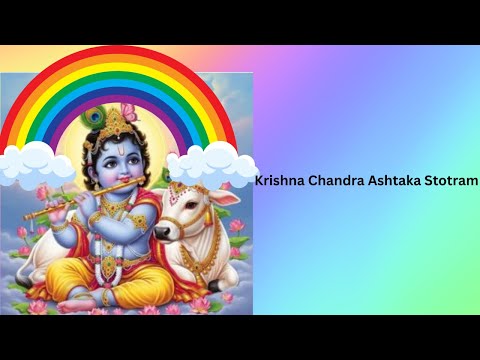
Krishna Chandra Ashtaka Stotram
महानीलमेघातिभव्यं सुहासं शिवब्रह्मदेवादिभिः संस्तुतं च ।
रमामन्दिरं देवनन्दापदाहं भजे राधिकावल्लभं कृष्णचन्द्रम् ॥ १॥
I worship Krishna Chandra, the beloved of Radhika, who is more magnificent than a great dark-blue cloud, who has an enchanting smile, and who is praised by Shiva, Brahma, and other celestial beings. He is the very abode of the Goddess Rama (Lakshmi) and the destroyer of calamities who bestows bliss upon the gods.
This verse presents the supreme and beautiful nature of Krishna. His complexion is famously compared to a 'mahānīlamegha', a dark, rain-laden cloud, an image that evokes beauty, coolness, and life-giving sustenance. The praise he receives from the principal deities of the cosmos—Shiva and Brahma—establishes his position as the Supreme Being, the source of all others. The description 'ramāmandiram', or the 'temple of Rama (Lakshmi)', signifies that all fortune, wealth, and spiritual opulence reside within him. Furthermore, he is the protector of the cosmic order, removing the distress ('āpada') of the gods and granting them joy ('nanda'). The verse culminates with the central theme of the hymn: worshipping this all-powerful being in his most intimate and loving form as 'rādhikāvallabham', the cherished beloved of Radhika.
रसं वेदवेदान्तवेद्यं दुरापं सुगम्यं तदीयादिभिर्दानवघ्नम् ।
लसत्कुण्डलं सोमवंशप्रदीपं भजे राधिकावल्लभं कृष्णचन्द्रम् ॥ २॥
I worship Krishna Chandra, the beloved of Radhika, who is the embodiment of all spiritual bliss ('rasa'). He is the ultimate truth to be known through the Vedas and Vedanta, yet is difficult to attain by such means alone. However, he is easily accessible to his own devotees. He is the slayer of demons, wears shining earrings, and is the brilliant lamp of the lunar dynasty.
This verse contrasts the path of intellectual knowledge with the path of pure devotion. Krishna is defined as 'rasa' itself—the divine nectar of loving relationships that is the ultimate goal of all spiritual pursuit. While the great scriptures like the Vedas and Vedanta attempt to describe him, he remains 'durāpaṃ', difficult to grasp through mere scholarship. The verse immediately offers the solution: he is 'sugamyaṃ', easily reached by 'tadīyādibhiḥ', his own people, the devotees who approach him with simple love. The verse also reminds us of his protective, divine activities as the 'slayer of demons' and paints a beautiful picture of his personal form with 'shining earrings'. Finally, 'somavaṃśapradīpaṃ' grounds him in his earthly lineage as the radiant light of the lunar dynasty, into which he descended.
यशोदादिसंलालितं पूर्णकामं दृशोरञ्जनं प्राकृतस्थस्वरूपम् ।
दिनान्ते समायान्तमेकान्तभक्तैर्भजे राधिकावल्लभं कृष्णचन्द्रम् ॥ ३॥
I worship Krishna Chandra, the beloved of Radhika, who was lovingly pampered by Yashoda and others. Though he is 'pūrṇakāma' (one whose every desire is already fulfilled), he is a delight to the eyes, and his form appears to be that of an ordinary human. I worship him who returns at the end of the day, accompanied by his devoted friends.
Here, the poem shifts to the profound sweetness of Krishna's childhood pastimes in Vrindavan. It highlights a beautiful paradox: the Supreme Lord, who is 'pūrṇakāma' or completely self-satisfied, submits to being 'saṃlālitaṃ', caressed and cared for like a child by his mother Yashoda and other elders. This demonstrates the power of pure parental love to control even the Absolute. Though his form is transcendental, it appears human ('prākṛtasthasvarūpam'), making him approachable and intensely lovable. He is 'dṛśorañjanaṃ', like soothing kohl for the eyes, meaning his sight brings immense joy and comfort. The verse closes with the iconic image of Krishna at dusk ('dinānte'), returning from the pastures with his cowherd friends, a scene cherished for its intimacy and rustic charm.
कृपादृष्टिसम्पातसिक्तस्वकुञ्जं तदन्तःस्थितस्वीयसम्यग्दशादम् ।
पुनस्तत्र तैः सत्कृतैकान्तलीलं भजे राधिकावल्लभं कृष्णचन्दम् ॥ ४॥
I worship Krishna Chandra, the beloved of Radhika, who consecrates his own garden-groves ('kunja') with the shower of his merciful glance. There, he bestows the supreme, perfect spiritual state upon his own dear devotees situated within those groves. And within that sacred space, he engages in intimate pastimes, being lovingly served and honoured by those very devotees.
This verse describes the most confidential arena of Krishna's pastimes. The 'kunja', or forest grove, is more than a physical location; it is a sacred space, sanctified ('sikta') by the downpour of Krishna's compassionate gaze ('kṛpādṛṣṭi'). Inside this sanctified realm, he grants his devotees their 'svīyasamygdaśā', their own unique and perfect eternal relationship with him. The dynamic is reciprocal: he bestows grace, and in response, his devotees honour and serve him ('sathkṛtaikāntalīlaṃ'), facilitating his most exclusive and private plays of divine love. It reveals that the Lord's most profound interactions unfold in an internal, sacred reality created by grace and shared only with his most intimate followers.
गृहे गोपिकाभिर्धृते चौर्यकाले तदक्ष्णोश्च निक्षिप्य दुग्धं चलन्तम् ।
तदा तद्वियोगादिसम्पत्तिकारं भजे राधिकावल्लभं कृष्णचन्द्रम् ॥ ५॥
I worship Krishna Chandra, the beloved of Radhika, who, upon being caught by the gopis in the midst of his thievery, threw milk into their eyes and tried to run away. In that moment, by his departure, he caused in them a state of loving separation, which is itself a great treasure.
This verse recalls the famous and charming 'mākhanchor' or butter-thief pastimes. The scene is playful: the gopis catch Krishna red-handed ('dhṛte cauryakāle'), and his boyish reaction is to create a diversion by splashing milk in their eyes to make his escape. The profound spiritual meaning lies in the final line. His act of running away creates an intense feeling of 'viyoga', or separation, in the hearts of the gopis. In the theology of pure devotion, this mood of painful longing is considered a 'sampatti', a great spiritual wealth, as it deepens and intensifies one's love and absorption in the beloved to the highest degree. Thus, even through a seemingly naughty act, Krishna bestows a precious spiritual gift.
चलत्कौस्तुभव्याप्तवक्षःप्रदेशं महावैजयन्तीलसत्पादयुग्मम् ।
सुकस्तूरिकादीप्तभालप्रदेशं भजे राधिकावल्लभं कृष्णचन्द्रम् ॥ ६॥
I worship Krishna Chandra, the beloved of Radhika, whose broad chest is adorned with the swaying Kaustubha gem, whose lotus feet are graced by the great Vaijayanti garland that reaches down to them, and whose forehead shines brightly with a mark of fine musk.
This is a 'dhyana shloka', a verse for meditation, focusing on the divine beauty and specific adornments of Krishna's form. Each element is symbolic. The 'Kaustubha' gem, resting on his chest, is said to represent the pure consciousness of all living souls. The long 'Vaijayanti' garland, made of five types of unwilting forest flowers, represents the five senses being perpetually offered in his service. His feet ('pādayugmam') are the ultimate shelter for devotees. The 'kasturi' or musk 'tilak' on his forehead ('bhālapradeśaṃ') is a sign of his supreme beauty and regal charm. Visualizing these details helps the devotee to fix their mind and heart on his personal, enchanting form.
गवां दोहने दृष्टराधामुखाब्जं तदानीं च तन्मेलनव्यग्रचित्तम् ।
समुत्पन्नतन्मानसैकान्तभावं भजे राधिकावल्लभं कृष्णचन्द्रम् ॥ ७॥
I worship Krishna Chandra, the beloved of Radhika, who, while in the midst of milking the cows, catches a glimpse of Radhika's lotus-like face. At that very moment, his mind becomes anxious and intensely eager for their union, and a singular, exclusive mood of love for her arises within his heart.
This verse captures a moment of supreme romantic and theological significance. The setting is ordinary—milking cows ('gavāṃ dohane')—but the internal event is extraordinary. The mere sight of Radha's face ('rādhāmukhābjaṃ') causes Krishna's mind ('cittam') to become completely agitated ('vyagra') with the desire to meet her. This glance gives rise to an 'ekāntabhāvam', an all-consuming, one-pointed state of love directed solely at her. This powerfully illustrates a central tenet of the faith: that Krishna, the Supreme Personality of Godhead who enchants the entire universe, is himself completely enchanted and captivated by the unparalleled love of his supreme devotee, Srimati Radharani.
अदः कृष्णचन्द्राष्टकं प्रेमयुक्तः पठेत्कृष्णसान्निध्यमाप्नोति नित्यम् ।
कलौ यः स संसारदुःखातिरिक्तं प्रयात्येव विष्णोः पदं निर्भयं तत् ॥ ८॥
Whoever recites this Krishnachandra Ashtakam with a heart full of love will eternally attain the close company of Krishna. In this age of Kali, such a person transcends the sorrows of worldly existence and most certainly reaches that supreme, fearless abode of Vishnu.
This final verse is the 'phala-shruti', detailing the fruit of reciting this hymn. The most crucial element for success is the inner disposition: one must recite it with love and devotion ('premayuktaḥ'). The result is twofold. The immediate benefit is 'kṛṣṇasānnidhyam', the constant, intimate presence of Krishna in one's life. The ultimate benefit, especially potent in the challenging age of Kali, is liberation from the miseries of the material world ('saṃsāraduḥkhātiriktaṃ'). The devotee is assured of reaching the 'padaṃ' or supreme abode of the Lord, which is described as 'nirbhayaṃ'—a realm completely free from fear, anxiety, and the cycle of birth and death.
महानीलमेघातिभव्यं सुहासं शिवब्रह्मदेवादिभिः संस्तुतं च ।
रमामन्दिरं देवनन्दापदाहं भजे राधिकावल्लभं कृष्णचन्द्रम् ॥ १॥
रसं वेदवेदान्तवेद्यं दुरापं सुगम्यं तदीयादिभिर्दानवघ्नम् ।
लसत्कुण्डलं सोमवंशप्रदीपं भजे राधिकावल्लभं कृष्णचन्द्रम् ॥ २॥
यशोदादिसंलालितं पूर्णकामं दृशोरञ्जनं प्राकृतस्थस्वरूपम् ।
दिनान्ते समायान्तमेकान्तभक्तैर्भजे राधिकावल्लभं कृष्णचन्द्रम् ॥ ३॥
कृपादृष्टिसम्पातसिक्तस्वकुञ्जं तदन्तःस्थितस्वीयसम्यग्दशादम् ।
पुनस्तत्र तैः सत्कृतैकान्तलीलं भजे राधिकावल्लभं कृष्णचन्दम् ॥ ४॥
गृहे गोपिकाभिर्धृते चौर्यकाले तदक्ष्णोश्च निक्षिप्य दुग्धं चलन्तम् ।
तदा तद्वियोगादिसम्पत्तिकारं भजे राधिकावल्लभं कृष्णचन्द्रम् ॥ ५॥
चलत्कौस्तुभव्याप्तवक्षःप्रदेशं महावैजयन्तीलसत्पादयुग्मम् ।
सुकस्तूरिकादीप्तभालप्रदेशं भजे राधिकावल्लभं कृष्णचन्द्रम् ॥ ६॥
गवां दोहने दृष्टराधामुखाब्जं तदानीं च तन्मेलनव्यग्रचित्तम् ।
समुत्पन्नतन्मानसैकान्तभावं भजे राधिकावल्लभं कृष्णचन्द्रम् ॥ ७॥
अदः कृष्णचन्द्राष्टकं प्रेमयुक्तः पठेत्कृष्णसान्निध्यमाप्नोति नित्यम् ।
कलौ यः स संसारदुःखातिरिक्तं प्रयात्येव विष्णोः पदं निर्भयं तत् ॥ ८॥
mahaaneelameghaatibhavyam' suhaasam' shivabrahmadevaadibhih' sam'stutam' cha .
ramaamandiram' devanandaapadaaham' bhaje raadhikaavallabham' kri'shnachandram .. 1..
rasam' vedavedaantavedyam' duraapam' sugamyam' tadeeyaadibhirdaanavaghnam .
lasatkund'alam' somavam'shapradeepam' bhaje raadhikaavallabham' kri'shnachandram .. 2..
yashodaadisam'laalitam' poornakaamam' dri'shoranjanam' praakri'tasthasvaroopam .
dinaante samaayaantamekaantabhaktairbhaje raadhikaavallabham' kri'shnachandram .. 3..
kri'paadri'sht'isampaatasiktasvakunjam' tadantah'sthitasveeyasamyagdashaadam .
punastatra taih' satkri'taikaantaleelam' bhaje raadhikaavallabham' kri'shnachandam .. 4..
gri'he gopikaabhirdhri'te chauryakaale tadakshnoshcha nikshipya dugdham' chalantam .
tadaa tadviyogaadisampattikaaram' bhaje raadhikaavallabham' kri'shnachandram .. 5..
chalatkaustubhavyaaptavakshah'pradesham' mahaavaijayanteelasatpaadayugmam .
sukastoorikaadeeptabhaalapradesham' bhaje raadhikaavallabham' kri'shnachandram .. 6..
gavaam' dohane dri'sht'araadhaamukhaabjam' tadaaneem' cha tanmelanavyagrachittam .
samutpannatanmaanasaikaantabhaavam' bhaje raadhikaavallabham' kri'shnachandram .. 7..
adah' kri'shnachandraasht'akam' premayuktah' pat'hetkri'shnasaannidhyamaapnoti nityam .
kalau yah' sa sam'saaraduh'khaatiriktam' prayaatyeva vishnoh' padam' nirbhayam' tat .. 8..





Other stotras


