Jayakara Gajanana Stotram
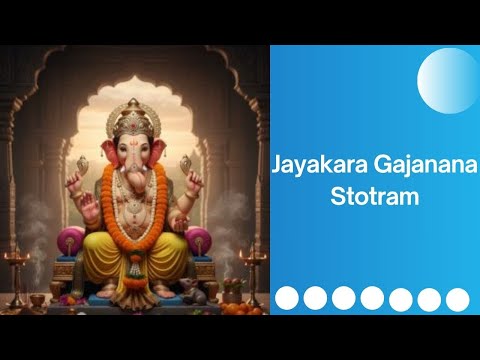
जय देव गजानन प्रभो जय सर्वासुरगर्वभेदक ।
जय सङ्कटपाशमोचन प्रणवाकार विनायकाऽव माम् ॥
'Hail, O Lord Gajanana (Ganesha), hail, O destroyer of the pride of all demons! Hail, O liberator from the bonds of difficulties, O Vinayaka of the form of Om, protect me!'
'This verse is a heartfelt salutation to Lord Ganesha, emphasizing his divine attributes. 'Gajanana' refers to his elephant head, a prominent feature that symbolizes wisdom and strength. He is praised as the 'destroyer of the pride of all demons,' highlighting his role as a protector of dharma and a vanquisher of negative forces. The epithet 'liberator from the bonds of difficulties' (saṅkaṭa-pāśa-mocana) underscores his popular image as the remover of obstacles. Most profoundly, he is addressed as 'Praṇavākāra Vināyaka,' meaning Vinayaka (Ganesha) who embodies the form of 'Om' (Praṇava). Om is the primordial sound of the universe, representing the ultimate reality in Hinduism. This connects Ganesha directly to the cosmic principle, signifying his supreme divinity and his role as the source of all creation. The verse concludes with a humble plea for his protection.'
तव देव जयन्ति मूर्तयः कलितागण्यसुपुण्यकीर्तयः ।
मनसा भजतां हतार्तयः कृतशीघ्राधिककामपूर्तयः ॥
'O Lord, victorious are Your forms, adorned with countless auspicious and meritorious glories. For those who worship You in their minds, their sorrows are destroyed, and their wishes are swiftly and amply fulfilled.'
'This verse elaborates on the benefits of worshipping Lord Ganesha. It declares the victory and auspiciousness of his various forms, implying that any form of Ganesha, when worshipped sincerely, bestows blessings. The key idea here is 'manasā bhajatām,' meaning 'for those who worship in their minds.' This emphasizes the importance of internal devotion and sincerity over mere ritualistic worship. For such devotees, their 'ārtayaḥ' (sorrows, sufferings) are 'hata' (destroyed). Furthermore, their 'kāmāḥ' (desires, wishes) are 'śīghra-adhika-pūrtayaḥ' (quickly and abundantly fulfilled). This reinforces Ganesha's role as 'Vighnaharta' (remover of obstacles) and 'Siddhidata' (bestower of success and fulfillment), promising both relief from distress and attainment of aspirations.'
तव रम्यकथास्वनादरः स नरो जन्मलयैकमन्दिरम् ।
न परत्र न चेह सौख्यभाङ्निजदुष्कर्मवशाद्विमोहभाक् ॥
'That person who disregards Your beautiful stories is merely a dwelling place for birth and dissolution (samsara). Such a person enjoys no happiness either in the next world or in this one, and due to their own evil deeds, is deluded.'
'This verse serves as a cautionary statement, highlighting the consequences of neglecting devotion to Ganesha, specifically by disregarding his 'ramya-kathāḥ' (beautiful stories). In Hindu tradition, stories of deities are not mere entertainment; they are vehicles for conveying profound spiritual truths, ethical lessons, and the glory of the divine. To be 'anādaraḥ' (disregardful) of these stories implies a lack of reverence and spiritual understanding. Such a person is described as 'janma-layaika-mandiram,' meaning 'a sole temple for birth and dissolution'—a perpetual cycle of samsara, devoid of spiritual progress. The verse warns that such an individual will experience no happiness 'paratra' (in the next world) nor 'iha' (in this world). This suffering and lack of joy are attributed to their 'nija-duṣkarma-vaśāt' (due to their own evil deeds) which leads them to 'vimoha-bhāk' (remain in delusion). This emphasizes the karmic consequences of spiritual negligence and the importance of devotion for overall well-being and liberation.'
गजवक्त्र तवाङ्घ्रिपङ्कजे ध्वजवज्राङ्कयुते सदा भजे ।
तव मूर्तिमहं परिष्वजे त्वयि हृन्मेऽस्तु सुमूषकध्वजे ॥
'O elephant-faced one, I always worship Your lotus feet, marked with the banner and thunderbolt. I embrace Your form, and may my heart reside in You, O one whose excellent banner bears the mouse.'
'This verse expresses deep personal devotion to Lord Ganesha. The devotee addresses him as 'gajavaktra' (elephant-faced), a common and affectionate epithet. The focus is on worshipping his 'aṅghri-paṅkaje' (lotus feet), which are described as 'dhvaja-vajrāṅka-yute' (marked with the banner and thunderbolt). These are auspicious symbols often found on the feet of divine beings, signifying sovereignty, power, and protection. The act of 'parishvaje' (embracing) his 'mūrti' (form) signifies an intimate, loving connection with the deity, going beyond mere external worship. The concluding line, 'tvayi hṛn me'stu sumūṣaka-dhvaje,' is a profound prayer: 'May my heart reside in You, O one whose excellent banner bears the mouse.' The mouse, Ganesha's vehicle (vahana), symbolizes humility, resourcefulness, and the ability to navigate through the smallest crevices, overcoming obstacles. For the devotee's heart to reside in Ganesha means complete surrender, continuous remembrance, and an unwavering focus on the divine.'
त्वदृते हि गजानन प्रभो न हि भक्तौघसुखौघदायकः ।
सुदृढा मम भक्तिरस्तु ते चरणाब्जे विबुधेश विश्वपाः ॥
'Indeed, O Lord Gajanana (Ganesha), apart from You, there is no one who bestows a flood of happiness upon the hosts of devotees. May my devotion to Your lotus feet be firm, O Lord of the wise, O Protector of the universe.'
'This verse emphatically declares Ganesha's unique position as the supreme bestower of happiness to his devotees. The phrase 'tvad ṛte hi... na hi' (indeed, apart from You, there is no one) highlights his unparalleled ability to grant 'bhaktaugha-sukhaugha-dāyakaḥ' (a flood of happiness to the hosts of devotees). This reaffirms his role as the fulfiller of wishes and the remover of sorrows. Following this declaration, the devotee expresses a fervent prayer: 'sudṛḍhā mama bhaktir astu te charaṇābje' (May my devotion to Your lotus feet be firm). This emphasizes the desire for unwavering and strong devotion. The verse concludes by addressing Ganesha with two powerful epithets: 'vibudheśa' (Lord of the wise or gods) and 'viśvapāḥ' (Protector of the universe). These titles elevate Ganesha's status, acknowledging his wisdom and his universal protective role, further solidifying the devotee's trust and reverence.'
फलपूरगदेक्षुकार्मुकैर्युत रुक्चक्रधराब्जपाशधृक् ।
अव वारिजशालिमञ्जरीरदधृग्रत्नघटाढ्यशुण्ड माम् ॥
'O You who hold a citrus fruit, a mace, a sugarcane bow, a splendid disc, a lotus, and a noose; O You who hold a stalk of paddy and a tusk, and whose trunk is adorned with jeweled pots—protect me!'
'This verse offers a vivid description of Lord Ganesha's iconic attributes and physical features, particularly focusing on the items he holds in his hands and aspects of his trunk. The list of items includes 'phalapūra' (a citrus fruit, symbolizing the fruits of spiritual efforts), 'gada' (mace, symbolizing power and destruction of evil), 'ikṣu-kārmukaiḥ' (sugarcane bow, symbolizing the mind's sweetness and the control over desires), 'ruk-chakra' (splendid disc, symbolizing cosmic order and the destruction of obstacles), 'abja' (lotus, symbolizing purity and spiritual awakening), and 'pāśa' (noose, symbolizing attachment and control over passions). He is also described as holding 'vārija-śāli-mañjarī' (a stalk of paddy, symbolizing abundance and prosperity) and 'rada' (a tusk). This refers to his broken tusk, a famous story where he broke his own tusk to write the Mahabharata for Vyasa, symbolizing sacrifice for knowledge. His 'śuṇḍa' (trunk) is described as 'ratna-ghaṭā-āḍhya' (adorned with jeweled pots), symbolizing wealth and auspiciousness. The verse concludes with a direct plea: 'ava mām' (protect me!). This detailed description serves to invoke Ganesha's complete form and power for protection.'
करयुग्मसुहेमशृङ्खल द्विजराजाढ्यक तुन्दिलोदर ।
शशिसुप्रभ विद्यया युत स्तनभारानमितेड्य रक्ष माम् ॥
'O You with two hands adorned with golden chains, O You with a moon-like radiant pot-belly, O You endowed with supreme knowledge, O You who are worshipped by the bowed-down by the weight of their breasts—protect me!'
'This verse continues the visual description of Lord Ganesha, focusing on more of his unique characteristics and offering a direct prayer for protection. 'Karayugma-suhema-śṛṅkhala' describes his 'two hands adorned with golden chains,' which could symbolize his ability to bind and release, or simply his regal adornment. He is then addressed as 'dvijarājāḍhyaka-tundilodara,' which likely means 'whose pot-belly is resplendent like the moon,' emphasizing his large, auspicious belly (tundila-udara) as a symbol of prosperity and containing the universe. He is then praised as 'vidyayā yuta' (endowed with supreme knowledge), reiterating his identity as the Lord of Wisdom. The phrase 'stanabhāra-ānamita-iḍya' is particularly intriguing. 'Stanabhāra-ānamita' means 'bowed down by the weight of breasts,' and 'iḍya' means 'worshipped.' This could be interpreted as Ganesha being worshipped by goddesses or female deities who bow down to him, or it could metaphorically refer to those who carry the 'burden' of the material world or are weighed down by responsibilities, seeking his refuge. The verse ends with the familiar plea 'rakṣa mām' (protect me!), seeking his divine safeguarding.'
शशिभास्करवीतिहोत्रदृक् शुभसिन्दूररुचे विनायक ।
द्विपवक्त्र महाहिभूषण त्रिदिवेशासुरवन्द्य पाहि माम् ॥
'O Vinayaka, whose eyes are the moon, the sun, and the fire; O You with an auspicious vermilion (sindoor) hue; O elephant-faced one, adorned with a great serpent; O You who are worshipped by the lords of the three worlds and by demons—protect me!'
'This verse further glorifies Ganesha by attributing cosmic powers and unique adornments to him, culminating in a plea for protection. His 'dṛk' (eyes) are described as 'śaśi-bhāskara-vīti-hotra,' meaning the moon, the sun, and fire. This implies his all-seeing nature, his control over light and energy, and his representation of the cosmic trinity (knowledge, consciousness, and illumination). He is then called 'śubha-sindūra-ruche Vināyaka,' referring to his auspicious red 'sindoor' (vermilion) color, which is commonly applied to Ganesha idols during worship, symbolizing energy, vitality, and power. He is addressed as 'dvipa-vaktra' (elephant-faced) and 'mahāhi-bhūṣaṇa' (adorned with a great serpent). The serpent (naga) symbolizes cosmic energy, protection, and is often associated with Shiva, indicating Ganesha's connection to the Shaivite tradition. Most importantly, he is declared 'tridiveśa-asura-vandya,' meaning 'worshipped by the lords of the three worlds (gods) and by demons.' This highlights his universal appeal and power, transcending the usual duality of gods and demons, signifying his supreme status. The verse concludes with a powerful request for protection: 'pāhi mām' (protect me!).'
सृणिपाशवरद्विजैर्युत द्विजराजार्धक मूषकध्वज ।
शुभलोहितचन्दनोक्षित श्रुतिवेद्याभयदायकाऽव माम् ॥
'O You who hold a goad, a noose, and a superior tusk; O You whose banner bears a crescent moon; O You anointed with auspicious red sandalwood; O You who are known through the Vedas and bestow fearlessness—protect me!'
'This verse continues to describe Ganesha's attributes and powers, emphasizing his divine nature and his role as a protector. He is described as 'sṛṇi-pāśa-vara-dvijaiḥ-yuta,' meaning 'holding a goad (sṛṇi), a noose (pāśa), and a superior tusk (vara-dvija).' The goad represents control over the mind and senses, the noose represents the power of attachment and detachment, and the tusk refers to his broken tusk used for writing, symbolizing wisdom and sacrifice. The phrase 'dvijarājārdhaka-mūṣakadhvaja' is interesting. 'Dvijarāja' again means moon, so 'dvijarājārdhaka' means 'half the moon.' This might refer to a crescent moon symbol, often associated with Shiva (Ganesha's father), potentially indicating his lineage or a specific iconographic detail on his banner, along with the 'mūṣaka-dhvaja' (mouse banner). He is then adorned with 'śubha-lohita-chandana-ukṣita' (anointed with auspicious red sandalwood), a common practice in Hindu worship, symbolizing purity, auspiciousness, and cooling properties. He is further identified as 'śruti-vedya-abhaya-dāyaka,' meaning 'known through the Vedas' (śruti-vedya) and 'bestower of fearlessness' (abhaya-dāyaka). This links him to the highest spiritual knowledge and assures devotees of his protective grace. The verse ends with the familiar plea, 'ava mām' (protect me!).'
स्मरणात्तव शम्भुविध्यजेन्द्विनशक्रादिसुराः कृतार्थताम् ।
गणपाऽऽपुरघौघभञ्जन द्विपराजास्य सदैव पाहि माम् ॥
'By remembering You, Shambhu (Shiva), Vidhi (Brahma, the creator), Aja (Vishnu, the preserver), Indra, and other gods achieve fulfillment. O Gaṇapa (Lord of Ganas), O destroyer of multitudes of sins, O elephant-faced one, always protect me!'
'This powerful verse highlights Ganesha's supreme position even among the other principal deities of Hinduism. It states that 'smaraṇāt tava' (by remembering You), great gods like 'Śambhu' (Shiva), 'Vidhi' (Brahma, the creator), 'Aja' (Vishnu, the preserver, though 'Aja' can also mean unborn/primordial, referring to Brahma), 'Indra' (king of gods), and 'ādi surāḥ' (and other gods) attain 'kṛtārthatām' (fulfillment or success in their endeavors). This underscores Ganesha's unique role as the first worshipped deity, whose blessings are essential even for other gods to succeed. He is then addressed as 'Gaṇapā' (Lord of the Ganas, his host of attendants, and by extension, the leader of all divine forces). He is also called 'agho'gha-bhañjana' (destroyer of multitudes of sins), emphasizing his ability to purify and liberate from negative karma. The address 'dviparājāsya' (elephant-faced one) is repeated, maintaining his iconic image. The verse concludes with an unwavering plea: 'sadāiva pāhi mām' (always protect me!). This reiterates the devotee's constant need for his divine safeguarding.'
शरणं भगवान् विनायकः शरणं मे सततं च सिद्धिका ।
शरणं पुनरेव तावुभौ शरणं नान्यदुपैमि दैवतम् ॥
'Lord Vinayaka (Ganesha) is my refuge; and Siddhikā (the embodiment of spiritual attainment and Ganesha's consort) is always my refuge. Again, both of them together are my refuge. I do not approach any other deity for refuge.'
'This verse is a profound declaration of exclusive surrender and devotion. It establishes Lord Vinayaka (Ganesha) as the primary 'śaraṇam' (refuge). This signifies complete trust and reliance on him for protection and guidance. Significantly, 'Siddhikā' is also declared as 'śaraṇaṃ me satataṃ' (always my refuge). Siddhikā is often considered one of Ganesha's consorts, personifying 'siddhi' (spiritual attainment, success, perfection). By taking refuge in Siddhikā, the devotee seeks not just Ganesha's protection but also the attainment of spiritual and worldly success that comes with his grace. The verse then reinforces this by stating, 'śaraṇaṃ punar eva tāv ubhau' (again, both of them together are my refuge), emphasizing the complete and complementary nature of their blessings. The final powerful statement, 'śaraṇaṃ nānyad upaimi daivatam,' means 'I do not approach any other deity for refuge.' This is a declaration of singular devotion (eka-bhakti), where Ganesha and Siddhikā become the sole focus of the devotee's spiritual aspirations and source of ultimate support, acknowledging their all-encompassing power.'
गणनाथ निबन्धसंस्तवं कृपयाङ्गीकुरु मत्कृतं ह्यमुम् ।
इदमेव सदा प्रदीयतां करुणा मय्यतुलाऽस्तु सर्वदा ॥
'O Gaṇanātha (Lord of Ganas), please kindly accept this hymn of praise, composed by me. May this (hymn) always be offered, and may Your matchless compassion always be upon me.'
'This concluding verse serves as a humble supplication from the devotee, offering the entire hymn to Lord Ganesha. The devotee addresses him as 'Gaṇanātha' (Lord of Ganas) and requests him to 'kṛpayā aṅgīkuru' (kindly accept) 'mat-kṛtam hi amum nibandha-saṁstavam' (this hymn of praise composed by me). This act of offering the stotram itself is an act of devotion, acknowledging Ganesha as the recipient of all good deeds. The devotee then expresses a desire for continuity: 'idam eva sadā pradīyatām' (May this [hymn] always be offered), indicating a wish for lifelong devotion and the continuous remembrance of the Lord through this praise. The ultimate prayer is for 'karuṇā mayy atulā'stu sarvadā' (May Your incomparable compassion always be upon me). This seeks Ganesha's boundless and unique mercy, which is considered the highest blessing, ensuring protection, guidance, and spiritual growth always.'
जय देव गजानन प्रभो जय सर्वासुरगर्वभेदक ।
जय सङ्कटपाशमोचन प्रणवाकार विनायकाऽव माम् ॥
तव देव जयन्ति मूर्तयः कलितागण्यसुपुण्यकीर्तयः ।
मनसा भजतां हतार्तयः कृतशीघ्राधिककामपूर्तयः ॥
तव रम्यकथास्वनादरः स नरो जन्मलयैकमन्दिरम् ।
न परत्र न चेह सौख्यभाङ्निजदुष्कर्मवशाद्विमोहभाक् ॥
गजवक्त्र तवाङ्घ्रिपङ्कजे ध्वजवज्राङ्कयुते सदा भजे ।
तव मूर्तिमहं परिष्वजे त्वयि हृन्मेऽस्तु सुमूषकध्वजे ॥
त्वदृते हि गजानन प्रभो न हि भक्तौघसुखौघदायकः ।
सुदृढा मम भक्तिरस्तु ते चरणाब्जे विबुधेश विश्वपाः ॥
फलपूरगदेक्षुकार्मुकैर्युत रुक्चक्रधराब्जपाशधृक् ।
अव वारिजशालिमञ्जरीरदधृग्रत्नघटाढ्यशुण्ड माम् ॥
करयुग्मसुहेमशृङ्खल द्विजराजाढ्यक तुन्दिलोदर ।
शशिसुप्रभ विद्यया युत स्तनभारानमितेड्य रक्ष माम् ॥
शशिभास्करवीतिहोत्रदृक् शुभसिन्दूररुचे विनायक ।
द्विपवक्त्र महाहिभूषण त्रिदिवेशासुरवन्द्य पाहि माम् ॥
सृणिपाशवरद्विजैर्युत द्विजराजार्धक मूषकध्वज ।
शुभलोहितचन्दनोक्षित श्रुतिवेद्याभयदायकाऽव माम् ॥
स्मरणात्तव शम्भुविध्यजेन्द्विनशक्रादिसुराः कृतार्थताम् ।
गणपाऽऽपुरघौघभञ्जन द्विपराजास्य सदैव पाहि माम् ॥
शरणं भगवान् विनायकः शरणं मे सततं च सिद्धिका ।
शरणं पुनरेव तावुभौ शरणं नान्यदुपैमि दैवतम् ॥
गणनाथ निबन्धसंस्तवं कृपयाङ्गीकुरु मत्कृतं ह्यमुम् ।
इदमेव सदा प्रदीयतां करुणा मय्यतुलाऽस्तु सर्वदा ॥
jaya deva gajaanana prabho jaya sarvaasuragarvabhedaka .
jaya sankat'apaashamochana pranavaakaara vinaayakaa'va maam ..
tava deva jayanti moortayah' kalitaaganyasupunyakeertayah' .
manasaa bhajataam' hataartayah' kri'tasheeghraadhikakaamapoortayah' ..
tava ramyakathaasvanaadarah' sa naro janmalayaikamandiram .
na paratra na cheha saukhyabhaangnijadushkarmavashaadvimohabhaak ..
gajavaktra tavaanghripankaje dhvajavajraankayute sadaa bhaje .
tava moortimaham' parishvaje tvayi hri'nme'stu sumooshakadhvaje ..
tvadri'te hi gajaanana prabho na hi bhaktaughasukhaughadaayakah' .
sudri'd'haa mama bhaktirastu te charanaabje vibudhesha vishvapaah' ..
phalapooragadekshukaarmukairyuta rukchakradharaabjapaashadhri'k .
ava vaarijashaalimanjareeradadhri'gratnaghat'aad'hyashund'a maam ..
karayugmasuhemashri'nkhala dvijaraajaad'hyaka tundilodara .
shashisuprabha vidyayaa yuta stanabhaaraanamited'ya raksha maam ..
shashibhaaskaraveetihotradri'k shubhasindooraruche vinaayaka .
dvipavaktra mahaahibhooshana tridiveshaasuravandya paahi maam ..
sri'nipaashavaradvijairyuta dvijaraajaardhaka mooshakadhvaja .
shubhalohitachandanokshita shrutivedyaabhayadaayakaa'va maam ..
smaranaattava shambhuvidhyajendvinashakraadisuraah' kri'taarthataam .
ganapaa''puraghaughabhanjana dviparaajaasya sadaiva paahi maam ..
sharanam' bhagavaan vinaayakah' sharanam' me satatam' cha siddhikaa .
sharanam' punareva taavubhau sharanam' naanyadupaimi daivatam ..
gananaatha nibandhasam'stavam' kri'payaangeekuru matkri'tam' hyamum .
idameva sadaa pradeeyataam' karunaa mayyatulaa'stu sarvadaa ..





Other stotras


