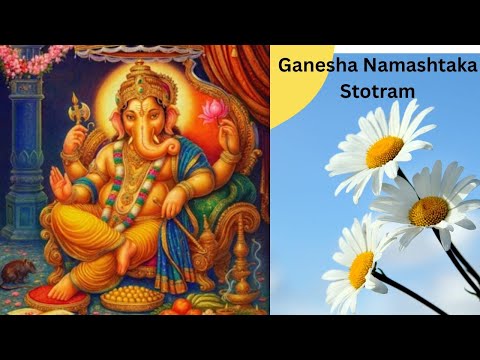
Ganesha Namashtaka Stotram
Shri Krishna Said:
श्रुणु देवि महाभागे वेदोक्तं वचनं मम ।
यच्छ्रुत्वा हर्षिता नूनं भविष्यसि न संशयः ।
'O greatly fortunate Devi, listen to my words, which are in full accordance with the Vedas. Upon hearing them, you shall surely be filled with joy; of this there is no doubt'.
In this opening verse, Shri Krishna addresses Parvati with reverence as 'Mahabhage' (greatly fortunate one) to set a sacred tone for the knowledge he is about to impart. This dialogue, which is found in texts like the Ganesha Purana, establishes the divine authority of the speaker and assures the listener that the forthcoming wisdom is not ordinary but is aligned with the eternal truths of the Vedas. It is a promise that understanding the true nature and glorious names of her son will lead to profound happiness.
यं कामः क्रोध उद्वेगो भयं नाविशते कदा ।
वेदस्मृतिपुराणेषु संहितासु च भामिनि ॥
'He is one whom desire, anger, agitation, and fear can never penetrate, O passionate lady, as is declared in the Vedas, Smritis, Puranas, and Samhitas'.
This verse describes the supreme state of Ganesha's consciousness. He is established in perfect equanimity, untouched by the turbulent emotions of desire (kama), anger (krodha), agitation (udvega), and fear (bhaya) that bind ordinary beings. By referencing the entire corpus of major Hindu scriptures—from the revealed Vedas to the remembered Smritis and narrative Puranas—Shri Krishna affirms that Ganesha's serene and transcendent nature is a universally acknowledged truth.
नामान्यस्योपदिष्टानि सुपुण्यानि महात्मभिः ।
यानि तानि प्रवक्ष्यामि निखिलाघहराणि च ॥
'His exceedingly sacred names, which destroy all sins, have been taught by great souls. I shall now proclaim these names to you'.
Here, the focus shifts to the power inherent in the divine names of Ganesha. In Hindu philosophy, a name (nama) is not merely a label but a sonic vibration that embodies the essence of the deity. Shri Krishna states that these names are 'supunyani' (supremely meritorious) and have been realized and taught by 'mahatmas' (enlightened masters). He introduces them as 'nikhilaghaharani', meaning they have the power to eradicate all sins and negative karmas, highlighting that the simple act of remembering and chanting them is a profound spiritual practice.
प्रमथानां गणा ये च नानारूपा महाबलाः ।
तेषामीशस्त्वयं यस्माद्गणेशस्तेन कीर्त्तितः ॥
'Since he is the lord of the various and mighty hosts of attendants known as the Pramathas, he is therefore celebrated as ‘Ganesha’'.
This verse provides the etymology for one of Ganesha's most famous names. The 'Ganas' are the formidable attendants of Lord Shiva, a diverse and powerful army. The name 'Ganesha' is a compound of 'Gana' (host or troop) and 'Isha' (lord or master). By being the master of these powerful entities, Ganesha demonstrates his supreme authority and leadership. This name signifies his ability to command cosmic forces and maintain order.
भूतानि च भविष्याणि वर्तमानानि यानि च ।
ब्रह्माण्डान्यखिलान्येव यस्मिंल्लम्बोदरः स तु ॥
'The past, the future, and the present, and indeed all the universes, are contained within him; for this reason, he is known as ‘Lambodara’'.
The name 'Lambodara' literally means 'one with a large belly'. This verse elevates its meaning from a physical attribute to a profound philosophical concept. His belly is not a sign of indulgence but a symbol of his cosmic form, signifying that he contains all of creation. Every universe (brahmanda), and all of time—past, present, and future—exists within him. It teaches the devotee to look beyond his charming form and recognize him as the container of all reality.
यः शिरो देवयोगेन छिन्नं संयोजितं पुनः ।
गजस्य शिरसा देवि तेन प्रोक्तो गजाननः ॥
'His head, which was severed by divine design, was then reattached with the head of an elephant, O Devi. For this reason, he is called ‘Gajanana’'.
This refers to the famous Puranic story where Parvati created a boy to guard her privacy. When Lord Shiva was denied entry, he, in his fury, severed the boy's head. To appease the grieving Parvati, Shiva replaced the original head with that of the first creature he found, which was an elephant. 'Gajanana' means 'elephant-faced'. This name is a reminder of his unique origin, a story of death and rebirth, transformation, and the confluence of human and animal, micro and macrocosm, embodied in one divine form.
चतुर्थ्यामुदितश्चन्द्रो दर्भिणा शप्त आतुरः ।
अनेन विधृतो भाले भालचन्द्रस्ततः स्मृतः ॥
'The moon, cursed and distressed after mocking Ganesha, was given a place on his forehead by him, and thus he is remembered as ‘Bhalachandra’'.
'Bhalachandra' means 'one who bears the moon on his forehead'. The story tells of the Moon-god (Chandra), who laughed at Ganesha's appearance. Ganesha, in turn, cursed the moon for his vanity. When a repentant Chandra begged for forgiveness, Ganesha softened the curse and, as a mark of his grace, placed the crescent moon on his own forehead. Symbolically, the moon represents the mind and the passage of time. By wearing the moon, Ganesha signifies that he is the master of the mind and its fluctuations, and he has control over time itself.
शप्तः पुरा सप्तभिस्तु मुनिभिः सङ्क्षयं गतः ।
जातवेदा दीपितोऽभूद्येनासौ शूर्पकर्णकः ॥
'When the fire-god, cursed by the seven sages, was diminishing, he was rekindled by this one; for this reason, he is known as ‘Shurpakarna’'.
'Shurpakarna' means 'one with ears like winnowing fans'. His large ears are symbolic of his great wisdom and ability to listen to the prayers of all devotees. This verse connects them to a story where Agni, the fire-god, was losing his power due to a curse. Ganesha used his large ears to fan the dying embers back into a powerful flame, saving the cosmic order. His ears thus also symbolize the ability to sift truth from untruth, just as a winnowing fan separates grain from chaff, allowing only what is essential and pure to remain.
पुरा देवासुरे युद्धे पूजितो दिविषद्गणैः ।
विघ्नं निवारयामास विघ्ननाशस्ततः स्मृतः ॥
'In ancient times, during the war between the Devas and Asuras, he was worshipped by the gods and he removed their obstacles; therefore, he is remembered as ‘Vighnanasha’'.
This explains Ganesha's most cherished role. 'Vighnanasha' (or Vighneshvara) means the 'destroyer of obstacles'. During the cosmic struggle between the gods (Devas) and demons (Asuras), the gods found their efforts thwarted. They prayed to Ganesha, who then cleared their path to victory. This establishes his fundamental role as the remover of all impediments, whether they are external challenges in the material world or internal obstacles like doubt, fear, and ego on the spiritual path.
अद्यायं देवि रामेण कुठारेण निपात्य च ।
दशनं दैवतो भद्रे ह्येकदन्तः कृतोऽमुना ॥
'Today, O auspicious Devi, struck by the axe of Parashurama, one of his tusks was broken, and for this reason he became known as ‘Ekadanta’'.
'Ekadanta' means 'one with a single tusk'. The narrative involves Parashurama, an incarnation of Vishnu, who came to visit Lord Shiva. Ganesha, fulfilling his duty as a guard, blocked his path. In the ensuing fight, Parashurama threw his powerful axe. Knowing the axe was a gift to Parashurama from his own father, Shiva, Ganesha chose not to stop it. Instead, he humbly received the blow on his tusk, which broke. This act symbolizes sacrifice, humility, and the profound respect Ganesha holds for his father's honor, choosing to accept imperfection rather than disrespect his father's weapon.
भविष्यत्यथ पर्याये ब्रह्मणो हरवल्लभः ।
वक्रीभविष्यत्तुण्डत्वाद्वक्रतुण्डः स्मृतो बुधैः ॥
'In a future cycle of Brahma, O beloved of Shiva, his trunk will be curved, and for that reason the wise will call him ‘Vakratunda’'.
'Vakratunda' means 'one with a curved trunk'. While a physical description, the name has deeper meanings. The curved trunk symbolizes that the path to enlightenment (Brahman) is not always simple or straight. It represents the power to bend and overcome any obstacle, no matter how complex. It also signifies the esoteric power of Pranava (Aum), the primordial sound, which his trunk is often seen to represent.
एवं तवास्य पुत्रस्य सन्ति नामानि पार्वति ।
स्मरणात्पापहारीणि त्रिकालानुगतान्यपि ॥
'Thus, O Parvati, are these names of your son. They destroy sins upon mere remembrance and are potent throughout all three phases of time'.
Shri Krishna summarizes the power and eternal relevance of these divine names. He reassures Parvati that these titles are not just laudatory but are potent spiritual tools. Their power is timeless—effective in the past, present, and future—and accessible through the simple yet profound act of remembrance (smarana), which purifies the devotee's mind and karma.
अस्मात्त्रयोदशीकल्पात्पूर्वस्मिन्दशमीभवे ।
मयास्मै तु वरो दत्तः सर्गदेवाग्रपूजने ॥
'Long ago, in the tenth age before this thirteenth cosmic cycle (kalpa), I myself granted him the boon of being worshipped first before all other gods'.
This is a powerful revelation where Shri Krishna states his own role in establishing Ganesha's preeminence. Hindu cosmology operates in vast cycles called 'kalpas'. Krishna specifies a time deep in the cosmic past when he conferred upon Ganesha the boon of 'agrapuja'—the right of first worship. This boon mandates that any ceremony, ritual, or new undertaking must begin with an invocation to Ganesha to ensure its success.
जातकर्मादिसंस्कारे गर्भाधानादिकेऽपि च ।
यात्रायां च वणिज्यादौ युद्धे देवार्चने शुभे ॥
'In all the sacraments from birth, including conception, during journeys, in commerce, in battle, and in the auspicious worship of deities'.
This verse elaborates on the practical application of the boon of first worship. It demonstrates Ganesha's integration into every aspect of a devout Hindu's life. His invocation is essential not only in grand temple rituals ('devarcane') but in all of life's rites of passage ('samskaras'), from conception to birth, and in worldly affairs such as business ('vanijya'), travel ('yatra'), and even conflict ('yuddhe'), ensuring divine grace and a path clear of obstacles in every endeavor.
सङ्कष्टे काम्यसिद्ध्यर्थं पूजयेद्यो गजाननम् ।
तस्य सर्वाणि कार्याणि सिद्ध्यन्त्येव न संशयः ॥
'Whoever worships Gajanana in times of great difficulty or for the fulfillment of a specific desire—all of their objectives will be accomplished without a doubt'.
This concluding verse serves as a powerful promise and benediction. It assures the devotee that Ganesha's grace is available to all, whether they are in 'sankashte' (a state of crisis or distress) or are performing a ritual for a specific outcome ('kamyasiddhi'). The verse ends with the unwavering declaration 'na samshayah' ('there is no doubt'), providing absolute assurance that sincere worship of Ganesha will lead to the successful accomplishment of all tasks.
श्रीकृष्ण उवाच -
श्रुणु देवि महाभागे वेदोक्तं वचनं मम ।
यच्छ्रुत्वा हर्षिता नूनं भविष्यसि न संशयः ।
यं कामः क्रोध उद्वेगो भयं नाविशते कदा ।
वेदस्मृतिपुराणेषु संहितासु च भामिनि ॥
नामान्यस्योपदिष्टानि सुपुण्यानि महात्मभिः ।
यानि तानि प्रवक्ष्यामि निखिलाघहराणि च ॥
प्रमथानां गणा ये च नानारूपा महाबलाः ।
तेषामीशस्त्वयं यस्माद्गणेशस्तेन कीर्त्तितः ॥
भूतानि च भविष्याणि वर्तमानानि यानि च ।
ब्रह्माण्डान्यखिलान्येव यस्मिंल्लम्बोदरः स तु ॥
यः शिरो देवयोगेन छिन्नं संयोजितं पुनः ।
गजस्य शिरसा देवि तेन प्रोक्तो गजाननः ॥
चतुर्थ्यामुदितश्चन्द्रो दर्भिणा शप्त आतुरः ।
अनेन विधृतो भाले भालचन्द्रस्ततः स्मृतः ॥
शप्तः पुरा सप्तभिस्तु मुनिभिः सङ्क्षयं गतः ।
जातवेदा दीपितोऽभूद्येनासौ शूर्पकर्णकः ॥
पुरा देवासुरे युद्धे पूजितो दिविषद्गणैः ।
विघ्नं निवारयामास विघ्ननाशस्ततः स्मृतः ॥
अद्यायं देवि रामेण कुठारेण निपात्य च ।
दशनं दैवतो भद्रे ह्येकदन्तः कृतोऽमुना ॥
भविष्यत्यथ पर्याये ब्रह्मणो हरवल्लभः ।
वक्रीभविष्यत्तुण्डत्वाद्वक्रतुण्डः स्मृतो बुधैः ॥
एवं तवास्य पुत्रस्य सन्ति नामानि पार्वति ।
स्मरणात्पापहारीणि त्रिकालानुगतान्यपि ॥
अस्मात्त्रयोदशीकल्पात्पूर्वस्मिन्दशमीभवे ।
मयास्मै तु वरो दत्तः सर्गदेवाग्रपूजने ॥
जातकर्मादिसंस्कारे गर्भाधानादिकेऽपि च ।
यात्रायां च वणिज्यादौ युद्धे देवार्चने शुभे ॥
सङ्कष्टे काम्यसिद्ध्यर्थं पूजयेद्यो गजाननम् ।
तस्य सर्वाणि कार्याणि सिद्ध्यन्त्येव न संशयः ॥
shreekri'shna uvaacha -
shrunu devi mahaabhaage vedoktam' vachanam' mama .
yachchhrutvaa harshitaa noonam' bhavishyasi na sam'shayah' .
yam' kaamah' krodha udvego bhayam' naavishate kadaa .
vedasmri'tipuraaneshu sam'hitaasu cha bhaamini ..
naamaanyasyopadisht'aani supunyaani mahaatmabhih' .
yaani taani pravakshyaami nikhilaaghaharaani cha ..
pramathaanaam' ganaa ye cha naanaaroopaa mahaabalaah' .
teshaameeshastvayam' yasmaadganeshastena keerttitah' ..
bhootaani cha bhavishyaani vartamaanaani yaani cha .
brahmaand'aanyakhilaanyeva yasmim'llambodarah' sa tu ..
yah' shiro devayogena chhinnam' sam'yojitam' punah' .
gajasya shirasaa devi tena prokto gajaananah' ..
chaturthyaamuditashchandro darbhinaa shapta aaturah' .
anena vidhri'to bhaale bhaalachandrastatah' smri'tah' ..
shaptah' puraa saptabhistu munibhih' sankshayam' gatah' .
jaatavedaa deepito'bhoodyenaasau shoorpakarnakah' ..
puraa devaasure yuddhe poojito divishadganaih' .
vighnam' nivaarayaamaasa vighnanaashastatah' smri'tah' ..
adyaayam' devi raamena kut'haarena nipaatya cha .
dashanam' daivato bhadre hyekadantah' kri'to'munaa ..
bhavishyatyatha paryaaye brahmano haravallabhah' .
vakreebhavishyattund'atvaadvakratund'ah' smri'to budhaih' ..
evam' tavaasya putrasya santi naamaani paarvati .
smaranaatpaapahaareeni trikaalaanugataanyapi ..
asmaattrayodasheekalpaatpoorvasmindashameebhave .
mayaasmai tu varo dattah' sargadevaagrapoojane ..
jaatakarmaadisam'skaare garbhaadhaanaadike'pi cha .
yaatraayaam' cha vanijyaadau yuddhe devaarchane shubhe ..
sankasht'e kaamyasiddhyartham' poojayedyo gajaananam .
tasya sarvaani kaaryaani siddhyantyeva na sam'shayah' ..





Other stotras


