Shankaracharya Dwadasa Nama Stotram
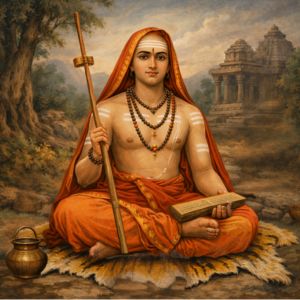
Lyrics:
सद्गुरुः शङ्कराचार्यः सर्वतत्त्वप्रचारकः।
वेदान्तवित् सुवेदज्ञः चतुर्दिग्विजयी तथा।।1।।
आर्याम्बातनुजो धर्मध्वजो दण्डधरस्तथा।
यतिराजो महाचार्य्यो मठादीनां प्रवर्तकः।।2।।
द्वादशैतानि नामानि शङ्करस्य महात्मनः।
यो नित्यं पठति प्रीत्या महज्ज्ञानं जनो भुवि।
अन्ते मोक्षमवाप्नोति साधूनां सङ्गतिं सदा।।3।।
sadguruh' shankaraachaaryah' sarvatattvaprachaarakah'.
vedaantavit suvedajnyah' chaturdigvijayee tathaa..1..
aaryaambaatanujo dharmadhvajo dand'adharastathaa.
yatiraajo mahaachaaryyo mat'haadeenaam' pravartakah'..2..
dvaadashaitaani naamaani shankarasya mahaatmanah'.
yo nityam' pat'hati preetyaa mahajjnyaanam' jano bhuvi.
ante mokshamavaapnoti saadhoonaam' sangatim' sadaa..3..
Meaning:
Verse 1
सद्गुरुः शङ्कराचार्यः सर्वतत्त्वप्रचारकः।
वेदान्तवित् सुवेदज्ञः चतुर्दिग्विजयी तथा।।1।।
The first verse introduces Adi Shankaracharya as the Sadguru, which literally translates to the true or supreme teacher who guides the soul from the darkness of ignorance to the light of truth. In Indian philosophy, the Sadguru is not merely an instructor but a self-realized master whose presence facilitates the spiritual liberation of the disciple. He is described as Sarvatattvapracaraka, the propagator of all essential principles of reality. This signifies his historical and mythological role in reviving the ancient wisdom of the Upanishads at a time when Vedic traditions were declining and various conflicting schools of thought were prevalent.
By using the term Vedantavit, the text highlights his profound mastery over the end portion of the Vedas, specifically the Upanishads. The epithet Suvedajna further emphasizes his complete and flawless understanding of all Vedic scriptures. These terms suggest that his authority is rooted in direct experience of the ultimate truth described in the texts. He is not just a scholar of the letter but a knower of the spirit. This depth of knowledge is presented as the foundation of his mission to restore the Vedic heritage and provide a unified vision of existence.
The term Chaturdigvijayi refers to his historical journey across the four corners of the Indian subcontinent. Unlike worldly kings who sought territorial expansion through military warfare, Shankara engaged in intellectual and spiritual debates known as Shastratrtha. His goal was to establish the non-dualistic philosophy of Advaita Vedanta as the supreme truth. This conquest was one of logic, debate, and realization, ensuring the philosophical unification of India under a single spiritual banner.
Philosophically, these epithets suggest that a true spiritual leader must possess both the theoretical knowledge of the scriptures and the practical ability to disseminate that knowledge effectively. Shankara is portrayed as the personification of divine wisdom who established the intellectual foundation for spiritual seekers across generations. His victory in the four directions symbolizes the universal applicability of the Advaita doctrine, which transcends geographical and cultural boundaries to address the fundamental nature of the human soul and its relationship with the Brahman.
Verse 2
आर्याम्बातनुजो धर्मध्वजो दण्डधरस्तथा।
यतिराजो महाचार्य्यो मठादीनां प्रवर्तकः।।2।।
The second verse begins with the epithet Aryambatanuja, identifying Shankara as the son of the pious Aryamba. This provides a personal and historical context to his life, reminding devotees of the human manifestation of the divine. Mythologically, Shankara is considered an incarnation of Lord Shiva, yet this name highlights his earthly duties and his deep respect for his mother. The title Dharmadhvaja describes him as the standard-bearer or the banner of righteousness. This indicates that his life and teachings served as a beacon for the moral and ethical revival of society during a period of spiritual confusion.
As Dandadhara, he is the wielder of the staff, which is the traditional symbol of a Sannyasi or a renunciant. In the Vedic tradition, the Danda represents the control over speech, thought, and action. It also signifies his authority over the monastic order he established. This epithet emphasizes his commitment to the path of renunciation and his role as a protector of the spiritual laws that govern the ascetic life. By carrying the Danda, he represents the disciplined path of the seeker who has abandoned worldly desires in pursuit of the eternal truth.
Further, he is hailed as Yatiraja, the king among ascetics, and Mahacharya, the preeminent teacher. These titles acknowledge his leadership in the monastic tradition and his unrivaled authority in interpreting the scriptures. The verse also mentions him as Mathadinam Pravartakah, the founder of the various monastic institutions. By establishing the four primary Mathas in the cardinal directions of India, Shankara ensured the systematic preservation and transmission of Vedic knowledge. This institutional framework was crucial for the long-term survival of the Advaita philosophy and the organized training of future teachers.
Spiritually, these names represent the integration of personal renunciation with institutional responsibility. They show how a realized soul works for the welfare of the world by creating structures that sustain wisdom. Shankara is seen here as both a solitary monk and a dynamic leader who organized the Dashanami Sampradaya to protect the spiritual integrity of the land. His life serves as an example of how one can be fully detached yet deeply engaged in the service of humanity through the propagation of Dharma and the establishment of sacred centers of learning.
Verse 3
द्वादशैतानि नामानि शङ्करस्य महात्मनः।
यो नित्यं पठति प्रीत्या महज्ज्ञानं जनो भुवि।
अन्ते मोक्षमवाप्नोति साधूनां सङ्गतिं सदा।।3।।
The third verse serves as the Phalasruti, or the statement of fruits, detailing the spiritual and worldly benefits of reciting these twelve names of the Mahatma Shankara. It emphasizes that those who recite these names daily with love and devotion, or Pritya, will be blessed with Mahajnanm, which is supreme spiritual knowledge. In the context of Indian philosophy, this knowledge is not mere data but a transformative realization of one's own identity with the Absolute. This suggests that the mere contemplation of the qualities of a realized master can catalyze the listener's own intellectual and spiritual awakening.
The act of reciting these names is presented as a way of tuning one's consciousness to the frequency of the great teacher's wisdom and his non-dualistic realizations. By remembering the various aspects of Shankara's life and work, the devotee internalizes the virtues of discipline, knowledge, and devotion. The verse suggests that the path to wisdom begins with the respectful remembrance of those who have already reached the goal. This practice helps in purifying the mind and preparing the heart for the deeper truths of Vedanta, making the complex philosophy accessible through the power of devotional chanting.
The verse further promises that such a practitioner will attain Moksha, or ultimate liberation from the cycle of birth and death, at the end of their life. This is the highest goal of human existence in the Hindu tradition. Additionally, it mentions that the devotee will always enjoy the company of the virtuous, or Sadhunm Sangatim. In Indian philosophy, Satsanga or the company of the wise is considered the first step toward liberation as it fosters the right environment for spiritual growth and prevents the seeker from falling back into the traps of ignorance and worldly attachments.
Thus, the stotram concludes by linking the practice of devotion to the highest goals of human life, known as Purusharthas. It teaches that by honoring the lineage of teachers and internalizing their divine attributes, a common person can transcend the mundane existence and achieve the highest state of peace. The presence of the holy company ensures that the seeker remains on the path of Dharma, while the knowledge gained through the names leads to the final dissolution of the ego. Ultimately, the verse affirms that devotion to the guru is a direct and effective means to attain the state of eternal freedom.





Other stotras


