Atma Jyoti Stotram
किं ज्योतिस्तवभानुमानहनि मे रात्रौ प्रदीपादिकं
स्यादेवं रविदीपदर्शनविधौ किं ज्योतिराख्याहि मे।
चक्षुस्तस्य निमीलनादिसमये किं धीर्धियो दर्शने
किं तत्राहमतो भवान्परमकं ज्योतिस्तदस्मि प्रभो।।
Kim jyotistavabhaanumaanahani me raatrau pradeepaadikam
syaadevam ravideepadarshanavidhau kim jyotiraakhyaahi me .
Chakshustasya nimeelanaadisamaye kim dheerdhiyo darshane
kim tatraahamato bhavaanparamakam jyotistadasmi prabho ..
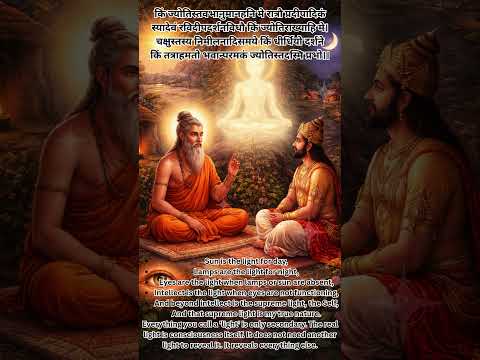
This is Yajnavalkya teaching Janaka in the Brihadaranyaka Upanishad. The question is simple: What is the light by which a person lives and sees?
The disciple asks:
'By what light do you function during the day?'
The answer is: 'By the light of the sun.'
Then he asks: 'At night, what is your light?'
Answer: 'A lamp or similar sources.'
Then he asks: 'If both the sun and lamp are absent, what is your light?'
Answer: 'The eye.'
Then he pushes further: 'If the eyes are closed or unable to see, what is the light then?'
Answer: 'The intellect (dhee) that knows and directs perception.'
Finally the disciple asks: 'What is beyond even the intellect?'
The teacher answers: 'The Self (Atman). That is the ultimate light. By that, everything else is known.'
The verse says:
-
Sun is the light for day,
-
Lamps are the light for night,
-
Eyes are the light when lamps or sun are absent,
-
Intellect is the light when eyes are not functioning,
-
And beyond intellect is the supreme light, the Self,
-
And that supreme light is my true nature.
Everything you call a 'light' is only secondary. The real light is consciousness itself. It does not need another light to reveal it. It reveals everything else.



Other stotras


