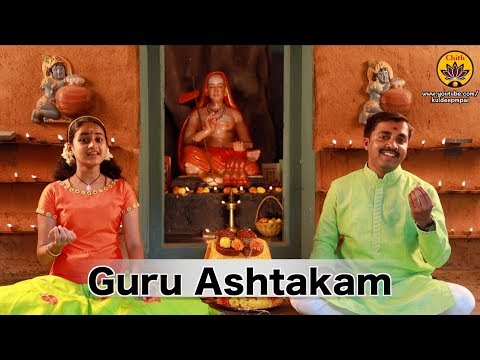
Guru Ashtakam
Verse 1
शरीरं सुरूपं तथा वा कलत्रं यशश्चारु चित्रं धनं मेरुतुल्यम्। मनश्चेन्न लग्नं गुरोरङ्घ्रिपद्मे ततः किं ततः किं ततः किं ततः किम्।
In this opening verse, Adi Shankaracharya establishes the central theme of the stotram, which is the absolute primacy of the Guru in spiritual life. He lists four major worldly achievements that often delude human beings: a beautiful body, a wonderful spouse, illustrious fame, and wealth as vast as the mythical Mount Meru. In the literal sense, the poet asks what use these external attainments are if the mind is not attached to the lotus feet of the Guru. The imagery of Mount Meru serves as a metaphor for immense, incomparable material abundance, yet the poet dismisses it as insignificant in the absence of spiritual connection.
Philosophically, this verse addresses the trap of ego and attachment to material form. Humans often derive their identity and sense of purpose from physical attractiveness, relational status, or social standing. The repeated phrase tatah kim, meaning what then, acts as a rhetorical challenge to the reader to examine the void beneath these glittering surfaces. Without the guidance of a Guru, these assets are merely temporal arrangements that cannot provide liberation or true fulfillment. The lotus feet represent the Guru's grace, the stabilizing anchor necessary to keep the mind from drowning in the ocean of samsara.
Verse 2
कलत्रं धनं पुत्रपौत्रादिसर्वं गृहं बान्धवाः सर्वमेतद्धि जातम्। मनश्चेन्न लग्नं गुरोरङ्घ्रिपद्मे ततः किं ततः किं ततः किं ततः किम्।
This verse expands the scope of attachment from personal attributes to the social and familial sphere. The Sanskrit term kulatra implies the wife, but in a broader sense, it encompasses the entire network of domestic life, including children, grandchildren, one's home, and kin. Shankaracharya notes that all these, though they seem like the essence of life, are merely born or manifested entities that will inevitably dissolve. The word jatam signifies that everything born must eventually perish, highlighting the transient nature of familial bonds when viewed from the perspective of ultimate truth.
From a deeper spiritual standpoint, the verse cautions the seeker against the excessive entanglement of householder life, where the mind is perpetually occupied with the care and sustenance of these connections. While duty and love for family are moral obligations, they become a spiritual liability if they obscure the higher pursuit of self-realization. The Guru is the necessary distraction from this domestic whirlpool. By fixing the mind on the Guru, one does not necessarily abandon the family but learns to view them through the lens of non-attachment, recognizing that true shelter is found only in the wisdom bestowed by the teacher, rather than in the shifting sands of domestic relationships.
Verse 3
षडङ्गादिवेदो मुखे शास्त्रविद्या कवित्वादिगद्यं सुपद्यं करोति। मनश्चेन्न लग्नं गुरोरङ्घ्रिपद्मे ततः किं ततः किं ततः किं ततः किम्।
The third verse addresses the domain of intellect and scholarly achievement. The mention of the shadanga or the six auxiliary sciences of the Vedas, along with the ability to compose beautiful poetry and prose, refers to the pride of the intellectual. A person may be a master of the scriptures, able to recite the Vedas flawlessly and dazzle society with their eloquence, yet if their heart is not devoted to the Guru, this knowledge remains sterile. It is a powerful critique of dry scholarship, where one confuses the map for the territory.
Philosophically, this verse suggests that intellectual accumulation without devotion creates a subtle form of arrogance. The knowledge of the scriptures is meant to lead to humility and eventually to the Guru, who alone can translate text into lived experience. When one possesses great scholastic capability, the ego is often reinforced, creating a barrier to surrender. Shankaracharya emphasizes that without the Guru’s transformative touch, all scriptural wisdom is merely information, a decoration of the tongue rather than a refinement of the spirit. The true test of a scholar is whether their knowledge leads them to the feet of a realized master.
Verse 4
विदेशेषु मान्यः स्वदेशेषु धन्यः सदाचारवृत्तेषु मत्तो न चान्यः। मनश्चेन्न लग्नं गुरोरङ्घ्रिपद्मे ततः किं ततः किं ततः किं ततः किम्।
In this verse, the focus shifts to external reputation and social morality. The poet describes a person who is highly respected abroad, considered fortunate in their own homeland, and deemed the most virtuous among all people. Such an individual is praised for their exemplary conduct and impeccable character. However, Shankaracharya asks, even with such universal acclaim, what does it truly matter if the mind is not attached to the Guru? Fame and social approval are fickle and ultimately external to the core of the self.
From a psychological and spiritual perspective, this verse speaks to the human desire for validation. We spend our lives cultivating a good image, adhering to social norms, and ensuring we are seen as righteous. Yet, this preoccupation with external virtue can become a cage. Virtue is a necessary precursor to spiritual practice, but it is not the goal itself. If one’s goodness is driven by a desire for social status rather than a humble devotion to a higher path, it is simply a refined form of ego. The Guru is the only one who can see past the mask of public persona and guide the seeker toward the absolute truth that transcends social labels.
Verse 5
क्षमामण्डले भूपभूपालवृन्दैः सदा सेवितं यस्य पादारविन्दम्। मनश्चेन्न लग्नं गुरोरङ्घ्रिपद्मे ततः किं ततः किं ततः किं ततः किम्।
The fifth verse introduces the domain of political power and worldly authority. The imagery depicts someone whose feet are constantly served by circles of kings and rulers, implying that this person is an emperor or a figure of immense influence, worshipped even by the powerful. The phrase kshamamandale, or circle of the earth, suggests a dominion of global scale. Despite holding the highest position possible in the political or social hierarchy, the poet remains unimpressed, reiterating the central refrain about the necessity of the Guru’s lotus feet.
This verse is particularly poignant in its subversion of worldly hierarchy. It reminds the reader that even the most powerful monarchs are subject to the laws of karma and time. Power over people and territory is transient and brings with it heavy burdens of responsibility and pride. By juxtaposing the feet of a worldly ruler being worshipped with the lotus feet of the Guru, Shankaracharya elevates the Guru to a status far above any earthly authority. True authority is not the power to command others, but the power to master one's own mind, a liberation that can only be obtained through the Guru's guidance.
Verse 6
यशो मे गतं दिक्षु दानप्रतात् जगद्वस्तु सर्वं करे यत्प्रसादात्। मनश्चेन्न लग्नं गुरोरङ्घ्रिपद्मे ततः किं ततः किं ततः किं ततः किम्।
Here, the poet discusses the fame earned through charity and the material abundance that makes everything in the world seem within one's grasp. The reference to dāna or charity acknowledges the merit that comes from giving, while the power to manifest everything one desires suggests a high degree of worldly success. Yet, again, Shankaracharya dismisses these as secondary to the Guru-bhakti. The literal meaning highlights that one may have the fame of a great benefactor and the resources of a king, but these are insufficient for the deeper journey of the soul.
Philosophically, this verse touches upon the concept of prosperity and its relationship to the ego. While charity is a noble act, if it is performed to build one's reputation or to solidify a sense of control over the world, it is still bound to the ego. The realization that all worldly objects are in one's hand is often a fleeting illusion. The only true possession one can have is the connection to the Guru, which provides a prosperity that cannot be lost, stolen, or diminished by time. The Guru is the source of all true grace, and without that grace, material success is merely a gilded cage.
Verse 7
न भोगे न योगे न वा वाजिराजौ न कन्तामुखे नैव वित्तेषु चित्तम्। मनश्चेन्न लग्नं गुरोरङ्घ्रिपद्मे ततः किं ततः किं ततः किं ततः किम्।
This verse moves into the realm of Vairagya, or dispassion. The poet explicitly states that his mind does not dwell onभोग, which refers to sensual enjoyments, nor on योग, which in this context can imply either the pride of yogic powers or perhaps a distracted pursuit of spiritual techniques without a focus. He also mentions वाजिराजौ or horses, symbolizing wealth and luxury, along with the beauty of women and other forms of wealth. The list represents the common temptations that capture the human mind and distract it from the goal of self-realization.
The philosophical significance here is the state of total detachment. The poet is essentially saying that even if one has conquered all desires and moved beyond the lure of material and sensual objects, the process is incomplete if the mind is not grounded in the Guru. Dispassion is not just the absence of desire; it is the presence of a higher, more intense longing for the Guru. It is a transition from the distraction of the world to the focus of the teacher, ensuring that the void created by renunciation is filled by the presence of divine wisdom rather than emptiness.
Verse 8
अरण्ये न वा स्वस्य गेहे न कार्ये न देहे मनो वर्तते मे त्वनर्घ्ये। मनश्चेन्न लग्नं गुरोरङ्घ्रिपद्मे ततः किं ततः किं ततः किं ततः किम्।
The eighth verse explores the idea of being free from physical location and bodily identification. The poet mentions being in the forest or at home, being engaged in work or in the body itself, stating that his mind does not find its home in any of these places. He describes the mind as precious or anarghye, yet it is not anchored in the fleeting experiences of environment or the physical vessel. Instead, it seeks something greater. It highlights the freedom from the tyranny of circumstances and the limitations of the body.
Philosophically, this verse speaks to the inner state of a seeker who has realized the non-dual nature of reality. Whether one is a hermit in the forest or a householder, the mind is often restless, seeking comfort in its surroundings. However, the true home of the mind is the lotus feet of the Guru. This is not a physical location but a state of consciousness where the ego is surrendered. It implies that the Guru's influence transcends physical presence; it is an internal alignment that allows one to be free regardless of whether they are in the bustle of the city or the silence of the wilderness.
Verse 9
गुरोरष्टकं यः पठेत् पुण्यदेही यतिर्भूपतिर्ब्रह्मचारी च गेही। लभेद्वाञ्छितार्थं पदं ब्रह्मसंज्ञं गुरोरुक्तवाक्ये मनो यस्य लग्नम्।
This concluding verse, known as the phala-shruti, outlines the benefits of reciting this hymn. Shankaracharya states that whoever reads this Gurvastakam, being a virtuous person, whether they are a sannyasi, a king, a student, or a householder, will attain the desired fruits. The ultimate reward mentioned is the padabrahmasanjnam, or the state of realization of the Supreme Brahman. However, the condition for this attainment is clearly defined: it is for those whose minds are attached to the words spoken by the Guru.
The philosophical significance here is the universality of the path. It does not matter what social or spiritual status one holds—all are eligible for liberation provided they have the correct disposition. The essence of the entire stotram is summarized here: spiritual success is not a matter of ritual perfection or social status, but of surrender. The words of the Guru act as the vehicle, and the devotion of the disciple acts as the fuel. By consistently meditating on the Guru's teachings and maintaining a focused, humble mind, the seeker transcends the cycle of worldly limitations and achieves the highest goal of existence, which is the direct experience of the infinite.
शरीरं सुरूपं तथा वा कलत्रं
यशश्चारु चित्रं धनं मेरुतुल्यम्।
मनश्चेन्न लग्नं गुरोरङ्घ्रिपद्मे
ततः किं ततः किं ततः किं ततः किम्।
कलत्रं धनं पुत्रपौत्रादिसर्वं
गृहं बान्धवाः सर्वमेतद्धि जातम्।
मनश्चेन्न लग्नं गुरोरङ्घ्रिपद्मे
ततः किं ततः किं ततः किं ततः किम्।
षडङ्गादिवेदो मुखे शास्त्रविद्या
कवित्वादिगद्यं सुपद्यं करोति।
मनश्चेन्न लग्नं गुरोरङ्घ्रिपद्मे
ततः किं ततः किं ततः किं ततः किम्।
विदेशेषु मान्यः स्वदेशेषु धन्यः
सदाचारवृत्तेषु मत्तो न चान्यः।
मनश्चेन्न लग्नं गुरोरङ्घ्रिपद्मे
ततः किं ततः किं ततः किं ततः किम्।
क्षमामण्डले भूपभूपालवृन्दैः
सदा सेवितं यस्य पादारविन्दम्।
मनश्चेन्न लग्नं गुरोरङ्घ्रिपद्मे
ततः किं ततः किं ततः किं ततः किम्।
यशो मे गतं दिक्षु दानप्रतापात्
जगद्वस्तु सर्वं करे यत्प्रसादात्।
मनश्चेन्न लग्नं गुरोरङ्घ्रिपद्मे
ततः किं ततः किं ततः किं ततः किम्।
न भोगे न योगे न वा वाजिराजौ
न कन्तामुखे नैव वित्तेषु चित्तम्।
मनश्चेन्न लग्नं गुरोरङ्घ्रिपद्मे
ततः किं ततः किं ततः किं ततः किम्।
अरण्ये न वा स्वस्य गेहे न कार्ये
न देहे मनो वर्तते मे त्वनर्घ्ये।
मनश्चेन्न लग्नं गुरोरङ्घ्रिपद्मे
ततः किं ततः किं ततः किं ततः किम्।
गुरोरष्टकं यः पठेत् पुण्यदेही
यतिर्भूपतिर्ब्रह्मचारी च गेही।
लभेद्वाञ्छितार्थं पदं ब्रह्मसंज्ञं
गुरोरुक्तवाक्ये मनो यस्य लग्नम्।
shareeram suroopam tathaa vaa kalatram
yashashchaaru chitram dhanam merutulyam.
manashchenna lagnam guroranghripadme
tatah' kim tatah' kim tatah' kim tatah' kim.
kalatram dhanam putrapautraadisarvam
gri'ham baandhavaah' sarvametaddhi jaatam.
manashchenna lagnam guroranghripadme
tatah' kim tatah' kim tatah' kim tatah' kim.
shad'angaadivedo mukhe shaastravidyaa
kavitvaadigadyam supadyam karoti.
manashchenna lagnam guroranghripadme
tatah' kim tatah' kim tatah' kim tatah' kim.
videsheshu maanyah' svadesheshu dhanyah'
sadaachaaravri'tteshu matto na chaanyah'.
manashchenna lagnam guroranghripadme
tatah' kim tatah' kim tatah' kim tatah' kim.
kshamaamand'ale bhoopabhoopaalavri'ndaih'
sadaa sevitam yasya paadaaravindam.
manashchenna lagnam guroranghripadme
tatah' kim tatah' kim tatah' kim tatah' kim.
yasho me gatam dikshu daanaprataapaat
jagadvastu sarvam kare yatprasaadaat.
manashchenna lagnam guroranghripadme
tatah' kim tatah' kim tatah' kim tatah' kim.
na bhoge na yoge na vaa vaajiraajau
na kantaamukhe naiva vitteshu chittam.
manashchenna lagnam guroranghripadme
tatah' kim tatah' kim tatah' kim tatah' kim.
aranye na vaa svasya gehe na kaarye
na dehe mano vartate me tvanarghye.
manashchenna lagnam guroranghripadme
tatah' kim tatah' kim tatah' kim tatah' kim.
gurorasht'akam yah' pat'het punyadehee
yatirbhoopatirbrahmachaaree cha gehee.
labhedvaanchhitaartham padam brahmasanjnyam
guroruktavaakye mano yasya lagnam.





Other stotras


