Dakshinamurthy Stotram
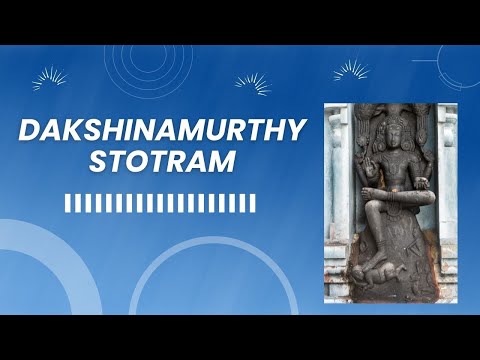
Verse 1
विश्वं दर्पणदृश्यमाननगरीतुल्यं निजान्तर्गतं
पश्यन्नात्मनि मायया बहिरिवोद्भूतं यथा निद्रया।
यः साक्षात्कुरुते प्रबोधसमये स्वात्मानमेवाद्वयं
तस्मै श्रीगुरुमूर्तये नम इदं श्रीदक्षिणामूर्तये।
This verse offers salutations to Shri Dakshinamurthy, who is the embodiment of the Guru. The core philosophical concept introduced here is the nature of reality, which is compared to a city seen in a mirror. The entire universe, which appears to be external, is in reality contained within the Self (Atman), just as the reflection of a city is contained within the mirror. The external projection is attributed to Maya, the cosmic power of illusion, which makes the internal reality appear as if it is outside. This is further analogized to the experience of a dream, where a whole world is created and experienced as real, yet upon waking, it is understood to be a mere projection of the mind. The verse states that upon enlightenment, the true state of non-duality (advayam) is realized.
The literal meaning of the words reinforces this idea. 'Viśvaṁ' means the universe, 'darpaṇa-dṛśyamāna-nagarī-tulyaṁ' means 'like a city seen in a mirror,' and 'nijāntargataṁ' signifies 'situated within oneself.' The phrase 'bahirivodbhūtaṁ yathā nidrayā' compares the external appearance of the world to something manifested during sleep. The true Guru, Dakshinamurthy, is the one who facilitates this 'awakening' ('prabodhasamaye'). Upon this awakening, one directly perceives ('sākṣātkurute') their own non-dual Self ('svātmānam evādvayaṁ'). The salutation, 'tasmai śrīgurumūrtaye nama idaṁ śrīdakṣiṇāmūrtaye,' is a prostration to that revered form of the Guru, Shri Dakshinamurthy, who reveals this ultimate truth. The mythological context is that of Shiva as the primordial teacher, who imparts the highest knowledge through silent eloquence.
The philosophical significance lies in the Advaita Vedanta principle that Brahman, the ultimate reality, is the only truth, and the world is a phenomenal appearance. The mirror analogy is crucial; the mirror is unaffected by the images it reflects, just as the Self remains untouched by the experiences of the world. The dream analogy emphasizes the subjective nature of the perceived reality and its ultimate unreality upon gaining higher knowledge. The Guru's role is not to provide something new but to remove the veil of ignorance (Maya) so that the ever-present truth of the non-dual Self can be directly experienced. This verse sets the stage for the entire stotram by establishing the relationship between the individual Self, the universe, and the ultimate reality, and the Guru's role in unveiling this connection.
Verse 2
बीजस्यान्तरिवाङ्कुरो जगदिदं प्राङ्निर्विकल्पं पुनः
मायाकल्पितदेशकालकलनावैचित्र्यचित्रीकृतम्।
मायावीव विजृम्भयत्यपि महायोगीव यः स्वेच्छया
तस्मै श्रीगुरुमूर्तये नम इदं श्रीदक्षिणामूर्तये।
This verse continues the exploration of creation and reality, offering salutations to Shri Dakshinamurthy, the Guru-form of Shiva. It begins with the analogy of a sprout ('aṅkuraḥ') existing in a potential, unmanifest state within a seed ('bījasyāntariva'). Similarly, this entire cosmos ('jagadidaṁ') existed in an undifferentiated, formless state ('prāṅnirvikalpaṁ') before its manifestation. This primordial, potential state is the non-dual Brahman. From this state, the universe is projected outwards, becoming variegated and diverse ('vaicitryacitrīkṛtam'). This diversification happens through the structuring principles of space ('deśa') and time ('kāla'), which are themselves creations of Maya ('māyākalpita').
The verse then describes the one who orchestrates this cosmic projection. He is compared to a magician ('māyāvīva') who unfolds his illusions, and also to a great Yogi ('mahāyogīva') who manifests worlds out of his own free will ('svecchayā'). This dual comparison is significant. The magician analogy points to the illusory nature of the created world from the standpoint of ultimate reality; it appears real but is not independently so. The Yogi analogy highlights the effortless and conscious power behind this manifestation. It is not a random or chaotic process but a projection willed by the supreme consciousness. This supreme being, the cosmic magician and great Yogi, is none other than Dakshinamurthy, the Guru.
The deeper philosophical meaning lies in the Vedanta concept of causation, specifically Vivartavada, the theory of apparent transformation. The universe is not a real transformation of Brahman, just as the sprout is not a different substance from the seed, or the magician's illusion is not a real object. It is an apparent manifestation. Dakshinamurthy, as the supreme Self, projects this complex universe structured by space and time, which are the fundamental coordinates of empirical experience, yet He remains transcendent and unaffected. The salutation is to this divine power who playfully ('vijṛmbhayati') brings forth the cosmos, and who, as the Guru, can reveal the secret behind this cosmic play, leading the disciple from the variegated illusion to the undifferentiated reality.
Verse 3
यस्यैव स्फुरणं सदात्मकमसत्कल्पार्थकं भासते
साक्षात्तत्त्वमसीति वेदवचसा यो बोधयत्याश्रितान्।
यत्साक्षात्करणाद्भवेन्न पुनरावृत्तिर्भवाम्भोनिधौ
तस्मै श्रीगुरुमूर्तये नम इदं श्रीदक्षिणामूर्तये।
This verse delves into the nature of consciousness and the role of the Guru in imparting the highest vedic teaching. It begins by stating that the very manifestation or shining forth ('sphuraṇaṁ') of the universe, which is essentially unreal ('asatkalpārthakaṁ'), is based on the existence of the eternal Self ('sadātmakam'). The world of names and forms appears real only because it is superimposed on the substratum of pure Being, or Brahman. This is akin to how a rope in dim light can be mistaken for a snake; the snake-appearance is unreal, but its perception is based on the real existence of the rope. Similarly, the universe shines ('bhāsate') with a borrowed reality from the Self.
The central point of the verse is the Guru's function. He is the one who teaches ('bodhayati') his disciples ('āśritān') the profound truth encapsulated in the great Vedic dictum, 'Tat Tvam Asi' ('That Thou Art'). This Mahavakya, or great saying, directly ('sākṣāt') reveals the identity of the individual self (Tvam) with the ultimate reality (Tat). The Guru does not merely provide intellectual information but facilitates a direct, experiential understanding of this non-dual truth. The verse then highlights the ultimate fruit of this realization. By directly experiencing this truth ('yatsākṣātkaraṇāt'), one is freed forever from the cycle of birth and death. There will be no return ('na punarāvṛttiḥ') to the ocean of worldly existence ('bhavāmbhonidhau').
The philosophical significance is immense. It encapsulates the core of Advaita Vedanta's soteriology. Ignorance of one's true nature as the non-dual Brahman is the root cause of suffering and bondage to the cycle of samsara. The Guru, in the form of Dakshinamurthy, removes this ignorance through the powerful instruction of 'Tat Tvam Asi.' This is not just a verbal instruction but a transmission of knowledge that triggers an intuitive awakening. The realization is not the creation of a new state but the recognition of an eternal truth. Once this identity is realized, the illusion of being a limited individual caught in the 'ocean of becoming' is shattered, leading to final liberation (Moksha). The salutation is to this benevolent Guru who rescues his devotees from this vast and turbulent ocean.
Verse 4
नानाच्छिद्रघटोदरस्थितमहादीपप्रभाभास्वरं
ज्ञानं यस्य तु चक्षुरादिकरणद्वारा बहिः स्पन्दते।
जानामीति तमेव भान्तमनुभात्येतत्समस्तं जगत्
तस्मै श्रीगुरुमूर्तये नम इदं श्रीदक्षिणामूर्तये।
This verse uses a powerful metaphor to explain how the singular, universal consciousness illuminates the individual's perceptions and the entire world. It offers salutations to Dakshinamurthy, who is the source of this illumination. The verse compares the Atman, or the Self, to a great lamp ('mahādīpa') placed inside a pot ('ghaṭodarasthita') that has many holes ('nānācchidra'). The light ('prabhābhāsvaraṁ') of this lamp, which is pure consciousness or knowledge ('jñānaṁ'), streams out through these holes. The holes represent the sense organs of the body, such as the eyes, ears, and so on ('cakṣurādikaraṇadvārā'). It is this inner light of the Self that shines outwards ('bahiḥ spandate') through the senses, enabling all perception and knowledge.
The second half of the verse elaborates on this concept. The entire world ('etatsamastaṁ jagat') is perceived and known only because the Self, the ultimate light, is shining. The world itself has no consciousness of its own; it 'shines after' ('anubhāti') the one who is self-luminous ('tameva bhāntam'). Our individual acts of knowing, expressed as 'I know' ('jānāmīti'), are nothing but a reflection of this fundamental, all-illuminating consciousness of the Self. We do not generate knowledge; rather, the ever-present light of awareness within us shines through the instruments of the mind and senses, making knowledge possible. The world is the object, and the Self is the ultimate subject, the eternal witness whose light makes all objects known.
The philosophical implication is a radical reorientation of our understanding of consciousness. We tend to believe that consciousness is a product of the brain or an attribute of the individual. This verse, however, presents the Advaitic view that Consciousness is primary, singular, and all-pervading. The body-mind complex is merely an instrument, like the pot with holes, through which this universal consciousness operates, creating the experience of individualized knowing. The world appears to us because the light of the Self falls upon it. Dakshinamurthy is worshipped here as that supreme, self-effulgent light of Consciousness, the ultimate source of all knowledge and experience, without which the universe would remain unmanifest and unknown.
Verse 5
देहं प्राणमपीन्द्रियाण्यपि चलां बुद्धिं च शून्यं विदुः
स्त्रीबालान्धजडोपमास्त्वहमिति भ्रान्ता भृशं वादिनः।
मायाशक्तिविलासकल्पितमहा व्यामोहसंहारिणे
तस्मै श्रीगुरुमूर्तये नम इदं श्रीदक्षिणामूर्तये।
This verse addresses the common error of misidentification of the Self and praises Dakshinamurthy as the one who destroys this profound delusion. It describes various schools of thought and ordinary people who, deluded by ignorance, identify the 'I' ('ahamiti') with things that are not the Self. These people are described as being thoroughly confused ('bhrāntā bhṛśaṁ vādinaḥ') and are compared to women, children, the blind, and the dull-witted ('strībālāndhajaḍopamāḥ'), signifying their naive or undeveloped understanding. They mistakenly identify the Self with the physical body ('dehaṁ'), the vital life force ('prāṇamapi'), the sense organs ('indriyāṇyapi'), the ever-changing intellect ('calāṁ buddhiṁ'), or even with a void or nothingness ('śūnyaṁ').
Each of these identifications represents a different level of philosophical error, from the grossest materialism (identifying with the body) to a form of nihilism (identifying with the void). The verse attributes this widespread and powerful confusion ('mahāvyāmoha') to the play ('vilāsa') of Maya's power ('māyāśakti'). Maya is the cosmic force that projects the world and, more subtly, veils the true nature of the Self, causing this fundamental error of superimposing the identity of the Self onto the not-self. The true 'I' is the pure consciousness that witnesses all these layers—body, breath, senses, and intellect—but is none of them.
The salutation is to Shri Dakshinamurthy, who is hailed as the destroyer ('saṁhāriṇe') of this great delusion created by the power of Maya. As the ultimate Guru, his grace and silent teaching cut through these layers of false identification. By revealing the nature of the true Self as the detached witness, he liberates the seeker from the limitations and suffering that arise from identifying with the perishable and changing aspects of the personality. He destroys the 'great delusion' which is the root cause of all human sorrow. This verse thus highlights the practical, soteriological role of the Guru: to correct our perception of who we are, moving us from a false, limited identity to the realization of our true, unlimited, conscious nature.
Verse 6
राहुग्रस्तदिवाकरेन्दुसदृशो मायासमाच्छादनात्
सन्मात्रः करणोपसंहरणतो योऽभूत्सुषुप्तः पुमान्।
प्रागस्वाप्समिति प्रबोधसमये यः प्रत्यभिज्ञायते
तस्मै श्रीगुरुमूर्तये नम इदं श्रीदक्षिणामूर्तये।
This verse uses the state of deep sleep (sushupti) to reveal the continuous, underlying nature of the Self. It begins with a powerful analogy. Just as the sun ('divākara') or moon ('indu') is temporarily obscured during an eclipse by Rahu ('rāhugrasta'), the true nature of the Self, which is pure Existence ('sanmātraḥ'), becomes veiled ('māyāsamācchādanāt') during deep sleep. In this state, the senses and mind ('karaṇa') are completely withdrawn ('upasaṁharaṇataḥ'), and the individual ('pumān') becomes temporarily non-manifest in their waking identity ('abhūtsuṣuptaḥ'). There is no perception of the world, the body, or the ego. From an external perspective, it seems like a state of non-existence or blankness.
However, the second part of the verse reveals the truth. Upon waking ('prabodhasamaye'), there is a distinct memory or recognition ('pratyabhijñāyate') of the prior state, expressed as 'I slept soundly' ('prāgasvāpsamiti'). This memory is crucial because it proves that consciousness was present even during deep sleep. If consciousness were completely absent, there could be no memory of that state, just as there is no memory of what happened before one's birth. The 'I' that was present as the witness of the 'nothingness' of deep sleep is the same 'I' that recognizes this fact upon waking. This demonstrates that the Self is the continuous, unchanging witness across all three states: waking, dreaming, and deep sleep.
The philosophical import is profound. It refutes the idea that the Self is the ego or the thinking mind, as both are absent in deep sleep. The Self is the foundational consciousness, the pure Existence which is temporarily veiled by the sleep state (a function of Maya), much like the sun is veiled by an eclipse. Dakshinamurthy is worshipped here as this very Self, the eternal witness who persists through all states. The analysis of deep sleep is a key methodology in Advaita Vedanta to help the seeker discriminate between the permanent Self and the transient states of the mind and body. The Guru guides the disciple to recognize this continuous 'I' which is the substratum of all experience.
Verse 7
बाल्यादिष्वपि जाग्रदादिषु तथा सर्वास्ववस्थास्वपि
व्यावृत्तास्वनुवर्तमानमहमित्यन्तः स्फुरन्तं सदा।
स्वात्मानं प्रकटीकरोति भजतां यो मुद्रया भद्रया
तस्मै श्रीगुरुमूर्तये नम इदं श्रीदक्षिणामूर्तये।
This verse elaborates on the unchanging nature of the Self (Atman) amidst all changing conditions and praises Dakshinamurthy for revealing this truth through a specific gesture. It states that through all the different stages of life, such as childhood, youth, and old age ('bālyādiṣvapi'), and also through all the states of consciousness, namely waking, dreaming, and deep sleep ('jāgradādiṣu tathā'), and indeed in all possible conditions ('sarvāsvavasthāsvapi'), there is one constant principle. While these states and stages come and go, they are transient and mutually exclusive ('vyāvṛttāsu'). However, running through them all as a continuous presence ('anuvartamānam') is the sense of 'I' ('ahamiti'), which always shines within ('antaḥ sphurantaṁ sadā').
This ever-present 'I' is the true Self, the witness consciousness that remains unaffected by the changes in the body, mind, and the world. The verse then describes how the Guru reveals this truth. To his devotees ('bhajatāṁ'), he reveals ('prakaṭīkaroti') this innermost Self ('svātmānaṁ'). He does this through his auspicious hand gesture ('mudrayā bhadrayā'). This refers to the Chinmudra (or Jnana Mudra), the gesture of knowledge, where the tip of the thumb and the index finger touch, forming a circle, while the other three fingers are extended. This gesture is rich in symbolism, representing the union of the individual self (index finger) with the supreme Self (thumb), and the transcendence of the three gunas or the three states of existence (the other three fingers).
The philosophical significance is in the method of 'anvaya-vyatireka' (presence and absence) used to identify the Self. The Self is that which is always present ('anvaya') when everything else is changing or absent ('vyatireka'). The 'I' consciousness is the only constant in our entire life experience. Dakshinamurthy, the silent teacher, does not need lengthy verbal explanations. Through his divine, auspicious gesture, he directly points to and reveals this immanent and transcendent reality within the heart of the seeker. The salutation is to this compassionate Guru who, through a simple, profound gesture, makes the ultimate, ever-shining Self manifest to his disciples.
Verse 8
विश्वं पश्यति कार्यकारणतया स्वस्वामिसम्बन्धतः
शिष्याचार्यतया तथैव पितृपुत्राद्यात्मना भेदतः।
स्वप्ने जाग्रति वा य एष पुरुषो मायापरिभ्रामितः
तस्मै श्रीगुरुमूर्तये नम इदं श्रीदक्षिणामूर्तये।
This verse describes the condition of the individual soul (Jiva) who is caught in the web of dualistic perceptions due to Maya's influence. It states that the individual person ('ya eṣa puruṣaḥ'), whether in the waking state ('jāgrati vā') or in the dream state ('svapne'), perceives the world ('viśvaṁ paśyati') entirely in terms of distinctions and relationships ('bhedataḥ'). This fragmented perception is the hallmark of an unenlightened existence. The verse provides several examples of these dualistic relationships: cause and effect ('kāryakāraṇatayā'), owner and owned or master and servant ('svasvāmisambandhataḥ'), teacher and disciple ('śiṣyācāryatayā'), and relationships like father and son ('pitṛputrādyātmanā').
The core idea is that the unawakened individual is completely ensnared in these categories of thought. Their entire reality is structured by these pairs of opposites and relational identities. They see a world of separate objects, people, and concepts, and define themselves in relation to these separated entities. The verse clearly states the cause of this fragmented worldview: the individual is 'thoroughly deluded by Maya' ('māyāparibhrāmitaḥ'). Maya is the power that projects this illusion of multiplicity and difference, making the one non-dual reality appear as a world of countless separate beings and things. The dream state is explicitly mentioned alongside the waking state to emphasize that both are phenomenal realms governed by the same principle of illusory differentiation.
The salutation, 'tasmai śrīgurumūrtaye nama idam,' in this context, is deeply poignant. It is a salutation to the one who is the very Self of this deluded individual. While the Jiva is tossed about by the illusions of relationship and separation, its true nature is none other than Dakshinamurthy, the non-dual reality. The grace of the Guru is what allows the individual to see through this Maya-induced delusion. By realizing his identity with Dakshinamurthy, the 'purusha' awakens from the dream and waking states of differentiation and understands that all relationships and distinctions ultimately resolve into the singular, non-dual Self. The verse implicitly honors the Guru as the one who can end this delusion.
Verse 9
भूरम्भास्यनलोऽनिलोऽम्बरमहर्नाथो हिमांशुः पुमान्
इत्याभाति चराचरात्मकमिदं यस्यैव मूर्त्यष्टकम्।
नान्यत्किञ्चन विद्यते विमृशतां यस्मात्परस्माद्विभोः
तस्मै श्रीगुरुमूर्तये नम इदं श्रीदक्षिणामूर्तये।
This verse presents a cosmic vision of Dakshinamurthy, identifying him with the entire universe in all its forms. It enumerates the eightfold form ('mūrtyaṣṭakam') of the Lord, which constitutes everything that exists. These eight forms are: Earth ('bhūḥ'), Water ('ambhāṁsi'), Fire ('analaḥ'), Air ('anilaḥ'), Ether or Space ('ambaram'), the Sun ('aharnāthaḥ'), the Moon ('himāṁśuḥ'), and the conscious individual or spirit ('pumān'). This list encompasses the five great elements that form the physical world, the two celestial bodies that govern time and life, and the conscious entity that experiences this world. The entire universe, comprising both moving and unmoving beings ('carācarātmakamidaṁ'), is nothing but the manifestation of these eight forms of the Lord.
The verse then draws the ultimate philosophical conclusion from this vision. For those who reflect deeply ('vimṛśatāṁ'), it becomes clear that apart from this supreme and all-pervading Lord ('yasmātparasmādvibhoḥ'), there exists nothing else whatsoever ('nānyatkiñcana vidyate'). This is the principle of non-duality asserted in its most expansive form. If everything in the universe—from the grossest element of earth to the subtlest entity of the individual spirit—is a form of the Lord, then there is no reality outside of or separate from Him. All that appears is simply the shining forth ('ityābhāti') of his eightfold form. This vision transforms the perception of the world from a collection of disparate objects into a living, divine reality, the very body of God.
This concept of 'Ashta Murti' is a classic Shaivite doctrine, identifying Shiva with the manifest cosmos. Here, it is applied to Dakshinamurthy as the Supreme Being. The salutation is to this cosmic form of the Guru, who is not just a teacher of non-duality but is the non-dual reality itself, manifesting as everything that we perceive. This verse encourages the seeker to move beyond seeing the world as mere matter and to recognize the divine presence in every element, every celestial body, and within oneself. The ultimate realization is the identity of the inner Self ('pumān') with the universal Self that constitutes all other forms.
Verse 10
सर्वात्मत्वमिति स्फुटीकृतमिदं यस्मादमुष्मिंस्स्तवे
तेनास्य श्रवणात्तदर्थमननाद्ध्यानाच्च सङ्कीर्तनात्।
सर्वात्मत्वमहाविभूतिसहितं स्यादीश्वरत्वं स्वतः
सिद्ध्येत्तत्पुनरष्टधा परिणतं चैश्वर्यमव्याहतम्।
This final verse is the 'Phala Shruti,' which describes the benefits of engaging with this hymn. It serves as a concluding summary and an encouragement to the seeker. The verse begins by stating that in this hymn ('amuṣmin stave'), the truth of the oneness of all selves, or the state of being the Self of all ('sarvātmatvam'), has been clearly explained and revealed ('sphuṭīkṛtamidaṁ yasmāt'). The preceding nine verses have systematically unfolded this Advaitic truth, showing how the individual Self is identical with the supreme Self, who is Dakshinamurthy, and how this Self is the substratum of the entire cosmos.
It then outlines the methods of engaging with the hymn to attain the promised result. These methods are: listening to it ('śravaṇāt'), reflecting upon its meaning ('tadarthamananāt'), meditating upon its truths ('dhyānācca'), and chanting or singing it ('saṅkīrtanāt'). This is the classical Vedantic path of spiritual discipline: Shravana (listening to the teaching), Manana (deep reflection to remove doubts), and Nididhyasana (meditative absorption). Chanting (Kirtana) is also included as a powerful devotional practice that helps to internalize the hymn's essence. The verse promises that through these practices, one will spontaneously ('svataḥ') attain the state of Lordship ('īśvaratvaṁ').
This 'Lordship' is characterized by the great glory ('mahāvibhūti') of realizing the oneness of all ('sarvātmatva'). Furthermore, it is accompanied by the unimpeded ('avyāhatam'), eightfold powers or lordliness ('aṣṭadhā pariṇataṁ caiśvaryam'). These are the traditional Siddhis or supernatural powers, which are said to arise as a natural consequence of Self-realization. The attainment of these powers is not the primary goal but a byproduct of realizing one's true nature as the supreme Lord of the universe. Thus, the hymn concludes by affirming that a sincere engagement with its teachings leads not only to liberation through the knowledge of oneness but also to the spontaneous manifestation of the inherent powers and glory of that supreme state.
विश्वं दर्पणदृश्यमाननगरीतुल्यं निजान्तर्गतं
पश्यन्नात्मनि मायया बहिरिवोद्भूतं यथा निद्रया।
यः साक्षात्कुरुते प्रबोधसमये स्वात्मानमेवाद्वयं
तस्मै श्रीगुरुमूर्तये नम इदं श्रीदक्षिणामूर्तये।
बीजस्यान्तरिवाङ्कुरो जगदिदं प्राङ्निर्विकल्पं पुनः
मायाकल्पितदेशकालकलनावैचित्र्यचित्रीकृतम्।
मायावीव विजृम्भयत्यपि महायोगीव यः स्वेच्छया
तस्मै श्रीगुरुमूर्तये नम इदं श्रीदक्षिणामूर्तये।
यस्यैव स्फुरणं सदात्मकमसत्कल्पार्थकं भासते
साक्षात्तत्त्वमसीति वेदवचसा यो बोधयत्याश्रितान्।
यत्साक्षात्करणाद्भवेन्न पुनरावृत्तिर्भवाम्भोनिधौ
तस्मै श्रीगुरुमूर्तये नम इदं श्रीदक्षिणामूर्तये।
नानाच्छिद्रघटोदरस्थितमहादीपप्रभाभास्वरं
ज्ञानं यस्य तु चक्षुरादिकरणद्वारा बहिः स्पन्दते।
जानामीति तमेव भान्तमनुभात्येतत्समस्तं जगत्
तस्मै श्रीगुरुमूर्तये नम इदं श्रीदक्षिणामूर्तये।
देहं प्राणमपीन्द्रियाण्यपि चलां बुद्धिं च शून्यं विदुः
स्त्रीबालान्धजडोपमास्त्वहमिति भ्रान्ता भृशं वादिनः।
मायाशक्तिविलासकल्पितमहा व्यामोहसंहारिणे
तस्मै श्रीगुरुमूर्तये नम इदं श्रीदक्षिणामूर्तये।
राहुग्रस्तदिवाकरेन्दुसदृशो मायासमाच्छादनात्
सन्मात्रः करणोपसंहरणतो योऽभूत्सुषुप्तः पुमान्।
प्रागस्वाप्समिति प्रबोधसमये यः प्रत्यभिज्ञायते
तस्मै श्रीगुरुमूर्तये नम इदं श्रीदक्षिणामूर्तये।
बाल्यादिष्वपि जाग्रदादिषु तथा सर्वास्ववस्थास्वपि
व्यावृत्तास्वनुवर्तमानमहमित्यन्तः स्फुरन्तं सदा।
स्वात्मानं प्रकटीकरोति भजतां यो मुद्रया भद्रया
तस्मै श्रीगुरुमूर्तये नम इदं श्रीदक्षिणामूर्तये।
विश्वं पश्यति कार्यकारणतया स्वस्वामिसम्बन्धतः
शिष्याचार्यतया तथैव पितृपुत्राद्यात्मना भेदतः।
स्वप्ने जाग्रति वा य एष पुरुषो मायापरिभ्रामितः
तस्मै श्रीगुरुमूर्तये नम इदं श्रीदक्षिणामूर्तये।
भूरम्भास्यनलोऽनिलोऽम्बरमहर्नाथो हिमांशुः पुमान्
इत्याभाति चराचरात्मकमिदं यस्यैव मूर्त्यष्टकम्।
नान्यत्किञ्चन विद्यते विमृशतां यस्मात्परस्माद्विभोः
तस्मै श्रीगुरुमूर्तये नम इदं श्रीदक्षिणामूर्तये।
सर्वात्मत्वमिति स्फुटीकृतमिदं यस्मादमुष्मिंस्स्तवे
तेनास्य श्रवणात्तदर्थमननाद्ध्यानाच्च सङ्कीर्तनात्।
सर्वात्मत्वमहाविभूतिसहितं स्यादीश्वरत्वं स्वतः
सिद्ध्येत्तत्पुनरष्टधा परिणतं चैश्वर्यमव्याहतम्।
vishvam darpanadri'shyamaananagareetulyam nijaantargatam
pashyannaatmani maayayaa bahirivodbhootam yathaa nidrayaa.
yah' saakshaatkurute prabodhasamaye svaatmaanamevaadvayam
tasmai shreegurumoortaye nama idam shreedakshinaamoortaye.
beejasyaantarivaankuro jagadidam praangnirvikalpam punah'
maayaakalpitadeshakaala-
kalanaavaichitryachitreekri'tam.
maayaaveeva vijri'mbhayatyapi mahaayogeeva yah' svechchhayaa
tasmai shreegurumoortaye nama idam shreedakshinaamoortaye.
yasyaiva sphuranam sadaatmakamasatkalpaarthakam bhaasate
saakshaattattvamaseeti vedavachasaa yo bodhayatyaashritaan.
yatsaakshaatkaranaadbhavenna punaraavri'ttirbhavaambhonidhau
tasmai shreegurumoortaye nama idam shreedakshinaamoortaye.
naanaachchhidraghat'odarasthita-
mahaadeepaprabhaabhaasvaram
jnyaanam yasya tu chakshuraadikaranadvaaraa bahih' spandate.
jaanaameeti tameva bhaantamanubhaatyetatsamastam jagat
tasmai shreegurumoortaye nama idam shreedakshinaamoortaye.
deham praanamapeendriyaanyapi chalaam buddhim cha shoonyam viduh'
streebaalaandhajad'opamaastvahamiti bhraantaa bhri'sham vaadinah'.
maayaashaktivilaasakalpitamahaa vyaamohasamhaarine
tasmai shreegurumoortaye nama idam shreedakshinaamoortaye.
raahugrastadivaakarendusadri'sho maayaasamaachchhaadanaat
sanmaatrah' karanopasamharanato yo'bhootsushuptah' pumaan.
praagasvaapsamiti prabodhasamaye yah' pratyabhijnyaayate
tasmai shreegurumoortaye nama idam shreedakshinaamoortaye.
baalyaadishvapi jaagradaadishu tathaa sarvaasvavasthaasvapi
vyaavri'ttaasvanuvartamaana-
mahamityantah' sphurantam sadaa.
svaatmaanam prakat'eekaroti bhajataam yo mudrayaa bhadrayaa
tasmai shreegurumoortaye nama idam shreedakshinaamoortaye.
vishvam pashyati kaaryakaaranatayaa svasvaamisambandhatah'
shishyaachaaryatayaa tathaiva pitri'putraadyaatmanaa bhedatah'.
svapne jaagrati vaa ya esha purusho maayaaparibhraamitah'
tasmai shreegurumoortaye nama idam shreedakshinaamoortaye.
bhoorambhaasyanalo-
'nilo'mbaramaharnaatho himaamshuh' pumaan
ityaabhaati charaacharaatmakamidam yasyaiva moortyasht'akam.
naanyatkinchana vidyate vimri'shataam yasmaatparasmaadvibhoh'
tasmai shreegurumoortaye nama idam shreedakshinaamoortaye.
sarvaatmatvamiti sphut'eekri'tamidam yasmaadamushmimsstave
tenaasya shravanaattadartha-
mananaaddhyaanaachcha sankeertanaat.
sarvaatmatvamahaavibhootisahitam syaadeeshvaratvam svatah'
siddhyettatpunarasht'adhaa parinatam chaishvaryamavyaahatam.





Other stotras


