Sankat Mochan Hanuman Ashtak
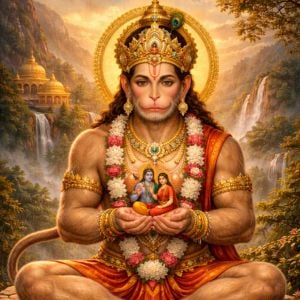
Verse 1
बाल समय रवि भक्षि लियो तब तीनहूं लोक भयो अंधियारो।
ताहि सों त्रास भयो जग को यह संकट काहु सों जात न टारो।
देवन आनि करी विनती तब छांडि दियो रवि कष्ट निवारो।
को नहिं जानत है जग में कपि संकटमोचन नाम तिहारो।
In his infancy, you swallowed the blazing sun, plunging the entirety of the three worlds into complete darkness. The whole universe was struck with immense terror, and this severe crisis could not be averted by anyone. When all the celestial gods came together and earnestly prayed to you, you released the sun and thereby removed the profound distress. Who in this vast world does not know your glorious name, Sankat Mochan, the ultimate remover of crises?
According to ancient lore, the child Hanuman mistook the newly risen sun for a ripe, glowing fruit and swallowed it whole. This innocent yet astonishing act triggered a sudden cosmic eclipse, causing absolute panic among the deities. To restore order, Lord Indra struck the child with his thunderbolt, causing him to drop the sun. Moved by this event, all the celestial beings subsequently bestowed immense boons upon the young monkey, blessing him with invincibility.
Philosophically, the sun stands for cosmic knowledge and illuminating light. Swallowing the sun illustrates that your divine nature is vast enough to encompass all universal light and profound intellect. The darkness signifies the ignorance of the mortal realm without divine grace. It is only through sincere devotion, represented by the unified prayers of the gods, that divine illumination is restored. The epithet Sankat Mochan reveals that true spiritual liberation from the relentless crises of material existence can only be attained through unwavering faith and surrender to the divine.
Verse 2
बालि की त्रास कपीस बसै गिरिजात महाप्रभु पंथ निहारो।
चौंकि महामुनि शाप दियो तब चाहिये कौन विचार विचारो।
कै द्विज रूप लिवाय महाप्रभु सो तुम दास के शोक निवारो।
Paralyzed by the immense fear of his brother Bali, the monkey king Sugriva resided upon the mountain, constantly looking out for a savior. Knowing the severe curse placed by the great sage, what further thought or consideration was required? Taking the humble form of a Brahmin, O great lord, you guided the Divine Supreme to him and entirely relieved your devoted servant of his deep sorrow.
Sugriva had been unjustly exiled by his formidable brother Bali, who had also taken Sugriva's wife. Seeking a safe haven, Sugriva took refuge on the Rishyamukha mountain. Bali could not enter this specific region due to a deadly curse from Sage Matanga. When Rama and Lakshmana wandered into the forest searching for Sita, Hanuman assumed the disguise of a learned Brahmin to discern their true intentions. Upon recognizing his beloved Lord Rama, he forged a crucial alliance between Rama and Sugriva.
On a deeper philosophical level, the towering mountain symbolizes a lofty state of spiritual elevation and a secure refuge from the relentless attacks of the false ego, which is perfectly embodied by the oppressive Bali. The sage's protective curse reflects the infallible cosmic law of karma, which always safeguards the righteous. Hanuman acting as a disguised Brahmin perfectly represents the ultimate spiritual master or Guru, who gently guides the seeking soul toward the Supreme Lord. This divine intervention permanently removes the agonizing sorrow of worldly separation.
Verse 3
अंगद के संग लेन गए सिय खोज कपीस यह बैन उचारो।
जीवत ना बचिहौं हम सों जु बिना सुधि लाए इहां पगु धारो।
हेरि थके तट सिंधु सबै तब लाय सिया सुधि प्राण उबारो।
You departed in the company of Angad and others to diligently search for Mother Sita, while the monkey king Sugriva proclaimed a harsh decree. He stated that no one would survive his wrath if they dared to return and set foot there without bringing valid news of her whereabouts. Completely exhausted at the edge of the vast ocean, the entire group lost hope, until you brought news of Sita and saved their very lives.
Sugriva dispatched multiple search parties in all directions to locate the abducted Sita. The southern expedition, led by the prince Angad and empowered by Hanuman, ultimately reached the seemingly impassable southern ocean. As their allotted time expired, the monkeys were trapped in profound despair, fearing Sugriva’s wrathful death penalty. It was then that Hanuman was reminded of his forgotten strength. He miraculously leaped across the vast ocean, found Sita in Lanka, and returned triumphantly with her token.
In Indian philosophy, the boundless ocean frequently symbolizes the vast and seemingly insurmountable cycle of birth, death, and material existence. The utter despair of the exhausted monkeys perfectly mirrors the spiritual seeker's intense frustration when their personal efforts fall short of divine realization. Hanuman embodies supreme divine grace, unwavering devotion, and the monumental effort required to bridge the profound gap between the seeking soul and the divine essence. His ultimate success brings the life-giving realization that the eternal divine mother is safe.
Verse 4
रावण त्रास दई सिय को तब राक्षस सों कहि सोक निवारो।
ताहि समय हनुमान महाप्रभु जाय महा रजनीचर मारो।
चाहत सीय असोक सों आगिसु दे प्रभु मुद्रिका सोक निवारो।
When the oppressive demon king Ravana inflicted terrible terror upon Mother Sita, you consoled her by cleverly speaking to the surrounding demonesses and removing her profound grief. At that very moment, O great Lord Hanuman, you went forth and completely annihilated the massive and fearsome night-wandering demons. When Sita desperately asked the Ashoka tree for a spark of fire to end her life, the Lord dropped the master's signet ring and removed her absolute sorrow.
Held captive in the Ashoka grove of Lanka, Sita faced constant psychological torture and fierce threats from Ravana. After Ravana departed, Hanuman strategically destroyed the beautiful grove and slaughtered Ravana’s elite guards, including the formidable prince Akshay Kumar. Later, overwhelmed by sheer hopelessness and unbearable separation, Sita tearfully begged the surrounding Ashoka tree to provide fire so she could immolate herself. In that critical fraction of a second, Hanuman dropped Lord Rama's signet ring from the branches above, instantly proving his authenticity.
Sita's tragic captivity vividly signifies the pure individual soul trapped by the arrogant ego, embodied by Ravana, and tormented by worldly desires, represented by the demonesses. The Ashoka tree literally translates to that which is without sorrow, yet the soul's true sorrow cannot end through material means. Hanuman acts as the perfect divine messenger delivering the sacred mantra or the unmistakable token of God. This divine intervention instantly extinguishes the profound grief of the isolated soul, replacing suicidal despair with eternal hope.
Verse 5
बान लग्यो उर लछिमन के तब प्राण तजे सुत रावण मारो।
लै गृह वैद्य सुखेन समेत तबै गिरि द्रोन सुबीर उपारो।
आनि संजीवनि हाथ दई तब लछिमन के तुम प्राण उबारो।
When a deadly arrow brutally struck the chest of Lakshmana, he surrendered his vital life force as the son of Ravana struck him down in battle. You swiftly brought the royal physician Sushena along with his entire house, and then you completely uprooted the massive Drona mountain, the home of great warriors. By bringing the miraculous Sanjeevani herb and placing it directly into his hand, you successfully saved the precious life of Lakshmana.
During the fierce and bloody war in Lanka, Ravana’s powerful son Indrajit unleashed the lethal Shakti weapon, striking Lakshmana and leaving him fatally unconscious. To save him, Hanuman flew at lightning speed to Lanka, physically lifting the physician Sushena along with his residence. Directed to the distant Himalayas to fetch the life-saving Sanjeevani herb before sunrise, Hanuman arrived but could not identify the specific glowing plant. Unwilling to risk failure, he uprooted the entire mountain and carried it back to the battlefield.
In a deep spiritual context, Lakshmana represents the state of absolute dedication, selfless service, and the vital breath of the pure devotee. The lethal weapon signifies the paralyzing, destructive effect of worldly illusion and material ignorance that can strike down even the strongest seeker. The Sanjeevani herb beautifully symbolizes profound spiritual awakening and the ultimate divine wisdom that revives the soul. Hanuman, acting as the sheer embodiment of infinite strength and faith, perfectly demonstrates that true devotion can literally move mountains to heal the wounded spirit.
Verse 6
रावन युद्ध अजान कियो तब नाग कि फांस सबै सिर डारो।
श्री रघुनाथ समेत सबै दल मोह भयो यह संकट भारो।
आनि खगेश तब हनुमान जु बन्धन काटि के त्रास निवारो।
When the ignorant and arrogant Ravana engaged in a deceitful battle, his side cast the terrifying serpent noose directly over everyone's heads. The revered Lord Sri Raghunath along with his entire massive army was completely deluded, creating an overwhelmingly burdensome and heavy crisis. It was then that you brought the mighty lord of birds, Garuda, and by severing those wicked, binding knots, you successfully removed their deep terror.
As the epic war raged on, Indrajit resorted to dark magical warfare by deploying the dreaded Nagapash, an inescapable weapon made of venomous serpents. This magical noose tightly bound both Lord Rama and Lakshmana, causing them to fall unconscious while the entire monkey army collapsed into weeping despair. Recognizing the dire severity of this magical trap, Hanuman urgently invoked Garuda, the divine eagle mount of Lord Vishnu and the natural mortal enemy of all serpents. Garuda swiftly arrived and completely destroyed the magical snake bonds.
The suffocating serpent noose perfectly represents the restrictive, binding chains of cosmic maya, immense ego, and deep material attachments that can entangle even the most enlightened beings. Lord Rama's temporary submission to the magical weapon honors the infallible laws of cosmic boons and nature. Hanuman's brilliant intercession by calling upon Garuda signifies the crucial role of the awakened intellect and the Guru. It teaches that higher divine forces must be invoked to violently sever the stubborn spiritual knots that bind the struggling devotee.
Verse 7
बंधु समेत जबे अहिरावण लै रघुनाथ पाताल सिधारो।
देविहिं पूजि भली विधि सों बलि देऊ सबै मिलि मंत्र बिचारो।
जाय सहाय भयो तबही अहिरावण सैन्य समेत संहारो।
When the dark sorcerer Ahiravana took the Lord of the Raghus along with his beloved brother directly to the deep netherworld, he properly worshipped his goddess and together with his followers planned the blood sacrifice. You arrived to be their ultimate savior at that exact moment, and you completely annihilated the wicked Ahiravana along with his entire demonic army.
Ahiravana, the powerful king of Patala, cleverly kidnapped Lord Rama and Lakshmana while they were deeply asleep in their fortified camp. His wicked intention was to offer the two divine brothers as a blood sacrifice to his patron goddess. Hanuman descended into the treacherous netherworld, fiercely defeated the guard Makardhwaja, and cleverly discovered the complex secret to killing the dark king. By assuming his terrifying five-faced form, Hanuman extinguished five mystical lamps simultaneously, instantly killing the demon and saving the beloved lords.
The murky netherworld of Patala accurately represents the deepest, darkest recesses of the human subconscious mind, where unacknowledged hidden fears, base instincts, and profound ignorance reside. The intended blood sacrifice vividly implies the destructive ego aggressively trying to consume the pure divine essence within. Hanuman bravely descending into this utter darkness represents the bold, illuminating power of supreme awareness. It perfectly illustrates how an awakened consciousness, fueled by sheer devotion, completely conquers the most hidden inner demons of the spiritual seeker.
Verse 8
काज किए बड़ देवन के तुम वीर महाप्रभु देखि बिचारो।
कौन सो संकट मोर गरीब को जो तुमसे नहिं जात है टारो।
बेगि हरो हनुमान महाप्रभु जो कछ संकट होय हमारो।
You have successfully accomplished incredibly great tasks for all the celestial gods; observe and think deeply upon this, O exceptionally brave and great Lord. What possible crisis of mine, a poor and humble soul, is there that cannot be completely averted by your supreme grace? Quickly completely remove any and all crises that may be mine, O great Lord Hanuman, the ultimate savior.
This powerful verse serves as the great poet Tulsidas's deeply personal and passionate plea. Having thoroughly recounted Hanuman's legendary and monumental feats of rescuing celestial deities, massive monkey armies, and even the Supreme Lord Rama himself, the poet directly invokes this immense track record. The logic is wonderfully simple: if Hanuman can effortlessly resolve massive cosmic crises and defeat invincible demons, a mortal human's worldly troubles are astonishingly trivial in comparison.
This beautifully concluding verse is a profound exercise in absolute spiritual surrender. The earnest devotee openly acknowledges their own complete helplessness and insignificant stature against the boundless, supreme capability of the Divine force. The term sankat refers deeply to the ultimate existential crisis of spiritual ignorance and the endless, painful cycle of rebirth. Calling upon Hanuman is a direct invocation of profound inner spiritual strength, begging for rapid divine grace to achieve ultimate liberation from the miseries of material life.
Verse 9
लाल देह लाली लसे अरु धरि लाल लंगूर।
बज्र देह दानव दलन जय जय जय कपि सूर।
Your glorious red body shines brilliantly with intense redness, and you magnificently bear a striking red tail. Your incredibly robust body is exactly like an indestructible thunderbolt, functioning as the ultimate destroyer of terrible demons; absolute victory, victory, victory to the brave and mighty monkey warrior.
Lord Hanuman is traditionally depicted throughout scripture with a vibrant, bright vermilion complexion. According to a beloved legend, he once covered his entire physical body in bright red paste upon learning that Mother Sita wore it to please Lord Rama and prolong his life. Furthermore, his thunderbolt-like body was an extraordinary boon granted directly by Lord Indra following the childhood incident with the sun, rendering him utterly invincible against any known weapon.
The brilliant color red vividly symbolizes immense cosmic vitality, the active life force, and the absolute, unblemished purity of dedicated devotion. The indestructible thunderbolt body signifies an unshakeable, profound faith and a deeply unwavering resolve that absolutely cannot be pierced by worldly temptations, physical pain, or mental sorrow. The ecstatic concluding chant of resounding victory represents the ultimate, final triumph of divine light over ignorance, supreme virtue over vice, and eternal spirit over temporary matter.
baala samaya ravi bhakshi liyo taba teenahoom loka bhayo andhiyaaro.
taahi som traasa bhayo jaga ko yaha sankat'a kaahu som jaata na t'aaro.
devana aani karee vinatee taba chhaand'i diyo ravi kasht'a nivaaro.
ko nahim jaanata hai jaga mem kapi sankat'amochana naama tihaaro.
baali kee traasa kapeesa basai girijaata mahaaprabhu pantha nihaaro.
chaunki mahaamuni shaapa diyo taba chaahiye kauna vichaara vichaaro.
kai dvija roopa livaaya mahaaprabhu so tuma daasa ke shoka nivaaro.
angada ke sanga lena gae siya khoja kapeesa yaha baina uchaaro.
jeevata naa bachihaum hama som ju binaa sudhi laae ihaam pagu dhaaro.
heri thake tat'a sindhu sabai taba laaya siyaa sudhi praana ubaaro.
raavana traasa daee siya ko taba raakshasa som kahi soka nivaaro.
taahi samaya hanumaana mahaaprabhu jaaya mahaa rajaneechara maaro.
chaahata seeya asoka som aagisu de prabhu mudrikaa soka nivaaro.
baana lagyo ura lachhimana ke taba praana taje suta raavana maaro.
lai gri'ha vaidya sukhena sameta tabai giri drona subeera upaaro.
aani sanjeevani haatha daee taba lachhimana ke tuma praana ubaaro.
raavana yuddha ajaana kiyo taba naaga ki phaamsa sabai sira d'aaro.
shree raghunaatha sameta sabai dala moha bhayo yaha sankat'a bhaaro.
aani khagesha taba hanumaana ju bandhana kaat'i ke traasa nivaaro.
bandhu sameta jabe ahiraavana lai raghunaatha paataala sidhaaro.
devihim pooji bhalee vidhi som bali deoo sabai mili mantra bichaaro.
jaaya sahaaya bhayo tabahee ahiraavana sainya sameta samhaaro.
kaaja kie bara devana ke tuma veera mahaaprabhu dekhi bichaaro.
kauna so sankat'a mora gareeba ko jo tumase nahim jaata hai t'aaro.
begi haro hanumaana mahaaprabhu jo kachha sankat'a hoya hamaaro.
laala deha laalee lase aru dhari laala langoora.
bajra deha daanava dalana jaya jaya jaya kapi soora.





Other stotras


