Anjaneya Mangala Ashtakam
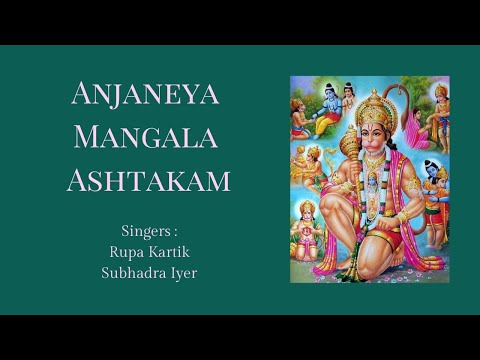
Lyrics:
कपिश्रेष्ठाय शूराय सुग्रीवप्रियमन्त्रिणे ।
जानकीशोकनाशाय आञ्जनेयाय मङ्गलम् ।।1।।
मनोवेगाय उग्राय कालनेमिविदारिणे ।
लक्ष्मणप्राणदात्रे च आञ्जनेयाय मङ्गलम् ।।2।।
महाबलाय शान्ताय दुर्दण्डीबन्धमोचन ।
मैरावणविनाशाय आञ्जनेयाय मङ्गलम् ।।3।।
पर्वतायुधहस्ताय रक्षःकुलविनाशिने ।
श्रीरामपादभक्ताय आञ्जनेयाय मङ्गलम् ।।4।।
विरक्ताय सुशीलाय रुद्रमूर्तिस्वरूपिणे ।
ऋषिभिः सेवितायास्तु आञ्जनेयाय मङ्गलम् ।।5।।
दीर्घबालाय कालाय लङ्कापुरविदारिणे ।
लङ्कीणीदर्पनाशाय आञ्जनेयाय मङ्गलम् ।।6।।
नमस्तेऽस्तु ब्रह्मचारिन् नमस्ते वायुनन्दन ।
नमस्ते गानलोलाय आञ्जनेयाय मङ्गलम् ।।7।।
प्रभवाय सुरेशाय शुभदाय शुभात्मने ।
वायुपुत्राय धीराय आञ्जनेयाय मङ्गलम् ।।8।।
आञ्जनेयाष्टकमिदं यः पठेत् सततं नरः ।
सिद्ध्यन्ति सर्वकार्याणि सर्वशत्रुविनाशनम् ।।9।।
kapishresht'haaya shooraaya sugreevapriyamantrine .
jaanakeeshokanaashaaya aanjaneyaaya mangalam ..1..
manovegaaya ugraaya kaalanemividaarine .
lakshmanapraanadaatre cha aanjaneyaaya mangalam ..2..
mahaabalaaya shaantaaya durdand'eebandhamochana .
mairaavanavinaashaaya aanjaneyaaya mangalam ..3..
parvataayudhahastaaya rakshah'kulavinaashine .
shreeraamapaadabhaktaaya aanjaneyaaya mangalam ..4..
viraktaaya susheelaaya rudramoortisvaroopine .
ri'shibhih' sevitaayaastu aanjaneyaaya mangalam ..5..
deerghabaalaaya kaalaaya lankaapuravidaarine .
lankeeneedarpanaashaaya aanjaneyaaya mangalam ..6..
namaste'stu brahmachaarin namaste vaayunandana .
namaste gaanalolaaya aanjaneyaaya mangalam ..7..
prabhavaaya sureshaaya shubhadaaya shubhaatmane .
vaayuputraaya dheeraaya aanjaneyaaya mangalam ..8..
aanjaneyaasht'akamidam' yah' pat'het satatam' narah' .
siddhyanti sarvakaaryaani sarvashatruvinaashanam ..9..
Meaning:
Verse 1
Kapishreshthaya shuraya Sugrivapriya mantrine
Janaki shoka nashaya Anjaneyaya mangalam
This verse offers auspicious salutations to Hanuman, addressing him as Kapishreshtha, the foremost among the vanaras, and Shura, the heroic one. Sugrivapriya mantri means the beloved minister and wise counselor of Sugriva. Janaki shoka nasha refers to the one who destroyed the sorrow of Janaki, that is, Sita. Anjaneya means the son of Anjana. Mangalam means auspiciousness.
In the Ramayana, Hanuman stands out not merely as a warrior but as the most discerning and loyal advisor to Sugriva. It is he who recognizes Rama’s divinity and forges the alliance between Rama and Sugriva. His journey to Lanka and his consoling words to Sita in Ashoka grove remove her crushing despair. Thus, he becomes the remover of Sita’s sorrow.
Philosophically, Hanuman represents the ideal integration of strength, intelligence, and devotion. True heroism is not brute force but wise service aligned with dharma. By calling him Sugriva’s minister and Sita’s comforter, the verse teaches that spiritual greatness lies in using one’s power to uphold righteousness and relieve the suffering of others.
Verse 2
Manovegaya ugraya Kalanemi vidarine
Lakshmana prana datre cha Anjaneyaya mangalam
This verse praises Hanuman as swift as the mind, fierce in battle, the destroyer of the demon Kalanemi, and the giver of life to Lakshmana. Manovega means one whose speed equals the mind. Ugra means formidable or intense. Kalanemi vidarine refers to the slayer of the demon Kalanemi. Lakshmana prana datra means the giver of life to Lakshmana.
In the war at Lanka, when Lakshmana fell unconscious by Indrajit’s weapon, Hanuman leapt to the Himalayas to fetch the Sanjivani herb. On the way, he killed Kalanemi, who tried to obstruct him through deceit. Unable to identify the herb, Hanuman lifted the entire mountain and brought it to the battlefield, thereby saving Lakshmana’s life.
Symbolically, Hanuman’s speed signifies the power of focused consciousness. The mind, when disciplined, travels faster than any physical force. His destruction of Kalanemi represents overcoming inner deception and illusion. Bringing life to Lakshmana symbolizes restoring the life-force of righteousness when it seems defeated. Devotion combined with determination becomes the force that revives dharma in times of crisis.
Verse 3
Mahabalaya shantaya durdandi bandha mochana
Mairavana vinashaya Anjaneyaya mangalam
This verse salutes Hanuman as Mahabala, of immense strength, and yet Shanta, inwardly calm. Durdandi bandha mochana suggests the liberator from harsh bondage. Mairavana vinasha refers to the destroyer of Mairavana, a powerful demon.
In later Ramayana traditions, Mairavana abducts Rama and Lakshmana to the netherworld. Hanuman enters the subterranean realm, overcomes the demon through cleverness and strength, and rescues the brothers. He is also known for freeing devotees from physical and mental bonds, whether literal captivity or karmic entanglement.
The union of Mahabala and Shanta is deeply philosophical. True strength does not produce arrogance or agitation. It rests upon inner serenity. Bondage represents ignorance and attachment, which bind the soul. Hanuman’s role as liberator suggests that devotion to Rama frees the individual from the chains of fear and ego. His calm strength teaches that spiritual power is steady, not restless, and that liberation arises from disciplined, devoted action.
Verse 4
Parvata ayudha hastaya rakshah kula vinashine
Shri Rama pada bhaktaya Anjaneyaya mangalam
This verse praises Hanuman who holds a mountain as a weapon, the destroyer of the clan of rakshasas, and the devoted servant at the feet of Shri Rama. Parvata ayudha hasta refers to the one who carries a mountain in his hand. Rakshah kula vinashine means the destroyer of the race of demons. Shri Rama pada bhakta means one devoted to the feet of Rama.
The image of Hanuman carrying the mountain during the quest for Sanjivani has become iconic. He does not hesitate or calculate; he acts decisively for Rama’s cause. In the war, he plays a crucial role in defeating many rakshasas and weakening Ravana’s forces.
At a deeper level, the mountain symbolizes the weight of obstacles in life. For a devotee anchored in Rama bhakti, even a mountain becomes light. The destruction of rakshasas represents the annihilation of inner negative tendencies such as anger, greed, and pride. The essence of Hanuman’s greatness lies not in his feats, but in his unwavering devotion to Rama’s feet, which is the foundation of all his strength and success.
Verse 5
Viraktaya sushilaya Rudra murti svarupine
Rishibhih sevitayastu Anjaneyaya mangalam
This verse describes Hanuman as Virakta, detached from worldly desires, and Sushila, of noble conduct. Rudra murti svarupin indicates that he embodies an aspect of Rudra, that is, Shiva. Rishibhih sevitaya means revered and served by sages.
Tradition holds that Hanuman is an incarnation of Shiva, born to assist Rama. Though capable of unmatched power, he remains humble and detached. He does not seek kingdom, wealth, or recognition. Even after the war, he asks only to remain in service of Rama.
Detachment here does not mean withdrawal from action. It means freedom from selfish motive. Being Sushila indicates perfect character grounded in dharma. The connection with Rudra shows the unity of divine forces working for cosmic harmony. Sages revere Hanuman because he represents the ideal synthesis of jnana, karma, and bhakti. His life demonstrates that spiritual maturity combines strength, humility, and unwavering focus on the divine purpose.
Verse 6
Dirgha balaya kalaya Lankapura vidarine
Lankini darpa nashaya Anjaneyaya mangalam
This verse hails Hanuman as Dirgha bala, immensely strong, and Kala, like time itself in destructive power. Lankapura vidarine means the one who tore apart the city of Lanka. Lankini darpa nasha refers to the destroyer of Lankini’s pride.
When Hanuman entered Lanka in search of Sita, he confronted Lankini, the guardian spirit of the city. Upon being struck by him, she realized a prophecy that Lanka’s fall was near. Later, Hanuman burned a large portion of the city after being captured and his tail set aflame.
Time, or Kala, is the ultimate force that dissolves arrogance and injustice. Hanuman’s burning of Lanka is not mere destruction but a symbolic act of divine justice. The fall of Lankini’s pride reflects the collapse of ego when confronted by divine strength. Spiritually, this verse teaches that devotion aligned with righteousness becomes the instrument through which injustice is corrected and false pride is humbled.
Verse 7
Namaste astu brahmacharin namaste Vayu nandana
Namaste gana lolaya Anjaneyaya mangalam
This verse offers salutations to Hanuman as a Brahmacharin, one established in celibate discipline, and Vayu nandana, the son of the wind. Gana lola suggests one who delights in sacred music or divine gatherings.
Hanuman’s brahmacharya signifies control over senses and perfect mastery over energy. As the son of Vayu, he inherits swiftness, strength, and subtle presence. In many traditions, he is depicted joyfully singing Rama’s name and participating in devotional assemblies.
Philosophically, brahmacharya symbolizes channeling life-force toward higher purpose. Vayu represents prana, the vital energy within all beings. Hanuman thus embodies disciplined prana directed toward devotion. Delight in divine song reflects the joy of bhakti. The verse teaches that self-control does not suppress joy; it refines and elevates it. In Hanuman, disciplined energy becomes ecstatic devotion.
Verse 8
Prabhavaya sureshaya shubhadaya shubhatmane
Vayuputraya dhiraya Anjaneyaya mangalam
This verse salutes Hanuman as Prabhava, of mighty origin and influence, Suresha-like among the gods, Shubhada, the giver of auspiciousness, and Shubhatman, pure in soul. Vayuputra means son of Vayu, and Dhira means steadfast and courageous.
Hanuman’s presence in the Ramayana changes the course of events. His courage in crossing the ocean, his wisdom in speaking to Sita, and his valor in battle demonstrate divine influence. Though a vanara, he is honored even by the gods.
Dhirata, steadiness of mind, is central to spiritual life. Hanuman’s courage is not reckless but grounded in clarity and devotion. As giver of auspiciousness, he removes obstacles for those who remember him. The verse presents him as a bridge between human effort and divine grace. Through courage rooted in purity, one becomes an instrument of auspicious transformation.
Verse 9
Anjaneya ashtakam idam yah pathet satatam narah
Siddhyanti sarva karyani sarva shatru vinashanam
This concluding verse states that whoever regularly recites this eight-versed hymn to Anjaneya will achieve success in all undertakings and the destruction of all enemies. Siddhyanti means they are accomplished. Sarva karyani refers to all endeavors. Sarva shatru vinashanam means the destruction of all enemies.
In devotional tradition, such phala shruti verses highlight the practical benefits of remembrance. Enemies are not only external foes but also internal obstacles such as doubt, fear, and weakness. Recitation aligns the mind with Hanuman’s qualities of courage, discipline, and devotion.
The deeper teaching is that by contemplating Hanuman’s virtues, one gradually internalizes them. Success arises not by magic but by transformation of character. When strength, clarity, humility, and devotion become part of one’s nature, obstacles naturally diminish. Thus, the hymn serves as both praise and spiritual training, shaping the devotee into a reflection of Hanuman’s noble qualities.
This stotra describes Hanuman as:
- The supreme among the vanaras, the bravest warrior, and the wisest counselor of Sugriva.
- The remover of Sita’s sorrow, the one who brings hope where there is despair.
- Swift as the mind, fierce in battle, and the destroyer of powerful demons like Kalanemi and Mairavana.
- The life-giver of Lakshmana, symbolizing the restorer of strength and vitality when righteousness appears to fall.
- A being of immense physical strength who can lift mountains, yet inwardly calm and composed.
- The destroyer of rakshasa forces and the instrument of divine justice in Lanka.
- The embodiment of devotion at the feet of Shri Rama — his strength flows from bhakti, not ego.
- Detached from worldly rewards, noble in conduct, and an aspect of Rudra working in harmony with Rama’s mission.
- A disciplined brahmachari, master of his senses, and son of Vayu — representing controlled prana and spiritual power.
- Steadfast, courageous, pure-hearted, and a giver of auspiciousness.
- A liberator from bondage — whether physical captivity, fear, ignorance, or inner weakness.
Ultimately, the stotra presents Hanuman as the perfect synthesis of strength, wisdom, humility, devotion, discipline, and fearless action aligned with dharma.
Rendered By :
Rupa Kartik and Subhadra Vighnesh





Other stotras


