Hanuman Aarti
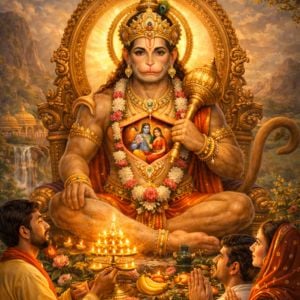
Verse 1
आरती कीजै हनुमान लला की।
दुष्ट दलन रघुनाथ कला की।
जाके बल से गिरवर कांपे।
रोग दोष जाके निकट न झांके।
The opening verse of this revered hymn invites devotees to perform the ceremonial worship of the beloved child Hanuman, describing him as the destroyer of the wicked and a profound manifestation of Lord Rama. Literally, it states that his immense strength causes even the mightiest mountains to tremble, while diseases and afflictions dare not approach anywhere near him or his devotees. The words establish both his endearing nature as an innocent child and his terrifying power against negative forces.
In the mythological context, this refers to his divine origin and his supreme role as the ultimate protector. The trembling mountains recall his legendary leaps across the ocean and his lifting of the Dronagiri mountain, feats that demonstrated his unparalleled physical prowess. Furthermore, Hanuman is considered an incarnation of Lord Shiva, which perfectly aligns with his description as an extension of Lord Rama's divine will and energy deployed specifically to eradicate evil from the world.
Philosophically, this verse represents the dual nature of divine grace, which is incredibly tender towards the seeker yet fiercely destructive towards inner impurities. The mountains that tremble symbolize our towering ego and stubborn ignorance, which are shaken to the core by the awakening of true devotion. The diseases and afflictions mentioned are not merely physical ailments but the spiritual maladies of greed, anger, and delusion. By performing this worship, the seeker invokes the awakened vital energy within, effectively clearing the mind of worldly afflictions and establishing pure consciousness.
Verse 2
अंजनी पुत्र महा बलदाई।
संतन के प्रभु सदा सहाई।
दे बीड़ा रघुनाथ पठाये।
लंका जारि सिया सुधि लाये।
This verse describes Hanuman as the immensely powerful son of Mother Anjani and the eternal helper of saints and holy beings. Literally, it recounts how Lord Rama entrusted him with the vital mission of finding Goddess Sita, offering him a ceremonial betel leaf as a mark of this great responsibility. Following this command, Hanuman traveled to Lanka, set the golden city ablaze, and successfully brought back the much-awaited news of Sita to his master.
From a mythological perspective, these lines summarize the pivotal Sundara Kanda episode of the great epic Ramayana. The offering of the betel leaf was a traditional ancient custom symbolizing the acceptance of a seemingly impossible task. Hanuman accepting this signifies his supreme devotion and readiness. His burning of Lanka was not an act of blind rage but a calculated demonstration of Rama's power to Ravana, serving as a warning while simultaneously destroying the morale of the demonic forces holding Sita captive.
On a deeper spiritual level, Mother Anjani represents pure, unblemished devotion, from which ultimate spiritual strength is naturally born. Lord Rama giving the betel leaf symbolizes the supreme self awakening the inner life force to seek out the lost soul, represented by Goddess Sita. Lanka embodies the fortress of ego, materialism, and sensory indulgence. Setting Lanka on fire philosophically signifies the burning away of worldly attachments and illusions through the intense fire of pure knowledge. Only when this citadel of ego is scorched can the seeker retrieve their pure consciousness.
Verse 3
लंका सो कोट समुद्र सी खाई।
जात पवनसुत वार न लाई।
लंका जारि असुरि सब मारे।
सीता रामजी के काज संवारे।
The literal translation of this verse highlights the formidable defenses of Lanka, which possessed massive fortified walls and a protective moat as vast as the ocean itself. Despite these insurmountable barriers, the son of the wind god did not take even a moment to cross over. He fearlessly burned down the entire fortress, destroyed the demonic entities residing there, and successfully accomplished the divine mission entrusted to him by Lord Rama and Goddess Sita.
Mythologically, this emphasizes the sheer physical scale of Ravana's stronghold, which was believed to be an impregnable city made of solid gold, protected by the treacherous ocean and heavily armed demonic guards. Hanuman crossing the ocean in a single magnificent leap showcases his status as the son of Vayu, inheriting the boundless speed and unbound nature of the wind. By dismantling the city defenses and annihilating the demons, he single-handedly proved that no worldly power could ever withstand the force of righteous devotion.
Philosophically, the heavily fortified city of Lanka represents the stubborn, heavily guarded human mind, surrounded by the vast, turbulent ocean of worldly desires and karmic cycles. The demons symbolize our inherent negative tendencies, such as lust, arrogance, and cruelty, which constantly guard our false ego. The wind represents the vital breath or Prana. When the life force is directed by pure devotion towards the supreme truth, it effortlessly crosses the ocean of illusion. The burning of the fort is the ultimate dissolution of the egoic mind.
Verse 4
लक्ष्मण मूर्छित पड़े धरणी में।
लाये संजीवन प्राण उबारे।
पैठि पाताल तोरि जम कारे।
अहिरावण की भुजा उखारे।
Literally, this section recalls the tragic moment when Lakshmana lay unconscious and dying on the battlefield. Hanuman swiftly brought the life-saving Sanjeevani herb, thereby rescuing him from the jaws of absolute death. The verse then shifts to another dark episode, describing how Hanuman descended into the deep netherworld, broke the heavy shackles of the god of death, and forcefully tore off the arms of the powerful illusionist demon Ahiravana.
In the mythological narrative, these lines refer to two distinct and critical rescue missions during the great Lanka war. First, when Meghnad struck Lakshmana with a fatal cosmic weapon, Hanuman flew to the Himalayas to bring the entire Dronagiri mountain since he could not identify the specific healing herb. Second, when Ahiravana abducted Rama and Lakshmana to the underworld for a blood sacrifice, Hanuman assumed his terrifying five-faced form. He infiltrated the netherworld, outsmarted the demon king, and physically dismembered Ahiravana to save his divine lords.
The spiritual significance of these heroic acts is incredibly profound. Lakshmana represents the individual soul focused awareness and sharp discrimination, which can sometimes be rendered unconscious by the lethal strike of deep-seated worldly ignorance. The Sanjeevani brought by Hanuman is the ultimate spiritual wisdom that revives the seeker inner clarity. Ahiravana represents the subconscious mind and the hidden subterranean fears that secretly kidnap our spiritual resolve. Hanuman descending to the underworld signifies the spiritual energy piercing the darkest depths of the subconscious mind to liberate the soul.
Verse 5
बाईं भुजा असुर संहारे।
दाईं भुजा सब संत उबारे।
सुर नर मुनि जन आरती उतारें।
जय जय जय हनुमान उचारें।
The literal meaning of this verse paints a vivid picture of Hanuman dual capacity, stating that with his left arm he completely destroys the demonic forces, while with his right arm he uplifts and protects all the saints and virtuous people. In absolute awe of these magnificent deeds, the celestial gods, human beings, and great sages collectively perform his ceremonial worship, continuously chanting joyful praises of victory to the glorious monkey god.
Mythologically, the right hand is traditionally considered the auspicious hand in Indian culture, heavily associated with blessing, giving, and performing sacred rituals. By using his right arm to protect the saints, Hanuman embodies the grace and benevolence of the supreme divine. The left hand, often associated with harsh or severe tasks, is appropriately used to crush evil entities. The collective worship by humans, sages, and gods demonstrates that Hanuman exploits bridge the earthly and celestial realms, establishing cosmic order and earning him universal adoration.
Philosophically, the two arms represent the twin functions of divine justice and divine grace within the grand cosmic play. The destruction of demons with the left hand signifies the necessary eradication of ignorance, negative conditioning, and harmful karma from our lives. The uplifting of saints with the right hand symbolizes the nurturing of inner virtues, deep peace, and spiritual wisdom. The massive chorus of gods and sages chanting his name signifies the total harmony of the entire spiritual universe when an individual aligns perfectly with the divine will.
Verse 6
कंचन थार कपूर की बाती।
आरती करत अंजना माई।
जो हनुमान जी की आरती गावैं।
बसि बैकुंठ अमर पद पावँ।
लंक विध्वंस किये रघुराई।
तुलसीदास स्वामी काीर्ति गाई।
This concluding verse literally describes Mother Anjani affectionately performing the worship of her heroic son using a golden platter adorned with a brightly glowing camphor wick. It carries a profound spiritual promise that anyone who sings this song of praise with true devotion will eventually reside in the highest celestial abode, attaining ultimate immortality. The hymn ends by acknowledging Lord Rama as the ultimate orchestrator of Lanka destruction, while the poet Tulsidas simply sings the glorious fame of his master.
The mythological image of Mother Anjani performing the aarti brings the grand epic narrative back to its sweet, domestic beginnings, beautifully contrasting his universe-shaking heroic feats with a mother tender love. The camphor burning on a golden plate is a traditional ritual item that famously leaves no residue when consumed by fire. By mentioning himself, the poet places this devotion within the great Bhakti tradition, recognizing himself as a humble witness who merely documents the immense glory that actually flows from Lord Rama through his perfect instrument.
In philosophical terms, the golden plate symbolizes a completely pure and enlightened intellect, while the camphor represents the human ego. Just as camphor burns out completely without leaving any trace behind, the ego must be entirely consumed by the fire of devotion, leaving behind nothing but the pure light of supreme consciousness. Attaining the celestial realm is not merely reaching a physical location after death, but arriving at a state of consciousness entirely free from anxiety. Through absolute surrender, the seeker transcends the mortal cycle completely.
aaratee keejai hanumaana lalaa kee.
dusht'a dalana raghunaatha kalaa kee.
jaake bala se giravara kaampe.
roga dosha jaake nikat'a na jhaanke.
anjanee putra mahaa baladaaee.
santana ke prabhu sadaa sahaaee.
de beeraa raghunaatha pat'haaye.
lankaa jaari siyaa sudhi laaye.
lankaa so kot'a samudra see khaaee.
jaata pavanasuta vaara na laaee.
lankaa jaari asuri saba maare.
seetaa raamajee ke kaaja samvaare.
lakshmana moorchhita pare dharanee mem.
laaye sanjeevana praana ubaare.
pait'hi paataala tori jama kaare.
ahiraavana kee bhujaa ukhaare.
baaeem bhujaa asura samhaare.
daaeem bhujaa saba santa ubaare.
sura nara muni jana aaratee utaarem.
jaya jaya jaya hanumaana uchaarem.
kanchana thaara kapoora kee baatee.
aaratee karata anjanaa maaee.
jo hanumaana jee kee aaratee gaavaim.
basi baikunt'ha amara pada paavam'.
lanka vidhvamsa kiye raghuraaee.
tulaseedaasa svaamee kaaeerti gaaee.





Other stotras


