Skanda Stava
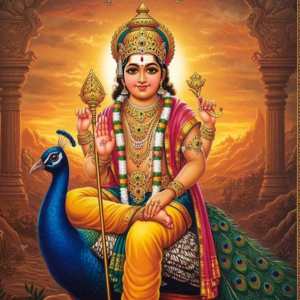
ऐश्वर्यमप्रतिममत्र भवान् कुमारः
सर्वत्र चावहतु नः करुणापणः सः ।
येनात्मवल्लषितभाग्यपरार्ध्यभूमिः
स्वाराज्यसम्पदपि शश्वदहो सनाथा ॥
May you, Lord Kumara, whose sovereignty is unparalleled, always grant us your compassion, which is your very currency. Ah, through you, even the great wealth of self-sovereignty finds its eternal support, and for those who cherish you as their own Self, you are the ultimate ground of their highest fortune.
This opening verse establishes Lord Kumara (Skanda) as the supreme ruler. The poet uses the unique phrase 'karuṇāpaṇaḥ', meaning his 'business' or 'transaction' is compassion. This suggests that the Lord's nature is simply to give grace freely, not in exchange for offerings. The verse goes on to state that even the highest spiritual goal, 'svārājya-sampad' (the state of total self-mastery or liberation), is sustained and given purpose by him. For a devotee who loves the Lord as their own innermost Self, this relationship is the greatest possible fortune, surpassing all other spiritual or material goals.
श्रीस्कन्दकल्पविटपी कुरुतात्स बाह्यम्
आभ्यन्तरं च विभवं युगपत्सदा नः ।
दृग्व्यापृतिप्रतिमितिं भ्रमरावलीं यो
नित्यं बिभर्ति करुणामकरन्दपुष्टाम् ॥
May Sri Skanda, the divine wish-fulfilling tree, grant us both external and internal prosperity, always and at the same time. He is the one who constantly bears a swarm of bees—his very own glances—which are nourished by the nectar of his compassion.
In this verse, Lord Skanda is compared to a 'kalpa-viṭapī', a celestial tree that grants any wish. The prayer is for both outer, worldly success ('bāhyam') and inner, spiritual wealth ('ābhyantaram') to be granted simultaneously. The second half paints a beautiful poetic picture: the Lord’s active glances ('dṛg-vyāpṛti') are likened to a swarm of bees. These bees are not seeking ordinary nectar; they are perpetually sustained by the sweet nectar ('makaranda') of his own compassion. This implies his grace is always active, seeking out devotees to bless them.
भद्रं कृषीष्ट नितरामिह सैद्धसेनी
सानुग्रहप्रकृतिनेत्रपरम्परा नः ।
मोहान्धकूपपतितेऽव्यभिचारतो द्राग्
या दोरकी भवति तत्पदबद्धचित्ते ॥
May the succession of glances from the Commander of the celestial army, whose very nature is grace, bestow upon us the highest good. For one whose mind is bound firmly to his feet, those glances unfailingly and instantly become a rope to rescue them from the dark well of delusion.
'Saiddhasenī' refers to Skanda as the leader of the divine army. The verse emphasizes that his fundamental nature is grace ('sānugraha-prakṛti'). The central metaphor is powerful: worldly attachment and ignorance ('moha') are portrayed as a dark well ('andhakūpa') into which people fall. For a devotee whose mind is completely focused on the Lord's feet, the continuous stream of his glances acts as a sturdy rope ('dorakī') that immediately pulls them out of this darkness. It highlights his role as the swift saviour from ignorance.
विद्या चतुर्दशतयी शरजन्मनाम्नि
यस्मिन्नु पर्यवसिताऽव्यवधानतो नः ।
पुष्णातु सैष सकलासु कलासु दाक्ष्यं
चिन्तामणिप्रतिभटी भवदङ्घ्रिरेणुः ॥
The fourteen traditional branches of knowledge find their ultimate and direct culmination in the one named Sharajanma. May this dust from your feet, which is a rival to the wish-fulfilling Chintamani gem, nourish our skill in all the arts.
This verse hails Skanda, also known as 'Sharajanma' ('born in a thicket of reeds'), as the supreme embodiment of all knowledge. The 'fourteen lores' represent the entire corpus of traditional sacred learning. The poet asserts that all this knowledge finds its final and most direct meaning in him. Then, in a classic expression of devotion, he praises the dust of the Lord's feet ('aṅghri-reṇuḥ'), claiming it is even more powerful than the mythical 'Chintamani' gem, which could grant any wish. This sacred dust is prayed to for the boon of proficiency ('dākṣyam') in all arts and sciences.
षाण्मातुरस्मितवलच्छरदागमो मे
प्रज्ञासरोवरमलं विमलं दधातु ।
येनात्र सच्चितियुसुखैकरसात्मचन्द्रं
साक्षात्करोत्वनिदमात्मतयाऽयमेव ॥
May the advent of autumn, which is the blossoming smile of the one with six mothers, make the lake of my intellect perfectly pure. By this, may this very self directly realize, as its own identity, the moon of the Self—the one essence of Existence-Consciousness-Bliss, which is beyond all description.
'Ṣāṇmātṛ' means 'one with six mothers', referring to the six Krittikas who nursed the infant Skanda. His smile is beautifully compared to the arrival of the clear autumn season, known for its pristine waters and clear skies. This divine smile is prayed to for purifying the 'lake of the intellect' ('prajñā-sarovaram'). The purpose of this inner purity is profound: it allows the individual to directly perceive ('sākṣāt-karotu') the true, innermost Self. This Self is described as a moon ('ātma-candram'), whose nature is 'sat-cit-sukha' (existence, consciousness, bliss), and which is 'anidam', meaning it cannot be objectified or pointed to as 'this'.
दद्युः श्रियस्त्रिभुवनाद्भुतबस्तुवार्द्धि-
मन्थाद्रिविभ्रमपटूनि गुहेक्षणानि ।
स्तन्यावसानसमये निजमातृवक्त्र-
पद्मे भ्रमद्भ्रमरिकालघुमन्थराणि ॥
May the glances of Guha grant us all blessings. His glances are skilled in acting like the Mandara mountain that churned the ocean to bring forth the wonders of the three worlds. At the same time, they are like gentle black bees that, after he finished nursing, hovered slowly over the lotus of his mother’s face.
This verse juxtaposes Skanda’s immense cosmic power with his tender, childlike form. His glances are first compared to the mighty Mandara mountain, which churned the celestial ocean to produce divine treasures, symbolizing his power to create all wonders. In the very next line, an intimate image is presented: the infant Guha (another name for Skanda) has just finished nursing from his mother, Parvati. His eyes, moving gently ('mantharāṇi') over her lotus-like face, are compared to soft, hovering bees. This contrast beautifully captures both the majesty and the sweetness of the divine.
नैसर्गिकी यदापि भिन्नपुमाश्रयात्वं
वाचः श्रियस्तदपि यत्करुणाकटाक्षः ।
सूतेऽन्वहं निजजनेषु रविप्रभेव
श्लिष्टे नुमः परमकारुणिकं गुहं तम् ॥
Although by nature the Goddess of Speech and the Goddess of Fortune reside with different male deities, we praise that supremely compassionate Guha, whose merciful side-glance, like the light of the sun, daily bestows both of them, united, upon his devotees.
This verse makes a point about the nature of the gods. Traditionally, Vāk (Saraswati, Goddess of Speech and knowledge) is the consort of Brahma, while Śrī (Lakshmi, Goddess of Fortune and wealth) is the consort of Vishnu. The poet notes that while they are separate, Lord Guha’s compassionate side-glance ('karuṇā-kaṭākṣaḥ') is so powerful that it grants both eloquence and prosperity together to his followers. His grace unites these two great powers, just as the sun brings both light and warmth, demonstrating his supreme and all-encompassing nature.
प्रत्यक्तया श्रुतिपुराणवचोनिगुम्फ-
स्तात्पर्यवान्भवति वर्णयितुं यमर्थम् ।
श्रेयांसि नैकविधया प्रकटं विदध्यात्
सैषोऽग्निभूरिह परार्थसमुद्यमेषु ॥
May that Agnibhu, who is the true intended meaning that all the scriptures, the Vedas and Puranas, strive to describe as the inmost Self, openly grant us various blessings in our endeavours for the welfare of others.
Here, Skanda is identified with the ultimate reality. The entire body of scriptures is said to have one final goal: to point toward the 'pratyak', the innermost Self or consciousness. The poet declares that Skanda, addressed here as 'Agnibhūḥ' ('born of fire'), is that very Self. The prayer is that this ultimate divine principle may bless all efforts ('samudyameṣu') that are undertaken not for personal gain, but for the good of others ('parārtha'). This shows that divine grace is sought to empower altruistic actions.
नैयत्यतो हृदि पदं स तनोतु बाल-
चर्यः स्थितिं य इह साक्षितयापि धत्ते ।
एवं च बुद्ध्यरणितत्पदचित्रगूत्था
संवित्तिदीपकलिकाखिलदीपिका स्यात् ॥
May he of childlike adventures, who also holds the position of the universal witness consciousness, firmly establish his presence in our hearts. In this way, may the small flame of pure awareness, sparked from the friction of the intellect-fire-stick against the kindling of his feet, become the light that illuminates everything.
This verse moves into deep philosophy. Skanda, though known for his youthful exploits ('bāla-caryaḥ'), is also the supreme 'sākṣī'—the silent, uninvolved witness consciousness that observes all of reality. The prayer is for this divine principle to become firmly fixed within the devotee’s heart. The second half uses the ancient Vedic image of creating fire with two wooden sticks ('araṇi'). The devotee's intellect ('buddhi') is one stick, and the Lord’s feet are the other. Through the 'friction' of deep meditation, a tiny flame of pure awareness ('saṁvitti-dīpa-kalikā') is born, and this inner light eventually grows to illuminate all of existence.
यमिन्मनागपि मनः प्रणिधाय काय-
व्यूहादिसर्वविभवं प्रतिपद्यते ना ।
योगेश्वरेश्वरमितः कृकवाकुकेतुं
भक्त्या व्रजामि शरणं करणत्रयैस्त्रिभिस्तम् ॥
By fixing the mind on him for even a moment, a person attains all powers, including that of creating multiple bodies. I, with devotion, take refuge with my three faculties in him, the Lord of the masters of yoga, whose banner is the rooster.
This verse speaks of the immense power gained from even brief meditation on Skanda. The 'kāya-vyūha' is a legendary yogic power (siddhi) to manifest in many bodies at once. This and all other powers are attainable by focusing on him, who is called 'Yogeśvareśvara' (the Lord even of the greatest masters of yoga). His banner is the rooster ('kṛkavāku-ketu'), which symbolizes the dawn of knowledge dispelling the darkness of ignorance. The poet concludes by surrendering completely with the 'three faculties' ('karaṇa-traya')—mind, speech, and body.
शब्दानुशासननयपतिनोऽत्र वर्ण-
व्यङ्ग्यस्ततो भवति योऽर्थ इवातिरिक्तः ।
स्फोटः स एष इति यं कथयन्ति नित्यं
कुर्मस्तमेयमिति षण्मुखनामधेयम् ॥
Just as in the system of grammar, there is a meaning that is suggested by the letters but is separate from them, which the wise eternally call 'Sphota'; we hold dear that very one who is known by the name Shanmukha.
This is a highly philosophical verse. It draws an analogy from the Indian philosophy of language, specifically the theory of 'Sphota'. This theory suggests that the true, indivisible meaning of a word ('Sphota') is a transcendent entity that is merely revealed by the temporary sounds of letters. The poet equates Lord Shanmukha ('the six-faced one') with this ultimate, unchanging reality. Just as Sphota is the real meaning behind the spoken word, Shanmukha is the ultimate truth behind all transient names and forms.
मार्गान्तरोक्तविधया परमाणुवर्गे-
ष्वाद्यं समुन्मिषति जन्तुकृतेन कर्म ।
यस्यात्मसंविदुदयस्य विभोः सिसृक्षा-
वेलासु नौमि परकारुणिकं गुहं तम् ॥
I bow to that supremely compassionate Guha, the Lord whose desire to create, at the appointed time, causes the first stirring in the groups of atoms, activated by the karma of living beings, for the sake of awakening their own self-awareness.
This verse places Skanda at the very beginning of cosmic creation. It acknowledges the atomic theories of other philosophical schools. The verse states that these fundamental atoms are first set into motion by the Lord's will to create ('sisṛkṣā'). This divine impulse is guided by the collective karma of all living beings. The ultimate purpose of this vast cosmic process, the poet says, is to provide a stage for these beings to eventually awaken to their true divine nature ('ātma-saṁvid-udaya'). Skanda is thus the compassionate prime mover of the universe.
यद्ययन्न पूरयति ते चरणानुषङ्ग-
स्तत्तद्ध्यनुद्भवपराहतमेव विद्मः ।
वस्त्वीप्सितं क्वचिदपीशतनूज तस्मा-
न्नेत्रामृतप्रभ दृशोर्विषयस्त्वमेधि ॥
O Son of the Lord Shiva! We know for certain that any desired object that is not fulfilled by devotion to your feet is as good as struck down by non-existence. Therefore, O you who shine like nectar for the eyes, please just be the object of our sight.
This verse expresses absolute faith. The poet declares that if a desire cannot be fulfilled through devotion to Skanda's feet, then it is simply an impossibility, as if it were 'struck by non-existence'. Having established this unshakable belief, the only remaining prayer is not for any worldly thing, but for the Lord himself. He is addressed as 'netrāmṛta-prabha' ('one whose radiance is like nectar to the eyes'), and the plea is simple: 'may you be the object of our vision'. The sight of the Lord becomes the ultimate fulfillment.
वाचस्पतिप्रमुखवागपि यत्र कुण्ठी-
भावं प्रयाति तमिति प्रणुवन्न लज्जे ।
त्वद्भक्तिभारमुखरीकरणान्मृषित्वा
स्वामिन्विधेहि तदपीह कृपार्द्रदृष्टिम् ॥
I am not ashamed to be praising him, about whom the speech of even Vachaspati (the lord of speech) and others becomes blunted. O Master, please forgive this act, which was prompted by the overwhelming weight of my devotion, and cast upon me your glance, moist with compassion.
The poet shows great humility. He acknowledges that the Lord's glory is so vast that even Brihaspati (Vachaspati), the master of eloquence, would be unable to describe him fully. Despite his own inadequacy, the poet is not ashamed because he feels compelled to speak by the sheer force of his devotion ('tvad-bhakti-bhāra'). He asks forgiveness for this 'transgression' of trying to describe the indescribable and prays for a glance 'moist with compassion' ('kṛpā-ārdra-dṛṣṭim').
कालत्रयेऽपि करणत्रयसम्पदे नः
सर्वोत्तमत्वत इहाभिमतं तवापि ।
यद्यद्धि तत्तदखिलं करुणाम्बुवारि-
वाहाशु मे वितर हे भगवन्नमस्ते ॥
O Lord, whatever you consider to be the most excellent attainment for our three faculties in all three divisions of time, please grant all of it to me quickly, O cloud of compassion. Salutations to you, O Bhagavan!
This is a prayer of complete and intelligent surrender. The devotee doesn't ask for specific boons based on his limited understanding. Instead, he asks for whatever the Lord himself deems best ('abhimataṁ tava'). This blessing should apply to his 'three faculties' (mind, speech, body) and encompass all 'three times' (past, present, and future). The Lord is addressed as a 'rain cloud of compassion' ('karuṇāmbu-vāri-vāha'), ready to shower grace. The verse is a total entrustment to divine wisdom, ending with a simple and profound 'namaste'.
श्रीबाहुलेयस्तवमुत्तमं यः
पठेत्प्रभाते प्रयतः स धीमान् ।
वागर्थविज्ञानघनाढ्यतामेति
अन्ते विशोकं पदमभ्युपेयात् ॥
The wise person who, with purity, recites this excellent hymn to Sri Bahuleya in the morning, attains great richness in speech, its meaning, and profound knowledge. At the end, they reach the state that is free from all sorrow.
This final verse, the 'Phalashruti', describes the benefits of reciting the hymn. 'Bahuleya' is a name for Skanda, from being nurtured by the Krittikas. It promises that a person who recites this hymn with a pure heart ('prayataḥ') in the morning will be blessed with deep proficiency in speech, its meaning, and spiritual wisdom. The ultimate reward is that 'at the end' ('ante'), they will attain the 'viśokaṁ padam'—the state beyond all sorrow, which is another name for liberation (Moksha).
ऐश्वर्यमप्रतिममत्रभवान्कुमारः
सर्वत्र चावहतु नः करुणापणः सः ।
येनात्मवल्लषितभाग्यपरार्ध्यभूमिः
स्वाराज्यसम्पदपि शश्वदहो सनाथा ॥
श्रीस्कन्दकल्पविटपी कुरुतात्स बाह्य-
माभ्यन्तरं च विभवं युगपत्सदा नः ।
दृग्व्यापृतिप्रतिमितिं भ्रमरावलीं यो
नित्यं बिभर्ति करुणामकरन्दपुष्टाम् ॥
भद्रं कृषीष्ट नितरामिह सैद्धसेनी
सानुग्रहप्रकृतिनेत्रपरम्परा नः ।
मोहान्धकूपपतितेऽव्यभिचारतो द्राग्
या दोरकी भवति तत्पदबद्धचित्ते ॥
विद्या चतुर्दशतयी शरजन्मनाम्नि
यस्मिन्नु पर्यवसिताऽव्यवधानतो नः ।
पुष्णातु सैष सकलासु कलासु दाक्ष्यं
चिन्तामणिप्रतिभटी भवदङ्घ्रिरेणुः ॥
षाण्मातुरस्मितवलच्छरदागमो मे
प्रज्ञासरोवरमलं विमलं दधातु ।
येनात्र सच्चितियुसुखैकरसात्मचन्द्रं
साक्षात्करोत्वनिदमात्मतयाऽयमेव ॥
दद्युः श्रियस्त्रिभुवनाद्भुतबस्तुवार्द्धि-
मन्थाद्रिविभ्रमपटूनि गुहेक्षणानि ।
स्तन्यावसानसमये निजमातृवक्त्र-
पद्मे भ्रमद्भ्रमरिकालघुमन्थराणि ॥
नैसर्गिकी यदापि भिन्नपुमाश्रयात्वं
वाचः श्रियस्तदपि यत्करुणाकटाक्षः ।
सूतेऽन्वहं निजजनेषु रविप्रभेव
श्लिष्टे नुमः परमकारुणिकं गुहं तम् ॥
प्रत्यक्तया श्रुतिपुराणवचोनिगुम्फ-
स्तात्पर्यवान्भवति वर्णयितुं यमर्थम् ।
श्रेयांसि नैकविधया प्रकटं विदध्या-
त्सैषोऽग्निभूरिह परार्थसमुद्यमेषु ॥
नैयत्यतो हृदि पदं स तनोतु बाल-
चर्यः स्तिथिं य इह साक्षितयापि धत्ते ।
एवं च बुद्ध्यरणितत्पदचित्रगूत्था
संवित्तिदीपकलिकाखिलदीपिका स्यात् ॥
यमिन्मनागपि मनः प्रणिधाय काय-
व्यूहादिसर्वविभवं प्रतिपद्यते ना ।
योगेश्वरेश्वरमितः कृकवाकुकेतुं
भक्त्या व्रजामि शरणं करणणैस्त्रिभिस्तम् ॥
शब्दानुशासननयपतिनोऽत्र वर्ण
व्यङ्ग्यस्ततो भवति योऽर्थ इवातिरिक्तः ।
स्फोटः स एष इति यं कथयन्ति नित्यं
कुर्मस्तमेयमिति षण्मुखनामधेयम् ॥
मार्गान्तरोक्तविधया परमाणुवर्गे-
ष्वाद्यं समुन्मिषति जन्तुकृतेन कर्म ।
यस्यात्मसंविदुदयस्य विभोः सिसृक्षा-
वेलासु नौमि परकारुणिकं गुहं तम् ॥
यद्ययन्न पूरयति ते चरणानुषङ्ग-
स्तत्तद्ध्यनुद्भवपराहतमेव विद्मः ।
वस्त्वीप्सितं क्वचिदपीशतनूज तस्मा-
न्नेत्रामृतप्रभ दृशोर्विषयस्त्वमेधि ॥
वाचस्पतिप्रमुखवागपि यत्र कुण्ठी-
भावं प्रयाति तमिति प्रणुवन्न लज्जे ।
त्वद्भक्तिभारमुखरीकरणान्मृषित्वा
स्वामिन्विधेहि तदपीह कृपार्द्रदृष्टिम् ॥
कालत्रयेऽपि करणत्रयसम्पदे नः
सर्वोत्तमत्वत इहाभिमतं तवापि ।
यद्यद्धि तत्तदखिलं करुणाम्बुवारि-
वाहाशु मे वितर हे भगवन्नमस्ते ॥
श्रीबाहुलेयस्तवमुत्तमं यः
पठेत्प्रभाते प्रयतः स धीमान् ।
वागर्थविज्ञानघनाढ्यतामे-
त्यन्ते विशोकं पदमभ्युपेयात् ॥
aishvaryamapratimamatrabhavaankumaarah'
sarvatra chaavahatu nah' karunaapanah' sah' .
yenaatmavallashitabhaagyaparaardhyabhoomih'
svaaraajyasampadapi shashvadaho sanaathaa ..
shreeskandakalpavit'apee kurutaatsa baahya-
maabhyantaram' cha vibhavam' yugapatsadaa nah' .
dri'gvyaapri'tipratimitim' bhramaraavaleem' yo
nityam' bibharti karunaamakarandapusht'aam ..
bhadram' kri'sheesht'a nitaraamiha saiddhasenee
saanugrahaprakri'tinetraparamparaa nah' .
mohaandhakoopapatite'vyabhichaarato draag
yaa dorakee bhavati tatpadabaddhachitte ..
vidyaa chaturdashatayee sharajanmanaamni
yasminnu paryavasitaa'vyavadhaanato nah' .
pushnaatu saisha sakalaasu kalaasu daakshyam'
chintaamanipratibhat'ee bhavadanghrirenuh' ..
shaanmaaturasmitavalachchharadaagamo me
prajnyaasarovaramalam' vimalam' dadhaatu .
yenaatra sachchitiyusukhaikarasaatmachandram'
saakshaatkarotvanidamaatmatayaa'yameva ..
dadyuh' shriyastribhuvanaadbhutabastuvaarddhi-
manthaadrivibhramapat'ooni guhekshanaani .
stanyaavasaanasamaye nijamaatri'vaktra-
padme bhramadbhramarikaalaghumantharaani ..
naisargikee yadaapi bhinnapumaashrayaatvam'
vaachah' shriyastadapi yatkarunaakat'aakshah' .
soote'nvaham' nijajaneshu raviprabheva
shlisht'e numah' paramakaarunikam' guham' tam ..
pratyaktayaa shrutipuraanavachonigumpha-
staatparyavaanbhavati varnayitum' yamartham .
shreyaam'si naikavidhayaa prakat'am' vidadhyaa-
tsaisho'gnibhooriha paraarthasamudyameshu ..
naiyatyato hri'di padam' sa tanotu baala-
charyah' stithim' ya iha saakshitayaapi dhatte .
evam' cha buddhyaranitatpadachitragootthaa
sam'vittideepakalikaakhiladeepikaa syaat ..
yaminmanaagapi manah' pranidhaaya kaaya-
vyoohaadisarvavibhavam' pratipadyate naa .
yogeshvareshvaramitah' kri'kavaakuketum'
bhaktyaa vrajaami sharanam' karananaistribhistam ..
shabdaanushaasananayapatino'tra varna
vyangyastato bhavati yo'rtha ivaatiriktah' .
sphot'ah' sa esha iti yam' kathayanti nityam'
kurmastameyamiti shanmukhanaamadheyam ..
maargaantaroktavidhayaa paramaanuvarge-
shvaadyam' samunmishati jantukri'tena karma .
yasyaatmasam'vidudayasya vibhoh' sisri'kshaa-
velaasu naumi parakaarunikam' guham' tam ..
yadyayanna poorayati te charanaanushanga-
stattaddhyanudbhavaparaahatameva vidmah' .
vastveepsitam' kvachidapeeshatanooja tasmaa-
nnetraamri'taprabha dri'shorvishayastvamedhi ..
vaachaspatipramukhavaagapi yatra kunt'hee-
bhaavam' prayaati tamiti pranuvanna lajje .
tvadbhaktibhaaramukhareekaranaanmri'shitvaa
svaaminvidhehi tadapeeha kri'paardradri'sht'im ..
kaalatraye'pi karanatrayasampade nah'
sarvottamatvata ihaabhimatam' tavaapi .
yadyaddhi tattadakhilam' karunaambuvaari-
vaahaashu me vitara he bhagavannamaste ..
shreebaahuleyastavamuttamam' yah'
pat'hetprabhaate prayatah' sa dheemaan .
vaagarthavijnyaanaghanaad'hyataame-
tyante vishokam' padamabhyupeyaat ..





Other stotras


