Subramanya Gadyam
Verse 1
पुरहरनन्दन रिपुकुलभञ्जन दिनकरकोटिरूप परिहृतलोकताप शिखीन्द्रवाहन महेन्द्रपालन
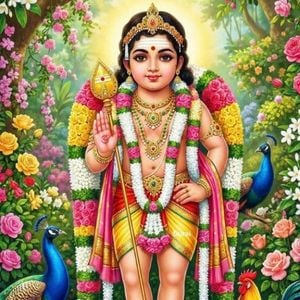
This opening verse establishes the divine lineage and the majestic persona of Lord Skanda. He is addressed as Puraharanandana, the delightful son of the one who destroyed the three cities, which refers to Lord Shiva. This identifies him as the offspring of supreme consciousness and power. He is further described as Ripukulabhanjana, the destroyer of the clans of enemies. In a spiritual context, these enemies are not just external foes but the internal vices like lust, anger, greed, and ego that prevent human spiritual evolution. His physical splendor is compared to Dinakarakotirupa, meaning he possesses the collective brilliance of ten million suns. This solar imagery signifies that he is the ultimate source of knowledge and the light that dispels the darkness of ignorance or Avidya. As Parihritalokatapa, he is the one who removes the miseries and burning heat of worldly existence. Life in the material world is often compared to a forest fire, and Skanda acts as the cooling rain or the protective shade for the soul. The verse also highlights his iconic iconography as Shikhindravahana, the one who rides the king of peacocks. The peacock represents the human ego and the mind’s wandering nature, which Skanda has subdued and turned into his vehicle, signifying his total mastery over pride and vanity. Finally, he is called Mahendrapalana, the protector of Indra, the king of the gods. This refers to the Puranic legend where Skanda led the celestial army to defeat the demon Surapadman, thereby restoring the heavens to the Devas. Through these names, the devotee acknowledges Skanda as both a fierce warrior and a compassionate savior who maintains the cosmic balance.
Verse 2
विधृतसकलभुवनमूल विधुतनिखिलदनुजतूल तापससमाराधित पापजविकाराजित कारुण्यसलिलपूराधार मयूरवरवाहन महेन्द्रगिरिकेतन
This segment delves deeper into the metaphysical nature of the Lord. He is Vidhruta-sakala-bhuvana-mula, the fundamental root that supports the entire universe. This suggests that Skanda is not merely a localized deity but the primordial energy from which all worlds emerge; he is the cosmic pillar of strength. He is further described as Vidhuta-nikhila-danuja-tula, the one who blows away the entire multitude of demons as if they were mere flakes of cotton. This metaphor emphasizes the ease with which divine power overcomes even the heaviest and most intimidating obstacles. The text identifies him as Tapasa-samaradhita, the one worshipped and meditated upon by great ascetics. This implies that while he is a warrior, his true essence is found in the deep silence of meditation. He is Papajavikara-ajita, the one who remains unconquered by the distortions or afflictions born of sin. He remains pure and unaffected by the modifications of the mind that plague ordinary mortals. Most touchingly, he is called Karunya-salila-puradhara, the reservoir or the vast receptacle of the waters of compassion. This portrays Skanda as an ocean of mercy, always ready to bathe his devotees in grace. He is again called Mayuravaravahana, riding his noble peacock, and Mahendragiriketana, the one whose abode or banner is on Mount Mahendra. This geographic reference connects the divine to the sacred landscapes of India, particularly the southern regions where his worship is most prevalent. This verse paints a picture of a God who is simultaneously the vast support of the cosmos and a tender, compassionate refuge for the suffering soul, ensuring that the devotee feels both protected by his power and comforted by his mercy.
Verse 3
भक्तिपरगम्य शक्तिकररम्य परिपालितनाक पुरशासनपाक निखिललोकनायक गिरिविदारिसायक महादेवभागधेय
In this verse, the focus shifts to the relationship between the devotee and the Lord. Skanda is Bhaktiparagamya, meaning he is reachable only through the path of supreme devotion. This suggests that while he is the supreme commander of the universe, he is easily captured by the thread of a devotee’s sincere love. He is Shaktikararamya, the one who is beautiful while holding the Shakti, which is his divine spear or Vel. The Vel is not just a physical weapon; it represents Jnana-Shakti, or the power of wisdom, which is sharp, deep, and wide. He is the protector of the heavens and the lord of all the worlds, as indicated by the titles Paripalitanaka and Nikhilalokanayaka. A key mythological feat is mentioned here: Girividarisayaka, the one whose arrow or spear split the mountain. This refers to the Krauncha mountain which the demon Taraka used as a hideout. Spiritually, the mountain represents the mountain of ego-based inertia. Skanda’s ability to pierce it symbolizes the soul’s liberation from the density of matter and the shattering of ignorance. Finally, he is called Mahadeva-bhagadeya, the fortune or the great merit of Lord Shiva. This is a profound philosophical statement implying that Skanda is the concentrated essence of Shiva’s own power and joy. As the son of Shiva and Parvati, he embodies the union of consciousness and energy. By praising him as the fortune of Shiva, the hymn suggests that even the Supreme Lord finds fulfillment in the manifestation of Skanda. For the devotee, this verse serves as a reminder that the path to the highest truth is through the cultivation of wisdom and the total surrender of the heart to the divine will.
Verse 4
विनतशोकनिवारण विविधलोककारण सुरवैरिकाल पुरवैरिबाल भवबन्धनविमोचन दलदम्बुजविलोचन करुणामृतरससागर
This verse addresses the existential concerns of the human condition and the cycle of rebirth. Skanda is Vinatashokanivarana, the remover of the sorrow of those who bow down to him. The act of bowing signifies the surrender of the ego, which is the prerequisite for the removal of grief. He is the Vividhalokakarana, the cause of the various worlds, acknowledging his role in the cosmic cycle of creation and maintenance. A powerful title used here is Suravairikala, the death or the time for the enemies of the gods. In Indian philosophy, Time is the ultimate destroyer, and by being the end for demons, Skanda represents the inevitable triumph of Dharma over evil. He is the Puravairibala, the young son of Shiva. The word Bala or child is significant because Skanda is often worshipped as Kumara, the eternally youthful prince, representing an energy that never decays and is always fresh and vigorous. The most vital spiritual promise is found in Bhavabandhanavimochana, the liberator from the bonds of Samsara. The fetters of existence are the attachments and karmas that keep the soul wandering through various births. Skanda, with his spear of wisdom, cuts these bonds. He is described as having eyes like the petals of a blooming lotus, Daladambujavilochana, which look upon the world with peace and love rather than anger. He is the Karunamritarasasagara, the ocean of the nectar-essence of compassion. This verse assures the seeker that the Lord is not just a distant warrior, but a loving father whose very gaze is a source of immortality and whose primary mission is the liberation of his children from the sorrows of the material world.
Verse 5
तरुणामृतकरशेखर वल्लीमानहारवेष मल्लीमालभारिकेश परिपालितविबुधलोक परिकालितविनतशोक
This portion of the hymn focuses on the divine aesthetic and the dual nature of Lord Skanda as both a celestial ruler and a charming, relatable figure. He is described as Tarunamritakarashekhara, which means he wears the young, nectar-shedding moon upon his head. This connects him directly to his father, Lord Shiva, and symbolizes his control over time and his cool, meditative temperament. He is Vallimanaharavesha, the one who assumed a captivating form to win the heart of Valli, the daughter of the earth. This epithet celebrates the Lord’s accessibility and his deep connection to nature and the tribal people. His adornment with jasmine garlands, Mallimalabharikesha, further emphasizes his beauty and the sweetness of his presence. He is the protector of the wise and the learned, Paripalitavibudhaloka, ensuring that those who seek knowledge are shielded from distractions and harm. The verse also calls him Parikalitavinatashoka, the one who carefully removes the grief of those who seek refuge in him. This indicates a very personal and attentive form of divine grace; the Lord does not just remove sorrow in a general sense but attends to the specific pain of the humble seeker. This section highlights that while Skanda is a great cosmic power, he is also an intimate protector who values beauty, love, and the intellectual and spiritual well-being of his devotees. It invites the practitioner to see the Lord as a guardian who is as gentle as a jasmine flower yet as profound as the crescent moon, providing a sense of comfort and aesthetic delight to the heart of the worshiper.
Verse 6
मुखविजितचन्दिर निखिलगुणमन्दिर भानुकोटिसदृशरूप वितृन्मनोहारिमन्दहास रिपुशिरोदारिचन्द्रहास श्रुतिकलितमणिकुण्डल रुचिविजितरविमण्डल
This segment provides a vivid description of the Lord's radiant and powerful appearance. His face is said to surpass the beauty of the moon, Mukhavijitachandira, suggesting a level of serenity and charm that is beyond any celestial body. He is Nikhilagunamandira, the temple or the dwelling place of all auspicious qualities. Every virtue known to mankind is found in its perfected state within him. The contrast is then made with his intense power, being Bhanukotisadrusharupa, possessing a form as brilliant as ten million suns. This duality of the moon-like face and sun-like radiance signifies that he is both the source of peace and the source of invincible power. His smile is described as Vitrun-manoharimandahasa, a gentle smile that enchants the heart and dispels the 'trishna' or thirst of worldly desires. Yet, he is also a fierce warrior, holding the Chandrahasa sword that can split the heads of enemies. His physical form is further embellished with gem-studded earrings, Shrutikalitamanikundala, which signify that his ears are always listening to the Vedic hymns. His overall glow is so intense that it conquers the brilliance of the solar orb itself, Ruchivijitaravimandala. This verse encourages the devotee to meditate on the physical form of the Lord, using these descriptions to build a mental image that is both beautiful and awe-inspiring. By doing so, the mind is purified and focused on the divine, leading to a state where the individual’s own internal light begins to reflect the brilliance of the Lord.
Verse 7
भुजवरविजितसाल भजनपरमनुजपाल नववीरसंसेवित रणधीर संभावितमनोहरशील महेन्द्रारिकील
In this verse, the poet praises the physical strength and the heroic nature of Lord Skanda. His arms are described as being so strong that they surpass the sturdy Sala trees, Bhujavaravijitasala. This indicates his immense capacity to protect and his unshakeable stability. He is the guardian of those humans who are devoted to him, Bhajanaparamanujapala, showing his special affection for those who engage in constant worship and prayer. The text mentions that he is served by nine great heroes, Navavirasansevita, referring to the legendary warriors who were born from the power of Parvati and who fought alongside Skanda in his battles against evil. He is Randhira, a brave warrior in the field of battle, whose nature is inherently beautiful and noble, Sambhavitamanoharashila. The epithet Mahendrarikila describes him as the fire or the destructive force for the enemies of Indra. This reinforces his role as the commander-in-chief of the divine forces. The verse portrays Skanda as a figure of immense dynamic energy and moral uprightness. He is not a passive deity but an active participant in the struggle against darkness. For the devotee, this description provides a sense of security, knowing that they are under the protection of a hero who is both physically invincible and morally perfect. It emphasizes that the Lord’s strength is always used for the benefit of the world and the protection of the righteous.
Verse 8
कुसुमविशदहास कलशिखरनिवास विजितकरणमुनिसेवित विगतमरणजनिभाषित स्कन्दपुरनिवास नन्दनकृतविलास कमलासनविनत चतुरागमविनुत
This section focuses on the Lord’s residence and his mastery over the spiritual path. His smile is as clear and bright as a flower, Kusumavishadahasa, representing his pure and joyous nature. He resides on the beautiful peaks of mountains, Kalashikharanivasa, such as the sacred hills where he is famously worshipped. He is served by sages who have conquered their senses, Vijitakaranamunisevita. This is a key point in the hymn, as it suggests that only those who have achieved self-mastery can truly serve and understand the essence of Skanda. He is described as being beyond the cycle of birth and death, Vigatamaranajanibhashita, meaning he is the eternal truth that remains unchanged. He dwells in the divine city of Skandapura and delights in his pastimes, Nandanakritavilasa. The verse also mentions that he is bowed to by Brahma, Kamalesanavinata, the creator who sits upon the lotus. Furthermore, he is praised by the four Vedas, Chaturagamavinuta. This elevates Skanda to the highest level of divinity, showing that even the creator of the universe and the primordial scriptures recognize his supremacy. This verse teaches the devotee that to reach the Lord, one must strive for the purity and sense-control modeled by the sages. It also reassures the practitioner that by worshipping Skanda, they are connecting with an eternal reality that is honored by the highest celestial beings and the very source of all knowledge.
Verse 9
कलिमलविहीन कृतसेवनसरसिजनिकाशशुभलोचन अहार्यानरधीर अनार्यानरदूर विदलितरोगजाल विरचितभोगमूल
In this verse, the Lord is hailed as the purifier and the healer. He is Kalimalavihina, the one who is free from the taints and sins associated with the Kali Yuga, the current age of spiritual decline. By worshipping him, the devotee also becomes free from these modern-day corruptions. His eyes are described as auspicious and resembling blooming lotuses, Sarasijanikashashubhalochana, looking upon his servants with kindness. He is Aharyanaradhira, the one whose courage cannot be taken away or shaken, and he remains distant from those who are not noble or righteous, Anaryanaradura. This highlights the importance of character in the spiritual journey. One of his most vital roles is mentioned as Vidalitarogajala, the destroyer of the web of diseases. This refers to both physical ailments and the spiritual disease of ignorance. He is the root cause of all true enjoyment and fulfillment, Virachitabhogamula, indicating that real happiness in life comes from divine grace rather than material pursuits. This verse provides great hope to those who are suffering from illness or the stresses of the modern age. It portrays Skanda as a steady, courageous guide who cleanses the soul and restores the body to health. It encourages the devotee to cultivate nobility and steadfastness, as these qualities bring one closer to the Lord who sits at the heart of all pure experience.
Verse 10
भोगीन्द्रभासित योगीन्द्रभावित पाकशासनपरिपूजित नाकवासिनिकरसेवित विद्रुतविद्याधर
This verse emphasizes the universal worship and the multifaceted appeal of Lord Skanda across different planes of existence. He is Bhogindrabhasita, meaning he is illumined or praised by the king of serpents, representing the subterranean powers and the kundalini energy. Simultaneously, he is Yogindrabhavita, meditated upon by the masters of yoga, indicating his presence in the highest states of spiritual consciousness. He is worshipped by Indra, the ruler of the gods, who is also known as Pakashasana. This shows that even the most powerful celestial rulers rely on Skanda’s strength and wisdom. Furthermore, he is served by the entire host of heavenly dwellers, Nakavasinikarasevita, and the Vidhyadharas, the celestial beings who possess great knowledge and magical powers. The term Vidrutavidyadhara suggests his ability to move even these semi-divine beings with his presence. This verse paints a picture of a deity who is the center of devotion for everyone—from the serpents of the underworld to the gods of the heavens and the yogis in their caves. It suggests that Skanda is a unifying force in the universe, bridging the material and spiritual worlds. For the devotee, this means that worshipping Skanda aligns them with the entire cosmic order, from the lowest to the highest realms of existence.
Verse 11
विद्रुमहृद्याधर दलितदनुजवेतण्ड विबुधवरदकोदण्ड परिपालितभूसुर मणिभूषणभासुर अतिरम्यस्वभाव श्रुतिगम्यप्रभाव
This section continues the glorification of Skanda’s physical beauty and his protective role. His lips are compared to coral, Vidrumahridyadhara, adding to the image of his divine attractiveness. He is the one who destroyed the elephant-like demons, Dalita-danuja-vetanda, a metaphor for his ability to crush the most powerful and stubborn obstacles. He holds a bow that grants boons to the wise, Vibudhavaradakodanda, showing that he is prepared to defend the righteous and reward the learned. He is the protector of the Brahmins and the spiritually inclined, Paripalitabhusura. His form is radiant with gem-studded ornaments, Manibhushanabhasura, which signify his royal status as the king of the universe. The poet describes his nature as extremely pleasing and beautiful, Atiramyasvabhava. Crucially, his power and influence are said to be understood through the study of the Vedas, Shrutigamyaprabhava. This connects the devotional aspect of the hymn back to the intellectual and scriptural foundations of the tradition. This verse reminds the seeker that while the Lord is aesthetically beautiful and compassionate, he is also the fierce protector of the cosmic law and the ancient wisdom. It encourages the devotee to seek the Lord both through the beauty of his form and the truth of the scriptures, promising that such a path leads to total protection and the fulfillment of all noble desires.
Verse 12
लीलाविशेषतोषितशङ्कर सुमसमरदन शशधरवदन विजयीभव विजयीभव
The final verse of the hymn concludes with a celebration of the Lord’s relationship with his father and a triumphant blessing. Skanda is the one who pleases Lord Shiva through his divine plays and heroic deeds, Lilavisheshatoshitashankara. This highlights the joy that the divine child brings to the Supreme Consciousness. His teeth are compared to small, beautiful flowers, Sumasamaradana, and his face is once again compared to the moon, Shashadharavadana, emphasizing his eternal youth and serenity. The hymn reaches its powerful climax with the repeated chant Vijayibhava, Vijayibhava, which means 'May you be victorious!' or 'Be thou the Victor!' This is not just a wish for the Lord’s victory, but a declaration of his eternal triumph over all that is dark and ignorant. For the devotee, this final chant acts as a powerful mantra for success in their own life’s battles. By chanting the victory of Skanda, the devotee participates in that victory and invokes the Lord's power to overcome their own obstacles, diseases, and spiritual bondages. The hymn ends on a high note of optimism and divine confidence, leaving the practitioner with a sense of peace, strength, and the assurance of divine protection. It summarizes the entire journey of the stotram—from acknowledging the Lord's birth to witnessing his beauty and finally celebrating his ultimate and inevitable victory over all worlds.
पुरहरनन्दन रिपुकुलभञ्जन दिनकरकोटिरूप
परिहृतलोकताप शिखीन्द्रवाहन महेन्द्रपालन
विधृतसकलभुवनमूल विधुतनिखिलदनुजतूल
तापससमाराधित पापजविकाराजित
कारुण्यसलिलपूराधार मयूरवरवाहन महेन्द्रगिरिकेतन
भक्तिपरगम्य शक्तिकररम्य परिपालितनाक
पुरशासनपाक निखिललोकनायक
गिरिविदारिसायक महादेवभागधेय
विनतशोकनिवारण विविधलोककारण सुरवैरिकाल पुरवैरिबाल भवबन्धनविमोचन दलदम्बुजविलोचन करुणामृतरससागर
तरुणामृतकरशेखर वल्लीमानहारवेष
मल्लीमालभारिकेश परिपालितविबुधलोक
परिकालितविनतशोक मुखविजितचन्दिर
निखिलगुणमन्दिर भानुकोटिसदृशरूप
वितृन्मनोहारिमन्दहास रिपुशिरोदारिचन्द्रहास
श्रुतिकलितमणिकुण्डल रुचिविजितरविमण्डल
भुजवरविजितसाल भजनपरमनुजपाल
नववीरसंसेवित रणधीर संभावितमनोहरशील
महेन्द्रारिकील कुसुमविशदहास कलशिखरनिवास
विजितकरणमुनिसेवित विगतमरणजनिभाषित
स्कन्दपुरनिवास नन्दनकृतविलास कमलासनविनत
चतुरागमविनुत कलिमलविहीन कृतसेवनसरसिजनिकाशशुभलोचन अहार्यानरधीर अनार्यानरदूर विदलितरोगजाल विरचितभोगमूल
भोगीन्द्रभासित योगीन्द्रभावित पाकशासनपरिपूजित
नाकवासिनिकरसेवित विद्रुतविद्याधर
विद्रुमहृद्याधर दलितदनुजवेतण्ड
विबुधवरदकोदण्ड परिपालितभूसुर
मणिभूषणभासुर अतिरम्यस्वभाव
श्रुतिगम्यप्रभाव लीलाविशेषतोषितशङ्कर
सुमसमरदन शशधरवदन विजयीभव विजयीभव
puraharanandana ripukulabhanjana dinakarakot'iroopa
parihri'talokataapa shikheendravaahana mahendrapaalana
vidhri'tasakalabhuvanamoola vidhutanikhiladanujatoola
taapasasamaaraadhita paapajavikaaraajita
kaarunyasalilapooraadhaara mayooravaravaahana mahendragiriketana
bhaktiparagamya shaktikararamya paripaalitanaaka
purashaasanapaaka nikhilalokanaayaka
girividaarisaayaka mahaadevabhaagadheya
vinatashokanivaarana vividhalokakaarana suravairikaala puravairibaala bhavabandhanavimochana daladambujavilochana karunaamri'tarasasaagara
tarunaamri'takarashekhara valleemaanahaaravesha
malleemaalabhaarikesha paripaalitavibudhaloka
parikaalitavinatashoka mukhavijitachandira
nikhilagunamandira bhaanukot'isadri'sharoopa
vitri'nmanohaarimandahaasa ripushirodaarichandrahaasa
shrutikalitamanikund'ala ruchivijitaravimand'ala
bhujavaravijitasaala bhajanaparamanujapaala
navaveerasamsevita ranadheera sambhaavitamanoharasheela
mahendraarikeela kusumavishadahaasa kalashikharanivaasa
vijitakaranamunisevita vigatamaranajanibhaashita
skandapuranivaasa nandanakri'tavilaasa kamalaasanavinata
chaturaagamavinuta kalimalaviheena kri'tasevanasarasijanikaashashubhalochana ahaaryaanaradheera anaaryaanaradoora vidalitarogajaala virachitabhogamoola
bhogeendrabhaasita yogeendrabhaavita paakashaasanaparipoojita
naakavaasinikarasevita vidrutavidyaadhara
vidrumahri'dyaadhara dalitadanujavetand'a
vibudhavaradakodand'a paripaalitabhoosura
manibhooshanabhaasura atiramyasvabhaava
shrutigamyaprabhaava leelaavisheshatoshitashankara
sumasamaradana shashadharavadana vijayeebhava vijayeebhava





Other stotras


