Relationship Between The Vedas And The World
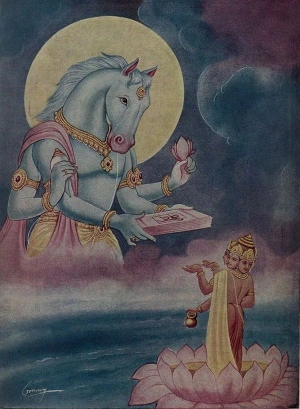
We know that the Vedas are Mantras.
Mantras are vibrations of fixed patterns.
These vibrations can manifest into both matter and energy.
When Brahma chants these Mantras at the time of creation, the world comes into existence.
Veda Mantras are of three types:
- Richas - poems.
- Yajus - prose.
- Samas - composed as music.
Rigveda and Atharva Veda are made up of Richas.
Yajurveda is made up of Yajus.
Samaveda is made up of Samas.
Veda explains how these Mantras manifest into the world.
ऋग्भ्यो जातां सर्वशो मूर्त्तिमाहुरन्या गतिर्याजुषी हैव शश्वत्।
सर्वं तेजः सामरूपं ह शश्वत् सर्वं हेदं ब्रह्मणा हैव सृष्टम्॥
Rigveda Mantras became all bodies, both movable and immovable.
Yajurveda Mantras became all the movements.
Samaveda Mantras became all the energies.
Atharva Veda Mantras connected all these together.
Close your eyes for a moment and imagine that the entire universe, with all its solid mountains, flowing rivers, and burning stars, didn't begin as 'stuff.' Instead, imagine it began as a sound. Not a random noise, but a precise, mathematical vibration.
In the ancient Vedic tradition, this is the foundational truth of our existence. We are told that the Vedas are not just books or stories; they are Mantras. And a Mantra, at its core, is a vibration of a fixed pattern. These aren't just words—they are the underlying code of reality. When we speak of the creation of the world, we are speaking of the moment Brahma, the creator, chanted these Mantras. Through that chant, sound became substance. Vibration manifested into both matter and energy.
To understand how this worked, we have to look at the architecture of these Mantras. They aren't all the same. They take three distinct forms, each serving a specific purpose in the 'construction' of our universe.
First, there are the Richas. These are the poetic Mantras, full of structure and rhythm. Most of the Rigveda and the Atharva Veda are composed of these poetic vibrations.
Then, we have the Yajus. This is prose—a more direct, flowing form of sound. This is the primary language of the Yajurveda.
Finally, there are the Samas. These are Mantras composed specifically as music. They are meant to be sung, carrying a melodic frequency that resonates differently than poetry or prose. These make up the Samaveda.
Think of these three—poetry, prose, and music—as the three primary colors from which the entire spectrum of the universe is painted.
But how does a poem or a song become a physical object? The ancient texts provide a profound explanation of this transformation.
The Rigveda, composed of those poetic Richas, is said to be the source of all 'bodies.' Every form you see—whether it is movable like an animal or a human, or immovable like a mountain or a tree—owes its physical structure to the vibrations of the Rigveda. It is the blueprint for matter. It provides the shape, the boundary, and the physical presence of everything in the cosmos.
But a body without movement is just a statue. That’s where the Yajurveda comes in. The prose of the Yajus becomes the principle of movement itself. It is the kinetic energy, the flow of time, the orbit of planets, and the circulation of blood in our veins. If the Rigveda provides the 'form,' the Yajurveda provides the 'action.'
Then, we have the Samaveda. Remember, these are the Mantras of music. The ancient wisdom tells us that the Samaveda manifested as all the energies of the world—what is called 'Tejas.' This is the heat of the sun, the light of a flame, and the electrical impulses in our nervous system. It is the brilliance and the power that animates the physical forms.
So, we have the Body from the Rigveda, the Movement from the Yajurveda, and the Energy from the Samaveda.
But there is one more piece to this cosmic puzzle. How do these three distinct forces stay together? Why doesn't the energy simply fly away from the body? Why doesn't the movement become chaotic?
This is the role of the Atharva Veda. The Mantras of the Atharva Veda act as the 'connector.' They are the unifying field, the spiritual glue that binds matter, movement, and energy into a single, cohesive, and functioning universe. It ensures that the 'fixed patterns' of the Mantras remain stable so that life can flourish.
When we look at the world through this lens, we realize that we aren't living in a collection of random accidents. We are living inside a massive, ongoing symphony.
Every object you touch, every movement you make, and every spark of energy you feel is a manifestation of a specific Vedic vibration. We are, quite literally, made of sound. Brahma’s chant didn't just happen once at the beginning of time—it is vibrating right now, in the very atoms of your being.
The next time you find yourself in silence, remember that beneath that silence is the ancient rhythm of the Vedas, holding the world together, one vibration at a time.



English
Vedas
Click on any topic to open
7
30
Astrology
Bhagavad Gita
Bhagavatam
Bharat Matha
Devi
Devi Mahatmyam
Ganapathy
Garuda Puranam
Glory of Venkatesha
Hanuman
Kathopanishad
Mahabharatam
Mantra Shastra
Mystique
Practical Wisdom
Purana Stories
Radhe Radhe
Ramayana
Rare Topics
Rigveda Explained
Rituals
Sages and Saints
Shiva
Spiritual books
Sri Suktam
Story of Sri Yantra
Temples
Vedas
Vishnu Sahasranama
Yoga Vasishta
26
17
10
0


