The True Spirit and Essence of Vedic Marriage
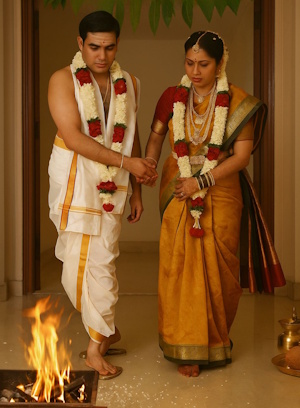
Two most important rituals in Vedic marriage are Pani Grahanam and Sapta Padi.
Pani Grahanam means taking hold of the hand.
The bride stretches her hand, holding the fingers like a flower bud, and the groom takes hold of her hand.
Where else do you see two people holding hands? In a handshake.
When two people are meeting, they show warmth to each other by holding each other’s hands — a gesture of friendliness, a gesture of equality.
When a deal is struck where both sides are satisfied, they shake hands expressing satisfaction — this handshake is also a commitment towards each other.
This is a modern practice in the civilized world — an expression of friendliness, equality, and commitment.
This is built into marriage, right at its beginning — through this gesture.
Gender equality is built into Vedic marriage. We don’t need another law for bringing this about.
These gestures matter a lot, you see.
You don’t shake hands with your guru, because he is above you — clear.
You don’t sit cross-legged in a chair when a puja is going on at your place.
You sit down with folded hands — clearly showing Bhagavan is above you.
These are clearly conveyed through signs and gestures.
But marriage starts with holding hand — equal footing, friendship, commitment.
Not just signs and gestures — look at the mantras used here.
The groom is telling the bride:
सखा सप्तपदा भव – having taken these seven steps, be my friend.
Why seven steps? The seven worlds above — bhu, bhuva, etc.
Growth, progress — together. The steps are taken together, jointly.
There is no individual progress hereafter. Whatever happens, is together only.
The husband has to grow with the wife. The wife has to grow with the husband.
सखायौ सप्तपदा बभूव – let’s be friends.
सख्यं ते गमेयं – may I be your friend, accept my friendship.
सख्यान्मे मा योषं – may I never be deprived of your friendship.
सख्यान्मे मा योष्ठाः – may you never be deprived of my friendship.
समयाव संकल्पावहै – let’s take this resolve.
संप्रियौ रोचिष्णू – let’s be good to each other.
Let’s strengthen each other through mutual help.
सुमनस्यमानौ – being good to each other, kind to each other.
इषमूर्जमभि संवसानौ – by experiencing everything together, by enjoying everything together.
सं नौ मनांसि – may we both be like-minded, may we think alike, may we have the same choice, same goal, same destination.
सं व्रता – may our vows be together, may our religious observances be together.
समु चित्तान्याकरम – may our chittas, our hearts, our minds be alike, our emotions, our thoughts be alike.
सा त्वमस्यमूहममूहमस्मि सा त्वं – You are Rigveda, I am Samaveda.
In Omkara, there are three syllables — a, u, and ma.
You are the ukara connecting the akara and makara which is me.
This also denotes Yajurveda, since ukara joins and Yajurveda exists as Samhita — or joined together.
द्यौरहं पृथिवी त्वं – I am sky, you are earth — always joined together along the horizon, inseparable.
रेतोहं रेतेभृत्त्वं – I am the progenitor and you are its commander.
अमूऽहमस्मि वाक्त्वं – I am mind, you are words.
सामाहमस्मि ऋक्त्वं – once again, I am Samaveda, you are Rigveda.
सा मामनुव्रता भव – you be favourable to me.
What do you see here — gender equality or gender discrimination and oppression?
This is the true spirit of Sanatana Dharma. This is the true essence of marriage in Sanatana Dharma.
There could be cases of oppression, discrimination — isolated cases or many cases — but that should not be used to paint a picture that this is the practice of Sanatana Dharma.
No, it is not. That is not what Sanatana Dharma stands for.
What more proof do you want?
The very mantras used in marriage speak only about friendship and equality between husband and wife.






English
Rituals
Click on any topic to open
7
30
Astrology
Bhagavad Gita
Bhagavatam
Bharat Matha
Devi
Devi Mahatmyam
Ganapathy
Garuda Puranam
Glory of Venkatesha
Hanuman
Kathopanishad
Mahabharatam
Mantra Shastra
Mystique
Practical Wisdom
Purana Stories
Radhe Radhe
Ramayana
Rare Topics
Rigveda Explained
Rituals
Sages and Saints
Shiva
Spiritual books
Sri Suktam
Story of Sri Yantra
Temples
Vedas
Vishnu Sahasranama
Yoga Vasishta
26
17
10
0


