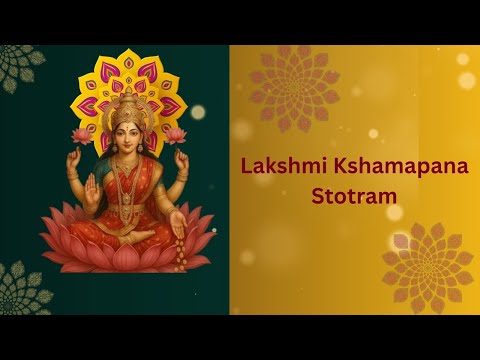
Lakshmi Kshamapana Stotram
क्षमस्व भगवत्यम्ब क्षमाशीले परात्परे । शुद्धसत्त्वस्वरूपे च कोपादिपरिवर्जिते ॥
Forgive us, O Divine Mother, O You whose very nature is forgiveness, O Supreme of the supreme. You are the embodiment of pure goodness (sattva) and are completely devoid of anger and other such passions.
This opening verse is a plea for forgiveness, addressing the Goddess with titles that highlight her compassionate nature. By calling her 'Kshamashile', or one whose innate character is forgiveness, the devotee immediately establishes her as merciful and approachable. The term 'Paratpare' means 'supreme of the supreme', acknowledging her ultimate position in the divine hierarchy. The description 'shuddhasattvasvarupe' signifies that she is the personification of 'sattva', the quality of purity, harmony, and goodness. As a result, she is inherently free from negative qualities like anger ('kopa') and passion, which arise from the lower modes of nature. This establishes the deity's pure and benevolent essence.
उपमे सर्वसाध्वीनां देवीनां देवपूजिते । त्वया विना जगत्सर्वं मृततुल्यं च निष्फलम् ॥
You are the very standard of comparison for all virtuous women and goddesses, and You are worshipped by the gods. Without You, the entire world is like a corpse, lifeless and futile.
This verse elevates the Goddess to the position of the ultimate ideal. She is the 'upama' or the benchmark against which all virtue ('sadhvinam') is measured, both among mortals and divine beings ('devinam'). The second line makes a profound philosophical statement: she is the animating force, the 'Shakti', that infuses the universe with life. Without her presence, the cosmos ('jagat sarvam') is inert, meaningless, and equivalent to a dead body ('mritatulyam'). This reflects the core Tantric and Shakta concept that consciousness (Shiva) without energy (Shakti) is static; it is the Divine Mother who provides the energy for all creation, sustenance, and activity.
सर्वसम्पत्स्वरूपा त्वं सर्वेषां सर्वरूपिणी । रासेश्वर्यधिदेवी त्वं त्वत्कलाः सर्वयोषितः ॥
You are the embodiment of all forms of wealth, and for all beings, You take on all forms. You are the presiding deity of the Rasa dance, and all women are but your partial manifestations.
Here, her all-encompassing nature is praised. She is not merely a giver of wealth ('sampat'), but is wealth itself in all its forms—material, spiritual, and intellectual. As 'Sarvarupini', she is the substance behind every form in existence, revealing her immanence. The specific mention of her as 'Raseshvaryadhidevi' identifies her with Radha, the queen of the celestial Rasa dance with Krishna, signifying her as the embodiment of the highest, most ecstatic devotional love. The final declaration, 'tvatkalah sarvayoshitah', is a powerful statement of immanence, viewing all femininity as divine; every woman in the world is considered a spark or a part ('kala') of the great Goddess.
कैलासे पार्वती त्वं च क्षीरोदे सिन्धुकन्यका । स्वर्गे च स्वर्गलक्ष्मीस्त्वं मर्त्यलक्ष्मीश्च भूतले ॥
In Kailasha, You are Parvati, and in the ocean of milk, You are the Daughter of the Ocean (Lakshmi). In heaven, You are the celestial Lakshmi, and as mortal Lakshmi, You are on the earthly plane.
This verse begins to identify the singular great Goddess with various well-known goddesses in their specific abodes, a common devotional practice that unifies different traditions under one Supreme Mother. In Mount Kailasha, the abode of Shiva, she is his consort Parvati. In the ocean of milk ('Kshiroda'), she is 'Sindukanyaka' (daughter of the ocean), a name for Lakshmi who emerged from its churning. She manifests as 'Svargalakshmi' for the gods in heaven and as 'Martyalakshmi' to bestow fortune upon beings on Earth ('bhutale').
वैकुण्ठे च महालक्ष्मीर्देवदेवी सरस्वती । गङ्गा च तुलसी त्वं च सावित्री ब्रह्मालोकतः ॥
In Vaikuntha, You are Mahalakshmi, and You are the goddess of goddesses, Saraswati. You are Ganga and Tulsi, and in the realm of Brahma, You are Savitri.
The hymn continues to equate her with other primary forms of divinity. In Vaikuntha, the abode of Vishnu, she is Mahalakshmi, the great goddess of fortune. She is also identified as Saraswati, the goddess of knowledge, arts, and wisdom. The verse then expands her identity beyond anthropomorphic forms to sacred elements of nature: she is the holy river Ganga and the sacred plant Tulsi (holy basil), both revered as divine living entities. Finally, in Brahmaloka, the abode of the creator Brahma, she is his consort Savitri, completing her identification with the feminine divine energies of the Hindu trinity of Brahma, Vishnu, and Shiva.
कृष्णप्राणाधिदेवी त्वं गोलोके राधिका स्वयम् । रासे रासेश्वरी त्वं च वृन्दावनवने वने ॥
You are the presiding deity of Krishna's very life-breath; in Goloka, You are Radha herself. You are the queen of the Rasa dance (Raseshwari) in the forests of Vrindavan.
This verse focuses on her supreme manifestation within the Vaishnava tradition, particularly that centered on Radha-Krishna. She is identified directly and unequivocally with Radha. She is not just a consort, but the very life force of Krishna ('Krishnapranadhidevi'), implying they are inseparable. In Goloka, the highest spiritual realm, she is Radha. In the divine play on earth, she is 'Raseshwari', the absolute mistress of the Rasa dance, which is the symbol of the highest union between the soul and the Divine, enacted in the sacred landscape of Vrindavan.
कृष्णा प्रिया त्वं भाण्डीरे चन्द्रा चन्दनकानने । विरजा चम्पकवने शतशृङ्गे च सुन्दरी ॥
You are Krishna's beloved (Priya) in the Bhandira forest, and you are Chandra in the sandalwood forest. You are Viraja in the Champaka forest, and in the hundred-peaked mountain, you are Sundari.
This and the following verses list her various specific manifestations, often associated with particular places within the holy land of Vraja. These names (Priya, Chandra, Viraja, Sundari) represent different 'gopis' or divine milkmaids who are expansions of Radha, each embodying a unique flavour of love for Krishna. By being present in each of these specific forms and locations, her intimate and personal connection to every aspect of the sacred, divine landscape is emphasized.
पद्मावती पद्मवने मालती मालतीवने । कुन्ददन्ती कुन्दवने सुशीला केतकीवне ॥
You are Padmavati in the lotus forest and Malati in the Malati grove. You are Kundadanti in the jasmine forest and Sushila in the Ketaki grove.
The list of her specific forms continues, linking her essence to the beauty of nature. Each form is named after a flower or a virtuous quality and is situated in a forest of that same flower. She is Padmavati (the one with lotuses) in the lotus forest and Malati (a type of jasmine) in the Malati grove. 'Kundadanti' means 'one with teeth like jasmine buds', a poetic description of beauty. This illustrates that the divine feminine is not an abstract concept but is immanent and can be perceived in the fragrance, beauty, and purity of the natural world.
कदम्बमाला त्वं देवी कदम्बकाननेऽपि च । राजलक्ष्मी राजगेहे गृहलक्ष्मीगृहे गृहे ॥
You are the goddess Kadambamala in the Kadamba forest. You are Rajalakshmi in the royal palace and Grihalakshmi in each and every home.
This verse concludes the list of her specific manifestations by moving from the wildness of the forests to the heart of human civilization. In the Kadamba forest, a tree famously associated with Lord Krishna's pastimes, she is 'Kadambamala' (one with a garland of Kadamba flowers). The hymn then brings her grace into society. As 'Rajalakshmi', she is the embodiment of the fortune and sovereignty of the king in his palace ('rajagehe'). As 'Grihalakshmi', she is the presiding auspiciousness, peace, and prosperity within every single household ('grihe grihe'), making her the source of well-being at all levels of existence.
इत्युक्त्वा देवताः सर्वा मुनयो मनवस्तथा । रूरूदुर्नम्रवदनाः शुष्ककण्ठोष्ठ तालुकाः ॥
Having spoken thus, all the gods, the sages, and the Manus, with faces bowed in humility and their throats, lips, and palates dry, began to weep.
This verse marks a dramatic shift in tone from praise to pathos. After extolling the Goddess in her myriad forms, the supplicants are revealed. They are not ordinary mortals but the highest of beings: the gods ('devatah'), the great seers ('munayah'), and the progenitors of humanity ('manavah'). Their physical state—bowed heads, dry mouths ('shushka kanthoshtha talukah'), and weeping ('ruruduh')—conveys extreme distress and desperation. This implies that this hymn was not offered in a time of peace, but as a desperate plea during a cosmic crisis, perhaps when the Goddess had withdrawn her auspicious presence from the world.
इति लक्ष्मीस्तवं पुण्यं सर्वदेवैः कृतं शुभम् । यः पठेत्प्रातरूत्थाय स वै सर्वै लभेद् ध्रुवम् ॥
This is the meritorious and auspicious hymn to Lakshmi, which was composed by all the gods. Whoever recites it after rising in the morning will certainly obtain everything.
This verse begins the 'Phalashruti', the section that describes the fruits or benefits of reciting the hymn. It establishes the stotram's divine origin, stating it is sacred ('punyam'), auspicious ('shubham'), and was composed by the gods themselves ('sarvadevaih kritam'). A simple prescription is given for its use: recite it in the morning ('pratarutthaya'). The promise is magnificent and all-encompassing: the devotee will 'certainly obtain everything' ('sarvai labhed dhruvam'), underscoring the hymn's immense power.
अभार्यो लभते भार्यां विनीतां सुसुतां सतीम् । सुशीलां सुन्दरीं रम्यामतिसुप्रियवादिनीम् ॥
A man without a wife obtains a wife who is humble, the mother of good sons, chaste, of good character, beautiful, charming, and one who speaks very sweetly.
The text now specifies the all-encompassing boons, starting with the fundamental needs of a householder. For a bachelor ('abharyah'), the hymn promises a wife endowed with all the ideal traditional virtues. She is described as 'vinita' (humble), 'sati' (chaste and devoted), 'sushila' (of good character), 'sundari' (beautiful), and 'ramya' (charming). Her ability to bear good sons ('susutam') and her pleasant speech ('atisupriyavadinim') are also highlighted as key qualities for a harmonious and prosperous family life.
पुत्रपौत्रवतीं शुद्धां कुलजां कोमलां वराम् । अपुत्रो लभते पुत्रं वैष्णवं चिरजीविनम् ॥
[He obtains a wife] who will have sons and grandsons, who is pure, of noble birth, gentle, and excellent. A sonless person obtains a son who is a devotee of Vishnu and long-lived.
This verse continues the description of the ideal wife and then addresses the profound human desire for progeny. The wife will ensure the continuation of the family line ('putrapautravatim'), and she is also 'shuddham' (pure), 'kulajam' (from a good family), and 'komalam' (gentle). The focus then shifts to the childless ('aputrah'). The hymn promises not just any son, but one of superior spiritual and physical quality: a 'Vaishnavam' (a devotee of Vishnu, hence righteous and spiritual) who will be 'chirajivinam' (long-lived).
परमैश्वर्ययुक्तं च विद्यावन्तं यशस्विनम् । भ्रष्टराज्यो लभेद्राज्यं भ्रष्टश्रीर्लभते श्रियम् ॥
[The son will be] endowed with great sovereignty, learned, and famous. One who has lost his kingdom will regain his kingdom, and one who has lost his fortune will regain his wealth.
The qualities of the promised son are elaborated further: he will possess great authority and wealth ('paramaishvaryayuktam'), be learned ('vidyavantam'), and renowned ('yashasvinam'). The hymn then moves to the theme of restoration, positioning itself as a remedy for loss of status and wealth. A king who has been deposed ('bhrashtarajyah') will regain his kingdom, and a person who has lost all prosperity ('bhrashtashrih') will regain that fortune ('shri'). This speaks to the Goddess's power to reverse misfortune.
हतबन्धुर्लभेद्बन्धुं धनभ्रष्टो धनं लभेत् । कीर्तिहीनो लभेत्कीर्तिं प्रतिष्ठां च लभेद् ध्रुवम् ॥
One who has lost his kinsmen will find kinsmen; one who has lost his money will get money. A person without fame will attain fame, and will certainly gain prestige.
This verse continues the list of restorative boons, covering social, financial, and reputational losses. One who is bereft of family and friends ('hatabandhuh') will find community again. One who is bankrupt ('dhanabhrashtah') will regain wealth. One who is obscure or has a bad reputation ('kirtihinah') will gain fame ('kirtim') and social standing ('pratishtham'). The word 'dhruvam' (certainly, surely) is repeated to instill faith in the unfailing power of the prayer.
सर्वमङ्गलदं स्तोत्रं शोकसन्तापनाशनम् । हर्षानन्दकरं शश्वद्धर्ममोक्षसुहृत्प्रदम् ॥
This hymn bestows all forms of auspiciousness and destroys grief and suffering. It eternally brings joy and bliss, and grants good friends, righteousness (dharma), and liberation (moksha).
This final verse summarizes the hymn's supreme benefits, elevating them from the material to the spiritual. It is a source of all that is auspicious ('sarvamangalam') and a destroyer of all sorrow ('shokasantapanashanam'). It is a perennial source of joy and bliss ('harshanandakaram'). The ultimate promise transcends worldly gains; it leads the devotee towards the highest goals of human life. It grants good company ('suhrit'), a life of righteousness ('dharma'), and ultimately, the final goal of spiritual liberation ('moksha'), thus offering a complete path to worldly and spiritual fulfillment.
क्षमस्व भगवत्यम्ब क्षमाशीले परात्परे ।
शुद्धसत्त्वस्वरूपे च कोपादिपरिवर्जिते ॥
उपमे सर्वसाध्वीनां देवीनां देवपूजिते ।
त्वया विना जगत्सर्वं मृततुल्यं च निष्फलम् ॥
सर्वसम्पत्स्वरूपा त्वं सर्वेषां सर्वरूपिणी ।
रासेश्वर्यधिदेवी त्वं त्वत्कलाः सर्वयोषितः ॥
कैलासे पार्वती त्वं च क्षीरोदे सिन्धुकन्यका ।
स्वर्गे च स्वर्गलक्ष्मीस्त्वं मर्त्यलक्ष्मीश्च भूतले ॥
वैकुण्ठे च महालक्ष्मीर्देवदेवी सरस्वती ।
गङ्गा च तुलसी त्वं च सावित्री ब्रह्मालोकतः ॥
कृष्णप्राणाधिदेवी त्वं गोलोके राधिका स्वयम् ।
रासे रासेश्वरी त्वं च वृन्दावनवने वने ॥
कृष्णा प्रिया त्वं भाण्डीरे चन्द्रा चन्दनकानने ।
विरजा चम्पकवने शतशृङ्गे च सुन्दरी ॥
पद्मावती पद्मवने मालती मालतीवने ।
कुन्ददन्ती कुन्दवने सुशीला केतकीवने ॥
कदम्बमाला त्वं देवी कदम्बकाननेऽपि च ।
राजलक्ष्मी राजगेहे गृहलक्ष्मीगृहे गृहे ॥
इत्युक्त्वा देवताः सर्वा मुनयो मनवस्तथा ।
रूरूदुर्नम्रवदनाः शुष्ककण्ठोष्ठ तालुकाः ॥
इति लक्ष्मीस्तवं पुण्यं सर्वदेवैः कृतं शुभम् ।
यः पठेत्प्रातरूत्थाय स वै सर्वै लभेद् ध्रुवम् ॥
अभार्यो लभते भार्यां विनीतां सुसुतां सतीम् ।
सुशीलां सुन्दरीं रम्यामतिसुप्रियवादिनीम् ॥
पुत्रपौत्रवतीं शुद्धां कुलजां कोमलां वराम् ।
अपुत्रो लभते पुत्रं वैष्णवं चिरजीविनम् ॥
परमैश्वर्ययुक्तं च विद्यावन्तं यशस्विनम् ।
भ्रष्टराज्यो लभेद्राज्यं भ्रष्टश्रीर्लभते श्रियम् ॥
हतबन्धुर्लभेद्बन्धुं धनभ्रष्टो धनं लभेत् ।
कीर्तिहीनो लभेत्कीर्तिं प्रतिष्ठां च लभेद् ध्रुवम् ॥
सर्वमङ्गलदं स्तोत्रं शोकसन्तापनाशनम् ।
हर्षानन्दकरं शश्वद्धर्ममोक्षसुहृत्प्रदम् ॥
kshamasva bhagavatyamba kshamaasheele paraatpare .
shuddhasattvasvaroope cha kopaadiparivarjite ..
upame sarvasaadhveenaam' deveenaam' devapoojite .
tvayaa vinaa jagatsarvam' mri'tatulyam' cha nishphalam ..
sarvasampatsvaroopaa tvam' sarveshaam' sarvaroopinee .
raaseshvaryadhidevee tvam' tvatkalaah' sarvayoshitah' ..
kailaase paarvatee tvam' cha ksheerode sindhukanyakaa .
svarge cha svargalakshmeestvam' martyalakshmeeshcha bhootale ..
vaikunt'he cha mahaalakshmeerdevadevee sarasvatee .
gangaa cha tulasee tvam' cha saavitree brahmaalokatah' ..
kri'shnapraanaadhidevee tvam' goloke raadhikaa svayam .
raase raaseshvaree tvam' cha vri'ndaavanavane vane ..
kri'shnaa priyaa tvam' bhaand'eere chandraa chandanakaanane .
virajaa champakavane shatashri'nge cha sundaree ..
padmaavatee padmavane maalatee maalateevane .
kundadantee kundavane susheelaa ketakeevane ..
kadambamaalaa tvam' devee kadambakaanane'pi cha .
raajalakshmee raajagehe gri'halakshmeegri'he gri'he ..
ityuktvaa devataah' sarvaa munayo manavastathaa .
rooroodurnamravadanaah' shushkakant'hosht'ha taalukaah' ..
iti lakshmeestavam' punyam' sarvadevaih' kri'tam' shubham .
yah' pat'hetpraatarootthaaya sa vai sarvai labhed dhruvam ..
abhaaryo labhate bhaaryaam' vineetaam' susutaam' sateem .
susheelaam' sundareem' ramyaamatisupriyavaadineem ..
putrapautravateem' shuddhaam' kulajaam' komalaam' varaam .
aputro labhate putram' vaishnavam' chirajeevinam ..
paramaishvaryayuktam' cha vidyaavantam' yashasvinam .
bhrasht'araajyo labhedraajyam' bhrasht'ashreerlabhate shriyam ..
hatabandhurlabhedbandhum' dhanabhrasht'o dhanam' labhet .
keertiheeno labhetkeertim' pratisht'haam' cha labhed dhruvam ..
sarvamangaladam' stotram' shokasantaapanaashanam .
harshaanandakaram' shashvaddharmamokshasuhri'tpradam ..





Other stotras


