Amba Stuti
Verse 1
चेटी भवन्निखिलखेटी कदंबवनवाटीषु नाकपटली
कोटीरचारुतरकोटीमणीकिरणकोटीकरम्बितपदा ।
पाटीरगन्धिकुचशाटी कवित्वपरिपाटी मगाधिपसुता
घोटीखुरादधिकधाटीमुदारमुखवीटीरसेन तनुताम् ‖ 1 ‖
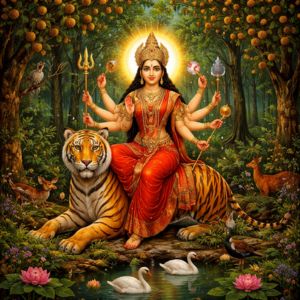
This opening verse introduces the Goddess in her idyllic abode, the Kadamba forest. The term cheti-bhavannikhila-kheti describes the host of celestial beings who serve her like humble attendants. The Goddess is depicted as Moadhipasuta, the daughter of the mountain king, Himavan. The imagery emphasizes her divine radiance, where the light from the millions of precious gems set in the crowns of gods—who bow at her feet—creates a shimmering aura around her lotus-like feet. She is described as wearing a garment that exudes the cooling fragrance of sandalwood, known as patira-gandhi-kucha-shati.
Philosophically, this verse establishes the absolute supremacy of the Devi, before whom the entire celestial pantheon bows. The mention of poetic structure, kavitva-paripati, suggests that she is the source of all artistic inspiration and linguistic beauty. The comparison of her swift grace and the sweetness of her breath, likened to the flavor of betel leaves, or mukhaviti-rasa, indicates the transition from the terrifying aspect of the destroyer to the soothing, nourishing mother who flows with grace and mercy toward her devotees. She is the fountainhead of wisdom and the embodiment of aesthetic delight.
Verse 2
द्वैपायनप्रभृतिशापायुधत्रिदिवसोपानधूलिचरणा
पापापहस्वमनुजापानुलीनजनतापापनोदनिपुणा ।
नीपालया सुरभिधूपालका दुरितकूपादुदञ्चयतु मां
रूपाधिका शिखरिभूपालवंशमणिदीपायिता भगवती ‖ 2 ‖
Here, the poet invokes the Goddess as the savior who redeems souls from the depths of worldly suffering. The epithet dvipayana-prabhriti-shapayudha refers to the great sages like Vyasa, whose wisdom and curses are governed by the power residing in her feet. The dust of her feet is compared to a ladder that elevates the seeker to the highest heavens. She is described as the one capable of removing the sins of humanity, papapaha, and providing shelter to those who seek refuge.
The mythological context points to her role as the daughter of the mountains, acting as a luminous beacon, manipayita, for the lineage of kings. The metaphor of the well of sins, duritakupa, signifies the entrapment of the soul in mundane attachments. Philosophically, the verse emphasizes that the Devi is not merely a mythological figure but the ultimate refuge from the cycle of karma. By invoking her, the devotee seeks liberation from the darkness of ignorance. Her presence is the radiant light that clarifies the path for the seeker, transforming the devotee through the purification of their internal nature.
Verse 3
यालीभिरात्मतनुतालीनकृत्प्रियकपालीषु खेलति भवा
व्यालीनकुल्यसितचूलीभरा चरणधूलीलसन्मणिगणा ।
यालीभृति श्रवसि तालीदलं वहति यालीकशोभितिलका
सालीकरोतु मम काली मनः स्वपदनालीकसेवनविधौ ‖ 3 ‖
In this verse, the Goddess is addressed as Kali, the dark and fierce yet loving mother. She is depicted playing with Shiva, who is the beloved Kapali, the bearer of the skull. The poet describes her beauty in detail: her hair is adorned with serpents, vyalinakula, and her feet are so radiant that even the gems upon them reflect the dust she walks upon. The use of alliteration highlights her ornaments, such as the palm-leaf earring, talidalam, and the auspicious tilaka on her forehead.
The spiritual significance lies in the union of the fierce and the tender. Kali is the destroyer of time and space, yet she resides in the heart of the devotee who performs the service of her lotus feet, padanalika. The repetition of the word yali denotes the playfulness and the subtle, elusive nature of her grace. This verse invites the seeker to move beyond the fear of the dark aspect of the divine and recognize that the destruction of the ego is the necessary prelude to the blissful service of the Divine Mother. She is the power that cleanses the mind of its dualistic perceptions.
Verse 4
बालामृतांशुनिभफालामनागरुणचेला नितम्बफलके
कोलाहलक्षपितकालामराकुशलकीलालशोषणरविः ।
स्थूला कुचे जलदनीलाकचे कलितवीला कदम्बविपिने
शूलायुधप्रणतिशीला दधातु हृदि शैलाधिराजतनया ‖ 4 ‖
This verse paints a vibrant portrait of the Goddess. Her forehead shines like the young crescent moon, balamritanshu, and she is dressed in vibrant crimson garments, arunachela. She is the radiant sun, ravi, who dries up the ocean of fear and chaos, kolsahala, that plagues the celestial beings. Her physical form is described with great devotion—her lush hair is like the dark rain-bearing clouds, jaladanilache, and her breasts are full and youthful, indicating her status as the mother of the universe.
She is the one who bows to the Shula-bearing Shiva, shulayudha-pranati-shila, yet is the master of all energies. Philosophically, this verse emphasizes the harmony of her being. She is both the youthful maiden and the ancient source of energy. By asking her to reside in the heart, hridi, the devotee seeks to internalize her qualities. She is the force that silences the internal agitation, the chaos of the mind, and establishes a state of stable, serene existence within the practitioner, mirroring the stillness of the Kadamba forest.
Verse 5
कम्बावतीव सविडम्बा गलेन नवतुम्बाभवीणसविधा
बिम्बाधरा विनतशम्बायुधादिनिकुरुम्बा कदम्बविपिने ।
अम्बा कुरङ्गमदजम्बालरोचिरिह लम्बालका दिशतु मे
शं बाहुलेयशशिबिम्बाभिराममुखसम्बाधिता स्तनभरा ‖ 5 ‖
The poet describes the Goddess as having a neck shaped like a conch shell, kamba, which is a mark of divine auspiciousness. Her lips are as red as the bimba fruit, and she is surrounded by celestial beings who bow before her. The description of her as wearing musk, kurangamada, evokes the earthy yet divine scent associated with her presence in the Kadamba grove. The verse mentions her son, Bahuleya, Kartikeya, whose beauty mirrors the radiance of her face.
This verse highlights the maternal and compassionate aspect of the Devi. Despite her power, she is the gentle Amba who provides welfare, sham. The reference to the weight of her breasts, stanabhara, is a traditional poetic expression of her abundant, nourishing grace, symbolizing the overflow of love that she pours upon her children. Philosophically, the verse reminds the seeker that the divine is intimately connected to the human experience of love and beauty. She is the embodiment of all that is desirable, and by meditating on her divine form, the devotee attracts that same divine grace into their own life.
Verse 6
दासायमानसुमहासा कदम्बवनवासा कुसुम्भसुमनो-
वासा विपञ्चिकृतरासा विधूतमधुमासारविन्दमधुरा ।
कासारसूनततिभासाभिरामतनुरासारशीतकरुणा
नासामणिप्रवरभासा शिवा तिमिरमासादयेदुपरतिम् ‖ 6 ‖
This verse celebrates the joy and the aesthetic richness of the Goddess. She possesses a radiant smile, mahasa, that makes even the gods act as her humble servants. Her abode is the Kadamba forest, and she wears clothes dyed with the saffron-like kusumbha flower. The imagery of the music of the veena, vipanchikrita-rasa, indicates that she is the orchestrator of the divine dance of creation. Her compassion is described as a cool shower, asara-shita-karuna, which provides relief from the scorching heat of worldly existence.
The philosophical core here is the removal of darkness, timira, which represents ignorance. Her nose-ring, which gleams with precious stones, illuminates the path for the seeker. She is Shiva, the auspicious one, who brings an end to the restless movement of the mind, uparatim. By focusing on her beauty and kindness, the seeker finds an inner stillness that transcends the turbulent fluctuations of life. The verse portrays the transition from active participation in the world to the deep, silent rest in the divine consciousness, where all contradictions find their reconciliation in her grace.
Verse 7
न्यङ्काकरे वपुषि कङ्कालरक्तपुषि कङ्कादिपक्षिविषये
त्वं कामनामयसि किं कारणं हृदयपङ्कारिमे हि गिरिजाम् ।
शङ्काशिलानिशितटङ्कायमानपदसङ्काशमानसुमनो-
झङ्कारिभृङ्गततिमङ्कानुपेतशशिसङ्काशवक्त्रकमलाम् ‖ 7 ‖
In a striking shift, the poet questions the devotee why they dwell on the temporary and the grotesque—like the skeletal, blood-stained, or animalistic aspects of existence, kankala-raktapushi—instead of focusing on the Goddess. He urges the mind, heart-pankari, to seek the daughter of the mountain, Girija. The verse describes her feet as being like a chisel that carves through the stony fear of the heart, shanka-shila-nishita-tankayamana. Her face is as lovely and luminous as the moon, and it attracts the buzzing bees of the devotee’s thoughts.
The deeper significance is an invitation to shift one’s focus from the perishable external world to the imperishable divine reality. The stark imagery of bones and birds is a reminder of the transience of the body and the ego. By turning toward the Goddess, whose face is the essence of sweetness, the seeker can overcome their doubts and fears. It is an exercise in mindfulness and concentration, teaching the seeker to replace base desires with the refined longing for the divine, effectively carving a path through the obstacles of the conditioned mind to reach the lotus of the heart.
Verse 8
जम्भारिकुम्भिपृथुकुम्भापहासि कुचसम्भाव्यहारलतिका
रम्भाकरीन्द्रकरदम्भापहोरुगतिडिम्भानुरञ्जितपदा ।
शम्भा उदारपरिरम्भाङ्कुरत्पुलकदम्भानुरागपिशुना
शं भासुराभरणगुम्भा सदा दिशतु शुम्भासुरप्रहरणा ‖ 8 ‖
This verse utilizes powerful metaphors to describe the physical beauty and the heroic nature of the Goddess. Her breasts, which put to shame the rounded forehead of Indra’s elephant, are adorned with pearl necklaces. Her gait, which mocks the grace of the elephant and the banana tree, reveals her divine majesty. She is the slayer of the demon Shumbha, and her embrace, parirambha, brings joy to the soul. The verse celebrates her as the one who bestows prosperity and peace, sham, through her radiant presence.
Mythologically, the victory over Shumbha represents the triumph of the divine light over the darkness of egoistic pride. Philosophically, the verse links the physical form of the Devi to her role as the destroyer of evil. The act of wearing ornaments and the pride in her beauty are symbols of the richness of creation that she presides over. The devotee is asked to look upon her as both the warrior who defends the righteousness and the mother who nourishes the spirit with her divine embrace, ensuring that the light of awareness always prevails over the darkness of ignorance.
Verse 9
दाक्षायणी दनुजशिक्षाविधौ विकृतदीक्षा मनोहरगुणा
भिक्षाशिनो नटनवीक्षाविनोदमुखि दक्षाध्वरप्रहरणा ।
वीक्षां विधेहि मयि दक्षा स्वकीयजनपक्षा विपक्षविमुखी
यक्षेशसेवितनिराक्षेपशक्ति जय लक्षावधानकलना ‖ 9 ‖
The Goddess is here invoked as Dakshayani, the daughter of Daksha, yet she is the one who destroyed the sacrificial rite of Daksha, dakshadhvara-praharana, because it lacked respect for Shiva. She is the teacher of the demons, danuja-shiksha-vidhau, and the consort of the beggar Shiva, bhikshashino. The poet pleads for her compassionate glance, viksham, to fall upon him, so that he may be counted among her own people, svakiya-jana-paksha.
This verse highlights her dual role as a strict teacher and a protective mother. Her power, shakthi, is absolute and unchallenged, as she is worshipped even by the Lord of the Yakshas, Kubera. Philosophically, the destruction of Daksha’s sacrifice symbolizes the destruction of the ego-driven rituals that do not recognize the unity of the divine. She is the one who clears the path of all obstacles, nirakshepa-shakti, and protects her devotees against the enemies of the self. The verse serves as a surrender to her divine will, seeking her intervention to turn the mind away from opposition and toward the ultimate realization of her presence.
Verse 10
वन्दारुलोकवरसन्धायिनी विमलकुन्दावदातरदना
बृन्दारुबृन्दमणिबृन्दारविन्दमकरन्दाभिषिक्तचरणा ।
मन्दानिला कलितमन्दारदामभिरमन्दाभिराममकुटा
मन्दाकिनीजवनभिन्दारवाचमरविन्दानना दिशतु मे ‖ 10 ‖
The Goddess is praised as the fulfiller of boons for those who pray to her, vandaru-loka-vara-sandhayini. Her teeth are as white as the pure jasmine, kunda, and her feet are bathed in the nectar-like adoration of the gods, who are compared to bees drinking the pollen of her lotus feet. She is adorned with Mandara garlands, and her crown is resplendent. The imagery of the river Mandakini flowing from her presence suggests the pure, cleansing, and life-giving stream of divine consciousness.
Spiritually, this verse emphasizes the nectar of devotion. The description of the gods worshipping her feet signifies that even the highest celestial beings recognize that the path to transcendence lies through the service and contemplation of the divine mother. Her face, which is as beautiful as a lotus, is the source of all peace. By invoking her, the seeker opens themselves to this cleansing flow of grace, allowing the nectar of her presence to wash away the stains of mundane life and revitalize the soul’s commitment to the divine path.
Verse 11
यत्राशयो लगति तत्रागजा भवतु कुत्रापि निस्तुलशुका
सुत्रामकालमुखसत्रासकप्रकरसुत्राणकारिचरणा ।
छत्रानिलातिरयपत्त्राभिभिरामगुणमित्रामरीसमवधूः
कुत्रासहीनमणिचित्राकृतिस्फुरितपुत्रादिदाननिपुणा ‖ 11 ‖
This verse expresses the intimacy between the devotee and the Goddess. Wherever the mind rests, the devotee wishes for the presence of Agaja, the daughter of the mountains. She is the one who protects her children from the jaws of time, the terrible cycle of birth and death, represented by Sutrama-kala. Her feet are the true refuge, sutrana-kari-charana, providing safety. The verse describes her as the one who grants all auspicious things, including prosperity, represented by the gift of sons and other blessings.
Philosophically, this is about the omnipresence of the Divine. The seeker prays that wherever their intention goes, the Goddess may manifest there. This is the stage of advanced meditation where the distinction between the meditator and the deity begins to dissolve. She is the constant companion, the inner guide who protects against the fear of the unknown. The reference to her miraculous form, chitra-akriti, indicates that she can appear in any way necessary to bless the devotee, showing that her grace is not limited by form or circumstance but is as vast as her compassion.
Verse 12
इन्धानकीरमणिबन्धा भवे हृदयबन्धावतीव रसिका
सन्धावती भुवनसन्धारणेऽप्यमृतसिन्धावुदारनिलया ।
गन्धानुभावमुहुरन्धालिपीतकचबन्धा समर्पयतु मे
शं धाम भानुमपिरुन्धानमाशु पदसन्धानमप्यनुगता ‖ 12 ‖
The concluding verse is a prayer for the ultimate union. The Goddess is the one who binds the heart with her love, hridaya-bandhavati, and is the embodiment of rasa, the essence of divine ecstasy. She holds the universe in balance, bhuvana-sandharane, yet she resides in the ocean of nectar, amrita-sindhu. The poet describes her hair, adorned with fragrant flowers, and asks for her to grant him the supreme abode that outshines even the brilliance of the sun, bhanam-api-rundhanam.
The spiritual culmination of this stotram is the request for the union of the soul with the divine, pada-sandhanam. The devotee acknowledges the Goddess as the source of all light and the sustainment of all existence. This verse moves beyond request for material gain to the desire for eternal bliss. By surrender to her beauty and her boundless power, the seeker finds their place in the ocean of nectar, finding peace and the dissolution of the ego into her radiance. It is a final act of devotion, entrusting one’s entire being to the Mother who is the beginning, the end, and the essence of all.
Lyrics:
चेटी भवन्निखिलखेटी कदम्बवनवाटीषु नाकपटली
कोटीरचारुतरकोटीमणीकिरणकोटीकरम्बितपदा ।
पाटीरगन्धिकुचशाटी कवित्वपरिपाटी मगाधिपसुता
घोटीखुरादधिकधाटीमुदारमुखवीटीरसेन तनुताम् ‖ 1 ‖
द्वैपायनप्रभृतिशापायुधत्रिदिवसोपानधूलिचरणा
पापापहस्वमनुजापानुलीनजनतापापनोदनिपुणा ।
नीपालया सुरभिधूपालका दुरितकूपादुदञ्चयतु मां
रूपाधिका शिखरिभूपालवंशमणिदीपायिता भगवती ‖ 2 ‖
यालीभिरात्मतनुतालीनकृत्प्रियकपालीषु खेलति भवा
व्यालीनकुल्यसितचूलीभरा चरणधूलीलसन्मणिगणा ।
यालीभृति श्रवसि तालीदलं वहति यालीकशोभितिलका
सालीकरोतु मम काली मनः स्वपदनालीकसेवनविधौ ‖ 3 ‖
बालामृतांशुनिभफालामनागरुणचेला नितम्बफलके
कोलाहलक्षपितकालामराकुशलकीलालशोषणरविः ।
स्थूला कुचे जलदनीलाकचे कलितवीला कदम्बविपिने
शूलायुधप्रणतिशीला दधातु हृदि शैलाधिराजतनया ‖ 4 ‖
कम्बावतीव सविडम्बा गलेन नवतुम्बाभवीणसविधा
बिम्बाधरा विनतशम्बायुधादिनिकुरुम्बा कदम्बविपिने ।
अम्बा कुरङ्गमदजम्बालरोचिरिह लम्बालका दिशतु मे
शं बाहुलेयशशिबिम्बाभिराममुखसम्बाधिता स्तनभरा ‖ 5 ‖
दासायमानसुमहासा कदम्बवनवासा कुसुम्भसुमनो-
वासा विपञ्चिकृतरासा विधूतमधुमासारविन्दमधुरा ।
कासारसूनततिभासाभिरामतनुरासारशीतकरुणा
नासामणिप्रवरभासा शिवा तिमिरमासादयेदुपरतिम् ‖ 6 ‖
न्यङ्काकरे वपुषि कङ्कालरक्तपुषि कङ्कादिपक्षिविषये
त्वं कामनामयसि किं कारणं हृदयपङ्कारिमे हि गिरिजाम् ।
शङ्काशिलानिशितटङ्कायमानपदसङ्काशमानसुमनो-
झङ्कारिभृङ्गततिमङ्कानुपेतशशिसङ्काशवक्त्रकमलाम् ‖ 7 ‖
जम्भारिकुम्भिपृथुकुम्भापहासि कुचसम्भाव्यहारलतिका
रम्भाकरीन्द्रकरदम्भापहोरुगतिडिम्भानुरञ्जितपदा ।
शम्भा उदारपरिरम्भाङ्कुरत्पुलकदम्भानुरागपिशुना
शं भासुराभरणगुम्भा सदा दिशतु शुम्भासुरप्रहरणा ‖ 8 ‖
दाक्षायणी दनुजशिक्षाविधौ विकृतदीक्षा मनोहरगुणा
भिक्षाशिनो नटनवीक्षाविनोदमुखि दक्षाध्वरप्रहरणा ।
वीक्षां विधेहि मयि दक्षा स्वकीयजनपक्षा विपक्षविमुखी
यक्षेशसेवितनिराक्षेपशक्ति जय लक्षावधानकलना ‖ 9 ‖
वन्दारुलोकवरसन्धायिनी विमलकुन्दावदातरदना
वृन्दारुवृन्दमणिवृन्दारविन्दमकरन्दाभिषिक्तचरणा ।
मन्दानिला कलितमन्दारदामभिरमन्दाभिराममकुटा
मन्दाकिनीजवनभिन्दानवाचमरविन्दानना दिशतु मे ‖ 10 ‖
यत्राशयो लगति तत्रागजा भवतु कुत्रापि निस्तुलशुका
सुत्रामकालमुखसत्रासकप्रकरसुत्राणकारिचरणा ।
छत्रानिलातिरयपत्त्राभिरामगुणमित्रामरीसमवधूः
कुत्रासहीनमणिचित्राकृतिस्फुरितपुत्रादिदाननिपुणा ‖ 11 ‖
इन्धानकीरमणिबन्धा भवे हृदयबन्धावतीव रसिका
सन्धावती भुवनसन्धारणेऽप्यमृतसिन्धावुदारनिलया ।
गन्धानुभावमुहुरन्धालिपीतकचबन्धा समर्पयतु मे
शं धाम भानुमपि रुन्धानमाशु पदसन्धानमप्यनुगता ‖ 12 ‖
chet'ee bhavannikhilakhet'ee kadambavanavaat'eeshu naakapat'alee
kot'eerachaarutarakot'eemaneekiranakot'eekarambitapadaa .
paat'eeragandhikuchashaat'ee kavitvaparipaat'ee magaadhipasutaa
ghot'eekhuraadadhikadhaat'eemudaaramukhaveet'eerasena tanutaam ‖ 1 ‖
dvaipaayanaprabhri'tishaapaayudhatridivasopaanadhoolicharanaa
paapaapahasvamanujaapaanuleenajanataapaapanodanipunaa .
neepaalayaa surabhidhoopaalakaa duritakoopaadudanchayatu maam'
roopaadhikaa shikharibhoopaalavam'shamanideepaayitaa bhagavatee ‖ 2 ‖
yaaleebhiraatmatanutaaleenakri'tpriyakapaaleeshu khelati bhavaa
vyaaleenakulyasitachooleebharaa charanadhooleelasanmaniganaa .
yaaleebhri'ti shravasi taaleedalam' vahati yaaleekashobhitilakaa
saaleekarotu mama kaalee manah' svapadanaaleekasevanavidhau ‖ 3 ‖
baalaamri'taam'shunibhaphaalaamanaagarunachelaa nitambaphalake
kolaahalakshapitakaalaamaraakushalakeelaalashoshanaravih' .
sthoolaa kuche jaladaneelaakache kalitaveelaa kadambavipine
shoolaayudhapranatisheelaa dadhaatu hri'di shailaadhiraajatanayaa ‖ 4 ‖
kambaavateeva savid'ambaa galena navatumbaabhaveenasavidhaa
bimbaadharaa vinatashambaayudhaadinikurumbaa kadambavipine .
ambaa kurangamadajambaalarochiriha lambaalakaa dishatu me
sham' baahuleyashashibimbaabhiraamamukhasambaadhitaa stanabharaa ‖ 5 ‖
daasaayamaanasumahaasaa kadambavanavaasaa kusumbhasumano-
vaasaa vipanchikri'taraasaa vidhootamadhumaasaaravindamadhuraa .
kaasaarasoonatatibhaasaabhiraamatanuraasaarasheetakarunaa
naasaamanipravarabhaasaa shivaa timiramaasaadayeduparatim ‖ 6 ‖
nyankaakare vapushi kankaalaraktapushi kankaadipakshivishaye
tvam' kaamanaamayasi kim' kaaranam' hri'dayapankaarime hi girijaam .
shankaashilaanishitat'ankaayamaanapadasankaashamaanasumano-
jhankaaribhri'ngatatimankaanupetashashisankaashavaktrakamalaam ‖ 7 ‖
jambhaarikumbhipri'thukumbhaapahaasi kuchasambhaavyahaaralatikaa
rambhaakareendrakaradambhaapahorugatid'imbhaanuranjitapadaa .
shambhaa udaaraparirambhaankuratpulakadambhaanuraagapishunaa
sham' bhaasuraabharanagumbhaa sadaa dishatu shumbhaasurapraharanaa ‖ 8 ‖
daakshaayanee danujashikshaavidhau vikri'tadeekshaa manoharagunaa
bhikshaashino nat'anaveekshaavinodamukhi dakshaadhvarapraharanaa .
veekshaam' vidhehi mayi dakshaa svakeeyajanapakshaa vipakshavimukhee
yaksheshasevitaniraakshepashakti jaya lakshaavadhaanakalanaa ‖ 9 ‖
vandaarulokavarasandhaayinee vimalakundaavadaataradanaa
vri'ndaaruvri'ndamanivri'ndaaravindamakarandaabhishiktacharanaa .
mandaanilaa kalitamandaaradaamabhiramandaabhiraamamakut'aa
mandaakineejavanabhindaanavaachamaravindaananaa dishatu me ‖ 10 ‖
yatraashayo lagati tatraagajaa bhavatu kutraapi nistulashukaa
sutraamakaalamukhasatraasakaprakarasutraanakaaricharanaa .
chhatraanilaatirayapattraabhiraamagunamitraamareesamavadhooh'
kutraasaheenamanichitraakri'tisphuritaputraadidaananipunaa ‖ 11 ‖
indhaanakeeramanibandhaa bhave hri'dayabandhaavateeva rasikaa
sandhaavatee bhuvanasandhaarane'pyamri'tasindhaavudaaranilayaa .
gandhaanubhaavamuhurandhaalipeetakachabandhaa samarpayatu me
sham' dhaama bhaanumapi rundhaanamaashu padasandhaanamapyanugataa ‖ 12 ‖
Meaning:
-
चेटी भवन्निखिलखेटी…
She whose feet are served by hosts of celestial maidens; the Divine Mother who dwells in the Kadamba grove. -
द्वैपायनप्रभृतिशापा…
She whose feet are sanctified by sages; the remover of sins and liberator of humanity. -
यालीभिरात्मतनुतालीन…
She who joyfully plays among attendants; may Goddess Kālī turn my mind toward devotion to her feet. -
बालामृतांशुनिभफाला…
The mountain-born daughter, radiant like nectar-moonlight, compassionate and worshipped with the trident. -
कम्बावतीव सविडम्बा…
The beautiful Mother with moonlike face and graceful form, enchanting even Śiva. -
दासायमानसुमहासा…
Śivā who dwells in the forest, whose compassion cools suffering and dispels darkness. -
न्यङ्काकरे वपुषि…
Why does the heart yearn for Girijā—she whose face is like the full moon amid humming bees? -
जम्भारिकुम्भिपृथुकुम्भा…
She who destroys the demon Śumbha, radiant with ornaments, ever granting auspiciousness. -
दाक्षायणी दनुजशिक्षा…
Dākṣāyaṇī, destroyer of Dakṣa’s sacrifice, protectress of devotees and foe of evil. -
वन्दारुलोकवरसन्धायिनी…
She whose lotus-feet are worshipped by gods, whose face blooms like a divine lotus. -
यत्राशयो लगति…
Wherever the mind rests, there she manifests—unequalled, bestower of prosperity and offspring. -
इन्धानकीरमणिबन्धा…
May the luminous Divine Mother swiftly unite my heart with her radiant abode.





Other stotras


