Why Brahmins Should Chant Gayatri Mantra Without Fail
Once upon a time, there was no rain on the earth for a few years.
Drought and famine spread everywhere.
Out of hunger and helplessness, people started killing and eating each other.
Seeking a solution, some Brahmins went to Gautama Muni.
Muni welcomed them and asked them what their worry was about.
They narrated the situation to him.
Muni told them - consider this ashrama as your own home.
Don't worry about anything as long as I am there.
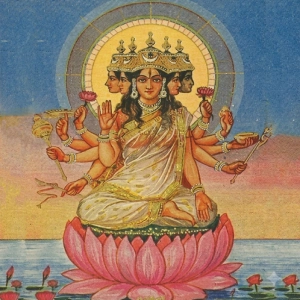
Muni started praising Gayatri Devi and Devi appeared.
Devi gave him an akshaya patra which would produce whatever was needed.
Muni produced grains, wealth, clothes, cows, etc. in abundance and gave to the Brahmins.
The Brahmins spent their time happily there.
It was always a festive mood in the ashrama.
Enemies and diseases could not even come near the ashrama.
More and more people came and took shelter in the ashrama.
Many yajnas were conducted.
People worshiped at the Gayatri temple every day.
Once, Narada Maharshi came to the ashrama.
He told Gautama Muni that his name had spread even in Swarga Loka.
Still, Gautama Muni did not have the slightest arrogance.
But some of the Brahmins who listened to this felt jealous.
They wanted to spoil Muni's name.
They created a cow using black magic.
It looked very weak.
They sent her to Muni's yagashala.
Even as the Muni was trying to send her out, the cow just collapsed and died.
The jealous Brahmins started spreading the rumor around that the Muni killed the cow.
Muni finished his yaga and came out.
Upon hearing what the Brahmins were doing, he felt very sad.
He cursed them - You will all become very lowly people.
You will lose your right over the Vedas and Gayatri Mantra.
You will lose interest in spiritual activities.
You will fall to such a level that you will have no hesitation in selling even your parents, wife, and children.
You will get the same Naraka where those who make a business out of holy places go.
Even your descendants will end up in Naraka.
The evil Brahmins became terribly scared.
They fell at Muni's feet and begged for mercy.
Muni said - My words can not go futile.
You will stay in Naraka till the time Bhagawan takes avatara as Sri Krishna.
Thereafter, you can take birth on earth.
But you will be protected from my curse only as long as you keep chanting Gayatri Mantra.
If you ever stop chanting Gayatri Mantra, you will again fall into serious trouble.
This is why Brahmins should chant Gayatri Mantra without fail every day.
- What does the extreme drought and subsequent cannibalism at the beginning of the story signify about the human condition?
It illustrates the total collapse of dharma and morality when basic survival needs are unmet. It highlights the overlooked principle that without both spiritual anchoring and material sustenance, humanity can easily revert to its most primal and destructive instincts. Gautama Muni's sanctuary thus becomes not just a physical refuge, but a necessary spiritual salvation. - How does Gautama Muni's reaction to the famine differ from the common people, and what deeper principle does this highlight?
While the common people resorted to violence and despair, Gautama Muni turned to devotion by invoking Gayatri Devi. This highlights the principle that true solutions to insurmountable worldly problems are often found through spiritual surrender and divine grace, rather than panic or moral compromise. - What is the deeper, mysterious symbolism of the Akshaya Patra provided by Gayatri Devi?
The Akshaya Patra represents the inexhaustible nature of divine providence. It reveals the hidden truth that when a pure mind is completely connected to the supreme consciousness, cosmic resources become limitless. It provided both material wealth and spiritual peace, reflecting the holistic, complete nature of true divine blessings. - Why did the Brahmins develop jealousy despite living in a perfect, disease-free ashrama provided entirely by the Muni?
Their jealousy exposes a profound human flaw: material comfort and safety, without internal spiritual discipline, inevitably breed ego. Despite living in an environment shielded from external enemies, their minds remained vulnerable to the internal enemy of envy, which was instantly triggered by Narada Maharshi praising someone other than them. - What is the hidden significance of the jealous Brahmins using black magic to create a weak cow?
The cow is universally revered in this tradition as the ultimate symbol of purity, innocence, and life-giving sustenance. By using dark arts to artificially create a dying cow for the purpose of deception, the Brahmins completely inverted their sacred duty. It shows how spiritual knowledge, when corrupted by arrogance, can be weaponized into destructive, unholy actions. - Why did Gautama Muni's curse specifically target the Brahmins' right to the Vedas and the Gayatri Mantra?
In spiritual law, a consequence always mirrors the offense. Because the Brahmins acted with profound ingratitude and deceit toward their savior, they proved themselves morally unworthy of holding supreme spiritual knowledge. Stripping them of the Vedas and the Gayatri Mantra reflects the hidden principle that spiritual authority and wisdom are entirely contingent upon inner moral purity. - What does the specific nature of the curse reveal about the karmic consequences of exploiting holy places?
The Muni stated they would suffer the same fate as those who make a business out of holy places. This indicates a mysterious and severe spiritual law: exploiting the sacred for personal gain, validation, or malicious intent is one of the gravest offenses. It leads to a complete loss of moral compass, generational degradation, and profound karmic suffering. - How does the arrival of Narada Maharshi act as a hidden catalyst in this narrative?
Narada Maharshi frequently acts as a divine instigator who forces hidden truths to the surface. By praising Gautama Muni's fame in Swarga Loka, Narada tested the spiritual maturity of everyone present. The Muni passed by remaining perfectly humble, while the Brahmins failed, allowing their hidden, toxic envy to manifest so it could ultimately be purged through the curse. - Why did Gautama Muni set the time of Sri Krishna's avatara as the turning point for the Brahmins' redemption?
Sri Krishna's descent to earth represents the cosmic restoration of dharma. By aligning their release from Naraka with this specific avatara, the Muni integrated their personal karmic punishment with the grander cosmic cycle of spiritual renewal. It shows that ultimate redemption from grave sins is tied to supreme divine intervention rather than just the passage of time. - What is the ultimate, overlooked message regarding the daily chanting of the Gayatri Mantra?
The story reveals that the Gayatri Mantra is not merely a passive, ritualistic chant, but an active, protective shield and a vital tether to one's spiritual identity. It suggests that continuous, disciplined connection to the divine through the mantra is the only fail-safe against falling back into karmic traps, moral degradation, and the latent effects of past transgressions.





English
Purana Stories
Click on any topic to open
7
30
Astrology
Bhagavad Gita
Bhagavatam
Bharat Matha
Devi
Devi Mahatmyam
Ganapathy
Garuda Puranam
Glory of Venkatesha
Hanuman
Kathopanishad
Mahabharatam
Mantra Shastra
Mystique
Practical Wisdom
Purana Stories
Radhe Radhe
Ramayana
Rare Topics
Rigveda Explained
Rituals
Sages and Saints
Shiva
Spiritual books
Sri Suktam
Story of Sri Yantra
Temples
Vedas
Vishnu Sahasranama
Yoga Vasishta
26
17
10
0


