Matsya Avatar
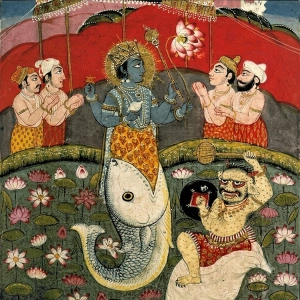
Why did Bhagawan Vishnu take Matsya avatar?
Once the world is created it would last for 4.32 billion years.
This period is called a Kalpa.
After that a pralaya would destroy everything.
At the time of pralaya, all worlds such as Bhumi would be submerged underwater.
At the end of the previous Kalpa….
Manu was the ruler of the earth.
He was the progenitor of mankind.
One day, he was offering tarpana (offering water filled by holding both palms together) for the forefathers at River Kritamala.
A small fish got trapped in the water in his palms.
He was about to put it back into the river.
The fish said: please don’t do that.
I am scared of the cruel animals in the river.
Manu put the fish into his pot and took it back to the palace.
By the time he reached the palace, the fish had already grown as big as the pot.
Manu transferred it to another bigger vessel.
The fish kept on growing.
It was put into a pond, then into a lake, and finally into the sea.
Manu knew that it was no ordinary fish.
With folded hands he told the fish: I realize that you are none other than Sriman Narayana.
Why are you testing me like this?
The fish said: yes, you are right; I am Narayana.
I have taken avatar as matsya (fish) to protect the world.
Seven days from now, pralaya is going to happen.
At that time, a boat would appear.
You invite the Saptarshis into that boat and also get seeds of everything required to create the world again.
There will be huge waves during pralaya.
You should keep the boat tied to my horn to keep it stable.
Stay in the boat till the time Brahma is ready for the next creation.
(After pralaya, it is the night of Brahma for 4.32 billion years. Creation happens again after that.)
After saying this, the fish disappeared.
After seven days, the world started submerging into water.
At that time a boat and huge fish appeared.
Manu followed Bhagawan’s instructions and stayed in the boat till it was time for the next creation.
When Brahma woke up and started creating again, he delivered his duty as the progenitor of man again.
- How does the concept of Kalpa and Pralaya reflect the fundamental cosmic principle of time and existence as described in the narrative?
The narrative reveals that creation is not a permanent, static state but a cyclical process. A Kalpa, lasting 4.32 billion years, represents the day of Brahma or the period of manifestation, while Pralaya is the necessary dissolution and period of rest known as the night of Brahma. This highlights the principle that destruction is not an absolute end, but a vital, restful phase of renewal and preparation for the next cycle of existence. - What is the hidden significance behind the fish continuously outgrowing its containers, from a small pot to the vast sea?
The rapid and unstoppable growth of the fish symbolizes the infinite and boundless nature of the Divine. It suggests that human attempts to contain, comprehend, or limit the Supreme within narrow confines, represented by the pot, pond, and lake, are futile. Ultimately, the Divine encompasses everything and can only reside in the limitless expanse, represented by the cosmic ocean. - Why did Bhagawan Vishnu specifically choose the form of a Matsya, or fish, to herald the onset of Pralaya?
A fish is a creature perfectly adapted to survive and navigate the chaotic, overwhelming waters of a deluge. By taking this form, Vishnu demonstrates that the Divine adapts perfectly to the specific crisis at hand. It also signifies that in the deep, turbulent waters of cosmic dissolution, the Divine presence remains the sole navigator and savior of life. - How does Manu's initial interaction with the trapped fish establish his qualification as the progenitor of mankind?
Manu's decision to save the tiny, fearful fish from cruel river animals demonstrates profound compassion and a sense of duty to protect the vulnerable. This act of empathy is a fundamental principle of Dharma. The Divine chose Manu not just because of his title as ruler, but because his inherent compassion made him the ideal guardian for the seeds of the next creation. - What is the deeper meaning behind the instruction to bring the Saptarshis and the seeds of everything into the boat?
The boat acts as an ark of preservation, carrying the essence of the previous world into the new one. The seeds represent the physical and biological continuity of life, while the Saptarshis, the Seven Sages, represent the preservation of spiritual wisdom, knowledge, and Dharma. Both material life and spiritual consciousness are necessary to build a complete and balanced new world. - What profound spiritual principle is illustrated by Manu tying the boat to the horn of the Matsya during the turbulent waves of Pralaya?
The boat represents the surviving souls and the essence of creation, while the turbulent waves represent the chaotic forces of cosmic dissolution and material existence. Tying the boat to the Lord's horn signifies that total surrender and attachment to the Divine is the only way to remain stable and secure when facing insurmountable cosmic or worldly upheavals. - How does Manu's shifting perspective of the fish reveal the journey of spiritual realization?
Initially, Manu sees a helpless creature needing his protection. As the fish grows beyond natural limits, his perception shifts from superiority to wonder, and finally to complete reverence when he recognizes Sriman Narayana. This mirrors the spiritual journey where a seeker moves from seeing the Divine in small, ordinary acts of daily duty to realizing the awe-inspiring, all-encompassing nature of the Supreme Lord. - What does the 4.32 billion-year wait during the night of Brahma teach about the nature of divine patience and cosmic timing?
The unimaginable duration of Brahma's night emphasizes that cosmic events operate on a scale far beyond human comprehension or urgency. It teaches the principle of divine patience, indicating that the seeds of creation must undergo a long period of dormancy and incubation in the cosmic waters before they are ready to sprout into a new, vibrant manifestation. - What is the mysterious irony in the Supreme Lord asking Manu for protection from river animals?
The Supreme Lord, who is the ultimate protector of the universe, playfully takes the role of a helpless being to test Manu's Dharma and compassion. This paradox reveals that the Divine often approaches humans in hidden, vulnerable forms, giving them the opportunity to exercise their righteous duties and express selfless love before revealing its true, omnipotent nature. - Beyond merely surviving the flood, what is the ultimate philosophical purpose of the Matsya Avatar in the context of the Kalpa cycle?
The ultimate purpose is to ensure the unbroken continuity of existence, knowledge, and cosmic order across the vast chasms of destruction. The Matsya Avatar bridges the gap between the end of one universe and the birth of the next, proving that while material forms are temporary and subject to dissolution, the divine thread of life and wisdom is eternal and continuously sustained by the Supreme.





English
Purana Stories
Click on any topic to open
7
30
Astrology
Bhagavad Gita
Bhagavatam
Bharat Matha
Devi
Devi Mahatmyam
Ganapathy
Garuda Puranam
Glory of Venkatesha
Hanuman
Kathopanishad
Mahabharatam
Mantra Shastra
Mystique
Practical Wisdom
Purana Stories
Radhe Radhe
Ramayana
Rare Topics
Rigveda Explained
Rituals
Sages and Saints
Shiva
Spiritual books
Sri Suktam
Story of Sri Yantra
Temples
Vedas
Vishnu Sahasranama
Yoga Vasishta
26
17
10
0


