What is this world?
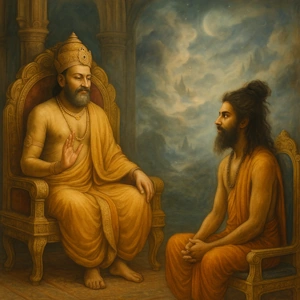
In Yoga Vasishta, we encounter enlightening conversations between Raja Janaka and Shukadeva, shedding light on the mysteries of existence and consciousness. Let's delve into their dialogue and glean insights into the nature of reality.
Journey into Existence: From Creation to Dissolution
Shukadeva, grappling with existential questions, seeks clarity from Raja Janaka regarding the origin and ultimate fate of the world. Janaka, echoing the teachings of Vyasa and the Upanishads, elucidates that the world emanates from the antahkarana, comprising the amalgamation of mind, intelligence, ego, and consciousness. According to Janaka, the world ceases to exist when the functioning of antahkarana ceases. Despite Janaka's assurances, Shukadeva remains unconvinced, yearning for definitive understanding.
Revelation of Ultimate Truth
Janaka reassures Shukadeva that the world is but a manifestation of the singular Paramatma. He elucidates that the world emerges when Paramatma chooses self-limitation and dissolves when it seeks liberation from this constraint. Janaka emphasizes that Shukadeva has attained the pinnacle of knowledge, warning against the pitfalls of perceiving a distinction between the self and the world. With this profound revelation, Shukadeva embarks on a transformative journey of realization.
The Transcendence of Shukadeva
Following his discourse with Janaka, Shukadeva retreats to Mount Meru, immersing himself in deep contemplation. For millennia, he abides in Nirvikalpa samadhi until he merges back into the essence of Paramatma. Shukadeva's transcendence serves as a testament to the profound wisdom imparted by Janaka, marking the culmination of his spiritual quest.
Parallels with Sriram Ji: Insights from Sage Vishwamitra
Sage Vishwamitra draws parallels between Shukadeva and Sriram Ji, acknowledging their profound realization yet lingering doubts.
The cessation of worldly influence can be likened to turning off a running car, highlighting that even with complete detachment, the momentum of worldly interactions persists.
Vishwamitra underscores Sriram Ji's vairagya, indicating his readiness for supreme wisdom.
The Role of Guru: Guiding Light on the Path to Enlightenment
Recognizing Sriram Ji's readiness, Vishwamitra implores Vasishta to bestow the upadesha of supreme truth. He emphasizes the significance of a capable Guru in affirming one's realization, ensuring its preservation for future generations. Vasishta, graciously accepting the responsibility, prepares to impart timeless wisdom to Sriram Ji, thus perpetuating the lineage of enlightenment.
-
The world doesn't arise from an outside source; it comes from the internal mechanism called antahkarana, which includes mind, intelligence, ego, and consciousness.
-
When this inner mechanism stops functioning, the world also dissolves — meaning the world has no independent or permanent reality.
-
The world is not separate from Paramatma; it is just a play of self-limitation and self-expansion of the one supreme reality.
-
Shukadeva’s struggle to accept this truth shows that realization doesn't always arrive in one flash — it deepens through sustained contemplation.
-
Raja Janaka emphasizes that even the most subtle spiritual doubts must be addressed to break the illusion of separation.
-
Shukadeva attains full realization only after withdrawing from the world, meditating for eons, and dissolving back into the ultimate source.
-
Vishwamitra compares Shukadeva and Sriram Ji, noting both had reached high spiritual understanding but needed a final affirmation from a realized teacher.
-
Even when detachment is complete, past tendencies can still linger — like a car that keeps rolling for a while even after the engine is shut.
-
A qualified Guru is essential to affirm, sharpen, and transmit spiritual realization — otherwise, it may not hold or benefit others.
-
Vairagya (complete disinterest in worldly pleasures) is not rejection but freedom from dependence — and it's the soil in which wisdom flowers.
-
The purpose of spiritual dialogue is not just personal clarity but the preservation and passing on of truth across generations.
-
What creates the experience of the world according to this teaching?
The world is a projection of the antahkarana — the inner instrument made of mind, intellect, ego, and awareness. When this inner mechanism is active, it reflects as the external world. When it shuts down, the world disappears too. -
How does this change how we see reality?
It makes you question whether anything 'outside' truly exists on its own. What if everything we call 'world' is just a ripple in consciousness? -
Isn't the world clearly independent of our inner state?
It feels that way, but every experience of the world depends on perception. When you're in deep sleep or samadhi, the world vanishes — not because it's gone, but because perception has paused. That tells us the world and the perceiver are tightly linked.
-
What is Paramatma's role in the creation and dissolution of the world?
Paramatma, the supreme self, manifests the world by adopting self-limiting forms and dissolves it by reclaiming its infinite nature. It’s like a wave rising from the ocean and then merging back — all movement is within the same water. -
Why would something infinite want to limit itself?
To express, to play, to reflect. Just as an artist uses lines to express what lies beyond words, Paramatma uses creation to reflect its own boundless nature. -
How can one entity be both limitless and limited?
Limitation is a temporary role, not a loss of true nature. Just like an actor playing a beggar doesn’t stop being rich, Paramatma doesn't cease being infinite when appearing as finite forms.
-
Why did Shukadeva go to Mount Meru after the dialogue?
Because he still had subtle doubts, he chose deep solitude and Nirvikalpa samadhi — a formless, thoughtless state — to let realization fully ripen and become irreversible. -
What makes Nirvikalpa samadhi so transformative?
It erases all remaining impressions (vasanas) and dualities. Like melting ice back into water, the sense of 'I' and 'world' both dissolve. -
Is such extreme retreat necessary for everyone?
No — it depends on inner readiness. Some need intense withdrawal, while others may awaken gradually through life itself. Shukadeva needed that depth to complete what had begun.
-
What parallel does Vishwamitra draw between Shukadeva and Sriram Ji?
He shows that even with high understanding, a seeker may still carry subtle inertia — past momentum that needs to be fully neutralized. Both needed a teacher to finalize the journey. -
How is past momentum like a running car?
Even after switching off the engine, the car keeps rolling. Likewise, even after dispassion arises, old habits or mental traces may persist briefly. -
Can someone with intense detachment still be affected by the world?
Yes — not through fresh desire, but through leftover impressions. Like smell lingering after incense burns out, traces remain until fully resolved.
-
What does a Guru offer that self-effort alone can't?
A Guru confirms the seeker’s realization, clears final confusions, and ensures the truth becomes stable and communicable. He transforms insight into wisdom. -
Why is Guru's affirmation so crucial?
Because self-realization can feel unstable or ambiguous. The Guru locks it in, making it functional, radiant, and transmissible. -
Can't one realize truth without a Guru?
Possible, but rare. Even realized beings often benefit from a Guru’s presence — not to gain truth, but to stabilize and express it fully.
-
What is the significance of vairagya in this teaching?
Vairagya, or detachment, means you’re no longer emotionally dependent on outcomes. It’s the inner space needed for truth to shine without distortion. -
Is detachment the same as indifference?
No. Detachment means freedom from clinging, not coldness. You still care, but without being bound or thrown off balance. -
Isn't total detachment unrealistic in daily life?
Not if it's practiced internally. You can be active in the world and still untouched inside — like a lotus in water, wet all around, but never soaked.





English
Yoga Vasishta
Click on any topic to open
7
30
Astrology
Bhagavad Gita
Bhagavatam
Bharat Matha
Devi
Devi Mahatmyam
Ganapathy
Garuda Puranam
Glory of Venkatesha
Hanuman
Kathopanishad
Mahabharatam
Mantra Shastra
Mystique
Practical Wisdom
Purana Stories
Radhe Radhe
Ramayana
Rare Topics
Rigveda Explained
Rituals
Sages and Saints
Shiva
Spiritual books
Sri Suktam
Story of Sri Yantra
Temples
Vedas
Vishnu Sahasranama
Yoga Vasishta
26
17
10
0


