Why Can't We Get Peace?
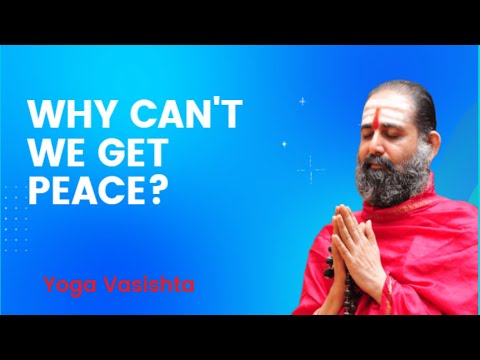
Why are we not able to achieve complete peace?
Total peace.
Childhood is full of fears and anxieties.
Elders keep pushing you around.
Do this, don't do this.
Youth is all about ambitions, desires.
Entertaining the body.
Entertaining the mind.
When that doesn't happen, frustration.
Old age is all about worries, pain, and incapability.
When will you find peace?
Lord Rama is asking in the 27th sarga of the Vairagya prakarana of Yoga Vasishta.
Can permanent peace be obtained by doing something, through action, through karma?
Not necessarily.
Two countries that are on war with each other
Then the rulers sit together and make some agreement.
Ceasefire.
But then, for how long will it work?
If you see history, this doesn't stop.
If there is unrest between two countries it keeps on erupting every now and then.
Every few years it erupts again.
Even Veda says-
तद्यथेह कर्मजितो लोकः क्षीयत एवमेवामुत्र पुण्यजितो लोकः
Worlds such as Swarga achieved through Karma, they go away after some time.
Your life is reset to the cycle of births and deaths even if you have achieved Swarga
So action, karma is not the path if you want to achieve permanent peace.
And also there is no guarantee that action will get you the desired result.
You have to be lucky.
Then only you will get results.
There is no guarantee that action or hard work will get you the desired result.
This is visible, right?
Someone works hard, he doesn't get anything.
Someone is lazy, he gets everything on a platter.
What is it?
Luck.
Scriptures say both are there.
Certain things you get by hard work.
Certain things you get by luck.
But one thing is certain, if you are not lucky, even hard work will not yield results.
This is about all worldly achievements.
The old man on his deathbed would think:
Did I do anything to achieve peace?
Even when you do something there is no guarantee about the result.
I didn't even try.
All that I did throughout my life was eat-drink-sleep.
What did I do throughout my life?
Earned, ate, fed, built a house, bought a car.
What about peace?
Did I do anything to achieve peace?
I didn't even try.
How can I complain now?
You are given something then it is taken back after some time.
Then that doesn't belong to you.
You have taken a comfortable room in a hotel for a day.
But the next day you have to check out.
Because that doesn't belong to you.
Even enjoying in Swarga is like this.
It is not permanent.
Most of these enjoyments are like the bait around the hook.
The fish goes for it, relishes it for a moment, but then the hook hidden inside pierces.
Someone enjoys smoking, but then what is the result?
Cancer.
Someone enjoys drinking, but then what is the result?
The liver is gone.
Every kind of enjoyment has a hook hidden inside.
At least the frustration when that pleasure is no longer available.
Says Lord Rama.
-
Life moves through stages that are each filled with different kinds of unrest — fear in childhood, craving in youth, and worry in old age — making total peace feel out of reach.
-
Human life is constantly bound to doing something — following instructions as a child, chasing pleasures in youth, and managing decline in old age — but none of this leads to lasting contentment.
-
Actions (karma) can bring temporary relief or enjoyment, but they do not guarantee permanent peace or freedom from sorrow.
-
Peace treaties, agreements, and even spiritual rewards like Swarga (heaven) are short-lived and unstable; they never last forever.
-
The Vedas themselves say that even higher worlds achieved through good karma eventually fade, returning one to samsara (cycle of birth and death).
-
Efforts don’t always lead to results; hard work doesn’t promise success, while some people get everything effortlessly — pointing to the presence of luck alongside action.
-
Scriptures acknowledge two forces: effort (karma) and luck (daiva); both influence life, but lack of luck can make effort fruitless.
-
Peace requires deliberate effort, not accidental living — but most people never even try to pursue it and then regret it too late.
-
Worldly success — house, car, family, income — doesn't bring inner peace; chasing them often leads to neglecting what truly matters.
-
Anything that can be taken back was never truly yours; like a hotel room or even Swarga, borrowed pleasures end when time runs out.
-
Sensory enjoyments often lure like bait but hide consequences — from health issues to emotional pain — turning pleasure into suffering.
-
Even simple joys come with the pain of their eventual loss; every fleeting high sets you up for future disappointment.
What keeps us from lasting peace?
Each phase of life is loaded with its own form of stress — childhood fear, youthful ambition, old age anxiety — so restlessness persists throughout.
Why do we always feel like peace is around the corner but never reach it?
Because we keep thinking the next stage will bring it, but every stage has its own disturbance waiting.
Isn't peace just a state of mind anyone can choose?
It can be, but unless one understands the traps of each life stage and steps out of that cycle consciously, peace remains a distant idea.
Can actions alone give permanent peace?
No, actions may bring temporary outcomes, but true peace isn't guaranteed by doing more or achieving more.
Then what is the purpose of effort at all?
Effort is important, but it needs to be rightly directed — towards stillness, not just accomplishments.
But isn’t karma the backbone of all progress?
Yes, but karma only creates results within a limited field. It doesn’t touch the root of suffering, so it can’t deliver unshakable peace.
Are even higher worlds like Swarga impermanent?
Yes, even heavenly realms obtained through good deeds eventually expire, and the soul falls back into the birth-death cycle.
Why would anyone want to reach Swarga then?
Because it's a better experience than earth for a while — but it’s not the final solution, just another temporary phase.
Doesn't this make spiritual rewards feel pointless?
Not pointless — they’re stepping stones. But mistaking them for the final destination leads to disappointment.
Do hard work and effort guarantee success?
No. While effort is necessary, outcomes are also shaped by unseen factors like timing and circumstances — what we call luck.
Then should I stop working hard?
Not at all. Work hard, but don’t pin your peace on the results alone. Use effort wisely and stay detached from outcome.
How is it fair that lazy people get success while hard-working ones suffer?
Life isn’t a tidy equation. Many forces act behind the scenes — karma from past lives, social conditions, and timing all matter.
Why do people regret not seeking peace at the end of life?
Because they realize they spent decades chasing things that never brought lasting happiness, and ignored what truly matters.
When is the right time to seek peace?
Right now — peace needs conscious effort, not just hope. Waiting till later often means never doing it at all.
Isn’t this just fearmongering about death?
No. It’s a wake-up call. People genuinely waste their lives assuming there’s always more time, until time runs out.
Why isn’t anything truly ours in this world?
Because anything that can be taken back — whether money, health, or even joy — was never under our full control.
Then what should we consider truly ours?
Only inner stillness and self-awareness — they aren’t borrowed and can’t be taken away by time or fate.
Isn’t that a pessimistic way to live?
It’s realistic. It frees you from false ownership and prepares you to live more lightly and joyfully.
Why are pleasures compared to bait on a hook?
Because they look attractive, feel good briefly, but often carry long-term pain — like addiction, illness, or loss.
Are all pleasures bad then?
No, but blind indulgence without wisdom brings suffering. Pleasures are safe only when seen in their full context.
Isn't that just overthinking joy?
No, it’s seeing through the illusion. True joy uplifts and frees you — fake joy traps you like bait hides a hook.
Is even the loss of pleasure a form of pain?
Yes. Once the mind tastes enjoyment, its absence creates longing, and that longing becomes new suffering.
How do we escape this cycle of craving and disappointment?
By learning to observe joy and pain as passing waves, without clinging to either. That’s the start of real freedom.
Doesn’t that make life boring — without highs and lows?
Not at all. It replaces shallow ups and downs with a quiet, steady bliss — which is far more satisfying.





English
Yoga Vasishta
Click on any topic to open
7
30
Astrology
Bhagavad Gita
Bhagavatam
Bharat Matha
Devi
Devi Mahatmyam
Ganapathy
Garuda Puranam
Glory of Venkatesha
Hanuman
Kathopanishad
Mahabharatam
Mantra Shastra
Mystique
Practical Wisdom
Purana Stories
Radhe Radhe
Ramayana
Rare Topics
Rigveda Explained
Rituals
Sages and Saints
Shiva
Spiritual books
Sri Suktam
Story of Sri Yantra
Temples
Vedas
Vishnu Sahasranama
Yoga Vasishta
26
17
10
0


