Sri Hari Alone Existed and Willed to Become Many
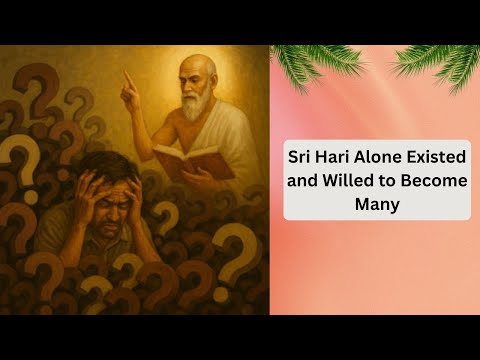
He willed to become many from a single.
Why? We don’t know. It is just like that. He desired, He willed. That’s it.
Is there an answer to every question?
Why do you like orange? Is there a real, complete answer to this question?
This is another problem.
Science told us — keep asking questions, that is how you learn.
Keep doubting, keep suspecting — that is how you perfect.
We don’t know where to put a stop now.
We ask questions about anything and everything.
We need answers for anything and everything.
It has become a bad habit.
Why do you enjoy music? Is there an answer to this question?
Why is the height of Everest 8848 m and not 7748 m or 9948 m?
Is there an answer to this question?
So, why did Sri Hari want to become many instead of the one that He originally was? No answer.
He desired to multiply. Why?
Because He felt lonely. He felt bored. Simple answer.
Scriptures sometimes give these kinds of answers.
It serves the purpose and allows us to go ahead rather than getting stuck to some useless point.
So He imposed upon Himself three things — time, action, and nature (swabhava).
When He imposes upon Himself time, action, and swabhava, He becomes the universe that we see around ourselves — which comprises different beings and objects: trees, plants, clouds, animals, butterflies, vehicles, sand, sea, humans, book, pencil.
How can time create different objects?
Something that existed in the past. Something that exists today.
Take dinosaurs — they existed in the past, not anymore, not in the present.
The fact that they existed for some time — a few millennia maybe —
making them distinct living beings is because of time.
Time can make distinction between beings — ancestors who existed in the past and us who are alive now.
How can action cause distinction between various beings?
Moving, non-moving — based on action.
Growing, non-growing — based on action.
Flying, walking, crawling — based on action.
How can nature cause distinction between various beings and objects?
What is nature?
bahirhetvanapekshi tu swabhavo'tha prakeertitah
Whatever is inherent in something, natural to it — is called swabhava.
Roughness, smoothness — sand is rough, clay is smooth.
Cruelty — inherent in beasts.
Coolness is natural in water.
Sweetness is natural in sugar.
So swabhava can make distinction into various beings and objects.
We know about this thing called body sculpting and cosmetic surgery which are becoming popular these days.
These are means to transform your body the way you want.
Some are exercises and some involve even surgery.
When we say time, action, and swabhava — these are the tools and means with which Sri Hari transforms Himself from His nirguna nature into saguna nature.
We have already seen that the three gunas — satwa, rajas, and tamo gunas — along with materials, awareness, and actions — this is what Sri Hari uses to create this illusory world with His maya shakti.
Time — that is, division of time into past, present, and future.
Time is actually continuous.
This is again an illusion — its division apparently into past, present, and future.
This time agitated the three gunas.
Agitated means — like you stir a dish with a spoon.
The second thing called swabhava — nature — transformed the three gunas.
And acted upon by karma — action — the three gunas gave birth to mahat tatva.
Looking at it again:
Initially, Sri Hari alone — the Paramatma.
Then, He wanted to multiply into many.
For this, He made use of His maya shakti.
Maya shakti comprising of satwa, rajas, tamo gunas, along with dravya, jnana, and karma.





English
Vishnu Sahasranama
Click on any topic to open
7
30
Astrology
Bhagavad Gita
Bhagavatam
Bharat Matha
Devi
Devi Mahatmyam
Ganapathy
Garuda Puranam
Glory of Venkatesha
Hanuman
Kathopanishad
Mahabharatam
Mantra Shastra
Mystique
Practical Wisdom
Purana Stories
Radhe Radhe
Ramayana
Rare Topics
Rigveda Explained
Rituals
Sages and Saints
Shiva
Spiritual books
Sri Suktam
Story of Sri Yantra
Temples
Vedas
Vishnu Sahasranama
Yoga Vasishta
26
17
10
0


