Pushpavrishti in Ayodhya
Young Sriram Ji expressed his lack of faith in the world, and he requested Sage Vishwamitra for the means to get permanent peace. The issues he raised were absolutely relevant. His reasoning was flawless. This was happening in the court of Dasharatha.
When they heard this conversation, all the members of the court stood up. Sage Valmiki says that they all had such goosebumps that their hair strands pierced their clothes. Hearing the words of Sriram Ji, even they all developed dispassion, vairagya, instantly. They were all listening to the Lord so intently.
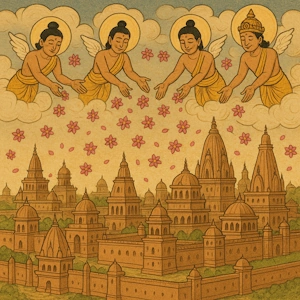
Not just those present in the court, Sriram Ji's voice reverberated in the entire Ayodhya. Even birds and animals stood still and listened. Devas and Siddhas showered flowers from the sky. This pushpavrishti happens whenever something very very important happens on earth. Raising of these issues by Sriram Ji was such an important event.
Siddhas were heard saying - we have heard everything that has been said till now, right from the time of creation, words of Rishis, words of great scholars and teachers. But these words are like nectar to our ears. We should definitely listen to the answers to the issues raised by Sriram Ji.
They started inviting Sages Narada, Vyasa, Pulaha to come to the court to listen to the answers. All the great Rishis started arriving at the court. All the great Siddhas arrived. Sages Vishwamitra and Vasishta welcomed them all offering arghya. Dasharatha worshiped them all.
The Rishis and Siddhas praised Sriram Ji's words. His words are the words of a mahatma. He is very clear about his stand. His words are enough to develop vairagya in anyone. His mind is so pure, that's why such questions are rising in his mind. His issues should definitely be answered, said the Rishis and Siddhas.
With this ends the vairagya prakarana of Yoga Vasishta. Next, we will start with the mumukshu prakarana.
-
Young Lord Rama, disillusioned with worldly pleasures, asked Sage Vishwamitra for a way to attain permanent peace.
-
His questions were sharp, sincere, and showed spiritual maturity far beyond his age.
-
The moment he spoke in King Dasharatha’s court, it triggered a wave of deep detachment (vairagya = inner dispassion) among all listeners.
-
The impact was so strong that even seasoned ministers and elders stood up, visibly moved, their bodies reacting with goosebumps.
-
Rama’s words echoed throughout Ayodhya, and even animals paused, sensing the weight of truth.
-
Devas and Siddhas from the heavens acknowledged the moment with a shower of flowers, marking its cosmic importance.
-
Ancient sages declared that his speech surpassed anything heard since the beginning of creation, including teachings from great rishis.
-
They invited exalted sages like Narada, Vyasa, and Pulaha to hear the answers to Rama’s questions.
-
As the sages arrived, they were welcomed with due honor by Vishwamitra, Vasishta, and King Dasharatha.
-
The sages and siddhas praised Rama as a mahatma (great soul), saying that only a pure mind could raise such questions.
-
They insisted that his doubts must be answered, as they could ignite vairagya in others too.
-
With this divine moment, the section on dispassion concluded, and the stage was set for the seeker’s journey toward liberation to begin.
-
What did young Rama do that caused such a stir in the court?
He expressed his deep disinterest in worldly pleasures and asked for a path to true peace. This wasn’t emotional rebellion but calm, reasoned inquiry. His clarity reflected a seeker’s readiness, not a boy’s confusion. -
Why would someone like Rama, born in a royal family, turn away from the world?
Some souls awaken early. Comfort and power don’t blind them. For such beings, inner peace is more attractive than external success. Rama's dispassion came from purity, not disappointment. -
Isn't it risky to glorify renunciation in someone so young?
Only if it's superficial. But Rama's questions were mature, precise, and echoed truth. Even sages validated his state, showing it wasn’t a phase but true inner awakening.
-
How did Dasharatha’s court react to Rama’s speech?
Everyone rose in awe. Even battle-hardened ministers were shaken. Their bodies responded involuntarily, showing the spiritual force of Rama’s words. -
Can words really affect people so powerfully?
Yes. Words that come from pure realization touch deeper than intellect. They bypass argument and land directly in the heart, stirring transformation. -
Could this be an exaggeration to dramatize the story?
No. Multiple sages and chroniclers report the same reaction. When different witnesses agree on an experience, it's more likely to be truth than ornamentation.
-
Did Rama’s message remain limited to the court?
Not at all. It spread through Ayodhya like a divine vibration. Even animals stopped to listen, and devas responded with flower showers. -
Why would birds and gods react to a human’s speech?
Because truth resonates beyond species. Pure wisdom vibrates through all layers of existence. When such truth is uttered, all beings—earthly or celestial—tune in. -
Isn’t that just symbolic language?
Symbolic or not, the point is clear—Rama’s words broke barriers. If even nature paused, it tells us something profound was taking place.
-
What did the celestial sages say about Rama’s words?
They called them sweeter than anything heard since creation began. Even the teachings of rishis and scriptures seemed dull in comparison. -
Why would great sages be so moved by a boy’s questions?
Because wisdom isn’t about age. When purity and clarity align, the source doesn’t matter. Rama’s inquiry struck the very root of suffering. -
Would real sages overpraise someone just because he’s royal?
True sages are indifferent to status. They praised Rama not for being a prince, but for speaking eternal truths with piercing lucidity.
-
What happened after the sages heard Rama’s questions?
They summoned the greatest seers—Narada, Vyasa, Pulaha—to join the gathering. The court turned into a divine assembly, a true satsanga. -
Why invite more sages when answers hadn’t even begun?
Because the questions themselves were worth deep listening. When the seeker is sincere, even the unspoken carries spiritual power. -
Isn’t that too much fuss for one seeker’s doubts?
No. Sincerity in a pure soul draws the highest forces. Just like a beacon attracts ships, Rama’s questions drew wisdom from all quarters.
-
How did the host sages and king receive the arriving rishis?
Vishwamitra and Vasishta offered sacred welcome, and Dasharatha worshiped them respectfully. The gathering became a confluence of divine minds. -
Why is ritual hospitality important in such moments?
It sets the tone—honoring wisdom prepares the space for deeper truths. Just as a clean plate readies you for good food, hospitality purifies the moment. -
Aren’t these customs unnecessary formalities?
Not at all. They signal humility and reverence, essential for any serious spiritual exchange. Without such grounding, even great wisdom can scatter.
-
What did the sages say about Rama’s mind?
They praised its purity and focus. Such questions don’t rise from cleverness—they emerge from a heart untainted by ego. -
How does purity of mind shape our questions?
A clean mind doesn’t ask to argue; it asks to understand. It looks inward, not outward. Questions from such minds unlock answers effortlessly. -
Can’t sharp questions come from skeptical minds too?
Yes, but they often lack surrender. Rama’s questions were humble yet piercing—he wasn’t challenging truth, he was opening to it. That’s the difference.
-
What’s the significance of this event in the larger journey?
It marks the end of dispassion and the start of true seeking. Vairagya has matured; now the seeker must move toward moksha (liberation). -
Why not end the journey at dispassion itself?
Because dispassion is a clearing, not the destination. Without further seeking, it can turn dry or stagnant. Action must follow insight. -
Isn’t dispassion alone enough for freedom?
No. Like removing weeds doesn’t create a garden, dispassion clears obstacles but doesn’t build the path. Mumuksha—active longing for liberation—must now take over.





English
Yoga Vasishta
Click on any topic to open
7
30
Astrology
Bhagavad Gita
Bhagavatam
Bharat Matha
Devi
Devi Mahatmyam
Ganapathy
Garuda Puranam
Glory of Venkatesha
Hanuman
Kathopanishad
Mahabharatam
Mantra Shastra
Mystique
Practical Wisdom
Purana Stories
Radhe Radhe
Ramayana
Rare Topics
Rigveda Explained
Rituals
Sages and Saints
Shiva
Spiritual books
Sri Suktam
Story of Sri Yantra
Temples
Vedas
Vishnu Sahasranama
Yoga Vasishta
26
17
10
0


