What Is Vasana in Simple Words?
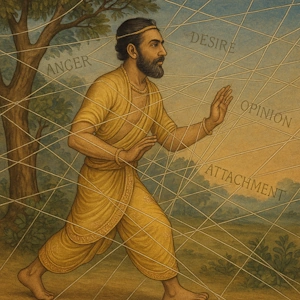
Yoga Vasistha differentiates between two kinds of vasana – pure and impure.
वासना द्विविधा प्रोक्ता शुद्धा च मलिना तथा
मलिना जन्मनो हेतुः शुद्धा जन्मविनाशिनी
What is vasana? – we all say vasana, what is it?
वासयति कर्म्मणा योजयति जीव-
मनांसीति वासना
Vasana is a thread – take a garland of pearls. What is it that connects the individual pearls one to one and makes them into one single garland? Don’t allow them to go here and there. Holding them together, make them flow from one to the next, giving continuity – the thread that passes through them. This thread is vasana.
This thread connects the mind to actions or actions to mind, creating a continuity. This vasana is what causes memory – connectivity between past, present, and future.
Memory that – yes, I know this, I recognize this, this is an apple, it is a fruit, it grows on trees, it is tasty, but I don’t like it.
When you see an apple, all these come to your mind. Where do they come from? From your memory. When you see something for the very first time, this doesn’t happen.
You see a new kind of fruit – say a carambola or kiwano – never heard of them, right? You don’t know what it is going to taste like because you have no memory associated with it. There is no impression within you about this.
Now, this memory is not vasana. What causes this memory is vasana.
A hard disk on which images, impressions are stored, which can be taken from machine to machine and installed. When you install it in a new machine, they are all there. The continuity is established.
Vasana is conditioning of the mind. When you make conclusions about people and things and stuff, it becomes vasana. That is why Vedanta says neti neti – don’t arrive at conclusions.
When you make judgements, it becomes vasana. When you think that all believers are good people and all atheists are bad people, then it becomes vasana. When you become opinionated, it becomes vasana. When you develop strong likes and dislikes, it becomes vasana.
Let’s say you are typing a document in Microsoft Word. The autosave function is turned off. You go on writing and finish, then you try to close the window. So far it is not vasana.
Now, Microsoft Word will ask you to save or not. If you save, it becomes vasana. If you simply come out without saving, it will not become vasana. If you save, when you reopen your computer even after years, it will be there. You take your hard disk from this computer to another, it will be there. This is vasana.
So mere functioning does not create vasana. Mere physiological functioning or mental functioning does not cause vasana. Even this can – if it is highly repetitive in nature, highly exclusive in nature – which then becomes ahamkara, as in antah karana chatushtaya. This can later on become a vasana.
Too much habituated to something – it can become vasana. Otherwise, mere eating and drinking and walking and talking will not become vasana.
Being judgemental, being opinionated, being preferential, being habitual – will lead to creation of vasana.
What does it mean? As long as you enjoy music from your music player, there is no problem. But when you start believing that your music player is a talented singer or only good music will come out of that player every time – then it becomes a vasana.
So avoidance of formation of vasana does not restrict your functioning.
Vasana is a continuity – continuity that is there from birth to birth, birth after birth.
Now, you may have seen a carambola or a kiwano in the previous birth and may not remember it now. So, this is not the memory we are talking about here. We are talking about a kind of memory that gets carried forward from birth to birth.
Is there such a memory? Think deeply. You will understand, there is one. It is not the memory that makes impressions of apple or orange in your mind.
When a dog – a puppy – sees something is eatable, it naturally goes to it, starts licking at it, and eventually tries to bite and eat it. Where does this come from? Nobody has taught the puppy that it has to eat. Nobody has taught the puppy that this can be eaten.
Now, this is not even vasana. What is behind this action is vasana. Got it?
So, what you bring in from your previous birth is vasana – or from previous births is vasana.
Now, don’t confuse this with karma. While vasana can generate karma and vice versa, they are not the same.
So, essentially vasana is the thread that is between births, rebirths. If this thread is cut, then there is no continuity, and you become free-floating.
The problem is not in existence, because you can never be non-existent – you are imperishable.
The problem is that you have become bound, like a pearl in a garland. Your freedom to float freely is gone. This is the problem.
You can never become non-existent. Because you have become connected by this vasana, you have become limited. You have to aspire to become unlimited, break that thread and come out of it.
Now, even for breaking that thread, effort is required. It won’t simply disintegrate and disappear like that – unless you are one of those select chosen ones.
So, while it is still left to your discretion and choice, the only effort worth putting in is to break that thread.
So this also has to happen within the scope and limitations of this human birth.
The vasana that will make you put in that kind of effort is called pure vasana. Vasana that binds you more and more is impure vasana.
Vasana that doesn’t cause rebirth but causes the end of rebirth is pure vasana.
When this vasana has achieved its purpose successfully, then what remains as body is a seed with no sprout inside.
The body will still exist, but it will not germinate into the next one in sequence. It will be like those genetically modified grains we have these days. You can eat them, but if you sow them, they won’t germinate and grow into another plant.
If you are looking out for a permanent solution, this is the only path. The rest are all patchwork.
Catch cold today – take medicine for that. Get stomach-ache tomorrow – get medicine for that. Get a headache day after tomorrow – take medicine for that.
These are not solutions.
Solution is only one: get out of this. Get out of this chain of rebirths.
-
Vasana is the subtle thread that holds together mental patterns, giving continuity to experience across time and even across births.
-
It is not memory itself, but the force behind memory — the subtle conditioning that links impressions and responses.
-
Vasana causes the mind to associate, react, and expect, even without conscious recall or reasoning.
-
This thread survives death and reappears in future births, preserving unfulfilled tendencies and patterns.
-
Vasana is not formed by routine activity alone, but by strong judgments, attachments, and repeated preferences.
-
Opinionated thinking, habitual emotional reactions, and strong likes or dislikes become vasana.
-
Simply acting or experiencing is not enough to form vasana; it forms only when impressions are saved through identification and emotional tagging.
-
There are two types of vasana — pure and impure. Pure vasanas lead toward liberation, while impure ones bind the soul to rebirth.
-
Even spiritual effort is powered by a vasana — the desire to be free. This is a purifying force.
-
The goal is to break the thread of vasana that binds the soul to the cycle of birth and death.
-
Once the binding vasana is cut, the body remains like a sterile seed — alive, but incapable of causing rebirth.
-
Unless effort is made to dissolve vasana, existence continues in repetitive cycles, just like saving a file ensures it reopens the same way later.
What is vasana in simple terms?
Vasana is the invisible thread that holds together our mental impressions, tendencies, and habits. It is not memory, but what causes memory and links past experiences with present reactions. It’s like a thread passing through beads, keeping them in a specific sequence.
How does this thread affect daily life?
It makes the mind react in familiar ways even to new situations. If you've disliked something in the past, vasana makes that dislike return without conscious thought.
How do we know this isn't just ordinary memory?
Because vasana operates even when memory doesn’t. For example, a newborn puppy seeks food though it has never seen food before — this action is driven by vasana, not memory.
How is vasana formed in the first place?
Vasana is created when thoughts and actions are emotionally reinforced and repeated over time. Making rigid judgments or developing strong preferences hardwires the mind and stores those patterns.
Can we avoid forming vasanas while still functioning normally?
Yes. Actions done without ego, judgment, or emotional tagging do not form vasana. Just like typing without saving a document — the action happens, but no record is stored.
Isn't every action we do forming vasana by default?
No. Routine functioning doesn't form vasana unless it's done with intense identification or emotional repetition. Walking, eating, or working without obsession doesn't bind the mind.
What is the difference between pure and impure vasana?
Pure vasanas guide a person toward self-realization and freedom from rebirth. Impure vasanas bind the soul to repeated existence and suffering.
How can one develop pure vasanas?
By cultivating noble desires — like the longing for truth, freedom, or inner peace. These refine the mind and eventually lead to the end of bondage.
Isn't any desire still a chain, even if it seems good?
Yes, but a golden chain can lead you to the key that removes all chains. Pure vasana serves as a ladder — once used, it too can be discarded.
Why is vasana considered the cause of rebirth?
Because it’s what creates continuity between lives. It carries unresolved mental patterns and tendencies that shape the next life’s circumstances.
Can we destroy this continuity completely?
Yes, through sustained effort, awareness, and detachment. Once the vasana-thread is broken, rebirth stops, and the self becomes free.
What’s the evidence that this continuity exists at all?
Instinctive behavior, like a baby knowing how to suckle, shows patterns not taught in this life. These deep tendencies suggest a carry-over from earlier existence.
Why is just curing symptoms of suffering not enough?
Because they’re patchwork solutions. Treating surface issues without removing vasana is like trimming weeds without pulling the roots.
So is breaking vasana the only real solution?
Yes. Until the root cause — vasana — is destroyed, life keeps throwing the same problems in new forms.
Isn't this view too extreme or all-or-nothing?
Not at all. You can live a balanced life and still work toward removing vasana. But without aiming to cut this thread, true freedom will always stay out of reach.





English
Yoga Vasishta
Click on any topic to open
7
30
Astrology
Bhagavad Gita
Bhagavatam
Bharat Matha
Devi
Devi Mahatmyam
Ganapathy
Garuda Puranam
Glory of Venkatesha
Hanuman
Kathopanishad
Mahabharatam
Mantra Shastra
Mystique
Practical Wisdom
Purana Stories
Radhe Radhe
Ramayana
Rare Topics
Rigveda Explained
Rituals
Sages and Saints
Shiva
Spiritual books
Sri Suktam
Story of Sri Yantra
Temples
Vedas
Vishnu Sahasranama
Yoga Vasishta
26
17
10
0


