The Notion Of Ownership
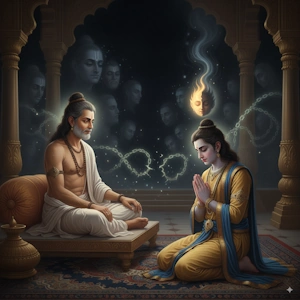
In the past 28 sargas of Yoga Vasishta, after a brief introduction about the background, we have been seeing how Sri Ramji developed vairagya, towards the world, why he doesn't trust the world anymore.
He continues -
I find every single perception about the world to be faulty.
This like a fire has burned down the forest in my mind which was full of various ideas and concepts, all utterly wrong.
Now, I am clear, my mind is clear.
I have no love lost for the world.
My intelligence is working now.
Not the mind full of passion and emotions.
I don't have desire for any kind of enjoyment anymore.
As time goes, I am getting more and more bitter towards this world.
In the natural course, a man becomes more and more evil as he grows.
The goodness in him goes on reducing.
He goes on breaking the boundaries of civilized living.
You don't notice this on an ongoing basis because he does it silently, secretly.
Sight of beautiful women and nice gardens does not excite me.
I want to be alone.
The only joy is in peace.
Mind running after objects of pleasure can never give you peace.
I am not interested in a long life.
I am not eager to die as well.
I want a state free from miseries, be it when I am alive, or be it after I die.
I am not in any hurry.
If you think that the kingdom around you is yours, then it is yours.
Otherwise not.
If you think that the wealth around you is yours, then it is yours.
Otherwise not.
I have come across people who are told all of a sudden that their family owned 300 / 400 acres of land in a far away place which they were not aware of.
From that moment it belongs to them.
The land was there even before.
The ownership arises when you think that it is yours.
For ownership, you have to be there.
This is me and these are mine.
Ahamkara.
Ownership arises out of ahamkara.
Ownership is something that your ahamkara superimposes on objects.
Sriram Ji says - my ahamkara is washed away.
I don't own anything anymore.
Whatever gives pleasure to your senes, it is very difficult to avoid them.
Plus, man is bound by the karmic rope which forces his take birth after birth.
These are what man should strive to get relief from.
Over and above these, Kamadeva tramples the tender mind by showing beautiful women.
If this disease is not cured at a young age, then it can never be cured.
A young plant can be plucked out.
But once it takes roots and grows into a big tree, it can not be plucked.
These are all poisons.
A poison kills you only once.
But these poisons, they kill you birth after birth.
Jnanis don't get bound by pleasure, pain, relations, friendship, birth, or death even though they are in the middle of all these.
Now, Sri Ramji requests Sage Vishwamitra to give him upadesha of jnana that will give him permanent relief from bondage.
Ignorance is like a forest.
There are traps everywhere in which you get caught.
I want to get out of it fast.
I can bear the pain if someone splits me into two pieces with a saw, I am capable of that.
But I can no longer bear the pain of worldly relationships.
Pain arising out of their complications.
My mind is trembling under their pressure like a flame in wind.
I don't want to cut these bonds through aggression.
I want to do it smoothly after learning from you how to do it.
It should be smooth like how moonlight removes darkness.
Bhagawan is not in favor of harsh methods to cut the karmic bonds.
He wants it to be smooth.
Sriramji is further preempting a likely objection from the Sage that he is too young for this kind of knowledge.
I have complete control over my mind and senses meaning he is eligible for this kind of knowledge.
-
Ramji has lost faith in worldly perceptions; he sees them as false and misleading.
-
His mind, once crowded with desires and concepts, is now clear and dispassionate.
-
He finds no attraction in pleasures, beauty, or luxury; only peace gives him joy.
-
Human nature tends to degrade over time, with goodness diminishing and selfishness growing.
-
Ownership is rooted in ahamkara (ego), which falsely superimposes possession onto objects.
-
He feels his ego dissolved, free from the idea of 'mine' or 'belonging'.
-
Pleasure, pain, relationships, and desires act as poisons that bind the soul across births.
-
Kamadeva (god of desire) destabilizes the young mind, making detachment harder as one ages.
-
Ramji wants release from karmic bondage and worldly ties, not through harsh rejection, but by gentle wisdom like moonlight clearing darkness.
-
He is prepared for higher knowledge, claiming mastery over mind and senses, despite his youth.
-
What does Ramji mean when he says all perceptions of the world are faulty?
He sees the world as an illusion where our interpretations are distorted by ego and desire. Each perception is like smoke that hides truth. Real clarity comes only when one burns these false notions and rests in peace beyond likes and dislikes. -
Why would a person start distrusting every perception of the world?
Because repeated experience shows how unstable and deceptive life is. What looks joyful turns bitter, what feels secure slips away. Seeing this again and again makes one conclude that no perception gives lasting truth. -
Is it not extreme to reject all perceptions as false?
Not when you notice that perceptions are never permanent. A garden looks beautiful at dawn but withers by dusk. The mind attaches to these passing pictures and calls them real, but their very change proves their falseness.
-
Why does Ramji say he is drawn only to peace, not pleasures?
Pleasures excite the senses but never give rest. Peace alone cools the mind, like shade under a tree on a burning day. His dispassion comes from realizing that chasing enjoyment leads only to restlessness. -
Can peace really be more fulfilling than pleasures?
Yes, because pleasures demand constant renewal while peace sustains itself. Eating a sweet lasts seconds, but a calm mind gives strength all day. Once tasted, peace makes other joys feel shallow. -
Is rejecting pleasure healthy, or does it make life empty?
Rejecting is not the point; it is about seeing pleasure’s limits. When you know fire burns, you don’t grab it for thrill. A mind resting in peace lives fuller, not emptier, because it is no longer tossed around.
-
What is meant by ownership arising from ahamkara?
Ahamkara is the sense of 'I' and 'mine'. Without it, land, wealth, or objects simply exist, neutral. The feeling of ownership is a projection of ego, not an inherent truth in the object itself. -
If ownership is just ego, how does society function?
Society depends on agreements, but those agreements are mental constructs. At the level of truth, nothing is owned. Recognizing this frees a person internally, even while playing roles outwardly. -
Isn’t it obvious that if a person inherits land, it becomes theirs?
Only in law, not in reality. The land existed before them and will exist after. Ownership is a temporary stamp of ego; remove the ego, and possession loses meaning.
-
Why does Ramji call pleasures, pain, and relationships 'poisons'?
Because they trap the soul in samsara, the cycle of birth and death. A normal poison kills once, but these bind repeatedly, causing suffering across lives until one seeks liberation. -
Can ordinary life really be compared to poison?
Yes, because its sweetness hides the long-term cost. Like sugar tasting sweet but causing disease, worldly bonds feel good but breed endless attachment, grief, and rebirth. -
Isn’t it harsh to call relationships poisonous?
It is not about rejecting love, but about seeing attachment’s danger. Love with wisdom uplifts, but blind clinging chains. Poison is the word used to stress the seriousness of bondage.
-
Why does Ramji want a gentle method of breaking bonds, not a harsh one?
Because true release should be like moonlight dissolving darkness, not like an axe cutting violently. Harsh methods create more ego; wisdom-based methods free without disturbance. -
Can liberation be gentle when desires are so strong?
Yes, if the mind is guided with patience and steady insight. Just as a teacher corrects a child with calm firmness, not anger, inner bondage too is untied best with gentleness. -
Wouldn’t harsh rejection of the world be faster?
No, because forced rejection leaves scars. Desires return with greater force if suppressed. Only understanding their emptiness smooths them out permanently.
-
Why does Ramji emphasize his control over mind and senses despite his youth?
He wants to show he is ready for higher wisdom. Mastery of impulses, not age, decides fitness for knowledge. His dispassion proves maturity beyond his years. -
Is youth really a problem for spiritual learning?
No, in fact it is the best time because habits are not yet hardened. A young plant can be uprooted easily, but an old tree resists change. Similarly, a young seeker adapts more easily. -
But how can one trust that a youth truly has control over senses?
By observing consistency in action. If someone resists temptations without strain and remains steady in peace, it shows mastery. True control is calm presence, not forced suppression.





English
Yoga Vasishta
Click on any topic to open
7
30
Astrology
Bhagavad Gita
Bhagavatam
Bharat Matha
Devi
Devi Mahatmyam
Ganapathy
Garuda Puranam
Glory of Venkatesha
Hanuman
Kathopanishad
Mahabharatam
Mantra Shastra
Mystique
Practical Wisdom
Purana Stories
Radhe Radhe
Ramayana
Rare Topics
Rigveda Explained
Rituals
Sages and Saints
Shiva
Spiritual books
Sri Suktam
Story of Sri Yantra
Temples
Vedas
Vishnu Sahasranama
Yoga Vasishta
26
17
10
0


