Bala Bhujanga Stotram
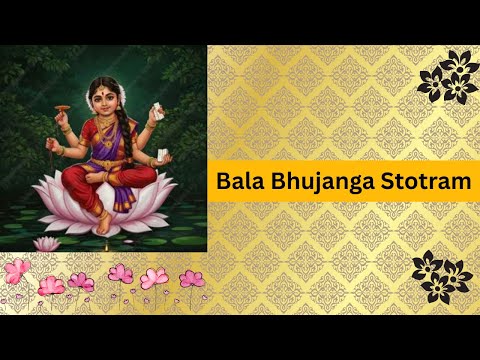
जगद्योनिरूपां सुवेशीं च रक्तां गुणातीतसंज्ञां महागुह्यगुह्याम् । महासर्पभूषां भवेशादिपूज्यां महात्युग्रबालां भजेऽहं हि नित्याम् ॥
I eternally worship that Mahatyugra Bala, who is the form of the universe's womb, who is beautifully attired and red in complexion, who is known to be beyond the Gunas, who is the most secret of all secrets, who is adorned with great serpents, and who is worshipped by Bhava (Shiva) and other gods.
The hymn opens by establishing the Goddess's fundamental nature as the ultimate source of all existence, the 'Jagadyoni' or cosmic womb. Her red colour symbolizes the vibrant, dynamic energy of creation and life itself. By describing her as 'gunatita', beyond the three qualities of nature (sattva, rajas, tamas), the text elevates her to the status of the Absolute, the unconditioned reality. Her nature is 'mahaguhya-guhyam', a profound mystery revealed only through deep devotion. The great serpents she wears as ornaments connect her to primal, untamed energy, the cycles of time, and the Kundalini force. That she is worshipped even by Lord Shiva ('Bhava') and other deities confirms her supreme position in the divine hierarchy. The refrain, 'I eternally worship the Great, Extremely Fierce Maiden', sets the tone of reverent devotion.
महास्वर्णवर्णां शिवपृष्ठसंस्थां महामुण्डमालां गले शोभमानाम् । महाचर्मवस्त्रां महाशङ्खहस्तां महात्युग्रबालां भजेऽहं हि नित्याम् ॥
I eternally worship that Mahatyugra Bala, who is of a great golden complexion, who is seated upon the back of Shiva, whose neck is beautifully adorned with a great garland of skulls, who is clothed in a great hide, and who holds a great conch in her hand.
This verse details her divine form. Her golden complexion signifies spiritual illumination, purity, and supreme consciousness. The image of her seated upon Shiva's back is a profound Tantric concept, symbolizing the supremacy of Shakti (dynamic energy) over the static consciousness of Shiva; without her, consciousness is inert. The garland of skulls represents her mastery over time and death, and her power to destroy the ego. The skulls also symbolize the letters of the alphabet, the sonic building blocks of creation. Clothed in a hide, she embodies a primal, untamed power that has conquered all animalistic instincts. The great conch in her hand represents the primordial sound 'Om', the origin of the cosmos.
सदा सुप्रसन्नां भृतासूक्ष्मसूक्ष्मां वराभीतिहस्तां धृतावक्षपुस्ताम् । महाकिन्नरेशीं भगाकारविद्यां महात्युग्रबालां भजेऽहं हि नित्याम् ॥
I eternally worship that Mahatyugra Bala, who is ever-pleased, who is the subtlest of the subtle, whose hands grant boons and dispel fear, who holds a rosary and a book, who is the great queen of the Kinnaras, and who is the very knowledge embodied in the shape of the 'bhaga' (yoni).
Here, her paradoxical nature is revealed. Though her name is 'atyugra' (extremely fierce), she is 'sada suprasannam', always gracious and pleased with her devotees. She is the ultimate reality, 'subtlest of the subtle', beyond the perception of the ordinary senses. Her hands display the 'varada' (boon-granting) and 'abhaya' (fear-dispelling) mudras, assuring her followers of her grace and protection. The rosary and book she holds symbolize her as the source of all sacred knowledge and the path of spiritual discipline. As queen of the celestial musicians (Kinnaras), she presides over the divine arts. The phrase 'bhagakara-vidyam' is deeply esoteric, identifying her with the sacred knowledge of the 'yoni', the symbol of the cosmic source, representing her as the ultimate creative power.
तिनीं तीकिनीनां रवां किङ्किणीनां हहाहाहहाहामहालापशब्दाम् । तथैथै तथैथै महानृत्यनृत्यां महाट्युग्रबालां भजेऽहं हि नित्याम् ॥
I eternally worship that Mahatyugra Bala, who is the sound of 'tinim' and 'tikinim' from her jingling anklets, who utters the great sound of 'hahahahahaha' in laughter, and who performs a great cosmic dance to the rhythm of 'tathai thai tathai thai'.
This verse transitions from visual form to dynamic sound and movement. The jingling of her anklets is not mere sound but the subtle vibrations that orchestrate the universe. Her thunderous laughter is a cosmic expression of absolute freedom and power, capable of shattering all illusions and negativity. Her great dance is the eternal cosmic activity of creation, preservation, and dissolution. She is the divine dancer whose movements are the very processes of existence.
ननानारिरीरीमहागीशशम्बू हुहूवूहुहूवूपशो रक्तपानाम् । धिमिन्धीं धिमिन्धीं मृदङ्गस्य शब्दां महात्युग्रबालां भजेऽहं हि नित्याम् ॥
I eternally worship that Mahatyugra Bala, who is the great song of 'nanana ririri', who is the 'huhuvu huhuvu' sound of the Pashu whose blood she drinks, and who is the 'dhimindhim dhimindhim' sound of the mridanga drum.
The auditory imagery continues, creating a primal and powerful soundscape. The sounds are primordial vibrations, not conventional words. The description of her as a 'raktapanam' (drinker of blood) of the 'pashu' is highly symbolic. In this context, 'pashu' refers to the limited, ego-bound individual soul. The Goddess 'drinks the blood' by annihilating this limited ego, absorbing the devotee's consciousness into her own infinite being and thereby granting liberation. The beat of the mridanga drum provides the cosmic rhythm for her fierce, liberating dance.
महाचक्रसंस्थां त्रिमात्रास्वरूपां शिवार्धाङ्गभूतां महापुष्पमालाम् । महादुःखहर्त्रीं महाप्रेतसंस्थां महात्युग्रबालां भजेऽहं हि नित्याम् ॥
I eternally worship that Mahatyugra Bala, who resides in the great 'chakra' (yantra), who is the form of the three 'matras' (A-U-M), who has become one half of Shiva's body, who wears a great garland of flowers, who is the remover of great sorrows, and who is seated upon a great corpse.
This verse explores her theological status. She resides at the centre of the great mystical diagram ('Mahachakra'), the geometric map of the cosmos. She is the essence of the sacred syllable 'Om', embodied in its three constituent sounds ('trimatra-svarupam'). As 'Shivardhanga-bhutam', she is the inseparable other half of Shiva in the form of Ardhanarishvara, signifying the indivisible unity of energy and consciousness. The garland of flowers shows her benevolent aspect, contrasting with the earlier garland of skulls. She is the ultimate solace, the 'mahaduhkha-hartri' or remover of all suffering. Her seat upon a corpse ('mahapreta-samstham') symbolizes her absolute transcendence over death and the material world, which is inert and lifeless without her animating energy.
स्फुरत्पद्मवक्त्रां हिमांशोः कलापां महाकोमलाङ्गीं सुरेशेन मान्याम् । जगत्पालनैकाग्रचित्तां सुपुष्टां महात्युग्रबालां भजेऽहं हि नित्याम् ॥
I eternally worship that Mahatyugra Bala, whose face is like a radiant, blooming lotus, who is adorned with the crescent moon, whose limbs are exceedingly tender, who is revered by the lord of the gods (Indra), whose mind is solely focused on the protection of the world, and who is well-nourished and full of vitality.
This verse beautifully portrays her benevolent and protective nature. Her face, like a blooming lotus, signifies divine beauty, purity, and enlightenment. The crescent moon on her head connects her to Shiva and represents mastery over the mind and the cycles of time. Despite her immense power, her form is 'mahakomalangim' (exceedingly tender), revealing her motherly compassion. Revered even by Indra, the king of heaven, her ultimate purpose is singular: her mind is solely focused on protecting the world ('jagat-palan-aikagra-chittam'). She is 'supushtam', full and vibrant, the very source of all cosmic nourishment.
महादैत्यनाशीं सुरान्नित्यपालीं महाबुद्धिराशिं कवीनां मुखस्थाम् । जटीनां हृदिस्थां मनूनां शिरःस्थां महात्युग्रबालां भजेऽहं हि नित्याम् ॥
I eternally worship that Mahatyugra Bala, who is the destroyer of great demons, the eternal protector of the gods, a great mass of intelligence, who resides in the mouths of poets, who is established in the hearts of ascetics, and who is situated at the head of all mantras.
This final verse of praise summarizes her cosmic functions. She is the divine force that destroys evil ('mahadaitya-nashim') and protects righteousness ('suran-nitya-palim'). She is not just power but supreme wisdom, a 'mahabuddhi-rashim'. She is the divine inspiration that resides on the tongues of poets and the object of meditation found in the hearts of ascetics. Crucially, she is the inherent power ('shakti') that animates all sacred formulas, residing at the 'head of mantras', for without her grace, no mantra can bear fruit.
भुजङ्गाख्यं महास्तोत्रं त्रिषु लोकेषु दुर्लभम् । महासिद्धिप्रदं दिव्यं चतुर्वर्गफलप्रदम् ॥
This great hymn named 'Bhujanga' is rare in the three worlds. It is divine, bestows great spiritual accomplishments (siddhis), and grants the fourfold fruits of life.
This verse begins the 'Phala Shruti', the section detailing the benefits of recitation. It declares the hymn to be a rare and divine treasure. Its recitation is said to bestow 'mahasiddhi' (great spiritual powers and ultimate realization) and the 'chaturvarga-phala'—the four legitimate aims of human existence: Dharma (righteous living), Artha (prosperity), Kama (fulfillment of desires), and Moksha (final liberation).
सर्वक्रतुफलं भद्रे सर्वव्रतफलं तथा । सर्वदानोद्भवं पुण्यं लभते नात्र संशयः ॥
O gracious one, one obtains the fruit of all sacrifices, the fruit of all religious vows, and the merit born of all charities. Of this, there is no doubt.
The power of this hymn is such that its recitation is equated with the accumulated merit ('punyam') of performing all great Vedic sacrifices, undertaking all sacred vows, and giving all forms of charity. The verse asserts with absolute certainty ('na atra samshayah') that the devotee gains the full benefit of these foundational spiritual practices simply through this act of devotion.
विवादे कलहे घोरे महादुःखे पराजये । ग्रहदोषे महारोगे पठेत्स्तोत्रं विचक्षणः ॥
A wise person should recite this hymn during disputes, terrible quarrels, great sorrow, and defeat, as well as during planetary afflictions and in times of serious disease.
This verse presents the hymn as a potent spiritual remedy and shield ('kavacha') against life's adversities. It is specifically recommended for gaining divine assistance to overcome conflicts, emotional suffering, failure, negative astrological influences, and severe illness, transforming it from a hymn of praise into a practical tool for protection and solace.
सर्वे दोषा विनश्यन्ति लभते वाञ्छितं फलम् । दूतीयागे पठेद्देवि सर्वशत्रुक्षयो भवत् ॥
All faults are destroyed and one obtains the desired fruit. O Devi, if one recites this during a 'Duti Yaga', a complete destruction of all enemies occurs.
The recitation promises the removal of all flaws and obstacles ('sarve dosha vinashyanti') and the fulfillment of one's righteous desires. It then mentions a specific Tantric application: when recited during a 'Duti Yaga' (a specialized ritual), the hymn's power is amplified to the point of causing the complete vanquishing of all hostile forces.
महाचक्रे पठेद्देवि लभते परमं पदम् । पूजान्ते पठते भक्त्या महाबलिफलप्रदम् ॥
O Devi, if one recites this within a 'Mahachakra', one attains the supreme state. If one recites it with devotion at the end of worship, it bestows the fruit of a great offering.
Reciting the hymn within a 'Mahachakra' (a great ritual circle or yantra) is said to lead the practitioner to the ultimate goal of 'paramam padam', the supreme state of liberation. Furthermore, when chanted with devotion at the conclusion of one's daily worship, the prayer itself is considered as meritorious and effective as making a 'mahabali', or a great physical offering to the deity.
पितृगेहे तुर्यपथे शून्यागारे शिवालये । बिल्वमूले चैकवृक्षे रतौ मधुसमागमे ॥
In a paternal home, at a crossroad, in a deserted house, in a Shiva temple, at the root of a Bilva tree, under a solitary tree, during lovemaking, or during the spring festival.
This verse, paired with the next, lists specific times and places for recitation that yield extraordinary results. The locations range from the sacred and conventional (a Shiva temple) to the liminal and esoteric (a crossroad, a deserted house). The inclusion of 'ratau' (during sacred union) is deeply Tantric, viewing the act not as profane but as a moment of heightened energy where divine consciousness can be accessed.
पठेत्स्तोत्रं महेशानि जीवन्मुक्तस्स उच्यते । त्रिकालं पठते नित्यं देवीपुत्रत्वमाप्नुयात् ॥
O great Goddess, one who recites this hymn (in these conditions) is said to be liberated while living. One who recites it daily three times a day attains the state of being a son of the Devi.
This is the final and most profound promise. One who recites the hymn under the special conditions mentioned previously can attain 'jivanmukti', the state of full liberation while still in the physical body. For the dedicated practitioner who recites it daily at the three junctures of the day (dawn, noon, dusk), the reward is an intimate and cherished relationship with the Divine Mother, attaining the status of her own child ('deviputratvam'), thereby ensuring her eternal love, grace, and protection.
जगद्योनिरूपां सुवेशीं च रक्तां गुणातीतसंज्ञां महागुह्यगुह्याम् ।
महासर्पभूषां भवेशादिपूज्यां महात्युग्रबालां भजेऽहं हि नित्याम् ॥
महास्वर्णवर्णां शिवपृष्ठसंस्थां महामुण्डमालां गले शोभमानाम् ।
महाचर्मवस्त्रां महाशङ्खहस्तां महात्युग्रबालां भजेऽहं हि नित्याम् ॥
सदा सुप्रसन्नां भृतासूक्ष्मसूक्ष्मां वराभीतिहस्तां धृतावक्षपुस्ताम् ।
महाकिन्नरेशीं भगाकारविद्यां महात्युग्रबालां भजेऽहं हि नित्याम् ॥
तिनीं तीकिनीनां रवां किङ्किणीनां हहाहाहहाहामहालापशब्दाम् ।
तथैथै तथैथै महानृत्यनृत्यां महाट्युग्रबालां भजेऽहं हि नित्याम् ॥
ननानारिरीरीमहागीशशम्बू हुहूवूहुहूवूपशो रक्तपानाम् ।
धिमिन्धीं धिमिन्धीं मृदङ्गस्य शब्दां महात्युग्रबालां भजेऽहं हि नित्याम् ॥
महाचक्रसंस्थां त्रिमात्रास्वरूपां शिवार्धाङ्गभूतां महापुष्पमालाम् ।
महादुःखहर्त्रीं महाप्रेतसंस्थां महात्युग्रबालां भजेऽहं हि नित्याम् ॥
स्फुरत्पद्मवक्त्रां हिमांशोः कलापां महाकोमलाङ्गीं सुरेशेन मान्याम् ।
जगत्पालनैकाग्रचित्तां सुपुष्टां महात्युग्रबालां भजेऽहं हि नित्याम् ॥
महादैत्यनाशीं सुरान्नित्यपालीं महाबुद्धिराशिं कवीनां मुखस्थाम् ।
जटीनां हृदिस्थां मनूनां शिरःस्थां महात्युग्रबालां भजेऽहं हि नित्याम् ॥
भुजङ्गाख्यं महास्तोत्रं त्रिषु लोकेषु दुर्लभम् ।
महासिद्धिप्रदं दिव्यं चतुर्वर्गफलप्रदम् ॥
सर्वक्रतुफलं भद्रे सर्वव्रतफलं तथा ।
सर्वदानोद्भवं पुण्यं लभते नात्र संशयः ॥
विवादे कलहे घोरे महादुःखे पराजये ।
ग्रहदोषे महारोगे पठेत्स्तोत्रं विचक्षणः ॥
सर्वे दोषा विनश्यन्ति लभते वाञ्छितं फलम् ।
दूतीयागे पठेद्देवि सर्वशत्रुक्षयो भवत् ॥
महाचक्रे पठेद्देवि लभते परमं पदम् ।
पूजान्ते पठते भक्त्या महाबलिफलप्रदम् ॥
पितृगेहे तुर्यपथे शून्यागारे शिवालये ।
बिल्वमूले चैकवृक्षे रतौ मधुसमागमे ॥
पठेत्स्तोत्रं महेशानि जीवन्मुक्तस्स उच्यते ।
त्रिकालं पठते नित्यं देवीपुत्रत्वमाप्नुयात् ॥
jagadyoniroopaam' suvesheem' cha raktaam' gunaateetasanjnyaam' mahaaguhyaguhyaam .
mahaasarpabhooshaam' bhaveshaadipoojyaam' mahaatyugrabaalaam' bhaje'ham' hi nityaam ..
mahaasvarnavarnaam' shivapri'sht'hasam'sthaam' mahaamund'amaalaam' gale shobhamaanaam .
mahaacharmavastraam' mahaashankhahastaam' mahaatyugrabaalaam' bhaje'ham' hi nityaam ..
sadaa suprasannaam' bhri'taasookshmasookshmaam' varaabheetihastaam' dhri'taavakshapustaam .
mahaakinnaresheem' bhagaakaaravidyaam' mahaatyugrabaalaam' bhaje'ham' hi nityaam ..
tineem' teekineenaam' ravaam' kinkineenaam' hahaahaahahaahaamahaalaapashabdaam .
tathaithai tathaithai mahaanri'tyanri'tyaam' mahaat'yugrabaalaam' bhaje'ham' hi nityaam ..
nanaanaarireereemahaageeshashamboo huhoovoohuhoovoopasho raktapaanaam .
dhimindheem' dhimindheem' mri'dangasya shabdaam' mahaatyugrabaalaam' bhaje'ham' hi nityaam ..
mahaachakrasam'sthaam' trimaatraasvaroopaam' shivaardhaangabhootaam' mahaapushpamaalaam .
mahaaduh'khahartreem' mahaapretasam'sthaam' mahaatyugrabaalaam' bhaje'ham' hi nityaam ..
sphuratpadmavaktraam' himaam'shoh' kalaapaam' mahaakomalaangeem' sureshena maanyaam .
jagatpaalanaikaagrachittaam' supusht'aam' mahaatyugrabaalaam' bhaje'ham' hi nityaam ..
mahaadaityanaasheem' suraannityapaaleem' mahaabuddhiraashim' kaveenaam' mukhasthaam .
jat'eenaam' hri'disthaam' manoonaam' shirah'sthaam' mahaatyugrabaalaam' bhaje'ham' hi nityaam ..
bhujangaakhyam' mahaastotram' trishu lokeshu durlabham .
mahaasiddhipradam' divyam' chaturvargaphalapradam ..
sarvakratuphalam' bhadre sarvavrataphalam' tathaa .
sarvadaanodbhavam' punyam' labhate naatra sam'shayah' ..
vivaade kalahe ghore mahaaduh'khe paraajaye .
grahadoshe mahaaroge pat'hetstotram' vichakshanah' ..
sarve doshaa vinashyanti labhate vaanchhitam' phalam .
dooteeyaage pat'heddevi sarvashatrukshayo bhavat ..
mahaachakre pat'heddevi labhate paramam' padam .
poojaante pat'hate bhaktyaa mahaabaliphalapradam ..
pitri'gehe turyapathe shoonyaagaare shivaalaye .
bilvamoole chaikavri'kshe ratau madhusamaagame ..
pat'hetstotram' maheshaani jeevanmuktassa uchyate .
trikaalam' pat'hate nityam' deveeputratvamaapnuyaat ..





Other stotras


