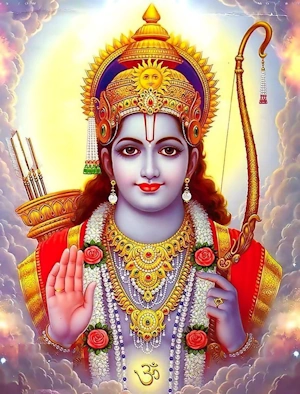
When Bhagawan takes avatara on earth, he must observe the rules of earthly life. One primary rule is cause and effect—without a cause, there cannot be an effect. Bhagawan himself sets these rules. Though he can change them for anyone, he doesn’t, even for himself, because it is his own game. He is the creator, referee, and umpire. Breaking his own rules would ruin the sanctity of the game.
Everything in Lord Rama’s life had to have a cause. Before taking avatara, Bhagawan created causes to experience apparent miseries due to apparent ajnana in earthly life. It is make-believe. Just like playing a game requires full involvement to keep it fun, Bhagawan too fully embraced his earthly role.
For example, if a top bureaucrat wants a remote transfer, he might offend a minister to make it happen. Similarly, Sri Hari had to create causes, like curses, to descend to earth.
In Satya Loka, Sri Hari approached Sanatkumara, who did not rise to greet him. Sanatkumara, a vairagi, believed respect was meaningless. Sri Hari seized the opportunity and accused Sanatkumara of arrogance. In turn, Sanatkumara cursed Sri Hari to spend time on earth as a human. Sri Hari responded with a counter-curse, ensuring both their roles in earthly life. Thus, Lord Rama’s incarnation began.
In an earlier kalpa, Maharishi Bhrigu’s wife, Khyati, wished for Vishnu Sayujya. Bhagawan granted her wish, but Maharishi Bhrigu, overwhelmed by grief, cursed Vishnu to lose his wife and suffer viraha dukkha. This set the stage for Lord Rama to lose Sita Devi.
Another curse came from Radha Rani, who cursed a gopa named Sudama, leading to his rebirth as the asura Jalandhara. Jalandhara’s wife, Vrinda, was a chaste pativrata. To defeat Jalandhara, Sri Hari disguised himself as Jalandhara and spent time with Vrinda, causing her to lose her pativratya. When Jalandhara was killed, Vrinda cursed Sri Hari to suffer viraha dukkha.
Devadatta’s wife also cursed Narasimha after losing her life upon seeing his terrifying form. She wished Sri Hari to experience viraha dukkha, especially when his wife was pregnant. This added to the circumstances for Lord Rama’s separation from Sita when she was expecting.
Thus, every incident in the Ramayana has a cause, all created by Bhagawan himself. This shows how karma operates—nothing is accidental. Everything has a backdrop and a reason. If you suffer today, it is because of your past karma. Similarly, good actions today create positive outcomes tomorrow. This truth must always be remembered: take responsibility for your actions and strive to do good.
-
When Bhagavan takes avatara, he abides by the laws of earthly existence, especially cause and effect, even though he is their creator.
-
Breaking his own rules would undermine the integrity of his creation, so he submits to them in full.
-
Every event in Rama’s life required a cause, and Bhagavan himself arranged those causes before incarnation.
-
Curses served as the chosen instruments that created the necessary conditions for Rama’s experiences.
-
Sanatkumara’s curse set the stage for Bhagavan to descend to earth as a human.
-
Bhrigu’s grief-driven curse ensured Rama would face the pain of separation from Sita.
-
Vrinda’s curse, born from betrayal and loss, also destined Bhagavan to undergo viraha dukkha (the sorrow of separation).
-
Devadatta’s wife added another layer, cursing him to suffer separation during his wife’s pregnancy.
-
These causes collectively explain Rama’s trials, showing how karma works with precision—every effect has a reason behind it.
-
The larger lesson is universal: human suffering and joy also arise from one’s own past actions. Responsibility and conscious good deeds are the only way forward.
What does it mean that Bhagavan follows cause and effect?
It means that even though he is beyond rules, he accepts the discipline of earthly law when incarnating. Without a cause, no effect can arise, so every event in his avataric life had to be backed by a reason. This preserves the sanctity of the cosmic order he himself designed.
If he is all-powerful, why not simply skip these causes?
Because skipping them would turn life into a hollow performance, not a meaningful play. By binding himself to rules, he demonstrates the seriousness of dharma and the reliability of karma. It is his way of honoring his own creation.
Isn’t it contradictory that the lawmaker is bound by his own laws?
No, it shows integrity. A referee who breaks his own rules destroys the game. By adhering to them, Bhagavan makes the system trustworthy for all beings.
Why did curses become the chosen causes for Rama’s suffering?
Curses were a way to create binding conditions that ensured the avatar’s human experiences. Each curse was like a seed planted beforehand to sprout at the right moment. This gave structure and logic to the trials Rama faced on earth.
Are curses really that powerful?
Yes, because a curse is not just anger but a concentrated intent backed by tapas (spiritual power). Once spoken, it becomes a force that even Bhagavan chooses to respect in his cosmic play. It ensures consequences unfold with inevitability.
Isn’t this superstition—thinking curses can bind even divinity?
Not if you understand them as instruments. In this context, curses are narrative tools chosen by Bhagavan himself, not external limitations. They keep the storyline consistent with cause and effect.
What was the role of Bhrigu’s curse?
Bhrigu’s grief at losing his wife made him curse Vishnu to suffer separation from his consort. This became the seed for Sita’s abduction and Rama’s sorrow. It ensured that the avatara would mirror human pain of losing loved ones.
Why would Bhagavan accept such a painful fate?
Because experiencing viraha dukkha allowed him to model endurance and righteousness even in grief. It showed humans how to remain dharmic in the face of unbearable loss. His pain became a teaching.
If the curse was born of grief, wasn’t it unfair to Rama?
Fairness is not the issue here—purpose is. Bhagavan chose to turn even unfair curses into tools of teaching. What appears unfair to humans becomes part of the grand design in his hands.
What was Vrinda’s curse about?
When Bhagavan disguised himself to break her pativratya (chastity), Vrinda cursed him to suffer the agony of separation from his own wife. This carried forward into Rama’s life when Sita was taken away.
How does this connect to karma?
It shows the chain of cause and effect runs unbroken. Even when Bhagavan acts in divine purpose, he ensures consequences follow, so that mortals never doubt the working of karma.
Couldn’t he have avoided hurting Vrinda altogether?
Defeating Jalandhara required breaking her power of chastity, or else the asura would remain invincible. Bhagavan acted for cosmic balance, but then bore the consequence himself, teaching that dharma often demands sacrifice.
What is the larger human lesson from all these causes?
Just as Rama’s trials had specific causes, our own joys and sorrows also arise from past actions. Nothing is random; karma ties it all together. This insight pushes us toward responsibility for our deeds.
How should one live with this understanding?
By consciously choosing good actions today, you shape a better tomorrow. Accepting suffering as a result of past karma prevents self-pity and encourages proactive dharmic living.
Does this mean everything is fixed and free will is an illusion?
Not at all. Past karma sets conditions, but present choice creates new karma. The path forward always lies in using awareness and dharma to transform the future.