When Krishna Breaks All the Rules
सर्वः –
असतश्च सतश्चैव सर्वस्य प्रभवाप्ययात्
सर्वस्य सर्वदा ज्ञानात् सर्वमेनं प्रचक्षते
प्रभवाप्ययात् प्रभवाप्ययाभ्याम्
There are two words here prabhava and aapyaya.
Prabhava means source.
Aapyaya connects to nourishment.
Bhagawan Vyasa says since he is source and he is the nourisher of both the real and non-real—non-real means whatever he has created with his maya—and also because he always knows everything about everything, he is called sarvaha.
सर्वस्य सर्वदा ज्ञानात्
येन सर्वमिदं प्रोतम् – By whom all this is penetrated, so he is sarvaha.
स वै सर्वमिदम् – Isn’t he all this?
सर्वं समाप्नोति ततोसि सर्वः – We obtain everything from you, hence you are called sarvaha.
This is not very easily understood. We use all these words, but they are not conceived by the mind completely.
Beyond mechanical chanting, we should make efforts to get into the meanings of these terms.
Understand one term properly, one name properly, then the whole truth will reveal itself before you.
This is not just with humans. This issue with comprehension happens even with Devas.
This happened after the incident wherein Krishna saved the calves and Gopa boys from Aghasura.
Once Lord Krishna and the Gopa boys had taken the calves for grazing on the banks of Yamuna.
The weather was very pleasant.
Lunchtime approached.
Krishna told everyone, let’s all have lunch.
Some of the boys said, oh we haven’t brought anything and Nandagaon is far away. So we will take the calves and go back.
The Lord said, don’t worry, whatever we have, we will all share.
They all sat around the Lord under the shade of a tree.
Sri Hari in his peetanbara at the center and the Gopa boys wearing clothes of various colors all around him.
It looked as if Devendra was holding his court.
Such a majestic scene.
It looked as if a lotus with multi-colored petals had opened.
Those boys who had brought their lunch packets opened them.
One boy came up to the Lord and offered in his mouth a little bit of what he had brought.
Sri Hari smiled and relished it.
He said, distribute around whatever you all have brought. Let us all have together.
This joy of sharing, can we ever get it back into our society?
Now each of us is in a box.
Imprisoned in a box.
Smaller boxes of individuals placed within a bigger box for the nuclear family.
It stops there.
Today, if this happens, the mother will shout – why my son should give?
It is the responsibility of his mother.
Why should I take the trouble?
This is all planned, you know, she does it every time.
Those days they used to look out for opportunities to share.
Anyway.
Lord said, everyone share whatever you have brought.
One by one each of the boys got up and started offering food to Krishna with their own hands in his mouth.
See the affection he was able to generate among them towards him.
Someone joked, now with all these different items mixed up in your mouth, your tongue must have lost its sense of taste.
And the Lord was enjoying himself sitting in the middle of them.
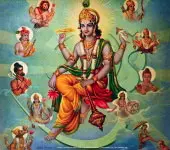
With his flute tucked into the girdle around his waist, his baton by his side, a bowl of food made of leaves in his left hand, a fruit in his right hand, beautiful crown on his head, beautiful golden yellow silk clothes, vanamala around his neck, golden chain around his waist, brilliant anklets, Sree Vatsa and Kaustubha upon his chest, sitting in the middle of Gopa boys, laughing out loud and enjoying themselves.
Can you visualize that beautiful scene?
You won’t need anything else to reach divine ecstasy.
Sri Hari yajna himself, yajno vai Vishnu, accepting the most pure offerings, still further sanctified with mantras, and here he is seated among Gopa boys, sharing their food, not bothered about the rules of purity and sanctity, eating whatever is offered by them in his mouth.
What a divine scene.
This one scene challenges all conventions, all orthodoxy, our entire rigid thought process.
I am not saying rules don’t have any meaning.
Rules have meaning only when you know why they are there and know their scope and limitations.
Rules have scope – they don’t apply everywhere.
They don’t apply to everyone.
Normally, spiritually and by dharma shastra, if you are eating, you can’t use your hand to serve others.
The hand that you have put into your mouth, you don’t touch others with it.
There are even more stringent rules.
If two people, if both are having food, if they accidentally touch each other, they both have to stop eating, get up, and take bath to purify themselves.
There are rules wherein two people having food cannot share the same seat.
Their seats should not touch each other.
I am not saying these rules are baseless.
But unless you understand why they are there, there is no meaning.
They have valid reasons behind them and apply only to certain people following a certain path.
Anyway, we will not get into the details of all that.
Here, by accepting food out of the hands of Gopa boys who are themselves eating, without bothering about the rules, Bhagawan is showing this to us—
That rules are not common to everyone.
They don’t apply on all occasions.
Only someone with an insight into spirituality or religion can understand these.
However, for the common man who may not have that, to be on the safer side, better follow the common dos and don'ts.
Got it. Here are sharp, on-theme curiosities with straight answers — no fluff.
-
What does the name ‘Sarvaha’ assert?
He is the source and the nourisher of everything, real and apparent. He knows all, always. That total knowing and sustaining power is why he is called Sarvaha. -
How can he nourish what is ‘non-real’?
‘Non-real’ is appearance sustained by his power of maya. Even appearances need a substratum and energy; both rest on him. -
Why is sharing food spiritually weighty?
Sharing cuts ego and hoarding. Where ego softens, Lakshmi’s presence stabilizes as sufficiency, cleanliness, and timely provision. -
When do rules yield to love for Bhagavan?
Rules train the mind; love fulfils the goal. When the spirit of purity is intact, devotion takes precedence over form without becoming careless. -
How do I follow purity without becoming rigid?
Keep hygiene, intention, and respect. Drop superiority. Purity that insults others is impurity in disguise. -
What is the logic behind accepting a simple bite offered with affection?
The offering declares dependence on Bhagavan. Intention sanctifies; love raises the bite into worship. -
Why is omniscience essential to this vision?
If he sustains all, he must know all. Without omniscience, sustenance would be blind; with it, care is precise. -
How does bhakti strengthen physical health?
Regular nama-japa and remembrance calm the nervous system, improve breath rhythm, reduce cravings, and steady sleep. A calm body obeys wise choices. -
How does devotion repair family dynamics?
A shared daily remembrance makes one center. It reduces ego fights, normalizes apology, and turns meals into bonding, not score-keeping. -
What is a practical test that Lakshmi is honored at home?
Clean spaces, organized finances, grateful speech, fair payments, and punctual giving. Where these are steady, her grace is active. -
How do I keep rules meaningful at home meals?
Teach hand-washing, clean serving, and gratitude first. Let courtesy lead form. Do not weaponize rules against guests or children. -
Why does one name of Bhagavan change inner wiring?
Focused repetition directs attention; attention directs choices. The divine name fixes the compass so mind and action stop wandering. -
How do I bring back the joy of sharing in a city life?
Start with one shared dish weekly, invite a neighbor or colleague, and thank Bhagavan aloud before eating. Culture returns through small faithful acts. -
Is laughter and play around food unspiritual?
No. Joy offered to Bhagavan is sattvic. Laughter with respect purifies the space faster than dry formality. -
What should I do when someone looks down on simple offerings?
Keep dignity, keep purity, and offer with love. Lakshmi values clean intent over display. -
How do I teach children this spirit without forcing?
Give them a role: a short chant, a small serving duty, a thank-you line to Bhagavan. Ownership creates affection. -
What daily anchor ties this all together?
Early rising, brief nama-japa, clean meal shared without phones, and one act of giving. Repeat daily. Consistency invites grace. -
How do I know bhakti is deepening?
Faster forgiveness, cleaner speech, gratitude before meals, and a steady sense that you are held. Where these grow, Vishnu’s care is felt and Lakshmi stays.





English
Vishnu Sahasranama
Click on any topic to open
7
30
Astrology
Bhagavad Gita
Bhagavatam
Bharat Matha
Devi
Devi Mahatmyam
Ganapathy
Garuda Puranam
Glory of Venkatesha
Hanuman
Kathopanishad
Mahabharatam
Mantra Shastra
Mystique
Practical Wisdom
Purana Stories
Radhe Radhe
Ramayana
Rare Topics
Rigveda Explained
Rituals
Sages and Saints
Shiva
Spiritual books
Sri Suktam
Story of Sri Yantra
Temples
Vedas
Vishnu Sahasranama
Yoga Vasishta
26
17
10
0


