Story Of Alarka
सर्वगः सर्ववित् भानुः विष्वक्सेनो जनार्दनः।
वेदो वेदविदव्यङ्गो वेदाङ्गो वेदवित् कविः॥
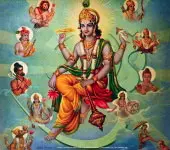
Today we will see the meaning of the divya nama Vishvaksena and also see the story of Alarka.
It has two parts - विष्वञ्चः and सेना. Vishvanchah means all beings everywhere, all over the universe. The Lord is not alone. He has an army, sena, to protect everyone, all beings, everywhere. Only in very special cases, he goes by himself. In the vast majority of cases, it is one of the soldiers of his army who would protect a devotee.
Someone is about to cross a road. He doesn't see a speeding car coming. The person behind him grabs his hand and pulls him back.
What has actually happened? One of Bhagavan's soldiers entered the body of the person behind - this is called avesha - and saved him. This is how Bhagavan acts. He is there in your day-to-day life, you may not know it, you may not notice it. Out of the Sankarshana - Vasudeva - Pradyumna - Aniruddha Chaturvyuha, it is Aniruddha who is represented by this name Vishvaksena. This protective quality of Bhagavan is what manifests through Aniruddha.
The meaning can be derived in another way also - विषूची सेना यस्य सः विष्वक्सेनः - विषुची means army, someone with an army is Vishvaksena.
Bhagavan's methods are unpredictable. Story of Alarka is an example of this. Alarka was born into a royal family. His mother wanted that all children born from her womb should not take rebirths. They should attain moksha. They should not get entangled in worldly affairs. So she sent away all her children to the forest to observe tapas and attain moksha, except the last one. The last son was Alarka. When Alarka was born, his father told his mother to leave him alone. He should grow up and take care of the kingdom. Alarka's mother agreed. Accordingly, Alarka grew up and became the king. After handing over the kingdom, his father and mother also left for the forest to observe tapas.
In the forest, they met their elder sons who by now were well accomplished in vairagya and yoga. Alarka's mother felt that she had deprived her youngest son of the greatest purpose of human life. She told her sons in the forest to go to Alarka and convince him to relinquish everything. They went to him. But by now Alarka had got the taste of power and position. He refused to budge. Then they went to the king of Kashi who was their maternal uncle. They requested him to attack Alarka's kingdom. He obliged and attacked Alarka with a huge army.
Alarka had no option but to run away to the forest. There he decided to leave everything and strive for moksha. Soon he achieved Bhagavan's lotus feet.
This happens today also. You might have seen people who are unsuccessful in worldly life turning to the spiritual path. Bhagavan takes everything away from them one by one so that they can finally turn towards the supreme goal. We may think that it is their misfortune or lack of capability that they lost everything. No. It is one of Bhagavan's ways of releasing them from worldly bondage and taking them towards the highest place.
-
If protection is real, why do dangers still come close before help arrives?
Because grace often works through timely nudges, not magic shields. Near misses wake up attention, humility, and surrender. Practical: start your day with 11 names from Vishnu Sahasranama, then nama japa for 5 minutes. You build an alert, prayerful mind that notices help when it comes. -
How can I sense that help is from Bhagavan and not just random luck?
Patterns show up: unlikely assistance, inner calm during chaos, and outcomes better than your planning. Practical: after any narrow escape, sit for 3 minutes and chant the name ‘Narayana’ softly. Offer the event back to him. Gratitude sharpens recognition. -
If I am responsible for my actions, where does Bhagavan’s protection fit in?
Your effort is the steering wheel; his grace is the road holding up the car. Practical: before work, chant one shloka of Vishnu Sahasranama, then set one honest task for the day. Effort meets grace. -
Can chanting actually improve physical health or is it just emotion?
Slow, rhythmic japa steadies breath, reduces stress load, and helps sleep. A calmer nervous system supports immunity and recovery. Practical: 108 soft repetitions of ‘Om Namo Narayanaya’ after sunset. Keep spine straight, exhale longer than inhale. -
What does surrender look like when a job, loan, or case is stuck?
You do the next right step without panic, while handing outcome to him. Practical: chant 5 names from Sahasranama before every difficult call or meeting. Say inwardly: ‘You lead, I follow.’ Then proceed. -
How do I protect my family without becoming controlling?
Replace anxiety with intercession. Practical: choose a fixed time nightly, chant one verse of Vishnu Sahasranama for each family member, and end with 27 counts of nama japa. You act with care, not fear. -
What should I do when power and success make me forget prayer?
Schedule bhakti like a meeting. Practical: after any achievement, offer a brief archana using one stanza of Sahasranama and 54 japa. Success remains clean when it returns to its source. -
Why does life sometimes collapse just when I start praying more?
Old attachments loosen. What is weak falls so what is true can stand. Practical: keep a 21-day vrata of daily Sahasranama chanting (minimum one stanza) and 108 japa. Hold the line. Clarity follows. -
How do I balance ambition with seeking moksha?
Let ambition serve dharma. Practical: begin projects with a short sankalpa after chanting one stanza. End the day with ‘Vasudeva’ japa till breath settles. Work becomes sadhana, not a trap. -
When a stranger helps me at the right moment, how do I respond spiritually?
Treat it as Bhagavan’s intervention through a human channel. Practical: offer three slow repetitions of ‘Govinda’ immediately. If possible, help another person that week. Grace asks to be passed on. -
I keep slipping back into old habits. What specific bhakti routine arrests the slide?
Tighten rhythm, not volume. Practical: morning — 5 minutes Sahasranama aloud; noon — 1 minute silent nama japa; night — 5 minutes Sahasranama softly. Small, steady flames outlast bursts. -
How can couples use chanting to reduce conflict without preaching to each other?
Pray for each other, not at each other. Practical: both sit back-to-back for 3 minutes, chant one stanza together, then do 27 nama japa silently. Speak only after one minute of silence. Tone changes. -
What do I do in an emergency when there is no time for long prayer?
Use a single, sharp name like a lifeline. Practical: three strong repetitions of ‘Narayana’, then act. After the event, complete with 108 nama japa as thanksgiving. -
How do I introduce children to this without pressure?
Keep it short and joyful. Practical: one line of Sahasranama with a simple meaning, then 11-bead japa using fingers. Celebrate consistency, not perfection. -
If I feel nothing during chanting, is it still working?
Yes. Fire cooks even if you cannot hear the sizzle. Practical: maintain a 40-day log. Same time, same seat, same text. Results show in patience, sleep, and fewer impulsive reactions. -
How do I know which names to chant on tough days?
Choose names that emphasize protection and guidance. Practical: pick any one stanza ending with ‘senah’ or ‘ksena’ sounds if available to you, then follow with ‘Narayana’ japa. Keep it consistent rather than hunting for perfect picks. -
What is a compact daily plan that covers health, work, and relationships?
Morning: one stanza Vishnu Sahasranama, 54 nama japa for steadiness.
Midday: 1 minute silent japa before key task.
Night: one stanza for family welfare, 108 japa for restful sleep.
Keep water near you; sip after chanting as prasada.
If someone saves another person from an accident, isn’t it just chance or human reflex, not some invisible soldier of Vishnu?
Chance is just a word we use when we don’t see the deeper mechanism. Reflexes don’t explain why the right person happened to be at the right place, at the right time, with the right reaction. Calling it Vishnu’s sena is simply recognizing that life-saving interventions often come from beyond human calculation.
How can you say Bhagavan enters another person’s body? Isn’t that just imagination?
We already accept that emotions like anger or compassion can ‘take over’ a person. Science calls it a surge of hormones or altered brain chemistry. The idea of avesha is the same—an external divine force channeling through a human body. What science describes as chemical, tradition describes as spiritual agency.
If Bhagavan really protects, why do accidents, diseases, and tragedies still happen?
Protection doesn’t mean suspension of natural laws. If gravity didn’t work, the world would collapse. Vishnu’s protection is about the bigger arc of life—guiding you toward liberation. Sometimes survival is protection, sometimes removal from worldly entanglements is protection. Both are valid forms.
You say Vishnu can take away someone’s wealth or power to make them spiritual. Isn’t that just failure dressed up as philosophy?
Failure and loss are only ‘failure’ if we assume worldly success is the ultimate purpose. If the final goal of life is freedom from rebirth, then Bhagavan stripping away attachments is not punishment but acceleration. What looks like ruin outside may be release inside.
But how do you prove that Alarka’s story is more than a myth?
Historical proof is not the point here. The story is a teaching device. Even if you treat it as allegory, it describes a reality you can observe—people losing worldly ground and suddenly rising in spiritual intensity. The story encodes that law of life.
Isn’t it just psychology, not divinity? People turn spiritual because of trauma, not because of Vishnu’s plan.
Labeling it ‘psychology’ doesn’t cancel divinity. Psychology explains the process, not the purpose. From a spiritual lens, those very psychological shifts are the tools Bhagavan uses. The two views are not contradictory; one is about mechanism, the other about meaning.





English
Vishnu Sahasranama
Click on any topic to open
19


