So Easy To Be A Devotee Of Bhagawan
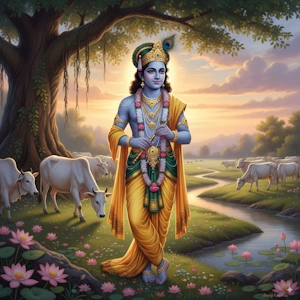
Today, we will see how simple and effective it is to be the devotee of Bhagawan Vishnu and then we will see the meaning of the 129th Divya nama वेदः of Vishnu Sahasranama.
वेदो वेदविदव्यङ्गो वेदाङ्गो वेदवित्कविः
Methods in the Bhakti Marga are quite simple indeed.
शयनादुत्थितो यस्तु कीर्तयेन्मधुसूदनम्।
कीर्तनात्तस्य पापस्य नाशमायात्यशेषतः ॥
As you get up from your bed in the morning, do that by saying नारायण or कृष्ण.
This much is enough to destroy all your papas.
Instead of reaching out for your mobile phone, say नारायण or कृष्ण as soon as you wake up.
You may not understand why papas should be destroyed.
Papa is not something that only sends people to Naraka.
Your own papa is responsible for every single trouble in your life - from small headaches to grave dangers to financial problems to losses to quarrels to obstacles in everything.
Every problem that you face in your life is because of your own papa.
So it is very important to keep burning away the papas that you have done or created.
And see this simple way with which you can do that.
Wake up every day saying नारायण or कृष्ण.
Bhagawan is called Veda.
He himself is Veda.
We say that Srimad Bhagavata itself is Sri Krishna.
It is not that Srimad Bhagavata is a book about Bhagavan.
The book itself is Bhagavan.
If Srimad Bhagavata is there at your home, then Bhagavan is there at your Home.
And What is Srimad Bhagavata?
The essence of Veda.
That's why it is said Bhagavan is Veda.
That is why we call him Veda.
वेदो वेदविदव्यङ्गो वेदाङ्गो वेदवित्कविः
-
Why should I start my day with Bhagavan’s name instead of rushing to my phone or work?
Because the first thought of the day sets the tone for everything that follows. If you wake up with ‘Om Namo Narayanaya’, you invite clarity, steadiness, and protection from negative forces. Your mind feels lighter, and even the body responds by reducing stress hormones. Try chanting ‘Om Narayanaya Namaha’ 11 times as soon as you rise. -
How does taking Bhagavan’s name reduce daily problems like quarrels or stress?
Papa creates unrest in relationships and health. Nama japa burns papa gradually, so irritability in the mind reduces. When you chant ‘Om Janardanaya Namaha’ 108 times daily, patience grows, anger cools down, and family harmony improves. This shift is not just psychological—it shows up in smoother conversations and fewer conflicts at home. -
Is there a connection between regular chanting and physical health?
Yes. Worries and papas disturb the nervous system. Daily chanting of the Vishnu Sahasranama at a slow pace calms the nerves and regulates breath naturally. It lowers blood pressure, reduces the burden on the heart, and strengthens immunity. Think of it as spiritual medicine with no side effects. -
Why is Bhagavan himself called Veda?
Because Veda is not just scripture; it is the eternal knowledge that sustains the universe. When you chant his names, you are aligning yourself with that eternal wisdom. Keeping a copy of the Sahasranama or Srimad Bhagavata in your home is not symbolic—it is Bhagavan’s very presence, influencing the atmosphere with sattva. -
How does chanting protect one’s family?
When one person in the house does nama japa, the vibrations spread to everyone. Children grow with more focus and less agitation. Elders feel respected and peaceful. Even financial stability improves because decisions are made with a calmer mind. Begin with ‘Om Vedaya Namaha’ 11 times daily as a family and see how the home atmosphere softens.
Isn’t it superstition to say a name in the morning and claim ‘sins’ vanish?
No. Think in two layers. Outer layer: attention and habit. The first 10 seconds after waking set your mind’s default route for the day. Naming Bhagavan anchors attention, lowers reactivity, and you make fewer bad calls. Inner layer: dharma law. ‘Papa’ is moral residue from harmful intent and action. Bhakti burns its fuel by turning the will back to the source. Both layers reduce damage. That is the claim.
How can a sound remove papa?
A name is not bare sound. It is a pointer to a person. In this tradition the name and the named are inseparable. When you invoke the name, you align to the will of Bhagavan. Alignment dissolves the inner friction that drives wrong action. Less wrong action, less residue. That is removal.
Isn’t this just placebo or self-suggestion?
Placebo is still a causal pathway: belief shaping physiology and behavior. Here, faith plus repetition builds a durable trait, not a weekend trick. You become calmer, clearer, and more truthful. Outcomes change because you change. Calling it placebo does not neutralize the effect.
If a criminal chants, does he get a free pass?
No. Chanting without correction of intent is noise. Bhakti demands aversion to wrongdoing. Where sincerity appears, reform follows. Where reform does not happen, there is no bhakti; there is only lip service. Consequences remain.
Why Narayana or Krishna specifically? Why not any word?
Because this path is relational. It is not generic mindfulness. The names Narayana and Krishna identify the personal absolute you are anchoring to. Specific relationship, specific response.
Isn’t ‘papa causes every problem’ a cruel claim, especially for children or the sick?
It is an explanation of moral causality across time, not a license to blame victims. Two truths run together: personal responsibility for intent now, and compassionate duty to care for those who suffer. Bhakti insists on both.
Is papa just guilt in Sanskrit clothing?
Guilt is a feeling. Papa is a causal load. You can feel no guilt and still carry papa; you can feel guilt and have none. Bhakti targets the load at the source: intent, action, and ego-fixation.
Where is evidence that chanting affects real life problems like money stress or quarrels?
Mechanism first: attention stabilizes, speech softens, impulses slow down, decisions improve. Quarrels de-escalate because one party refuses to feed the fire. Finances improve because fewer rash moves are made. These are observable, repeatable, and cumulative. That is evidence in plain sight.
Why should I not touch my phone first thing? What difference does 10 seconds make?
Phones pull you into a market of cravings and alerts. Start there and you spend the day reacting. Start with Bhagavan and you spend the day guided. First input trains the rest of the day’s filter.
How can a book be Bhagavan? Isn’t that category error?
Vishnu’s presence has many forms: cosmic, inner, consecrated image, and sacred sound. A text that carries his self-revealed teaching is treated as his sound-form. The point is not paper worship; it is recognition that the pattern of meaning itself is a living doorway.
If Srimad Bhagavata at home equals Bhagavan at home, what about a library copy on a dusty shelf?
Presence is relational. Reverence, hearing, and remembrance activate that mode of presence. A neglected copy is like an unvisited guest room: a place prepared, not a meeting happening.
Why call Bhagavan ‘Veda’? Veda is text; Bhagavan is deity.
Veda means knowledge that reveals what you cannot infer alone: ultimate cause, right action, and the way out. Bhagavan is both the source and the content of that revelation. Saying ‘Bhagavan is Veda’ states identity of knower, known, and knowledge at the summit.
Veda is finite verses. How can it be all-knowledge?
You confuse container with content. The verses are finite; what they open is not. Like code that opens an infinite space of computation, the mantra-body opens what your senses cannot.
Why Sanskrit? Shouldn’t truth be language-neutral?
Truth is language-neutral; delivery is not. Sanskrit mantras are engineered for precise sound-meaning coupling. That precision matters when sound itself is the vehicle. If you engage the path, you use the vehicle built for it.
If waking and chanting works, what about those with memory issues or different schedules?
The principle is primacy of first attention, not the clock trivia. Whatever your waking pattern, give the first lucid instant to Bhagavan. The law holds.
Is the bhakti marga really simple, or are you hiding complexities?
It is simple in gateway, not shallow in depth. Entry: take the name, bow the will. Depth: boundless. Complexity is not a virtue; transformation is.
If everything is papa and prarabdha, where is free will?
Right here: you can turn the mind to Bhagavan now. That turn is free. It reshapes tomorrow’s load. Causality is real; so is choice.
Different recensions of the Veda exist. Doesn’t that undercut your ‘eternal’ talk?
Transmission can vary in branches without altering what is being transmitted. Variants are surface; continuity is essence. The river meanders; the water is one.
Why privilege Vishnu over other deities?
This discussion is on Vishnu Sahasranama. Within that frame, Vishnu is the maintaining principle and the personal absolute addressed by these names. Other frames argue their metaphysics. Pick one lens at a time if you want clarity.
Bottom line: what exactly changes when I say Narayana or Krishna on waking?
Orientation. You start aligned to the highest reference point. That alignment trims impulsive error, cleans inner residue, and invites grace. From there, the day runs differently.





English
Vishnu Sahasranama
Click on any topic to open
7
30
Astrology
Bhagavad Gita
Bhagavatam
Bharat Matha
Devi
Devi Mahatmyam
Ganapathy
Garuda Puranam
Glory of Venkatesha
Hanuman
Kathopanishad
Mahabharatam
Mantra Shastra
Mystique
Practical Wisdom
Purana Stories
Radhe Radhe
Ramayana
Rare Topics
Rigveda Explained
Rituals
Sages and Saints
Shiva
Spiritual books
Sri Suktam
Story of Sri Yantra
Temples
Vedas
Vishnu Sahasranama
Yoga Vasishta
26
17
10
0


