Chitraketu: The Story of a King Who Found Enlightenment Through Suffering
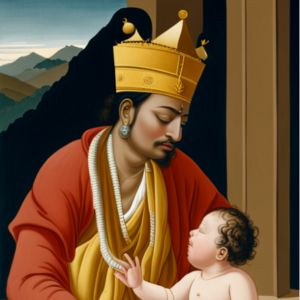
Today we will look at the meaning of the divya nama Vararohaha and also learn about king Chitraketu which is a very interesting story.
This name Vararoha has another significance.
The answer to Yoduhishtira's first two questions
किमेकं दैवतं लोके?
किं वाप्येकं परायणम्?
Who is the one and only God in the world?
What is the highest goal?
The answers to these two questions end with the divya nama Vararoha.
वर उत्कृष्ट आरोहः यस्य स्वप्राप्ति लक्षणः
Greatest ascend is to rise up to him.
To reach him.
To attain him.
When you made the highest climb, conquered the highest peak of spirituality, it means that you have attained him.
Because he is at the highest peak of spirituality.
This peak has a specialty.
यद्गत्वा न निवर्तन्ते तद्धाम परमं मम।
After climbing that peak, you don't have to come back.
Aroha also means vehicle.
Who is the Lord's vehicle?
Garuda.
Greatest of all vehicles.
Because of that also he is Vararoha.
There was a king called Chitraketu.
He had many queens but did not have children.
The king kept on worrying; what will happen to my kingdom if I don't get a successor.
He couldn't sleep at night.
One day Maharshi Angira came there.
Chitrketu told him his concern.
Angira thought; this king will get self realization if he happens to suffer the loss of a child.
Angira performed a yaga for Chitraketu.
At the end of the yaga, Angira gave prasada to Chitraketu and said: Ask any one of your queens to consume this prasada. She will conceive.
Chitraketu gave the prasada to one of the queens, she conceived and delivered a boy.
Since she gave him a successor, the king started showing more affection towards that particular queen.
The other queens became jealous.
They conspired and killed the child by giving him poison.
Chitraketu was inconsolable.
He kept on crying by the side of the dead body of the child, fainting every now and then.
At that time Rishis Angira and Narada came there together.
They told Chitraketu: Why are you upset so much?
Why are you crying so much?
The father-son relationship is just an illusion, just an imagination.
What was your relationship with this boy before he was born?
What will be his relationship with you in a future birth?
Nothing was going into Chitraketu's head.
Narada Maharshi brought back life into the boy's body and told the boy's jeevatma: Look, you father here is sad that you have gone away. Why don't you stay with him for more time?
Jeevatma said: Who is he? I have nothing to do with him.
I am on my own path.
I take births as per my own karma.
I have been taking births since time immemorial.
Sometimes, I become his father, sometimes his son, sometimes his friend, sometimes his enemy.
He should in fact consider me as his enemy and should be happy that I am gone.
Everyone knows that the body is not permanent.
Why is he wasting time crying for this body?
The atma never dies.
Saying this, the Jeevatma went back.
Chitraketu became peaceful and arranged for the cremation of the body.
After that, the Maharshis gave him methods to attain the Lord.
He started worshiping Bhagavan and soon became the chief of Vidayadharas.
Then he went to Bhagavan Sankarshana.
Sankarshana gave him knowledge about the supreme truth.
-
Why is rising towards the Lord called the greatest ascent?
Because every climb in life—career, wealth, health, relationships—still leaves a sense of incompleteness. The only peak that never collapses is the Lord himself. When you reach him, there is no slipping back, no restlessness, no return. -
What does it mean that once you reach him, you don’t return?
Ordinary goals give temporary relief. Once achieved, they fade or lose their charm. But union with the Lord is permanent. The peace, strength, and joy remain unshaken by time, age, or circumstance. -
Why is he compared to the highest vehicle?
Because he is not just a support for travel, he himself becomes the carrier who takes the devotee across all obstacles. Like Garuda soaring above storms, the Lord lifts his devotee above sorrow, disease, and confusion. -
How does devotion to him help in family life?
Families face jealousy, misunderstandings, and attachments. Remembering that every bond is given only for a period removes bitterness. When centered on the Lord, affection becomes purer—love without suffocating possessiveness. -
What lesson can one take from suffering losses?
Losses shake the illusion that life is in our control. They open the heart to deeper truths. Chanting the divine names gives courage to bear grief and channels pain into clarity and surrender. -
Why do rishis emphasize the atma is eternal?
Because if we identify only with the body, every loss feels like destruction. Realizing that the self never dies makes us live with more strength, health, and purpose, instead of wasting life in endless grief. -
How does chanting Vishnu Sahasranama help practically?
Each name carries power. Repeated chanting steadies the mind, reduces anxiety, improves sleep, and strengthens the heart. It also transforms relationships by removing hatred and filling the home with calm vibrations. -
Can bhakti affect physical health?
Yes. A peaceful mind brings balanced breathing, steady heartbeat, better digestion, and stronger immunity. Stress weakens the body; nama japa dissolves stress. The result is a healthier, longer, more meaningful life. -
What is the real inheritance one should leave behind?
Not just property or lineage, but the habit of turning to the Lord’s names. Children who grow in such an environment carry the strength of faith through every challenge in their lives. -
How does one know they are climbing the true peak?
If chanting his names gives increasing inner steadiness, if sorrows don’t crush the spirit, if family ties feel lighter yet more affectionate, then the climb is real. That ascent is the true vararoha—rising towards him.
Here is the sharp, cross-exam style section you asked for — no fluff, just the challenges and the answers.
If relationships like father and son are illusions, then why do they feel so real?
Because feelings are built on memory and attachment. They are real as experiences, but not absolute. The bond exists only in this body, in this lifetime. Strip away the body and the memory, the so-called relation vanishes. What remains is the atma, unchanged.
You say the atma never dies. Where is the proof?
Look at energy. Physics says it can’t be destroyed, only transformed. Atma is that conscious energy. Bodies burn, decay, dissolve. But awareness itself — the witness of all change — never gets destroyed. Every tradition, from Upanishads to quantum discussions, points in this direction.
If the boy’s atma had no permanent link to Chitraketu, why did Narada bring it back temporarily? Isn’t that contradictory?
Not contradictory — demonstrative. It was done to show the king the truth straight from the soul itself. Without such a shock, the king would remain trapped in grief. The act was an educational moment, not a permanent reversal of death.
Why should I believe there is any existence beyond death when all I see is the body burning on the pyre?
Because what you ‘see’ is only matter. The body is just the vessel. Consciousness that animated it is not visible to your eye, just as electricity itself isn’t seen — only its effects are. Death removes the connection, not the current itself.
If everything is karma, isn’t it just blind chance where we land up — as father, son, friend, or enemy?
Not blind chance — cause and effect. Karma is structured consequence. Like planting seeds: plant rice, reap rice; plant thorns, reap pain. The atma keeps moving through these results. Who becomes family or foe is the unfolding of that sequence.
If Vishnu is the highest peak, as Vararoha suggests, why can’t we just climb to that peak directly, without all this suffering?
Because without exhaustion from lower climbs, you won’t value the summit. The path of loss and gain breaks the illusion that anything else is final. Only then do you turn fully toward that supreme peak. Otherwise, you keep circling in the foothills.
So Chitraketu lost a child and then suddenly became peaceful. Isn’t that escapism dressed up as philosophy?
No. Escapism denies pain. Philosophy here digests pain and converts it into knowledge. Chitraketu didn’t deny his child died. He understood the death correctly — not as annihilation, but as a transition. That clarity is what stilled his grief.





English
Vishnu Sahasranama
Click on any topic to open
7
30
Astrology
Bhagavad Gita
Bhagavatam
Bharat Matha
Devi
Devi Mahatmyam
Ganapathy
Garuda Puranam
Glory of Venkatesha
Hanuman
Kathopanishad
Mahabharatam
Mantra Shastra
Mystique
Practical Wisdom
Purana Stories
Radhe Radhe
Ramayana
Rare Topics
Rigveda Explained
Rituals
Sages and Saints
Shiva
Spiritual books
Sri Suktam
Story of Sri Yantra
Temples
Vedas
Vishnu Sahasranama
Yoga Vasishta
26
17
10
0


