Everything About Him Is Sweet
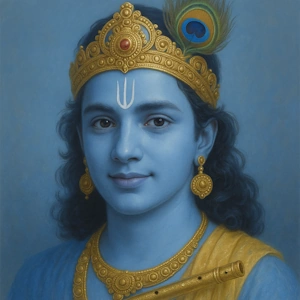
हृषीकेशः –
हृषीकम् means इन्द्रिय, हषीकाणामीशः हृषीकेशः.
He has only created the indriyas – the jnanendriyas and karmendriyas – and put them to work. Hence, he is their lord.
Kesha means hair. It also means rays or light – rays of sunlight and moonlight. These rays are like his hair. He gives happiness to the beings with these rays in the form of light, heat, and food. Hence, he is Hrishikesha.
Mahabharata says:
सूर्याचन्द्रमसौ शश्वदंशुभिः केशसंज्ञितैः
बोधयन् स्वापयंश्चैव जगदुत्तिष्ठते पृथक्
बोधनात्स्वापनाच्चैव जगतो हर्षणं भवेत्
अग्नीषोमकृतैरेवं कर्मभिः पाण्डुनन्दन
हृषीकेशो महेशानो वरदो लोकभावनः
With their kesha (rays), Surya and Chandra wake up the world and put it to sleep. The beings enjoy being awake and also sleep. Harshanam means enjoyment. As Surya and Chandra, it is Sri Hari only who does this – that is, harshanam of the world with his kesha. Hence, he is called Hrishikesha.
We earlier saw his roopa madhuri and venu madhuri – the sweetness of his form and the sweetness of venu naada.
Everything about him is sweet.
The way he walks – while taking the calves for grazing in the morning, while coming back in the evening.
Poets compare the gait of beautiful women to that of elephant and swan – gajagaminee, hamsagaminee.
But his gait has no comparison. It is unique.
Every now and then looking back, locking eyes with every gopika on the way.
And when he is gone, they all long to see him again. They keep on looking down the way – is he coming back?
He is so unpredictable.
Now he is here, now he is gone.
They say Parabrahma is unmoving, sthaayee, steady, stationary.
But this Parabrahma doesn’t seem so.
He is so very moving.
So, probably those who said Parabrahma is stationary, unchanging, unmoving – they probably have not seen this aspect of Parabrahma.
This Parabrahma is so chanchala. Chanchalyam is what you see all around him.
Now dancing with the gopikas. When they hold hands and go round and round, he is there in their middle. Then suddenly, he is gone. He can be seen standing away and playing his flute.
Isn’t this what the Upanishad calls as –
तदेजति तन्नैजति तद्दूरे तद्वन्तिके ।
तदन्तरस्य सर्वस्य तदु सर्वस्यास्य बाह्यतः
It moves and at the same time is stationary.
It is far away and at the same time close by.
It is inside and at the same time outside.
This is what Sri Hari shows us by his chanchalya.
He is clearing a confusion – with so many of the scriptures showing Parabrahma as static, changeless, stationary – we develop this wrong idea that Parabrahma is something like lifeless.
But here is Parabrahma, full of life – so chanchala.
After understanding this, your perception matures.
If you say – this is Parabrahma and this is not Parabrahma – then what you think is Parabrahma is not Parabrahma. Because Parabrahma is all-inclusive. If you are able to find something other than Parabrahma, it is only because what you think is Parabrahma is not Parabrahma.
पुञ्जीभूतं प्रेम गोपाङ्गनानां मूर्तीभूतं भागधेयं यदूनाम् ।
एकीभूतं गुप्तवित्तं श्रुतीनां श्यामीभूतं ब्रह्म मे सन्निधत्ताम्
What we see in him – all the love of all the gopikas assimilated at one place, all the fortune, all the punya in physical form – that he was born among them. All the secret wealth of all the Vedas at one place, and Parabrahma in shyamavarna, in the color of rain clouds.
श्यामाच्छबलं प्रपद्ये शबलाच्छ्यामं प्रपद्ये
If you have known Shyama, you have known Parabrahma. He is the path to reach Shabala Brahmaloka.
Knowing him is the most difficult path because he is so unpredictable, chanchala. But if you have known him, you have known Parabrahma.
But then – शबलाच्छ्यामं प्रपद्ये – you will also know that you don’t have to go to Brahmaloka. Just be with him. That is as good as being in Brahmaloka.
After attaining Brahmatva, if there is one thing that you want to do – it is to go back to him.
- If Bhagavan moves and yet is still, how do I stay steady without getting tossed around?
Fix a few non-negotiables: wake time, a short nama japa count, and one act of seva. Movement outside is fine when the core rhythm is tight inside. - Why does his unpredictable presence teach more than predictable proof?
It trains trust over control. You learn to act with purity when outcomes are unclear, and that builds real inner strength. - What changes in the senses show that devotion is maturing?
Tongue asks for simpler food, ears reject gossip, eyes look gentler. Cravings drop, posture improves, and sleep deepens. - How can I make daily work glow like rays from him?
Begin tasks after two calm breaths and a clear intention to serve. Close each task with a brief review and one correction. Ordinary work starts carrying light. - What do I do when I feel he comes and goes?
When you sense absence, serve immediately. Call a lonely relative, help a neighbor, or clean a shared space. Service dissolves the distance. - How do I avoid chasing spiritual thrills?
Keep your vow small and exact. Finish it daily without drama. Depth grows from repetition, not excitement. - How does this path help physical health in plain terms?
Lower inner friction reduces blood pressure swings, steadies breath, and trims late-night snacking. Add a 20-minute brisk walk with japa and one device-free hour before sleep. - What is a family routine that quietly builds devotion?
One lamp at dusk, one bhajan, and one gratitude line each. No speeches. Shared rhythm softens conflicts. - How do I pray for someone who hurt me without becoming weak?
Wish them clarity, keep your boundaries firm, and refuse revenge. The heart stays clean and the mind stays sharp. - What should I do during illness or pain spikes?
Use a fixed four-step script: slow exhale, short nama, required medicine, five minutes of rest. Repeat exactly the same way each time. The body learns calm. - How do I keep pride from sneaking in as peace grows?
Serve where your name is not used. Credit Bhagavan for every gain and take responsibility for every lapse. Pride cannot breathe in that air. - How do I bring children in without forcing them?
Let them ring the bell, place a flower, or count your beads. Keep it playful and short. Respect makes them curious. - What is a weekly self-check that proves progress is real?
Fewer outbursts, faster apologies, simpler food choices, and deeper sleep. If these rise, your bhakti is working. - How do scripture study and practice hold together?
Read a little, practice a lot, and verify through cleaner conduct. Shabda shows the map; sadhana walks the path.





English
Vishnu Sahasranama
Click on any topic to open
19


