Vedantis, Yogis, and Devotees Experience Sri Hari Differently
पद्मनाभः - सर्वजगत्कारणं पद्मं नाभौ यस्य स पद्मनाभः
On whose nabhi (navel) is the lotus, the cause of the universe, he is called Padmanabha. The lotus, the seat of the creator Brahma.
This lotus symbolically is kaala — time. Brahma’s creation is time-bound. It has a beginning and an end. He is seated on a lotus called kaala, meaning his basis, his foundation, his support is time.
Lotus blossoms at some point in time and withers after some time.
It is not permanent.
Likewise, Brahma’s creation and Brahma himself are not permanent.
Brahma sits on a lotus that comes out of the navel of Sri Hari, who is permanent.
As long as this lotus called kaala (time) is there, Brahma also is there.
As the lotus withers and goes, Brahma also goes.
कालात्मकं तु यत्पद्मं नाभौ यस्य स उच्यते पद्मनाभः
Brahma transforms himself into the whole creation consisting of billions of galaxies. That Brahma is seated on a small lotus coming out of the navel (nabhi) of Sri Hari. Imagine Sri Hari’s vastness.
Once Sri Hari looked in the mirror and said:
अहमपि परिभोक्तुं कामये राधिकेव
Who is this glorious being? How can you but not love him?
Had I been Radhika, I would have loved him myself.
Lord, after looking at the mirror, is exclaiming — had I been Radhika, I would have loved him myself. There is no other go.
अपरिकलितपूर्वः कश्चमत्कारिकारि
The Lord is saying about himself, after looking at the mirror — never seen someone so handsome before. Never has a flower so beautiful blossomed before. Had I been Radhika, I would have married him only.
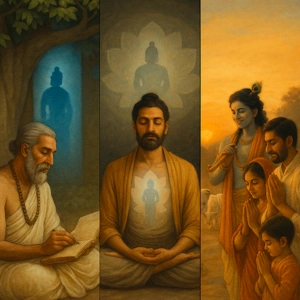
Sat, chit, and ananda are three ways of experiencing him.
When Vedantis use their discretion (viveka buddhi), discriminate between sat and asat and reach him, experience him — they experience him as sat.
When yogis, through chitta vritti nirodha, remove all distractions from their chitta, then he fills their chitta, and they experience him as chit — complete awareness.
But every time bhaktas see him, they are filled with ananda — ecstasy. That is how they experience him. The experience of the bhakta is ananda.
तं गोरजश्छुरितकुन्तलबद्धबर्ह-
वन्यप्रसूनरुचिरेक्षणचारुहासम् ।
वेणुं क्वणन्तमनुगैरुपगीतकीर्तिं
गोप्यो दिदृक्षितदृशोऽभ्यगमन् समेताः
Bhagavatam – Dashama Skandam – 15th Chapter
His thick, curly, black, shiny hair. He is returning in the evening after grazing the cows. Particles of dust raised from the hooves of cows are sticking to his shiny hair. A peacock feather adorns his hair.
There is something about that peacock feather.
राधाप्रियमयूरस्य पत्रं राधेक्षणम्
That feather is of a peacock which is the favorite of Radha Rani, which is there in her nikunja.
She likes that peacock a lot because the color of that peacock’s neck is that of Sri Hari. She keeps that peacock always near her. Now, Sri Hari has taken a feather of that peacock and kept it on his hair, because the eye of that peacock feather looks exactly like the eye of Radha Rani.
Look at the care, the love — he says: I not only have the deepest affection for you, I have it for your peacock as well. The feather of your dear peacock adorns my hair.
Everything about him is sweet — the wild flowers that he wears, his glances, his smile.
मथुराधिपतेरखिलं मधुरम्
And he plays the flute, which arouses hunger in the eyes of gopikas. They hear the venu nada first. They become eager to see him. They become restless to see him.
The gopikas are not happy that their eyes are placed below their eyebrows. They want their eyes to be still higher on the forehead so that they can see him from farther away, earlier.
That much is the eagerness to see him.
-
If creation is time-bound, what should I change today?
Prioritize what is eternal over what is urgent. Keep a small daily window for Sri Hari — mantra, quiet remembrance, or geeta study. This anchors the mind when deadlines, markets, or moods fluctuate. -
How do I relate to the lotus as a symbol of time in my routine?
Track one habit that blossoms and withers daily: breath. Begin and end the day with 6 slow breaths remembering Sri Hari at the navel center. It trains attention to rise above the mud of rush. -
Why does thinking on Sri Hari’s permanence reduce anxiety spikes?
The mind calms when it rests on what does not decay. Repeating a nama for 5 minutes lowers reactivity, improves sleep onset, and steadies decisions under pressure. -
Is entering through beauty shallow, or a valid doorway to bhakti?
Beauty is a clean entry. Krishna’s form, smile, and music soften the ego, then open the heart to surrender. Start with rupa, move to nama, then rest in remembrance. -
What do sat, chit, and ananda look like in one week of practice?
Sat: study a verse and act truthfully even when costly.
Chit: 10 minutes of breath-led focus before work.
Ananda: sing one kirtan with feeling in the evening. Rotate all three; balance arrives. -
How do I keep longing for the divine from becoming restless or escapist?
Convert longing into structured service: fix a time, offer food, donate discreetly, help a family member without credit-seeking. Longing becomes strength, not drift. -
How does Sri Hari’s care for what a devotee loves guide my relationships?
Honor what your spouse or child values. Learn one song they love, show up to their small milestone, keep their mementos with respect. Love deepens when you love their world. -
What is the flute’s call in practical terms?
It is a cue for attention. When you hear a trigger (phone chime, elevator ding), pause for one nama-japa cycle. Tie divine recall to daily sounds; attention returns home. -
How can bhakti help with physical health without making tall claims?
Gentle nama-japa with slow exhale aids relaxation, steadies pulse, and supports better sleep hygiene. Daily walking while remembering Sri Hari builds stamina without friction. -
How do I bring sweetness into a tense family atmosphere?
Introduce a short shared ritual: one bhajan after dinner, or two minutes of gratitude to Bhagavan. Keep it light, consistent, and non-argumentative. Sweetness grows by repetition, not debate. -
What should a busy professional drop first to make room for bhakti?
Drop passive scrolling before bed. Trade it for 7 minutes of nama and one verse reflection. The return on attention is immediate: clearer mornings, kinder tone, fewer impulsive replies. -
How do I measure progress without self-congratulation?
Track reductions in pettiness, faster recovery from irritation, and increased reliability in promises at home and work. These are clean metrics of grace at work. -
How do I handle days when form and music do not move me?
Serve anyway: cook, clean, help, donate. Bhakti is a vow, not a mood. Action keeps the channel open till feeling returns. -
Is it acceptable that my path starts with study rather than singing?
Yes. Vedantin clarity (sat) and yogic focus (chit) prepare the heart for ananda. Keep the ladder; don’t mock any rung. -
What single safeguard prevents spiritual pride?
Private, hidden service. Do one unseen act daily and offer it to Sri Hari. Humility becomes natural, not forced. -
How do I bring children into this without pressure?
Tell one Krishna story at snack time, keep it short, end with a gentle nama. No tests, no scolding. Curiosity beats compulsion. -
What is a graceful way to face aging and loss with this vision?
Remember: time withers the lotus, not Sri Hari. Keep nama on the tongue, keep promises to family, and leave a trail of kindness. This is dignified strength. -
What should I do in a crisis when the mind scatters?
Sit, lengthen exhale, chant a brief nama, and take the next right action. Offer the outcome to Bhagavan. Clarity returns when control is surrendered and duty is done.





English
Vishnu Sahasranama
Click on any topic to open
7
30
Astrology
Bhagavad Gita
Bhagavatam
Bharat Matha
Devi
Devi Mahatmyam
Ganapathy
Garuda Puranam
Glory of Venkatesha
Hanuman
Kathopanishad
Mahabharatam
Mantra Shastra
Mystique
Practical Wisdom
Purana Stories
Radhe Radhe
Ramayana
Rare Topics
Rigveda Explained
Rituals
Sages and Saints
Shiva
Spiritual books
Sri Suktam
Story of Sri Yantra
Temples
Vedas
Vishnu Sahasranama
Yoga Vasishta
26
17
10
0


