What Are the Problems Faced in Old Age
In the vairagya-prakarana of Yoga Vasishta, Lord Rama has already negated the glorification of childhood, shown how dangerous is the youth, and also exposed the trap which is sexuality, sexual urges.
Now the Lord proceeds into the characteristics of old age, in sarga 22.
When the youth came it swallowed, it finished the childhood.
When old age came it swallowed, it finished the youth.
Old age destroys the body, in every respect.
If you think that old is all about enjoying with your grandchildren, your son and daughter-in-law taking care of you; no, your body itself will not allow you any pleasure.
What does the body look like in old age?
Don't old people look like camels?
Wisdom runs away when the body is weak, ridden with diseases; all the wisdom that you used to give away to others, all the philosophy, all the proverbs, they all run away when your own body becomes old and weak.
People may be behaving politely out of compulsion.
But mostly everyone mocks at an old man behind his back.
Even your basic needs will start looking unreasonable to them.
See, he is eighty; still, he will not accommodate if salt is a little less in the dish.
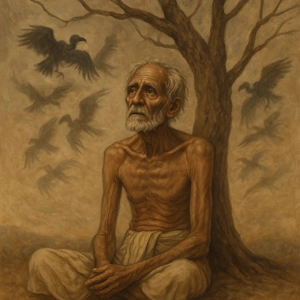
Have you seen what kind of trees vultures sit upon?
Old, dry.
In the same way, in the old weak body, disease-ridden body, desires come.
The vulture-like desires come to the body which looks like an old dry leafless tree.
Desires that can never be fulfilled.
They come only to torment the old man, torture the old man.
Fear, what after I die?
What is going to happen after I die?
Where am I going to go?
How will it be there?
This fear starts gripping.
Nothing can be done about it.
Loss of self-respect, self-confidence.
Feeling inferior.
I have lost my command.
I have become dependent.
Nobody listens to me anymore.
Nobody wants my advice anymore.
Nobody cares about my opinion anymore.
Better keep my mouth shut.
At least that will keep me away from their aggression.
I have become useless.
Not just this.
For some, an entire lifetime's earnings have been spent on the education of children.
Even the house mortgaged for an education loan.
Now it's gone.
No savings, no earning.
No place to stay.
Completely dependent on the mercy of children.
This feeling is what the Lord talks about here.
The worries are not just about earning, saving, spending, most basic things.
Will she give me proper food?
It is time for lunch.
Will she give me enough quantity?
I won't be able to complain.
Then she will tell my son when he comes back from the office.
They will start fighting.
Finally, the blame will come on me.
That I ill-treated the daughter-in-law.
I am too demanding.
Have to keep quiet.
Even where tasty food is available, the old man longs for it, but his digestive power is gone.
Eating as much as he wants will land him at the hospital.
Expecting death any time.
Anticipating death any time.
Slight breathlessness, I am going to die.
Slight discomfort in the chest, I am going to die.
Before going to sleep, what if I die in sleep?
Worrying, worrying, worrying.
Obsessed with death.
A city deserted can still look somewhat good.
A tree that has shed its leaves can still look somewhat beautiful.
A land without rains, a parched land can still look somewhat bright, but never an old man's body.
A vulture eagerly catches hold of a piece of meat only to eat it.
A girl goes near a flower and stretches her hand towards it, only to pluck it.
There are no two ways about these.
In the same way, Old age takes hold of the body only to consume it.
Not to keep in healthy and comfortable.
-
Life moves in phases that cancel each other out — youth ends childhood, and old age wipes out youth completely.
-
Old age is not a peaceful, graceful period but one of decay, discomfort, and deep inner suffering.
-
The body in old age becomes weak, unattractive, and unfit for any real enjoyment, even if the mind craves it.
-
Diseases and physical limitations rob the elderly of the clarity and strength they once had — even wisdom becomes inaccessible when the body fails.
-
Society starts mocking or ignoring the elderly, even when behaving outwardly respectful — their basic needs are seen as irritating or unreasonable.
-
The elderly often suppress complaints or preferences to avoid family conflict, especially with daughter-in-law or son.
-
Even strong desires arise in old age, but the body is no longer capable of fulfilling them — making those desires feel cruel and tormenting.
-
Fear of death becomes constant — every discomfort feels like a sign of the end, leading to obsessive worry.
-
Old people lose self-respect and confidence when they feel unheard, unwanted, and completely dependent on others.
-
Financial exhaustion after supporting children leaves many elders without savings, income, or even shelter — totally at the mercy of their offspring.
-
Even where good food or comforts are available, the old body rejects them — the digestive system and stamina are gone.
-
The body in old age, unlike nature’s other fading forms, has no remaining beauty — only a slow, painful decline.
-
Just like vultures circle a dying animal and a girl plucks a flower only to take it, old age comes only to consume the body — not preserve it.
What happens as we transition through life stages?
Each phase of life devours the one before it — youth erases childhood, and old age erases youth. Nothing stays intact for long.
Why is it important to understand this sequence?
It makes us see how temporary every stage is. If we grasp that, we stop clinging to our current phase as if it’ll last.
Isn’t that a depressing way to look at life?
It’s not about pessimism — it’s about realism. Denial leads to shock; clarity leads to wise preparation and detachment.
Is old age a peaceful time surrounded by family and joy?
No. The body becomes unreliable and blocks all forms of pleasure, no matter how loving the surroundings.
But isn’t spending time with grandchildren fulfilling?
It can be, but only if the body supports it. Most elders can’t sit long, can’t play, can’t laugh freely without pain or discomfort.
Isn’t that a cynical view of family bonds?
Not cynical — just practical. Even genuine love can’t reverse physical decline or relieve the suffering it brings.
What happens to wisdom and intellect in old age?
They retreat. When the body weakens, even a sharp mind struggles to function clearly under pain, fatigue, and disease.
Why does wisdom fade when it’s needed most?
Because wisdom depends on the body too — if your brain chemistry, senses, and energy drop, you can’t apply what you know.
Doesn’t age always bring greater insight?
Only if the person remains mentally and physically stable. Once health collapses, even the wise may go silent or confused.
How do people treat the elderly behind closed doors?
Often with ridicule or irritation. They may pretend to be polite, but inside they feel the old person is a burden.
Why does society mock the elderly despite respecting age in theory?
Because the elderly reflect our own future decline, and that makes people uncomfortable. So they hide it behind jokes or dismissal.
But don’t most cultures value elders?
Respect is often cultural lip service. In practice, when patience is tested daily, hidden irritation leaks out — especially in families.
Why do desires still arise in a weak old body?
Because the mind still holds on to impressions and cravings, even if the body can’t act on them. It becomes a source of torment.
Is it possible to train the mind to let go before old age?
Yes. That’s the goal of spiritual practice — to quieten desire early so that old age is not a battlefield of unmet cravings.
Isn’t desire natural even in old age?
Yes, but unfulfilled desire in a failing body causes only pain. Knowing this, one must redirect longing toward inner peace.
What is the biggest emotional shift in old age?
A deep loss of self-worth. The elder feels unheard, unwanted, and forced to stay silent to avoid being blamed.
Why does no one value their opinions anymore?
Because power has shifted. When you can no longer earn or assert control, people stop seeing you as relevant.
Is that the family’s fault?
Partly, but mostly it’s how worldly life works — power and attention move to the capable. That’s why inner strength matters more.
What financial condition do many elders face?
Total dependence. After spending a lifetime supporting children, some end up without income, savings, or shelter of their own.
Isn’t that a failure of planning?
Not always. Life throws curveballs — medical bills, loans, or sacrifices for children can drain even careful savers.
Can’t children be relied upon?
Not necessarily. Even good children may have limits, priorities, or spouses who don’t want to carry the elder’s burden.
What everyday worries consume the old?
Will they get proper food? Will the daughter-in-law complain? Will they be blamed for family tensions? These anxieties are constant.
Why are small things like food such big concerns?
Because elders have no control. Even expressing a preference could spark fights or cause friction they can’t handle.
Isn’t that an overreaction?
It’s not. When you’re powerless, even basic needs feel like negotiations. Fear of backlash makes silence feel safer.
What about enjoying pleasures like tasty food?
The desire remains, but the digestion fails. Eating what the heart wants brings hospital visits, not joy.
Can elders train themselves to give up such pleasures?
Yes, and many do. But it requires detachment and maturity — otherwise, they live with cravings they can’t fulfill.
Doesn’t giving up food joy mean giving up life’s joy?
Only if joy is tied to the senses. Real joy can come from peace, not taste — if one is trained for it.
How does death occupy the elder’s mind?
They expect it any moment. A cough, a chest ache, or even sleep becomes a trigger for fear — ‘Is this it?’
Why does this fear become obsessive?
Because there’s nothing else to look forward to — no career, no thrills, no new desires. Only endings remain visible.
Can’t faith or philosophy counter that fear?
They can — but only if internalized early. If not, the fear overrides belief when the body starts failing.
Why is the old body described so negatively?
Because unlike other faded things in nature, the old body carries pain, decay, and dependency — with no beauty left.
Isn’t that harsh?
It is, but it’s honest. A parched land or a dead tree can be poetic — a diseased old body usually just hurts.
Isn’t there dignity in aging gracefully?
Only if one accepts decline without clinging. Otherwise, the body becomes a prison — not a temple.
What is the final truth about old age?
Old age doesn’t preserve — it consumes. Like a vulture or a flower-plucker, it comes not to beautify, but to end.
Is that a call to fear aging?
No — it’s a call to prepare early. Age is coming; the question is, will you be ready to rise above the body?
Isn’t that fatalistic?
Not at all. It’s empowering. If you know old age destroys, you can build your life around what doesn’t get destroyed.





English
Yoga Vasishta
Click on any topic to open
7
30
Astrology
Bhagavad Gita
Bhagavatam
Bharat Matha
Devi
Devi Mahatmyam
Ganapathy
Garuda Puranam
Glory of Venkatesha
Hanuman
Kathopanishad
Mahabharatam
Mantra Shastra
Mystique
Practical Wisdom
Purana Stories
Radhe Radhe
Ramayana
Rare Topics
Rigveda Explained
Rituals
Sages and Saints
Shiva
Spiritual books
Sri Suktam
Story of Sri Yantra
Temples
Vedas
Vishnu Sahasranama
Yoga Vasishta
26
17
10
0


