Life Is Not a Celebration
Life is not a celebration.
That's what Lord Rama is establishing through the Vairagya-prakarana of Yoga-vasishta.
Childhood is a period of helplessness, fears, and anxiety.
Youth is fraught with dangers, risks, and is a period of reckless living.
Old age- diseases, dependence.
Where is the time to celebrate?
The lord continues with the old age: as soon as old age sets in, it blossoms rheumatic diseases and respiratory problems in the body.
Like how the rising moon blossoms the Water lily.
Ash gourd, you know the vegetable ash gourd when it becomes ripe, its skin gets a white powdery coating.
That's when the farmer knows that it has become ripe.
Then it is cut and eaten.
Same with man also.
The ash gourd-looking head when it turns grey Kala knows it is ready to be consumed.
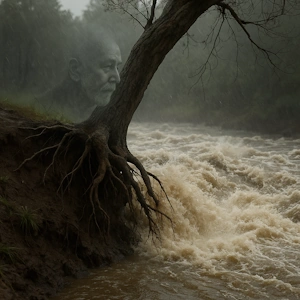
Like how a flooded raging river would take away the soil between and beneath the roots of trees standing on its banks and makes them fall, this is how it happens in old age also.
Old age is a howling jackal that has come into the forest.
The sound of coughing, lamenting, complaints.
The peace that prevailed in the forest is gone with the jackal's arrival.
The flame of life is still there in the body.
But it is like the flame coming from firewood that is wet, smoky, dark, and any time ready to extinguish.
Even the light in the eyes turns smoky and after some time it can go off fully also.
A creeper with white flowers and fruits is bending down because it is unable to bear the weight.
This is how the old man's body looks like.
Death can come any time like an elephant, pull out the plantain any time and throw it away.
When a king goes somewhere his retinue goes in front.
Here the retinue is diseases, worries, anxieties of old age, and the king- death always follows them.
There are those Sages who are all the time living in the caves of high mountains.
No enemy can ever come near them.
But even them old-age and death approach and destroy.
A house after heavy snowfall; doors, windows, everything is blocked with layers of thick snow.
The occupants of that house can not move out.
Their movement is restricted to the inside of the house.
That's how the sensory organs are inside the old man's body.
Man gets a third leg when he becomes old, the walking stick.
I don't trust this body, says Lord Rama; old age and death are inevitable destinations for this body.
First old age and then death.
How can you trust this body?
Life still wants to hold on to the body even after reaching this pitiable and miserable condition.
What use is it of?
Nothing can be achieved anymore.
Still, life holds on to it.
With some false hope.
-
Life is not designed to be a nonstop celebration; each stage carries its own burden — fear in childhood, reckless risk in youth, and decay in old age.
-
Old age doesn't just come quietly; it brings along diseases, breathlessness, and physical deterioration like a storm dragging down everything in its path.
-
Just as the moon causes water lilies to bloom, the onset of old age triggers the full blossoming of bodily suffering.
-
The body is like a ripe ash gourd — once it turns grey, it signals readiness for nature to take it back.
-
Aging hollows a person out slowly, like a river loosening the soil under a tree until it falls.
-
Old age disturbs the peace of life like a jackal’s howl disrupts the silence of a calm forest.
-
The life force continues in the body, but it is weak, unsteady, and smoky — like wet firewood that struggles to burn.
-
Vision fades with age just as smoke dims a lamp, showing that even the senses lose their strength gradually.
-
The aging body bends under its own weight, like a creeper heavy with flowers and fruits that can no longer hold itself upright.
-
Death strikes like an elephant uprooting a plantain tree — sudden, forceful, and complete.
-
Diseases, anxieties, and helplessness are the forerunners of death — like the royal entourage that travels ahead of a king.
-
No one is immune to aging — not even sages who live in isolated mountains; time reaches everywhere.
-
The body of the elderly becomes like a snow-covered house — sealed, slow, and disconnected from the outer world.
-
The walking stick is a third leg, a quiet admission that the body can no longer stand on its own.
-
Even when nothing is left to gain, life clings to the body with false hope, unable to let go.
What does old age do to the body?
It invites disease, weakens the lungs, bends the frame, and dulls the senses. It's a steady collapse from within.
Why is life described as difficult rather than joyous?
Because at every stage, suffering outweighs celebration — from fear in childhood to decay in old age.
Isn't there beauty in old age too, like wisdom and calm?
Wisdom can exist, but the physical and sensory breakdown is undeniable. Hope without function becomes a burden, not a gift.
How is old age like a storm on a riverbank?
Just as floodwaters loosen soil and topple trees, time eats away at the body's strength until it collapses.
Why compare life to nature’s destruction?
Because nature shows us how impermanence works — even the strongest tree can fall when the foundation is eroded.
Can't strong willpower prevent this decline?
No amount of mental strength can stop biological aging. It might help cope, but the body still obeys nature’s law.
Why is the body compared to a ripe ash gourd?
Because when grey hair appears, like the white coating on ripe gourds, it signals nature’s readiness to harvest life.
Why use such a harsh metaphor?
To strip away illusions. Sugar-coating age hides truth — this comparison forces us to see what we deny.
Isn't this fatalistic and depressing?
No, it's clarity. Seeing the truth lets you stop clinging and start preparing for what truly matters — inner stability.
Why does the flame of life become like smoky firewood?
Because in old age, the body no longer burns with clean energy. It's unstable, smoky, and close to going out.
Can anything make that flame bright again?
Physically, no. But spiritually, yes — inner realization can shift your focus from body to consciousness.
But isn't that just wishful thinking?
Not if it's practiced. Detachment from the body’s condition is a learnable mindset, proven by those who live joyfully with nothing.
Why are the senses described as trapped like people in a snow-covered house?
Because old age restricts their movement — eyes, ears, limbs all lose their function just like a house buried under snow becomes inaccessible.
Is this about physical decay or mental helplessness?
Both. The senses are bridges between the outer and inner worlds. When they fail, life becomes closed-off and lonely.
Can't science delay this restriction?
Only temporarily. Tech may extend function, but not eliminate decline. It's a patch, not a cure.
What is meant by death following like a king behind his retinue?
Diseases, weakness, and mental anguish prepare the stage. Death arrives last, but always on time.
Isn't that a grim way to look at life’s end?
It's not grim — it's honest. Facing it helps you live wisely before the king arrives.
Should we fear this king?
No, not if you're prepared. Fear comes from clinging; freedom comes from understanding.
Why does life still cling to a broken body?
Because the instinct to survive is deeply embedded — even when nothing is left to achieve, life resists letting go.
Can this clinging be stopped?
Yes, through clarity and detachment. When you know the body is not your true self, the grip loosens.
But isn’t holding on natural?
Yes, but so is letting go — when it’s time. Nature teaches both — birth and dissolution.





English
Yoga Vasishta
Click on any topic to open
7
30
Astrology
Bhagavad Gita
Bhagavatam
Bharat Matha
Devi
Devi Mahatmyam
Ganapathy
Garuda Puranam
Glory of Venkatesha
Hanuman
Kathopanishad
Mahabharatam
Mantra Shastra
Mystique
Practical Wisdom
Purana Stories
Radhe Radhe
Ramayana
Rare Topics
Rigveda Explained
Rituals
Sages and Saints
Shiva
Spiritual books
Sri Suktam
Story of Sri Yantra
Temples
Vedas
Vishnu Sahasranama
Yoga Vasishta
26
17
10
0


