The Real Devotee Resonates With Sri Hari
Then there are Jnani Bhaktas. The real Bhaktas – they have achieved, they have attained, they have realized. Brahma Loka, Vaikuntha, Goloka – they are all theirs. Just one step away. Just push the gate open, enter.
They are in no hurry. They don’t want to leave. They have not had enough of drinking the nectar of the beauty of his lotus feet. They have not had enough of serving his lotus feet. They don’t want to leave.
If you become one with Sri Hari, then where is the pleasure of serving his lotus feet? They are in no hurry. Brahma Loka can wait, Swarga can wait, Vaikuntha can wait.
They get so excited, they get so exhilarated, they get into ecstasy whenever they hear his divine name, remember his divine form. They become out of control.
Why does this happen? There is a phenomenon called resonance in physics. People who design musical instruments take this into consideration.
If you have two strings – like strings of a guitar or veena – whose natural frequencies are identical, if you strike one, the other picks up its vibrations and they, on its own, sync with each other and the sound is amplified. They start vibrating in sync with each other. You have struck only one, the other vibrates on its own.
This is called resonance – to be more precise, acoustic resonance. For resonance to happen, the two strings have to be similar in their natural frequencies. This is exactly what happens to the Jnani Bhaktas.
They resonate with Sri Hari. Whenever they think about him, hear about him – they get excited – they stand up and start dancing and singing. They can’t stop themselves. This is not a choreographed stage show. This is a natural phenomenon – resonance.
Through ardent bhakti, they have reached a state where their natural frequency is the same as that of Sri Hari. So when a vibration comes in the form of his name or thought, they are excited. Their state of ananda syncs with the paramananda of Sri Hari, and they resonate together. They amplify themselves together. They can’t stop themselves.
The only prayer they have towards Sri Hari – just stay out of my mind for one moment. My body needs some rest. That doesn’t happen, because that is not a sincere prayer.
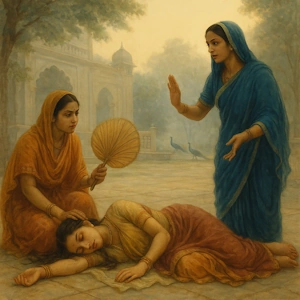
When Sri Hari left Vrindavan, one of the Gopikas fainted. A friend of hers was sitting by her side and fanning her. A third friend came in and started saying something about Sri Hari. She was told to shut up, because the fainted Gopika really needed some rest. If she hears the name of Sri Hari, she would get up again and be uncontrollable. Her body needs some rest.
This is real bhakti. The bhakti of the Jnani. Not the bhakti of the scholar.
The real Bhakta is not bothered whether the scholars spend thousands of years arguing and counter-arguing about the existence and non-existence of God and establish who is the superior God. For him, it is immaterial and irrelevant. How does it matter?
For them, the divine experience is only a dish on the menu card. It has to be ordered, prepared, brought, and tasted. Don’t know how long it can take. Don’t know how good the cook would be. Don’t know whether it will be burnt or too salty or whether it is stale.
The real Bhakta is already enjoying the dish. He doesn’t need someone to prove to him that it is good. He doesn’t need a quality certificate that it is good. You go and ask him to prove to you that Sri Hari exists – he would simply smile at you, bless you, and walk away.
-
Why would someone delay liberation if it is within reach?
Because love seeks presence, not escape. Serving Sri Hari here and now is meaningful in itself. Liberation is not a prize to grab; it is the natural state that unfolds. When devotion is full, hurry drops. -
Is it wrong to desire heaven or higher lokas?
No, but it is smaller than loving Sri Hari for his own sake. Desire for places keeps the mind outward. Love for Bhagavan centers the heart and makes every place enough. -
What does it mean to resonate with Sri Hari?
When the inner habits of the mind match the qualities of Bhagavan, even a small reminder of him sets the heart into joyful motion. Like a tuned instrument, the self vibrates in harmony with truth. -
Is intense emotion in devotion a lack of self-control?
Not necessarily. It is a response to value. When love aligns with wisdom, emotion becomes clarity, not chaos. The test: after the emotion, you are kinder, steadier, and more truthful. -
Can ordinary people experience this resonance or is it only for saints?
Everyone can grow into it. Start with daily remembrance, truthful living, and selfless service. The frequency of the mind changes with practice. -
How do knowledge and devotion fit together?
Knowledge shows what is real. Devotion unites you with it. Head and heart converge: knowing without loving is dry; loving without knowing is blind. Together they mature into freedom. -
Is serving Sri Hari different from becoming one with him?
From the side of love, serving is joy. From the side of truth, oneness is the fact. Mature devotion holds both without conflict: the heart serves, the self rests in unity. -
How do I know my devotion is genuine and not performance?
Check your life between prayers. Humility increases, criticism decreases, honesty rises, and compassion becomes natural. If ego swells, it is performance; if ego thins, it is devotion. -
Why does remembering the divine name have such power?
Attention shapes the mind. The name points attention to the highest good. Repeated remembrance cuts grooves of clarity, lowers agitation, and lifts the whole personality. -
Isn’t all this just psychological conditioning?
Conditioning is part of it, and that is fine. But truth-tested conditioning frees you from fear, greed, and hatred. What frees is not mere suggestion; it is alignment with reality. -
What happens to duties and relationships when devotion deepens?
They become cleaner. You still act, but with less possessiveness and more responsibility. Love for Bhagavan widens love for people, it does not shrink it. -
Why dismiss endless debates about who or what is supreme?
Because experience settles what argument cannot. Direct contact with the highest turns comparison into a small game. Clarity grows by practice, not by winning points. -
Can joy in devotion coexist with pain and fatigue?
Yes. The body and mind have limits. Joy is the current beneath the waves. Rest when needed, but do not cut the current; refine it with steady practice. -
How do I tune my mind to this so-called natural frequency?
Daily sadhana: truthful speech, clean earnings, gratitude, japa of the divine name, study of wise texts, and service without bargaining. Small, consistent steps tune faster than rare grand efforts. -
Is dancing and singing necessary for devotion?
No. Expression follows temperament. Some dance, some sit silent, some serve tirelessly. Measure depth by sincerity and transformation, not by display. -
Does devotion reject reasoning and science?
It uses reason well and then goes further. Reason removes error; devotion fills the space with love for the real. They are allies when rightly used. -
What is the practical sign that devotion is maturing?
Less inner noise, quicker recovery from upset, honest work, stable cheer, and a natural pull toward remembrance of Sri Hari without force or guilt. -
If the goal is oneness, why speak of Sri Hari as other?
Language serves practice. Relationship purifies; knowledge finalizes. You approach the ocean as a lover, and discover you were water from the start.





English
Vishnu Sahasranama
Click on any topic to open
7
30
Astrology
Bhagavad Gita
Bhagavatam
Bharat Matha
Devi
Devi Mahatmyam
Ganapathy
Garuda Puranam
Glory of Venkatesha
Hanuman
Kathopanishad
Mahabharatam
Mantra Shastra
Mystique
Practical Wisdom
Purana Stories
Radhe Radhe
Ramayana
Rare Topics
Rigveda Explained
Rituals
Sages and Saints
Shiva
Spiritual books
Sri Suktam
Story of Sri Yantra
Temples
Vedas
Vishnu Sahasranama
Yoga Vasishta
26
17
10
0


