Spiritual Resorts Create a New Problem in Life
Muktanam Paramagatih – The ultimate destination of the liberated, those liberated from samsara.
Who are the liberated, the muktas?
Prakriti-bandha – avidya – karma – samskara – ruchi-vipakebhyah avaranebhyah ekantatah atyantatah cha vishlishta muktah.
The avaranas called attachment to nature, ignorance, karma, samsara – everything generated from these – the results therefrom; those who are liberated from each and every one of them completely, they are called muktas.
What is attachment to nature – prakriti-bandha?
What is prakriti?
Bhumir apo’nalo vayuh kham mano buddhir eva cha ahankara iti iyam me bhinna prakritir ashtadha.
The external world and the faculty within you which recognizes the external world through vision, sound, touch, taste, and smell; the mind which analyzes these into good and bad, favorable and unfavorable; and the ahankara which distinguishes the external world as something different from you, apart from you – are together called prakriti or nature.
Any relationship with any of these could be a cause of attachment and bondage and a hindrance in attainment of moksha.
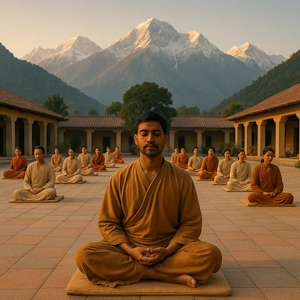
Attachment to bhumi – a particular place. This place is very quiet. Vibrations are very good. So tranquil. You sit, meditate, you don’t know how time flies.
This is attachment to place. If you want to meditate, you have to be in a peaceful and quiet place, a tranquil place.
This is an attachment.
This is what you are told – sit in a calm and quiet place. Ideally, early morning, before others wake up, before the noise starts. Sit in a dimly lit room, light an incense stick, meditate. Then it happens.
You are simply creating another habit, another attachment.
You know that very well – once you are out and away from that artificially chosen tranquil atmosphere, you can’t meditate anymore.
So if your habitat is not calm and quiet, you want to get away.
If your natural habitat is calm and quiet, then whenever you are away, you want to get back to it.
You go to these spiritual resorts for a two-week or three-week meditation camp.
It’s a nice experience as long as you are there. Like inside a movie hall – it is nice as long as the movie lasts. Then you have to go back to the real world.
When the camp ends and when you go back home, mostly you will realize that you are not able to continue to get the same intense experience that you got at the resort.
Because the camp was simply a getaway.
You only created another attachment for yourself.
Now you start craving for these camp experiences – because what you experienced, the joy experienced during the camp was real. The peace was real. But the only problem is that you rarely can get it outside.
You rarely can get it in your natural habitat, your home.
So you start craving to go back to the resort, the meditation camp.
One more conflict started in your life.
-
Is needing a quiet place a subtle attachment? Yes. If your practice works only in special conditions, those conditions own you. Freedom means portability.
-
What does prakriti include in daily life? The outer world, the five senses, the mind that judges, and the ego that separates. Bondage starts when you cling to any of these.
-
How do senses, mind, and ego bind? Senses pull, mind labels, ego claims. Clinging and aversion follow, and the loop tightens.
-
Are retreats wrong? No. They are tools, not homes. Learn the skill there, live the skill everywhere.
-
Why do intense states fade after a camp? They were context-powered. Remove the context and the state collapses; skills must be internalized.
-
What is the test of real growth? You can practice anywhere. Disturbances settle faster. Craving for particular settings weakens.
-
Can habits become spiritual chains? Yes. Any fixed routine that you cannot drop has turned from support into shackle.
-
How to train portability of practice? Do short sessions in ordinary noise. Rotate time and place on purpose. Keep attention with breath and simple witnessing.
-
Are incense, music, and early hours helpful or harmful? Helpful as temporary supports. Use them; do not depend on them. Drop the crutch as strength returns.
-
How to enjoy serene places without clinging? Enjoy fully, release quickly. Gratitude in, grasping out.
-
What to do when craving for the ‘camp high’ returns? Notice it, name it, and sit anyway. Return to plain practice; let memory fade on its own.
-
What is real peace? A steady clarity that does not depend on walls, weather, or schedules. It is freedom from compulsive dependence.
-
How to handle noisy home and work? Make practice fractal: three mindful breaths at doorways, attentive dishwashing, gentle tone in speech. Convert triggers into bells.
-
What role does discipline play? Strong and simple. Keep a non-negotiable daily minimum; add variety to prevent dependence.
-
How does karma tie into attachment? Clinging drives repeated reactions that rebuild the same patterns. Non-clinging breaks the cycle.
-
What is moksha in practical terms? Not running away and not running after. Standing free in the middle of change.
-
How to serve family and society while detached? Act with care, drop ownership of outcomes. Do what is right; let results be where they belong.
-
What is one experiment for this week? Meditate 10 minutes daily in a different spot each day. Track ease, reactivity, and recovery; watch dependence shrink.





English
Vishnu Sahasranama
Click on any topic to open
7
30
Astrology
Bhagavad Gita
Bhagavatam
Bharat Matha
Devi
Devi Mahatmyam
Ganapathy
Garuda Puranam
Glory of Venkatesha
Hanuman
Kathopanishad
Mahabharatam
Mantra Shastra
Mystique
Practical Wisdom
Purana Stories
Radhe Radhe
Ramayana
Rare Topics
Rigveda Explained
Rituals
Sages and Saints
Shiva
Spiritual books
Sri Suktam
Story of Sri Yantra
Temples
Vedas
Vishnu Sahasranama
Yoga Vasishta
26
17
10
0


