Ganesha Helps Brahma To Create The World
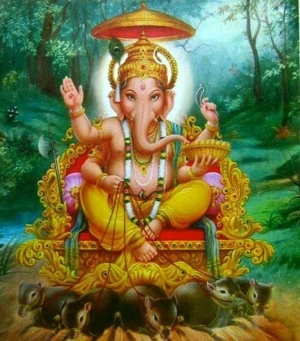
This story is from Mudgala Purana, Ekadanta khanda.
It was time for creation.
Brahma was sitting on the lotus that came out from the navel of Sri Hari.
With the permission of Sri Hari, Brahma started meditating.
His body heated up and water (sweat) started pouring out.
Soon, that water filled all around.
Brahma didn’t know what to do.
How to create the world out of this water?
Brahma got out of the lotus and moved about in the water.
He saw a banyan tree.
It was the Akshaya Vata which doesn’t get destroyed even at the time of pralaya.
On one of its leaves, was lying a small child the size of a thumb.
Brahma looked closely.
The child had four hands and the head of an elephant.
He playfully sprayed water upon Brahma with his trunk.
Brahma realized it was none other than Sri Mahaganapathy.
Brahma sang a stuti and praised him.
Ganesha became pleased and asked Brahma why there was worry on his face.
Brahma said: it is just water all around. I don’t know how to create the world out of this.
Ganesha grabbed Brahma with his trunk and swallowed him.
Brahma could see millions of universes inside Ganesha’s belly.
He then came out through one of Ganesha’s hair follicles and stood with folded hands.
Ganesha said: your confusion is because you didn’t remember as soon as you sat on that lotus to create the world. Now, I am pleased with you. Go back and sit on that lotus. Start creating. Everything will happen smoothly now.
Brahma went back and started creation again.
This time, he was successful and our world came into existence thus.
- What is the deeper philosophical meaning behind Brahma body heating up and producing sweat that fills the universe before creation can begin?
The heating of Brahma body represents Tapas, which is the intense spiritual heat, concentration, and energy required for any cosmic or creative manifestation. The resulting water or sweat represents the primal causal waters, known in Vedic philosophy as the Garbhodaka or Apah. It signifies that before physical matter can be formed, the universe exists in a fluid, unmanifested, and potential state. It shows that creation is not a sudden material accident but a spiritual process born from intense internal energy. - Why does the Akshaya Vata banyan tree and the child Ganesha exist in the water even before Brahma starts the creation?
The Akshaya Vata represents the eternal, indestructible reality that survives the cosmic dissolution or pralaya. The presence of Ganesha on its leaf signifies that Ganesha is the absolute supreme reality, or Para Brahman, who exists prior to time, space, and the creator God Brahma himself. It reveals a hidden principle that while the functional creator Brahma has a beginning and an end tied to cosmic cycles, the Supreme Divinity remains untouched by the cycles of destruction and creation. - What is the significance of Ganesha being described as the size of a thumb on the banyan leaf?
In Upanishadic thought, the supreme soul or Purusha residing within the heart of all living beings is often described as Angustha Matra, meaning the size of a thumb. By appearing in this specific size, Ganesha symbolizes that the vast, infinite cosmic power is identical to the micro-cosmic divine spark within every individual. It bridges the gap between the macrocosm and the microcosm, showing that the ultimate reality is both infinitely large and intimately small. - Why does Ganesha playfully spray water upon Brahma with his trunk as soon as Brahma approaches him?
The playful spraying of water is an act of divine sport or Leela, but it carries a mysterious awakening power. In spiritual traditions, a splash of water symbolizes purification, consecration, and a spiritual awakening from a state of ignorance or confusion. By spraying water, Ganesha is gently shattering Brahma ego and confusion, preparing his consciousness to receive the ultimate truth and cosmic vision. - What cosmic truth does Brahma realize when he is swallowed by Ganesha and sees millions of universes inside his belly?
This act reveals the principle of Vishwarupa, or the cosmic form. Brahma realizes that the physical space he was trying to navigate was just an illusion, and that all potential universes, past, present, and future, already exist completely within the divine body of Ganesha. It shifts Brahma perspective from a limited creator who thinks he has to build something from scratch, to a divine instrument who simply needs to project what is already contained within the Supreme. - What is the hidden meaning behind Brahma exiting through a hair follicle of Ganesha instead of his mouth or another major passage?
Exiting through a single hair follicle emphasizes the unimaginable scale of Ganesha supreme form. It shows that an entire universe, along with its creator Brahma, is so infinitesimally small compared to the absolute divinity that it can pass through a mere pore of his skin. This humbles Brahma completely, removing the last traces of individual doership or pride, which is a necessary prerequisite for flawless creation. - Ganesha states that Brahma confusion arose because he forgot to remember him as soon as he sat on the lotus. What universal law of the Purana does this highlight?
This highlights the fundamental cosmic law of Ganesha as Vighnaharta, the remover of obstacles, and Vighnaraja, the master of obstacles. In the Puranic tradition, even supreme deities like Brahma, Vishnu, or Shiva must worship Ganesha at the beginning of any endeavor to ensure success. By forgetting this primordial rule due to the urgency of creation, Brahma faced the obstacle of confusion and overwhelming water. The story teaches that action without spiritual alignment and remembrance of the source leads to stagnation. - Why does Ganesha tell Brahma to go back and sit on the exact same lotus instead of changing the environment or removing the water?
Ganesha does not change the external situation; he changes Brahma internal state of consciousness. The lotus represents Brahma assigned duty, his seat of power, and his cosmic destiny. By sending him back to the same spot, Ganesha teaches that the outer world and its challenges do not need to be altered if one has attained inner clarity, divine grace, and alignment with the supreme truth. The chaos of the water remains, but Brahma perspective turns it into a canvas for creation. - How does this narrative alter the popular understanding of Ganesha as merely a secondary deity who grants wealth and wisdom?
This text from the Mudgala Purana elevates Ganesha to the status of the Ultimate Reality or Saguna Brahman. He is portrayed not just as a helper, but as the source from whom Vishnu emerges, from whose navel Brahma emerges, and within whom all creation rests. It shows him as the independent, absolute ruler of the cosmos, making him the primary cause of all causes, which is the core principle of the Ganapatya sect. - What is the overlooked lesson regarding the nature of successful creation and work that human beings can derive from this story?
The story reveals that true success in any major creation or work does not come from frantic effort or intellectual anxiety when faced with overwhelming challenges, represented by the boundless water. Instead, when progress stalls, one must pause, seek the divine source within, surrender the ego of doership, and gain a broader perspective. True productivity is an effortless flow that happens automatically once internal spiritual alignment and humility are achieved.





English
Ganapathy
Click on any topic to open
7
30
Astrology
Bhagavad Gita
Bhagavatam
Bharat Matha
Devi
Devi Mahatmyam
Ganapathy
Garuda Puranam
Glory of Venkatesha
Hanuman
Kathopanishad
Mahabharatam
Mantra Shastra
Mystique
Practical Wisdom
Purana Stories
Radhe Radhe
Ramayana
Rare Topics
Rigveda Explained
Rituals
Sages and Saints
Shiva
Spiritual books
Sri Suktam
Story of Sri Yantra
Temples
Vedas
Vishnu Sahasranama
Yoga Vasishta
26
17
10
0


