Precision Is Very Important in Vedic Rituals
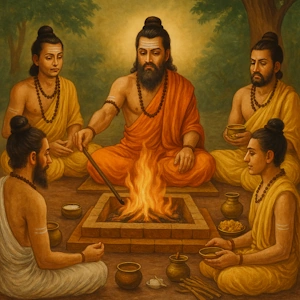
Vedic rituals are very elaborate.
A lot of attention is given to precision.
Fuel is needed to kindle agni for homa.
This is not the offering. This is fuel.
This is called Samit or Idhma.
They both have the same meaning: अग्निसन्दीपनकाष्ठादि — firewood used to light up, ignite, or kindle agni.
This is done after agni is installed in the homakunda, but definitely before offerings are made in agni.
In any offering, there are three components:
-
The material that is offered
-
The devata to whom it is meant
-
And a tyaga – a sentence or a vakya
For example:
Somaya idam na mama
This offering is of soma.
It is meant for him.
It has become his.
Not mine anymore.
Na mama.
So, here we are talking about making the flames grow after agni is installed, not installation of agni.
This is done by adding firewood to already installed agni.
What kind of firewood?
They are specific — from specific trees, the yajna vrikshas.
For example, palasha.
Here also, what species is used will have bearing on the result of the yajna as well.
They have their own properties, which they transfer to agni.
So, in general, samits are sticks from a particular tree used to kindle agni in homas.
What is their size?
प्रादेशमात्राः सशिखाः सवल्काश्च
The length of the samit is pradesha — the span between the tip of the thumb and forefinger.
There is another measure called aratni, which is the span between the thumb and the little finger with the rest of the fist closed.
The length of the samit should be pradesha.
They should have tips.
That means you can’t take a one-meter-long branch and cut it into three or four pieces.
This is how we get samit when we buy them today.
For general rituals that we do at home, there is no other option.
But shrauta rituals are very precise.
So much precision goes into it.
That is also the reason our forefathers could do anything with yajnas — power of mantras and precision.
The samit should have skin — savalkala.
नाङ्गुष्ठादधिका न्यूना समित् स्थूलतया क्वचित्।
न निर्म्मुक्तत्वचा चैव न सकीटा न पाटिता॥
प्रादेशात् नाधिका नोना न तथा स्याद्विशाखिका।
न सपत्रा न निर्वीर्य्या होमेषु च विजानता॥
The size and thickness of the samit should be that of the thumb — not more, not less.
The length should not be more than or less than pradesha.
When it comes to skin, the skin should not even be loosely hanging.
The samit should not be infested with insects.
It should not be split.
There should not be leaves on the samit.
It should not be completely dry also.
Vishakhika — it should not be branched.
विशीर्णा विदला ह्रस्वा वक्राः स्थूला द्विधाकृताः।
कृमिदष्टाश्च दीर्घाश्च समिधो नैव कारयेत्॥
It should not be very thin.
Should not be split.
Should not be bent.
Not very thick — that’s why they said the size of the thumb.
You should not vertically split samit into two or more pieces.
What will happen if the samit is defective?
-
If the samit is very thin or over-dry – it will reduce lifespan.
-
If it is very thick – loss of wealth.
-
Longer than pradesha – it will destroy cattle of the yajamana.
-
Shorter – will destroy yajamana patni.
-
Split – bad for children.
-
Infested with insects – will bring all kinds of diseases.
-
If you vertically split samit and use it – there will be quarrel among members of the family.
See, you can’t just put a few gears and pins together and expect them to show time precisely. Same everywhere.
You can’t put Shakespeare’s drama into a computer and expect it to do tasks for you.
For anything that works, precision is important.
Follow proper procedure — rituals also will work 100%.





English
Rituals
Click on any topic to open
7
30
Astrology
Bhagavad Gita
Bhagavatam
Bharat Matha
Devi
Devi Mahatmyam
Ganapathy
Garuda Puranam
Glory of Venkatesha
Hanuman
Kathopanishad
Mahabharatam
Mantra Shastra
Mystique
Practical Wisdom
Purana Stories
Radhe Radhe
Ramayana
Rare Topics
Rigveda Explained
Rituals
Sages and Saints
Shiva
Spiritual books
Sri Suktam
Story of Sri Yantra
Temples
Vedas
Vishnu Sahasranama
Yoga Vasishta
26
17
10
0


