Prahlada Used To Advise His Friends How To Live
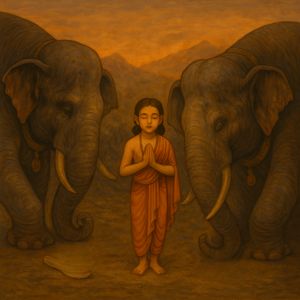
Prahlada said –
भयं भयानामपहारिणि स्थिते
मनस्यनन्ते मम कुत्र तिष्ठति
यस्मिन्स्मृते जन्म जरान्तकादि
भयानि सर्वाण्यपयान्ति तात
Fear, in me – my Lord, just by his remembrance even fear of birth, old age and death, that is the fear of samsara, runs away. He lives in my heart. What fear will I have? Who should I fear?
Hiranyakashipu told nagas to attack him. Ferocious nagas started attacking him. Nothing happened. Their poisonous fangs broke. Nothing happened to Prahlada, not even a scratch on his skin.
The snakes said, give us something else to do. Hurting this boy is impossible.
Hiranyakashipu ordered the diggajas, the guardian elephants of the directions, to trample Prahlada to death. Elephants as huge as mountains threw Prahlada on the ground and attacked him. Nothing happened. They ended up breaking their huge tusks.
Prahlada just kept on remembering Sri Hari in his mind.
The daityas threw Prahlada into roaring fire. Prahlada said, it is a pleasant breeze, I feel like I am sitting in the middle of lotuses.
The scholars of the asura clan started to reconcile Hiranyakashipu. You should pardon him. He is, after all, your son. Let us give it one more try. We will teach him what is right and what is wrong.
So Prahlada went back again to gurukul. This time he started teaching other asura children.
You will all grow up, grow old and die one day, then be born again. This is what keeps on happening. This cycle of rebirths can only give you misery and grief. There is no real happiness you can get in this earthly life.
क्षुत्तृष्णोपशमं तद्वच्छीताद्युपशमं सुखम्
मन्यते बालबुद्धित्वात् दुःखमेव हि तत्पुनः
You drink a glass of cool orange juice. You enjoy it. You enjoy every sip of it. You relish it and feel happy. If you are not thirsty, say you take five glasses of water and then take the same juice, will you still like it?
After you have had a full satisfying meal, if someone serves you the same meal again immediately, can you still have it?
It is your thirst that makes you enjoy the juice.
It is your hunger that makes you enjoy the meal.
The same thirst, if not quenched, can be grief, pain, misery.
The same hunger, if not satisfied, can starve you and make you suffer.
Quenching of thirst and satisfying hunger – this is what you think to be enjoyment and happiness.
Merely removal of misery is what you think to be happiness.
You don’t know what real happiness is.
You are thrown into a pit and then rescued. This is what you think is happiness. The happiness you feel after drinking that glass of juice or having that delicious meal is just the same that you feel after being rescued from a pit into which you are thrown.
This is because you don’t know what real happiness is.
You are immature.
Can this body full of pain and diseases ever give you real happiness?
Can this lump of blood, flesh and bones ever give you real happiness?
Is this body that can any time give you cold, cough, allergy, diarrhea, constipation, ulcer, cancer, fever, rheumatism, osteoporosis, anemia, tumour, scabies, psoriasis – is this what you have fallen in love with?
If you like this what you call body, then you will also like hell.
You have fallen in love with it because you have not seen anything else. You have never experienced anything beyond your day to day bodily experiences.
-
What exactly is fear, and why does it shrink with remembrance?
Fear is your mind predicting loss and pain. When you remember Bhagavan with trust, your reference point shifts from the limited body to the unlimited source. The mind stops looping worst-case stories, so fear loses fuel. -
Is fearlessness the same as being reckless?
No. Fearlessness means a steady mind that can assess risk clearly and act wisely. Recklessness is ego rushing into danger without discernment. -
Why do ordinary pleasures feel intense at first and then fade?
Because most pleasures come from removing a discomfort. Thirst makes juice delightful; remove thirst and the same juice feels ordinary. The peak feeling is relief, not real fulfillment. -
So what is real happiness?
Real happiness is contentment that does not depend on fixing a lack. It is a stable inner ease that remains even when conditions change. -
Does saying the body brings pain mean we should neglect health?
Not at all. Take disciplined care of the body, but do not mistake it for the final source of joy. Use the body as a well-maintained instrument for dharma and sadhana. -
How do I taste a joy that is beyond relief from pain?
Practice daily remembrance of Bhagavan, quiet attention to the breath, and selfless service. These thin out craving and aversion, revealing a calm baseline that does not swing with circumstances. -
Why do spiritual people seem untouched by insults, heat, or hardship?
Their attention is anchored in the inner witness. Sensations arise and pass, but identity is not glued to them. This creates resilience without numbness. -
Is detachment anti-love or anti-family?
No. Attachment clings for security; detachment serves from clarity. Love actually deepens when it is not mixed with fear and control. -
What is the logic behind the cycle of birth and death?
Actions leave impressions; impressions drive desires; desires seek expression through experiences; experiences create more actions. The loop continues until knowledge and devotion dissolve the root restlessness. -
If pleasure is mostly relief, is life supposed to be joyless?
Not at all. Life becomes richer when you stop chasing spikes of relief and cultivate steady gratitude, purpose, and devotion. Then even simple acts carry quiet joy. -
How can I work with cravings without suppressing them?
Name the urge, feel it in the body, breathe through it, and redirect energy to a meaningful action or remembrance. Observe the rise–peak–fade pattern; repetition weakens the habit loop. -
What daily practices make this real, not theoretical?
Morning remembrance for 5 minutes, mindful meals with a pause before the first bite, short breath check-ins every hour, one act of service daily, and evening reflection on one fear you handled with awareness. -
How do I measure progress honestly?
Fewer knee-jerk reactions, quicker recovery from setbacks, more consistency in practice, and a gentler baseline mood that does not depend on external wins. -
Does devotion conflict with rational thinking?
No. Devotion gives direction and meaning; reason chooses right means. Together they prevent both blind faith and cold cynicism. -
What is the end goal in practical terms?
A mind that is steady, a heart that is open, actions aligned with dharma, and a joy that does not collapse when conditions shift.





English
Vishnu Sahasranama
Click on any topic to open
7
30
Astrology
Bhagavad Gita
Bhagavatam
Bharat Matha
Devi
Devi Mahatmyam
Ganapathy
Garuda Puranam
Glory of Venkatesha
Hanuman
Kathopanishad
Mahabharatam
Mantra Shastra
Mystique
Practical Wisdom
Purana Stories
Radhe Radhe
Ramayana
Rare Topics
Rigveda Explained
Rituals
Sages and Saints
Shiva
Spiritual books
Sri Suktam
Story of Sri Yantra
Temples
Vedas
Vishnu Sahasranama
Yoga Vasishta
26
17
10
0


