Everything Need Not Be Scientific
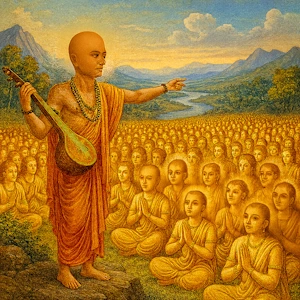
Heard a spiritual mentor drawing an analogy between Darwin’s Theory of Evolution and Dashavatara.
Life originated in water – Matsyavatara. Then amphibians – beings that can live in both water and land – Koorma, the tortoise. Life migrates to land – Varaha. Half man and half lion – man is being created. Vamana onwards, various stages of development of man. So convincing, but utterly wrong.
Darwin’s theory, right or wrong, is in its own place. Scriptures are in their own place. There is no progressive evolution as per scriptures. Creation of species is simultaneous – at the same time, as we have seen. When Matsya existed, all other species also existed. This is how we get misled.
Again, this obsession to be scientifically correct. Time is not far away when, like Aadhaar card, DNA certificate of parenthood will become compulsory. Where is trust gone? Everyone wants to show that he is scientifically correct. Very convincing arguments. These arguments – they are so convincing, but utterly foolish. Even the speaker doesn’t understand what he or she is saying. Theory of evolution and Dashavatara – Vyasa copied Darwin or Darwin copied Vyasa. Anyway, somebody’s copyright is infringed, it looks like.
Coming back to creation – Manu did tapasya and he got a wife, out of nowhere.
यथा भुजङ्गाः सर्पाणामाकाशं विश्वपक्षिणाम्
विदन्ति मार्गं दिव्यानां दिव्या एव न मानवाः
A snake would know its path. If a snake has to go from your courtyard to the back of your house, can you predict its path? If a bird has to go from point A to point B through the sky, can you predict its path? Like that, only the gods know about what they do and how they do.
न देवचरितं चरेत् – Don’t try to imitate Devas, don’t justify actions saying, Krishna did this, Rama did this. Their reasons could be different, you may not understand. Rules of Devas and men are different. Bhagawan had two or three of 16,008 wives. Why not me? Their purpose is different, not like yours.
अचिन्त्याः खलु ये भावा न तांस्तर्केण योजयेत् – We simply can’t fathom their reasons, don’t try to find logic in them.
So before the creation of Saraswathy itself, the Manasa Putras of Brahma were born. We have already seen how Rudra was born and what happened later, and also the birth of Sanat Kumaras. Then, for the couple Brahma and Saraswathy, Swayambhuva Manu was born. Manu did tapasya and got himself a wife called Ananthee. Two sons were born to the Manu–Ananthee couple – Priyavrata and Uthanapada. So that vamsha continued.
Swayambhuva was the first Manu, then Swaro Chisha. There are fourteen Manus, each presiding over one Manvantara. A Kalpa consists of fourteen Manvantaras. Each Manvantara is seventy-one Chaturyugas. The present Manvantara in the present Kalpa is the seventh. Six Manvantaras are over. The present Manvantara is called Vaivasavata Manvantara. Somewhere down this vamsha was born Daksha.
Until Daksha’s birth, for procreation, union of male and female was not necessary. Birth could happen merely by meditation, merely by looking, or merely by touch. After Daksha, procreation became primarily through male–female union. Until that time, creation was happening from the body and mind of Brahma alone. Multiplication was not happening.
A thousand sons were born to the couple Daksha–Panchajani. They were called Haryashwas. Daksha asked them to procreate and multiply. Narada told them, first you go around and understand the places where what you are going to create are going to live. Understand fully about earth, heaven, and Patala. Go around and see, then you start creating. They all left. Even to this day, they have not come back. We don’t know what happened to them.
Daksha had another wife called Veerini. Another thousand sons were born to Daksha by Veerini. To them also, Narada told the same thing. They followed the footsteps of their elder brothers. They also never came back. This is why it is said that a younger brother should never go after his elder brother, a younger brother should not try to follow his elder brother. A younger brother should never do what his elder brother is doing. They should do different things. Otherwise, it will be a disaster.
Daksha lost all his two thousand sons. Veerini again gave birth to sixty girls. Ten were given in marriage to Dharma, thirteen to Kashyapa, twenty-seven to Chandra – they are the twenty-seven nakshatras, four to Arishtanemi, two to Shukracharya, two to Krishashava, and two to Angira. Thus, procreation started happening through these sixty daughters of Daksha.
The Manasa Putras of Brahma, except Narada, got their own wives and their clans also flourished. Mareechi’s wife Sambhooti gave birth to Pornamasee, Purnima, full moon. They had two sons also. Their vamsa continued. Angira’s wife Smruti gave birth to Kuhu, Sineevali, Raka, and Anumati – Kuhu and Sineevali are variations of Amavasya, and Raka and Anumati are variations of Purnima.
From Atri and Anasuya were born Chandra, Durvasa, and Dattatreya. Agastya was reborn as Dattoli to Pulastya and his wife Preeti. Pulaha’s wife Kshama gave birth to Kardama, Urvareeyan, and Sahishnu. Sixty thousand powerful rishis the size of a section of the thumb, as brilliant as the sun, were born to Kratu and Santati. They were called Valakhilyas. Sons of Vasishta later on became the Saptarshis. Agni and his wife Swaha gave birth to all the various forms of Agni.
In this way, the vamsas of the Manasa Putras of Brahma also multiplied and flourished.
-
Is Dashavatara the same as Darwin's evolution?
No. Dashavatara is a sacred timeline of divine descents with moral and cosmic purposes. Darwin's theory explains biological change in species over time. Different lanes. -
The text says 'no progressive evolution' in scripture. What does that mean?
Scriptures present creation as simultaneous and cyclical. Many species and realms appear together at the start of each cycle, not step-by-step from fish to human. -
Then why do people compare Matsya to 'life from water', Kurma to 'amphibians', and so on?
Because it sounds clever and feels satisfying. But it forces a modern scientific template onto a theological narrative. It is a catchy analogy, not scriptural teaching. -
Where in tradition does 'simultaneous creation' come from?
Puranic cosmogony describes Brahma's emanations, Manasa Putras, and entire classes of beings appearing together across multiple realms. The emphasis is on ordered manifestation, not evolutionary succession. -
If all species existed when Matsya appeared, why take avatars at different times?
Avatars appear to restore dharma in specific contexts. Timing is about moral disorder and cosmic balance, not about when a species first shows up. -
Does any of this mean science is useless?
No. It means scripture and science answer different questions. Science describes mechanisms within nature. Scripture gives meaning, purpose, and the moral law behind nature. -
Who are the Manasa Putras of Brahma?
Sages 'born of mind' - archetypal teachers who carry forward knowledge, vows, and lineages. They stand for intellect, restraint, and dharma-transmission at the dawn of creation. -
What about Rudra and the Sanat Kumaras being 'born' before Saraswati's creation?
That sequence signals that force (Rudra), wisdom, and renunciation (Sanat Kumaras) are primal currents of the cosmos. Culture and arts (Saraswati) then shape these currents into civilizational life. -
Who is Swayambhuva Manu?
The first law-giver of this cycle. 'Manu' is a title; there are fourteen Manus per kalpa. Swayambhuva sets up the civilizational framework - order, duties, and governance. -
What is a Manvantara and where are we now?
A Manvantara is the period ruled by one Manu. A kalpa has fourteen Manvantaras. We are in the seventh, called 'Vaivasvata Manvantara'. -
'Manu did tapasya and got a wife out of nowhere' - how do we read that?
As scripture speaks: intense austerity aligns the cosmos to deliver what dharma requires. Creation here operates by will, merit, and divine sanction, not only by physical processes. -
Why did procreation change after Daksha?
The narrative says early beings multiplied through will, sight, or touch. After Daksha, the standard became male-female union. The lesson is that cosmic methods can shift across phases to stabilize creation. -
What happened to Daksha's sons, the Haryashvas and their younger set?
Narada told them to first understand the worlds they intended to fill. They set out and never returned. The point: knowledge before action. Imitation without insight leads nowhere. -
Why the warning that younger brothers should not blindly follow elder brothers?
Because context matters. Even a 'good' path fails if copied without the inner qualification and right timing. Scripture prefers discernment over copy-paste tradition. -
Who are the twenty-seven Nakshatra daughters married to Chandra?
They are the lunar mansions - fixed stellar sectors through which the moon travels. The marriage imagery encodes cosmic timekeeping tied to ritual calendars and human life rhythms. -
What role does Narada play in these stories?
He is the divine provocateur and teacher. He prevents shallow action, forces inquiry, and nudges events toward the larger plan of dharma. -
Who are the Valakhilyas, the thumb-sized sages bright as the sun?
Miniature ascetics of immense tapas. They symbolize that spiritual power is not about bulk or spectacle; concentration of austerity creates radiance. -
'Do not imitate Devas' - why?
Because their actions serve cosmic outcomes with full knowledge of past and future. Humans must act by revealed law and conscience, not by copying extraordinary deeds out of context. -
What does 'achintya' imply in this context?
Some realities are beyond the reach of argument. When scripture says 'achintya', it draws a boundary: reason has a place, but it does not swallow the infinite. -
Is the jab at 'being scientifically correct' anti-science?
No. It is anti-posturing. The point is: stop bending scripture just to look modern. Respect both domains without forcing one into the clothes of the other. -
Why the strong stance against the 'Darwin vs Vyasa' copyright joke?
To show how shallow conflations trivialize both science and scripture. Neither copied the other; they serve different ends. -
What practical takeaway should a seeker hold on to?
Use science for worldly skill. Use scripture for meaning and right living. Do not mix frameworks out of insecurity. Stand on dharma, think clearly, and act responsibly. -
How does all this help my daily practice?
It restores inner order: learn before acting (Narada's counsel), avoid blind imitation, honor time cycles, and keep your ethics anchored. That steadiness is real sadhana.





English
Vishnu Sahasranama
Click on any topic to open
7
30
Astrology
Bhagavad Gita
Bhagavatam
Bharat Matha
Devi
Devi Mahatmyam
Ganapathy
Garuda Puranam
Glory of Venkatesha
Hanuman
Kathopanishad
Mahabharatam
Mantra Shastra
Mystique
Practical Wisdom
Purana Stories
Radhe Radhe
Ramayana
Rare Topics
Rigveda Explained
Rituals
Sages and Saints
Shiva
Spiritual books
Sri Suktam
Story of Sri Yantra
Temples
Vedas
Vishnu Sahasranama
Yoga Vasishta
26
17
10
0


