Why Sri Hari Is Called Vishnu
The Second Name विष्णुः
वेवेष्टि व्याप्नोतीति विष्णुः — One who pervades, permeates everything. He has spread through every atom of everything. He is everywhere, in everything, always.
As we saw before, he created everything and then entered everything. There is nothing where Bhagawan is not present.
अन्तर्बहिश्च तत्सर्वं व्याप्य नारायण स्थितः — Inside, outside, everywhere Narayana has spread out, pervaded.
यस्माद्विष्टमिदं सर्वं तस्य शक्त्या महात्मनः तस्माद्विष्णुरिति ख्यातो विशेर्धातोः प्रवेशनात् — The dhatu root of the term Vishnu is 'Vish', meaning to enter. He has entered everything, his shakti, power, has entered everything. Hence, he is Vishnu.
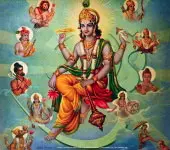
The true state of Bhagawan is Sachidananda — truth, consciousness, and bliss — nirguna, attributeless. But using his maya shakti, he assumes gross, visible forms as well, which are called the saguna forms. The bluish color, yellow clothes, four arms, his weapons — this is one of his gross forms.
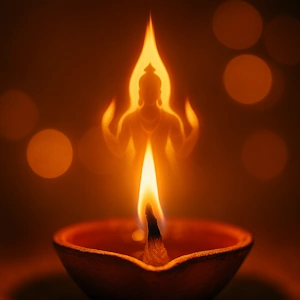
This is something that his maya shakti manifests out of the pancha bhutas. Cold wind turns water into ice. Fire turns wick and oil into a bright lamp. In the same way, it is his leela.
Shiva is tamo roopee — his nature is tamas, dark. Vishnu is satwa roopee — white, fair. Actually speaking, Vishnu should have been fair, being satwa swaroopi, and Shiva should have been dark, being tamas swaroopi. But he is karpoora gaura — as white as camphor.
Why is it the other way round? Bhagawan Vishnu meditates so much upon Lord Shiva that his body turned dark. Lord Shiva meditates so much upon Sri Hari that his body turned white.
And we fools — as Vaishnavites hate Shaivaites, and as Shaivaites ridicule Vaishnavites. The need of the hour is to understand that this differentiation is utterly foolish. By all means, every god has again and again reiterated this only. Every scripture says so, every sage says so.
And we go around asking the question — who is the greatest god? What matters is bhakti. Bhakti purifies. Bhakti which is not connected to any desire. Bhakti without a goal.
Not that you will go to God because you want this, you want that, or you don’t want this to happen, or that to happen. That is begging, not bhakti.
Bhakti is not something that comes and goes — bhakti on Saturdays, bhakti on Thursdays, bhakti on Ekadashi, other days you are not bothered. That is not bhakti. It is, of course, better than not having anything.
But you should strive towards bhakti that is permanent, never depleting. These rituals and pujas that you perform on certain days are only gateways, with which you enter the world of devotion — bhakti. Don’t stop yourself at the gate. Enter the world that is without any limits.
The gatekeeper doesn’t get to enjoy the show. He only looks inside and outside and collects tickets. As you develop this kind of bhakti in Sri Hari, you start developing jnana — knowledge that is not meant to achieve any purpose.
You study engineering, medicine — why? Because you want to have a good career with money, respect, comforts. You are acquiring knowledge in a certain subject with a purpose, a worldly purpose.
Bhakti in Sri Hari naturally instills in you the kind of knowledge which does not have a worldly use. It will purify you. It will show you what is good and what is bad, what is the real nature of the world. It will show you what is there behind the scenes. It will show you the maya shakti that makes the world run.





English
Vishnu Sahasranama
Click on any topic to open
7
30
Astrology
Bhagavad Gita
Bhagavatam
Bharat Matha
Devi
Devi Mahatmyam
Ganapathy
Garuda Puranam
Glory of Venkatesha
Hanuman
Kathopanishad
Mahabharatam
Mantra Shastra
Mystique
Practical Wisdom
Purana Stories
Radhe Radhe
Ramayana
Rare Topics
Rigveda Explained
Rituals
Sages and Saints
Shiva
Spiritual books
Sri Suktam
Story of Sri Yantra
Temples
Vedas
Vishnu Sahasranama
Yoga Vasishta
26
17
10
0


